Tinubu says tax-to-GDP rose to 12.5% from 7%. His finance ministry's workbook gives 7.15% as the mid-2026 actual; World Bank net figures put 2025 at 4.5%
An essay the State House published under President Tinubu's name on 30 October says Nigeria's tax-to-GDP ratio "has risen to 12.5% from 7%". The Finance Ministry's own Fiscal Analysis workbook gives 5.41 per cent for May 2023 and 7.15 per cent as the mid-2026 actual, while a scorecard in the same file says about 12.5 per cent. The World Bank's October report puts tax revenue for all tiers at 4.5 per cent of GDP in 2025. The essay's figures for FAAC distributions, the trade surplus, public debt and inflation hold against the official tables, with one rounding slip.
On 30 October the State House published an essay under President Bola Tinubu's name defending his government's new borrowing. Among the figures it offers as proof of "a stronger fiscal position" is this one: "tax-to-GDP has risen to 12.5% from 7%". The Federal Ministry of Finance has published its own figures for the same ratio, in the workbook it describes as the tables behind its reform briefing. One sheet of that workbook gives the tax-to-GDP ratio as 5.41 per cent at the May 2023 baseline and 7.15 per cent as the "Present Reality (Mid-2026 Actual)". Another sheet in the same file gives about 12.5 per cent as the current position. The World Bank's October 2026 Nigeria Development Update puts tax revenue for all three tiers of government at 4.5 per cent of GDP in 2025. Most of the essay's other figures that Vero Record could test hold up against the official tables.
The essay, titled "From reforms to delivery: Our infrastructure investment and growth strategy" and signed "Bola Ahmed Tinubu, President & Commander-in-Chief of the Armed Forces", was posted on statehouse.gov.ng at 10:41 Abuja time on Friday 30 October. A release from the President's adviser Bayo Onanuga, dated 29 October, said it would be published on Nigerian news platforms and presented it as a response to opposition criticism of new loans. The passage tested here reads, in full: "This shift is being supported by a stronger fiscal position: tax-to-GDP has risen to 12.5% from 7%, net FAAC increased by 44% from N15.2 trillion in 2024 to N21.9 trillion in 2025, and Nigeria recorded a N20.1 trillion trade surplus in H1 2026, almost double the N10.2 trillion recorded in H1 2025." The quotations in this report are taken from the official text on the State House website, which Vero Record downloaded on 8 November.

The ministry's workbook, Fiscal_Analysis.xlsx, is listed on finance.gov.ng with a publication date of 19 August 2026; its file properties record that it was created on 26 July and last saved on 17 August. The resource page says it holds "the tables behind the public reform briefing". The copy downloaded on 8 November is byte for byte the same as one Vero Record downloaded on 19 October. Its Counterfactual sheet compares "Key Indicators: Pre-reform 29 May 2023 vs 30 June 2026". In the row for "Tax-to-GDP Ratio", the column headed "May 2023 Baseline (Inherited Data)" shows 5.41 per cent and the column headed "Present Reality (Mid-2026 Actual)" shows 7.15 per cent. The Publication sheet carries a "Nigeria Economic Reform Scorecard", in which the same indicator reads "<10%" under "Baseline (May '23)", "~12.5%" under "Current Position" and "~6%" under "No-Reform '26 Est."
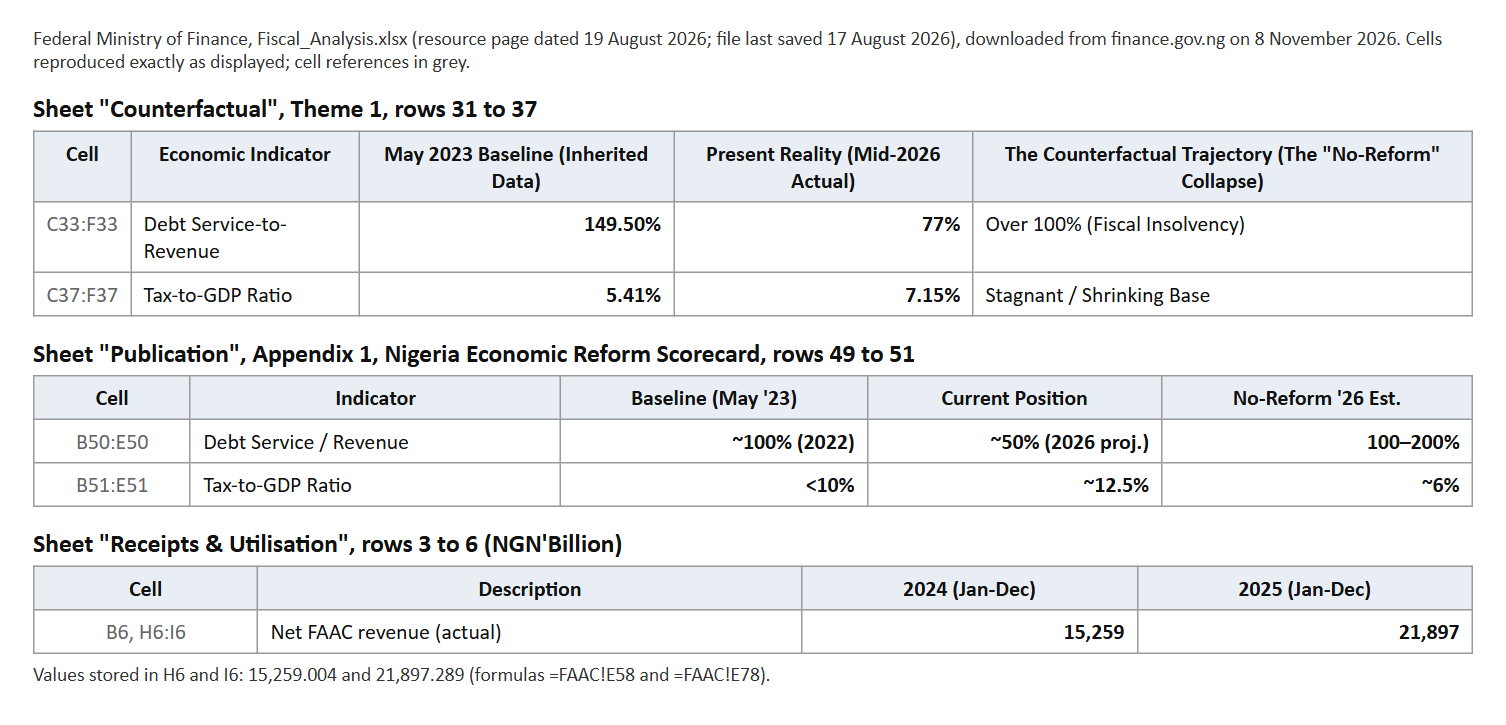
The essay's pair of figures matches neither pair in the workbook. Its 12.5 per cent is the scorecard's current position. Its starting point of 7 per cent is closest to the 7.15 per cent that the Counterfactual sheet labels as the mid-2026 actual, not to either sheet's baseline, which is 5.41 per cent on one and below 10 per cent on the other. Read together, the ministry's own file gives two current values for the ratio, 7.15 and about 12.5 per cent, which differ by 5.35 points. None of the four cells is a formula: each is a typed value, and the workbook does not show which taxes, which tiers of government or which GDP figure lie behind any of them.
The World Bank's report, published in October, sets out a fiscal annex for the whole federation, federal, state and local governments together. Its table of key fiscal indicators on page 63 gives tax revenues of 2.7 per cent of GDP in 2023, 3.7 per cent in 2024 and 4.5 per cent in 2025, with an estimate of 4.6 per cent for 2026. Total revenue, which adds oil and gas revenue and non-tax revenue to the taxes, is 5.6 per cent of GDP in 2023, 9.5 per cent in 2025 and an estimated 10.8 per cent in 2026. On the Bank's figures, even its total revenue line stays below 12.5 per cent of GDP in every year from 2022 to 2028. A note to the table explains that its revenues are net, "after excluding costs of collection, deductions, etc.", and that education tax and the revenues of government-owned enterprises other than dividends are left out. A gross measure would therefore come out higher; the documents do not say by how much.
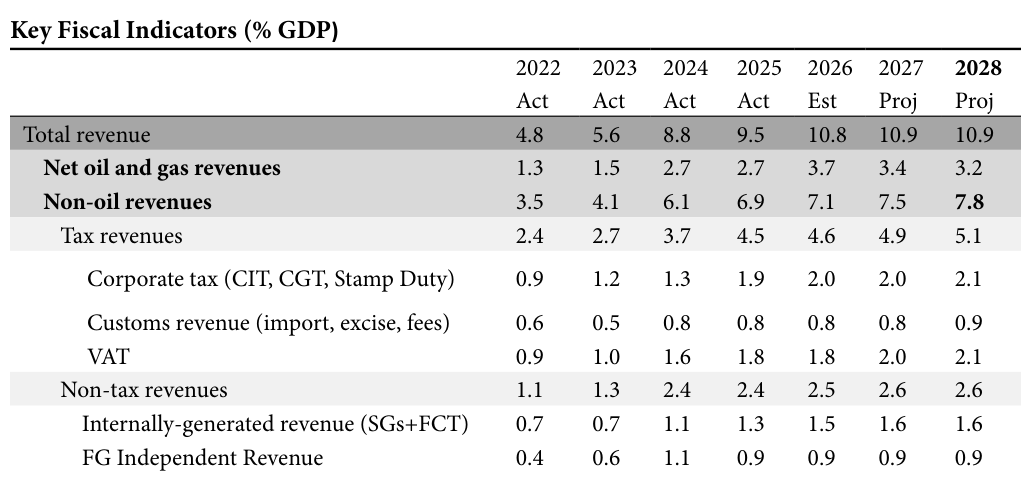
The ministry's own FAAC sheet gives a further check. It records the "Amount available" for sharing through the Federation Account Allocation Committee in 2025, before any deduction, as N35,637.85 billion. That covers oil revenue, VAT, customs and company taxes alike. The National Bureau of Statistics puts 2025 GDP at current market prices at N441,535,409.81 million. On those figures, everything the committee had available to share in 2025 came to 8.07 per cent of GDP. For taxes to reach 12.5 per cent of 2025 GDP, they would have to come to N55,191.93 billion, N19,554.08 billion more than the whole Federation Account total. That total leaves out revenue kept outside the account, such as states' own revenue and the Federal Government's independent revenue, which the World Bank puts at 1.3 and 0.9 per cent of GDP in 2025 and lists under non-tax revenues. The documents read for this report contain no calculation that yields a tax-to-GDP ratio of 12.5 per cent.
The next figure in the same sentence holds. The Accountant-General's monthly FAAC tables show the Federal Government, the states, the local councils and the 13 per cent derivation fund receiving N15,259.01 billion in the twelve months shared in 2024 and N21,897.29 billion in those shared in 2025. The ministry's workbook gives the same two totals, N15,259 billion and N21,897 billion, as "Net FAAC revenue (actual)". The essay's N21.9 trillion is correct. Its N15.2 trillion cuts off rather than rounds the 2024 total, which rounds to N15.3 trillion, and its 44 per cent is the rise between the two rounded figures. On the unrounded totals the increase is N6,638.28 billion, or 43.50 per cent.
The trade surplus also holds, on the statistics bureau's latest figures. Its reports for the first two quarters of 2026 give exports of N21,169.27 billion and N27,020.88 billion and imports of N13,619.33 billion and N14,424.01 billion, a surplus of N20,146.81 billion for the half year. For the first half of 2025, the same 2026 reports give revised imports of N16,644.42 billion and N16,493.67 billion. Against exports of N20,598.48 billion and N22,750.74 billion, that leaves a surplus of N10,211.13 billion, and the 2026 figure is 1.97 times as large. The bureau's own reports published in 2025 had put those two quarters' imports lower, at N15,426.17 billion and N15,286.78 billion; on those first figures the surplus for the first half of 2025 was N12,636.27 billion, and the 2026 surplus would be 1.59 times as large. The essay uses the revised figures, which are the ones the bureau now publishes.
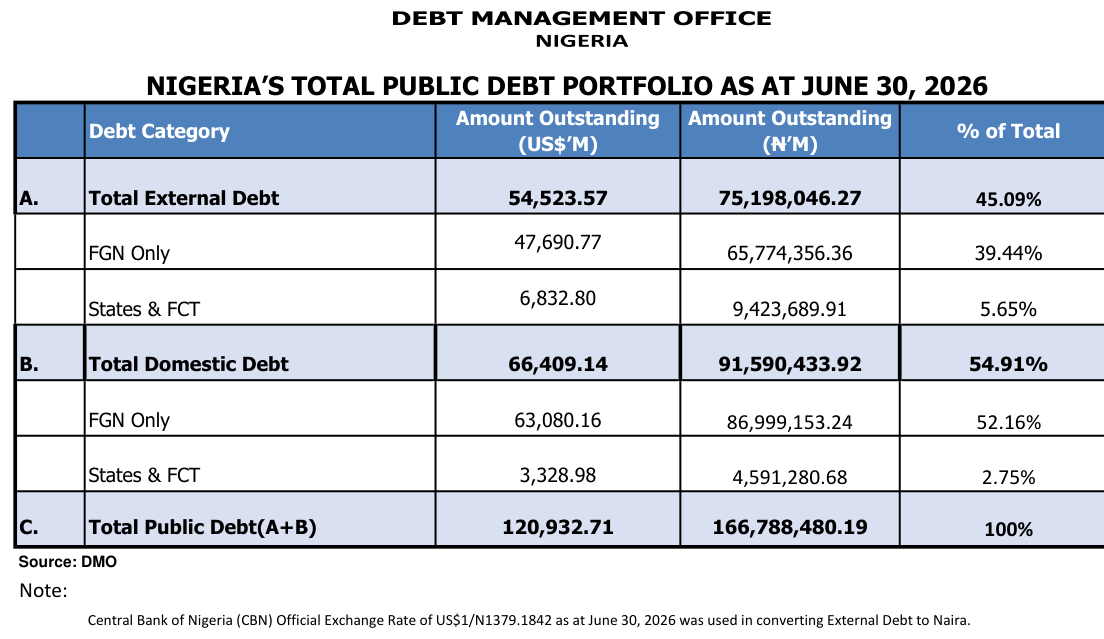
Several other figures check out. The Debt Management Office puts Nigeria's total public debt at 30 June 2026 at N166,788,480.19 million. The statistics bureau's GDP at current basic prices for the four quarters to June 2026 adds up to N466,478,979.58 million, and the debt is 35.75 per cent of that, the figure the essay gives; measured against GDP at market prices it would be 34.94 per cent. The bureau's September 2026 price report gives headline inflation of 14.63 per cent, against 20.98 per cent a year earlier, and food inflation of 19.59 per cent, all as the essay states. Its GDP report gives growth of 4.43 per cent for the second quarter of 2026, and its real GDP figures give 4.16 per cent for the first half, which the essay rounds to 4.2. The essay's comparison with "2.74% in 2023" could not be traced to a document in this check; the World Bank annex, which uses the rebased national accounts, gives 3.3 per cent for 2023.
The essay's figure for debt service does not match the ministry's workbook either. It says the borrowing shift "is taking place with public debt at 35.75% of GDP in Q2 2026 and debt service at about 65% of revenue in H1 2026". Four rows above the tax-to-GDP figures, the workbook's Counterfactual sheet gives "Debt Service-to-Revenue" as 149.50 per cent at the May 2023 baseline and 77 per cent as the mid-2026 actual, and its scorecard gives "~50% (2026 proj.)". Vero Record reported on 19 October that the ministry's statements and files already carried several different readings of this ratio; the essay adds another. The 65 per cent was not tested against the Budget Office's own tables for this report.
On states, the essay says "the share of state spending devoted to capital expenditure rose from 46% in 2023 to 61% in 2025". The World Bank's report, which drew on states' own budget implementation reports, gives the same end point. Its summary on page 13 says capital spending's share of total state spending rose "from 48 to 61 percent", and its chart on page 49 shows 47.5 per cent in 2023, 56.3 per cent in 2024 and 61.0 per cent in 2025. The essay's starting figure is 1.5 points below the Bank's chart.
What the documents do not show is how the ministry arrived at a tax-to-GDP ratio of about 12.5 per cent, which taxes and tiers of government it counts, or which GDP series it divides by. A ratio on a broader definition, counting non-tax revenue or collections before deductions, could be higher than the World Bank's tax line, and the ministry may hold calculations it has not published. Nor do they explain why the same workbook gives 7.15 per cent as the mid-2026 actual. Neither the Presidency nor the Ministry of Finance was asked for comment before publication. Nothing in the documents suggests wrongdoing by anyone, and none is alleged.
What this rests on
Documents read for this report: the essay "From reforms to delivery: Our infrastructure investment and growth strategy" on statehouse.gov.ng (posted 30 October 2026, 09:41 UTC, downloaded 8 November 2026, and the passage captured in a browser screenshot the same day), and the State House release by Bayo Onanuga dated 29 October 2026; Federal Ministry of Finance, Fiscal_Analysis.xlsx, downloaded from finance.gov.ng on 8 November 2026 (resource page dated 19 August 2026; created 26 July 2026, last saved 17 August 2026; byte-identical to the copy downloaded on 19 October), sheets Counterfactual (C3:F3, C31:F37), Publication (B49:E51), Receipts & Utilisation (B3:I6), FAAC (B44:E78) and 2024/2025 (row 25 "AMOUNT AVAILABLE", row 29 "Net Revenue for Distribution"); World Bank, Nigeria Development Update, October 2026, pages 13, 49, 62 and 63 (file reused from Vero Record's October checks); Office of the Accountant-General of the Federation, FAAC disbursement files, Table I, for the 24 months shared from January 2024 to December 2025; NBS Foreign Trade in Goods Statistics reports for Q1 2025, Q2 2025, Q1 2026 and Q2 2026 (pages 3, 4 and 6); NBS GDP Report Q2 2026 (pages 5, 25 to 27); NBS CPI September 2026 (pages 6 and 10); DMO, Nigeria's Total Public Debt Portfolio as at June 30, 2026. Arithmetic re-done: workbook tax-to-GDP 12.5 - 7.15 = 5.35 points. Net FAAC (FGN + States + LGCs + 13% Derivation, Table I totals) 2024: N1,127.41bn + N1,149.82bn + N1,152.76bn + N1,123.39bn + N1,208.08bn + N1,143.21bn + N1,354.37bn + N1,358.08bn + N1,203.79bn + N1,298.87bn + N1,411.74bn + N1,727.49bn = N15,259.01bn; 2025: N1,424.92bn + N1,703.05bn + N1,678.45bn + N1,578.76bn + N1,681.23bn + N1,659.89bn + N1,818.41bn + N2,000.83bn + N2,225.12bn + N2,103.39bn + N2,094.72bn + N1,928.51bn = N21,897.29bn (matches workbook 15,259.004 and 21,897.289); N21,897.29bn - N15,259.01bn = N6,638.28bn, / N15,259.01bn = 43.50 per cent; 21.9 / 15.2 = 1.4408, a 44.08 per cent rise on the rounded figures. Gross: workbook Amount available 2025 N35,637.85bn / NBS 2025 GDP at market prices N441,535.41bn = 8.07 per cent; 12.5 per cent of N441,535.41bn = N55,191.93bn; N55,191.93bn - N35,637.85bn = N19,554.08bn. Trade: H1 2026 exports N21,169.27bn + N27,020.88bn = N48,190.15bn, imports N13,619.33bn + N14,424.01bn = N28,043.34bn, surplus N20,146.81bn; H1 2025 exports N20,598.48bn + N22,750.74bn = N43,349.22bn, revised imports N16,644.42bn + N16,493.67bn = N33,138.09bn, surplus N10,211.13bn; N20,146.81bn / N10,211.13bn = 1.97; original imports N15,426.17bn + N15,286.78bn = N30,712.95bn, surplus N12,636.27bn, ratio 1.59. Checks on NBS totals: Q2 2026 N27,020.88bn + N14,424.01bn = N41,444.89bn (printed N41,444.89bn); Q1 2026 N21,169.27bn + N13,619.33bn = N34,788.60bn (printed N34,788.59bn, a rounding difference). Debt: GDP at current basic prices Q3 2025 N113,587,291.77m + Q4 2025 N122,810,658.96m + Q1 2026 N110,786,347.01m + Q2 2026 N119,294,681.84m = N466,478,979.58m; N166,788,480.19m / N466,478,979.58m = 35.75 per cent; at market prices N116,948,631.00m + N126,032,267.59m + N113,186,870.12m + N121,255,539.57m = N477,423,308.28m, 34.94 per cent. Real GDP H1 2026 N51,261,306.14m + N53,472,832.84m = N104,734,138.98m against H1 2025 N49,344,269.74m + N51,202,651.72m = N100,546,921.46m, growth 4.16 per cent. 2025 GDP at basic prices, quarters add to N431,180,185.03m against a printed N431,180,185.04m. State capital share: 61.0 - 47.5 = 13.5 points on the World Bank chart; 47.5 - 46 = 1.5 points.
What this does not establish
How the Ministry of Finance calculated a tax-to-GDP ratio of about 12.5 per cent, which taxes and tiers of government it counts, and which GDP series it uses; the scorecard cell is a typed value with no formula or source note. Why the same workbook gives 7.15 per cent as the mid-2026 actual and 5.41 per cent for May 2023, and whether the essay's 7 per cent was meant to refer to that figure. Whether the workbook, last saved on 17 August 2026, has been superseded by figures the ministry has not published. Whether a broader measure, such as all revenue before deductions or including revenue outside the Federation Account, would reach 12.5 per cent; the World Bank's annex reports net revenues only. The source of the essay's 65 per cent debt-service figure and of 2.74 per cent growth in 2023; neither was tested against a Budget Office or NBS table for this report. The reserve, exchange-rate, credit-rating and Lagos-Calabar figures in the essay were not checked. Neither the Presidency nor the Ministry of Finance was asked for comment. Nothing in the documents suggests wrongdoing by anyone, and none is alleged.
What we did ourselves
Took the claim from the essay's official text on the State House website and captured the passage. Downloaded the Finance Ministry's workbook and read the tax-to-GDP, debt-service and FAAC cells, checking which are typed values and which are formulas. Set the essay's tax-to-GDP pair against both of the workbook's pairs and against the World Bank's fiscal annex, and divided the ministry's own gross FAAC total for 2025 by NBS's 2025 GDP. Added up FAAC distributions to the three tiers and the derivation fund for all 24 months of 2024 and 2025 from the Accountant-General's tables and matched them to the workbook's totals. Rebuilt the half-year trade surpluses from four NBS trade reports, using both the original and the revised 2025 import figures, and recomputed debt to GDP from the DMO's total and four quarters of NBS nominal GDP.
Sources for this report
(A) Federal Ministry of Finance, Fiscal_Analysis.xlsx (sheets Counterfactual, Publication, Receipts & Utilisation and FAAC); World Bank, Nigeria Development Update, October 2026, Key Fiscal Indicators (p.63) and pages 13 and 49; Office of the Accountant-General of the Federation, FAAC disbursement tables, Table I, January 2024 to December 2025; NBS Foreign Trade in Goods Statistics, Q1 and Q2 2025 and 2026; NBS GDP Report Q2 2026, Tables 1 and 2; NBS CPI September 2026; DMO, Nigeria's Total Public Debt Portfolio as at June 30, 2026.
- From reforms to delivery: Our infrastructure investment and growth strategy (essay by President Bola Ahmed Tinubu) · The State House, Abuja · 30 October 2026
- President Tinubu defends borrowing plans, says investments will expand opportunities for future generations · The State House, Abuja (Bayo Onanuga) · 29 October 2026
- Fiscal Analysis Workbook (Fiscal_Analysis.xlsx) · Federal Ministry of Finance · 19 August 2026
- Fiscal Analysis Workbook (resource page) · Federal Ministry of Finance · 19 August 2026
- Nigeria Development Update, October 2026: Beyond the Federal Purse, How Higher Revenues Shaped State Priorities (66 pages) · World Bank · October 2026
- FAAC Disbursement January 2024 (first of 24 monthly files read, January 2024 to December 2025) · Office of the Accountant-General of the Federation · January 2024
- FAAC Disbursement December 2024 · Office of the Accountant-General of the Federation · December 2024
- FAAC Disbursement January 2025 · Office of the Accountant-General of the Federation · January 2025
- FAAC Disbursement December 2025 (last of 24 monthly files read) · Office of the Accountant-General of the Federation · December 2025
- Foreign Trade in Goods Statistics Q1 2025 (report) · National Bureau of Statistics · June 2025
- Q2 2025 Foreign Trade in Goods Statistics Report and Tables · National Bureau of Statistics · September 2025
- Q1 2026 Foreign Trade in Goods Statistics Report and Tables · National Bureau of Statistics · June 2026
- Q2 2026 Foreign Trade in Goods Statistics Report and Tables · National Bureau of Statistics · September 2026
- Nigerian Gross Domestic Product Report Q2 2026 (report and workbook) · National Bureau of Statistics · August 2026
- Consumer Price Index, September 2026 · National Bureau of Statistics · October 2026
- Nigeria's Total Public Debt Portfolio as at June 30, 2026 · Debt Management Office · September 2026
Confidence: high. This is our own assessment of whether the event occurred as described, separate from the grade, which describes what kind of thing the claim rests on.
Not obtained: where the underlying document is named above but not linked, we did not hold a copy at the time of publication. We purchase nothing and request nothing in our own name.
Corrections
None on this report. If you find an error, it will be published here, at the same length, with the date it was found, and the original wording will remain visible above it.
Dr VeroInvestigations editor, Vero Record
Reads the Nigerian public record that others leave unread: budgets, audit reports, court files and registers. Every claim on this page carries the grade of the document behind it, and the report says what that document does not establish.
All 181 reportsHow we grade evidenceAdd Vero Record as a preferred source on Google