
Nigeria's money is not hidden. It is simply unread.
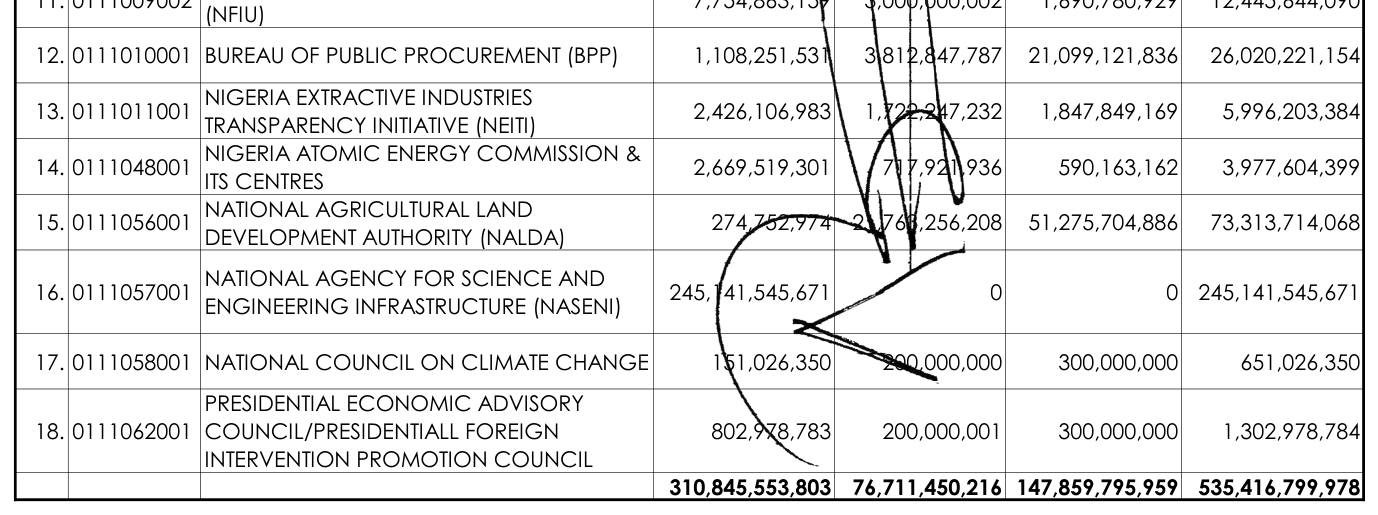
The 2026 Appropriation Act runs to 2,635 pages. It is public, it is downloadable, and the President's signature is on it. To find one line inside it, we opened the file and searched every page. The line was there: N1,302,978,784, attached to a body the Presidency has publicly called fake.
Nobody had found it, and not because it was concealed. Because no citizen has 2,635 pages of attention, and almost no newsroom has the time. That gap - between what is published and what is read - is the whole reason this paper exists.
Every figure in those pages began as somebody's money
A line in an appropriation act is not an abstraction. It is a market trader's levy, a civil servant's deduction, a share of what the country earned from oil that year. It belongs to a woman in Kano who will never open a budget PDF, to a teacher in Calabar who has no reason to know what a Service Wide Vote is, and to a man in Aba who is told each year that the money ran out.
They are not failing in a duty by not reading it. Reading 2,635 pages is not a citizen's job. But somebody has to do it, or the publishing of a document becomes a substitute for anyone checking it - a government can satisfy every transparency obligation in the world and still never be read.
So this paper is not written for the people who already follow Nigerian politics closely. It is written for the person who suspects the numbers do not add up and has never been given a way to find out. What we are trying to hand that person is not an opinion about their government. It is the page, the line and the figure, with instructions for finding it themselves.
That is also why every report here prints its sources as working links, why the documents are published alongside the reporting rather than described, and why the whole site is free to read, quote and mirror with no attribution required. A record that can only be reached through us is not much of a record.
Already on this site Every report links the documents it rests on. Every report is searchable in full text, and so is the Vero Archive of the documents themselves. Nothing behind either is metered.
This is not a campaign against a party, and we can show it rather than say it
Anyone can claim to be non-partisan. The claim is worthless; only the published record settles it. So here is ours.
Our lead report establishes that a council the Presidency calls non-existent has a code and a nine-figure line in the budget the President signed. The same report corrects a figure the government's critics had been circulating - including our own earlier version of it. The widely repeated N1.3bn is not that council's allocation; the Act assigns it to a single code shared with another body, and we said so in the report, against our own interest, because it is what the document shows.
Our report on the Tinapa resort concerns a project built by a former governor who is now an opposition presidential candidate, and it is as hard as anything we have published about the government. It also declines to confirm the $350m figure that has been used against him for years, because no audited document we could retrieve supports it.
We have published a separate report on every candidate in the 2027 presidential field - eighteen of them, including two women whose candidacies almost every published list of that field had dropped. We did not choose which of them to cover. The commission's list chose.
None of that is generosity. It is the only way the work holds. A finding that can be predicted from the politics of the person who published it is not a finding, it is an argument with footnotes, and a reader is right to discount it.
Already on this site File 01 on Tinubu is open and files on Obi and Atiku are in preparation. Reports exist on all eighteen 2027 candidates, from the President to a man about whom almost nothing is documented at all.
A report succeeds when the record gets clearer, not when somebody looks guilty
Those are different outcomes and they are constantly confused. A great deal of what passes for accountability journalism is really the production of embarrassment, and embarrassment has a short life: it is enjoyed for a week, it changes nothing, and it teaches the subject only to be more careful next time.
We are after something slower and more durable. When a figure is established to the naira and the page it sits on is published beside it, that fact stops being arguable. It is still there in five years, when the person it concerns has moved on and the next set of accounts is being drawn up. That is worth more than a bad week for anybody.
It is also why every report on this site carries a paragraph headed what this does not establish - and why that paragraph is often longer than people expect. Naming the limits of a finding is not hedging. It is a protection for the person in the report as much as a service to the reader: we will not let an inference we cannot support attach itself to a named human being because it made the story better.
We assert no criminality where no court has found any. Where a document could be read two ways, we print both readings. Where the record contradicts what we expected to find, we publish the contradiction rather than the expectation.
Already on this site Read any report to its end. The limits are set out under their own heading, in the same type as the findings.
One document rarely tells the whole story, so we connect thousands of them
Court records. Corporate registries. Archived websites. Audited accounts. Government publications. Offshore registers. Procurement notices. Historical newspapers. Pages that have since been deleted. Filings made in other countries. And old investigations that nobody ever connected to what happened afterwards.
We reconstruct timelines across years and sometimes decades. We set what was said this month against what was filed a decade ago. We follow companies through jurisdictions, people through corporate structures, and money as far as the publicly documented trail runs, and then we stop and say that is where it stops.
This is slow work and it does not look like much until the day it does. Most of it produces nothing. That is not a failure of the method; it is the method.
Already on this site File 01 was assembled from six bodies of record and carries 600 numbered findings, each one graded.
Some stories begin with a source calling a journalist. Ours can begin with one line on page 193 of a 300-page document.
A company name in an annual report leads to a filing. The filing names a director. The director turns up in another jurisdiction. A judgment names a bank. An archived page supplies the date that makes the sequence testable. Records created years apart, by people who never met, begin describing the same thing.
That is where the work actually is. Not in finding information, which is the easy part, but in reconstructing a record from documents that were never filed together and were never meant to be read side by side.
It is unglamorous and it is checkable, and those two facts are related.
Already on this site Every query, docket number and register reference is printed in the file, so a stranger can run them and reach the same page, or find that it has moved.
A newsroom is not one skill wearing different hats, and we stopped pretending it was
Retrieval is its own discipline: finding the register that holds a record, learning which jurisdictions publish and which ones make you ask, knowing that a gazette notice and a press release about the same event are not the same kind of thing even when they say the same words. It is closer to archival research than to reporting as it is usually taught, and it rewards patience over instinct.
Verification is a separate discipline again, and it runs closer to open-source intelligence than to journalism: reading a document's own metadata for signs it was altered after the date it claims; tracing a company through every jurisdiction that will show its filings and building the map nobody published on its own; checking a photograph against the shadows, signage and skyline it shows rather than against its caption; pulling a domain's registration and hosting history to learn when a claim first existed online, not when somebody says it did. None of this is glamorous. All of it is checkable, which is the only property that matters here.
Synthesis is a third discipline: taking material that survived retrieval and verification separately, setting it into a timeline, and writing the sentence that says exactly what it shows and exactly where it stops showing anything. This is where most journalism actually fails, not through fabrication but through a sentence that quietly claims ten per cent more certainty than the evidence behind it earned.
And presentation is a fourth discipline, not an afterthought to the first three: building pages, grading marks and a print layout that carry precisely the weight the evidence supports, so that good design never becomes a way of making a thin finding look thick. A team assembled to do all four well, rather than one person doing all four adequately, is the only structure we have found that survives contact with a hostile reading.
Already on this site The method page sets out the open-source techniques and the review process a finding has to survive before it is graded and published.
The newsroom you cannot see is where most of the actual work happens
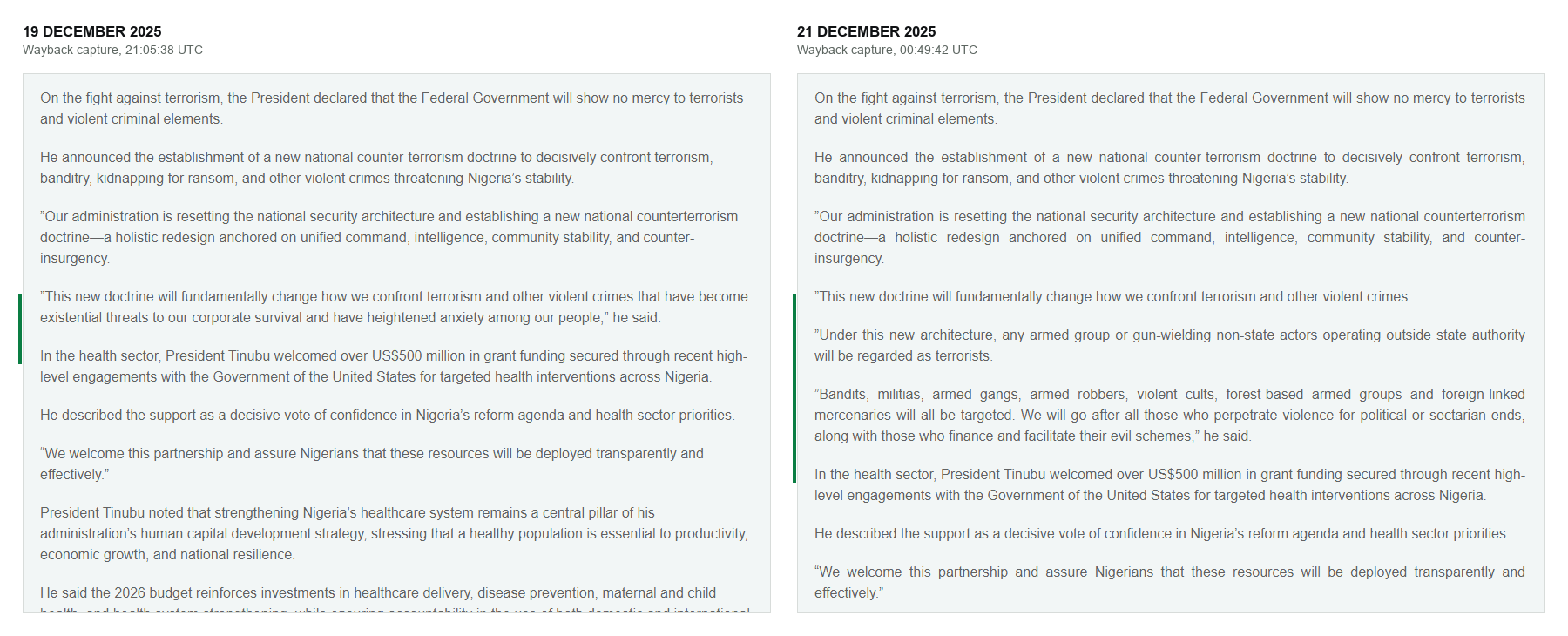
A finding is rarely won by finding information, which search engines already do well. It is won by connecting records that were never filed together and were never meant to be read side by side: a corporate address that recurs across three unrelated filings, a domain registered two weeks before a company it fronts for was incorporated, an archived page whose wording changed the week a story broke and was never mentioned again. This is close to the discipline the security field calls open-source intelligence, applied to institutions and money instead of to networks and systems, and it uses much of the same craft: patient enumeration, cross-referencing at a scale no single memory can hold, and a working assumption that anything worth hiding leaves more than one trace.
Source protection runs the other way. Where a document or a conversation could expose the person who supplied it, we treat that risk with the same seriousness a security team treats an unpatched system: minimising what is retained, separating what identifies a source from what the source provided, and publishing only the material, never the path it took to reach us, unless a source explicitly wants otherwise. The standing rule against purchasing or requesting documents in our own name, described further down this page, exists partly for this reason: a transaction that can be traced back to us can sometimes be traced back further, to whoever helped us reach it.
The publishing platform itself is built the same way. No advertising network, no analytics service, no third-party font or script, because every one of those is also a channel a reader's presence on this site could leak through. The measurement on the method page comparing this site's requests against eight Nigerian news sites is not a performance boast. It is what a newsroom's technical layer looks like when the reader's exposure is treated as a cost to be minimised rather than a resource to be monetised.
Already on this site Every page loads with a strict content security policy, serves its own fonts, and sets no cookie, which you can confirm yourself in your browser's network panel without asking us to prove it.
Power gets no special treatment here, and neither does opposition to it
Government. Opposition. Former presidents. Likely future ones. Companies, institutions, movements. If there is a genuine public-interest question and a document trail worth following, we are willing to follow it.
That means reopening questions everyone assumed were finished. It means reading the documents behind allegations that have been repeated for twenty years without anyone returning to the source. And sometimes it means finding that the allegation everyone believes cannot be proved at all.
We publish that too. The finding that a widely repeated charge has no document behind it is as much a public service as the finding that confirms one, and it is considerably less popular.
Already on this site Our report on the disputed council corrects the N1.3bn figure the government's critics keep repeating, and our report on Tinapa declines to confirm the figure everyone repeats about it.
You may never know who Dr Vero is, and that is the design rather than an accident
Dr Vero has no election to win, no appointment to protect and no candidate to sell you. The identity stays secondary because a personality that becomes more important than its evidence has stopped being useful to the person reading.
You should not have to trust a face. You should be able to inspect the work. That is a harder promise to keep than a byline and a photograph, and it is the only one worth making.
There is a practical reason as well, and it is not abstract in Nigeria. Journalists here are arrested over reporting on public money, and held for weeks before any court examines whether the reporting was accurate. One Nigerian investigative outlet has taken the names of its own trustees off its website because they were being targeted for what it published. In that environment, a masthead that does not depend on one nameable person is not vanity. It is continuity.
Where we could not obtain a document, we name the document, name its custodian and print its price, so that the gap in the record is as visible as the record.
Already on this site The method sets out the three grades, and every claim on this site carries one.
Most of the discipline is in refusing to let one thing pass for another
These are not pedantic distinctions. Collapsing any one of them is how a claim that nobody ever established ends up repeated for twenty years as though a court had settled it.
- an allegationis nota finding
- an investigationis nota conviction
- a connectionis nota cause
- a suspicionis nota proof
- a settlementis notan admission
- a filingis notthe truth of what it alleges
- four outlets repeating a claimis notfour sources
- absence of evidenceis notevidence of absence
We keep the material that contradicts our own hypothesis, and we print it next to the material that supports it. We tell you what we know, what we do not know, and exactly where the evidence stops.
The part that costs us
We obtain no document whose acquisition would create an attributable transaction. No purchased filings. No certified extracts. No register searches requested in our own name. Where such a document would settle a question, we name it, name its custodian, print its price, and leave the question open with the inference stated plainly as an inference.
There are questions in every file that a single paid extract would close. They stay open. A reader who wants one closed can close it, and will owe us nothing for doing so.
We assert no criminality where no court has found any. We carry no advertising, take no institutional funding, meter nothing, and record nothing about who reads this. If that last sentence ever ceases to be true, it will be changed on this page, dated, before the money is taken and not after.
Already on this site Reading this page contacts nobody but this site: the typefaces are served from here, so no third party learns that you were here.
A finding here is not an opinion, which means it can be broken
Produce the document that contradicts one and it goes: in place, on the page where it stood, at the same length, under the same heading, with the date it was found. The original wording stays visible above the correction. Nothing is silently edited and nothing is deleted.
This is deliberately the most expensive possible way to handle an error. A publication that can quietly change what it said last week has no way of proving it did not, and asking a reader to take that on trust is exactly the thing we exist to avoid asking.
Four errors have been found in File 01 that way. Each of them is still there. We would rather carry a visible record of being wrong four times than an invisible one of never having been checked.
Already on this site The corrections register counts every one, including the ones still to come.
The point is not the next story. It is a record that outlasts the people in it.
A story is read and forgotten inside a week. A record is consulted for years. Everything here is built for the second thing: stable pages that do not move, full-text search over everything published, documents held alongside the reporting, and a licence that lets anyone copy the whole lot without asking. If this paper disappeared tomorrow, the material should still be usable by whoever came next. That is a strange thing to design for, and it is the correct thing.
Three directions follow from it. The first is downward. Federal budget work is where we started because it is where the documents are best, but the money that vanishes most reliably vanishes at state and local-government level, where almost nobody is reading and the audited accounts are published by offices most citizens have never heard of. Our report on a state's carrying value for an idle resort came out of exactly such an office, and nobody had reported the figure.
The second is the team. Retrieval, verification, synthesis and presentation are four disciplines, and one person doing all four adequately is the constraint on everything above. The honest version of this plan is that it needs people, and that the quality of the fourth report a week is decided by whether they exist.
The third is the election. Nigeria votes in early 2027. Every candidate on the ballot now has a graded report here, built from the commission's own signed list rather than from anybody's summary of it. Between now and the vote, the useful thing a newsroom can do is not prediction and not endorsement. It is to make the documentary record of the people asking for power easier to check than the claims being made about them.
Already on this site Reports on all eighteen 2027 presidential candidates, seventy reports in all, fifty-eight of them graded (A), each with the documents it rests on published beside it.
Most of what the state publishes is never read. Some of it is never kept.
Government documents in Nigeria do not only go unread. They disappear. Ministries rebuild their websites, agencies move to new addresses, and a budget, an audit report or a gazette that was public last year returns an error today. A record held in one place, on one server, by the body it describes, is a fragile kind of public record.
So we built the Vero Archive beside the newsroom: 1,558,428 catalogue records from 69 sources, and 87,084 files kept exactly as they were published, each fingerprinted with a SHA-256 hash and linked to the address where we found it. It holds budgets and audit reports from all 36 states and the Federation, gazettes back to the colonial era, court judgments, procurement records, international files on Nigeria, and more than 560,000 records of government documents recovered after they vanished from gov.ng.
It is for Nigerians first: for the person who wants their own state's budget, or the audit report nobody mentioned, without knowing which office to ask. It is for journalists, in Lagos, Kano, Port Harcourt or abroad, who need the original document rather than somebody's summary of it, and who should not have to rebuild the same collection every time a ministry changes its website. It is for researchers, lawyers and students. And it is for anyone in the world who wants to understand Nigeria from its own records rather than from what is said about it.
It is free to search. Nothing in it sits behind a login or a fee, and we add no allegation to what it holds: every file is the publishing body's own document, as that body published it. Our reporting draws on it. Anybody else may draw on it too, and we would rather they did.
Already on this site The Vero Archive is open. Search it for a budget line, a name or a gazette year, and you get the document, not a description of it.
We will ask questions others will not. We will open files others forgot. We will connect records others read separately. We will spend unreasonable amounts of time on details most people scroll past. And we will follow the evidence even when it ruins the story we expected to find.
The country's accounts are already public.
Somebody has to actually read them.

Nigeria, on the record.
Truth has a paper trail.
Òtítọ́ korò.
Read File 01, all 487 pages How every claim is graded Search the Vero Archive