The 46% debt-service figure the Finance Ministry credits to the World Bank is not in the Bank's report; the ministry's workbook says 77% at mid-2026
Rejecting a reading that federal interest payments took 124 per cent of revenue, the Finance Ministry said on 18 October that the World Bank projects Nigeria's 2026 debt service at 46 per cent of revenue. The Bank's 66-page report and the outlook published with it contain no such figure; their only debt-service ratio, about 49.5 per cent for 2025, covers all tiers of government together. The ministry's own Fiscal Analysis workbook puts the ratio at 149.50 per cent in May 2023 and 77 per cent at mid-2026, where its statement says 97 per cent and below 60 per cent. Its first-half figures match the Bank's exactly.
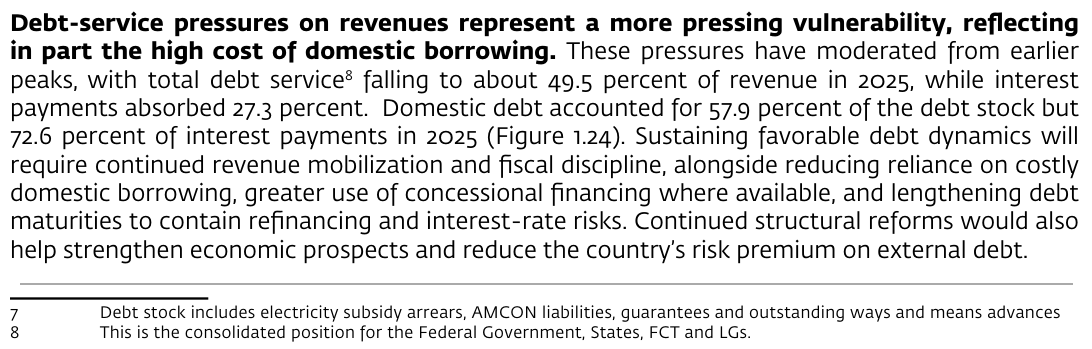
On Sunday, 18 October 2026, the Federal Ministry of Finance issued a statement rejecting claims that the Federal Government's interest payments reached 124 per cent of its revenue in the first half of 2026. It called that conclusion misleading and offered a different yardstick. "The same World Bank report projects Nigeria's full-year 2026 debt service, covering both interest and principal," the statement said, at 46 per cent of revenue, and it called that "the appropriate benchmark". Vero Record searched the full text of the World Bank's October 2026 Nigeria Development Update, all 66 pages, and the two-page Macro Poverty Outlook for Nigeria that the Bank issued for the same Annual Meetings. Neither contains a debt-service figure of 46 per cent, for 2026 or for any other year. The report's only debt-service ratio is on page 31: total debt service fell "to about 49.5 percent of revenue in 2025". Footnote 8 on the same page says that figure is "the consolidated position for the Federal Government, States, FCT and LGs."
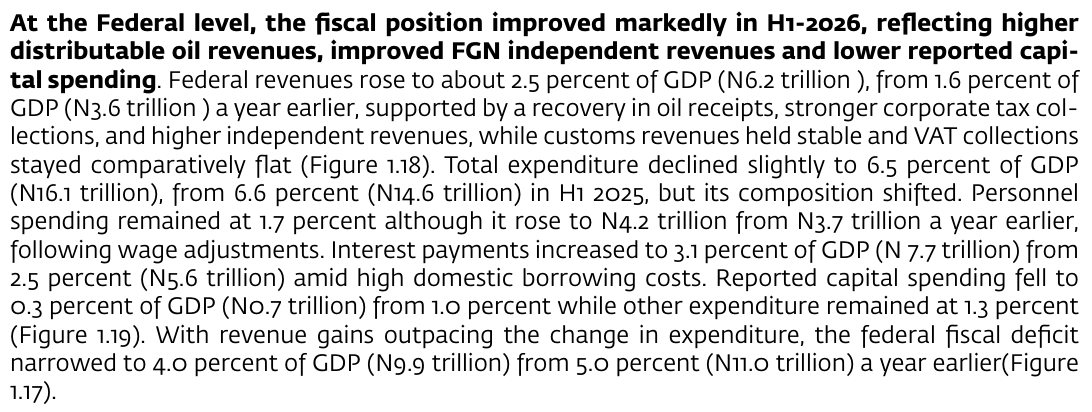
The ministry's account of the first half of the year is accurate. Page 28 of the report says federal revenues rose to N6.2 trillion in the first half of 2026 from N3.6 trillion a year earlier, and that interest payments rose to N7.7 trillion from N5.6 trillion. The statement uses exactly those four figures. Re-done, revenue rose by 72.2 per cent and interest by 37.5 per cent, which the statement rounds to 72 and 38. Interest equalled 155.6 per cent of revenue in the first half of 2025 and 124.2 per cent in the first half of 2026, a fall of 31.4 points; the statement's 32 comes from subtracting the rounded 124 from the rounded 156. The gap between interest and revenue narrowed from N2.0 trillion to N1.5 trillion, as the ministry says. The ministry is also right that the World Bank did not print a 124 per cent ratio. That number was worked out by others from the report's figures, and the statement aims its objection at "recent analysis and public commentary" citing the report.
The ministry's first objection is that the N7.7 trillion "includes debt the Federal Government services on behalf of other tiers of government, including external loans to states", so that measuring it against federal revenue alone "overstates the ratio which is only meaningful when debt and revenue cover the same level of government." Neither the report nor the statement says how much of the N7.7 trillion is paid on behalf of states. The benchmark the statement puts forward in its place is described as Nigeria's debt service, not the Federal Government's. The nearest measure in the report, the 49.5 per cent for 2025, covers all tiers together. The outlook says only that debt-service costs constrain federal fiscal space, "absorbing about 50 percent of revenues", without saying which tiers or which year. Figure 1.24, the report's chart of debt service against revenue, runs from 2015 to 2025 and has no point for 2026. The only 2026 estimate in the report's fiscal annex that bears on the question covers interest alone, for the whole federation: interest of 2.5 per cent of GDP against revenue of 10.8 per cent, which is 23.1 per cent. Principal is not projected; a note to the annex says "amortization is included below the line per international standards".
The statement's other figures for the ratio come without a source. It says "the full-year 2025 debt-service-to-revenue ratio was below 60%, down from 97% before the reforms." The ministry has published its own figures for the same ratio. Its Fiscal Analysis workbook, posted on finance.gov.ng with a resource page dated 19 August 2026 and described there as the tables "behind the public reform briefing", gives "Debt Service-to-Revenue" in its Counterfactual sheet as 149.50 per cent at the "May 2023 Baseline (Inherited Data)" and 77 per cent as the "Present Reality (Mid-2026 Actual)". The explanation in the next cell reads: "In May 2023, Nigeria spent 1.5x of its entire revenue purely on interest payments. Through aggressive fiscal reforms, we halved this crushing burden down to 77%." A second sheet in the same file, Publication, carries a Nigeria Economic Reform Scorecard that gives "Debt Service / Revenue" as "~100% (2022)" at baseline and "~50% (2026 proj.)" as the current position.
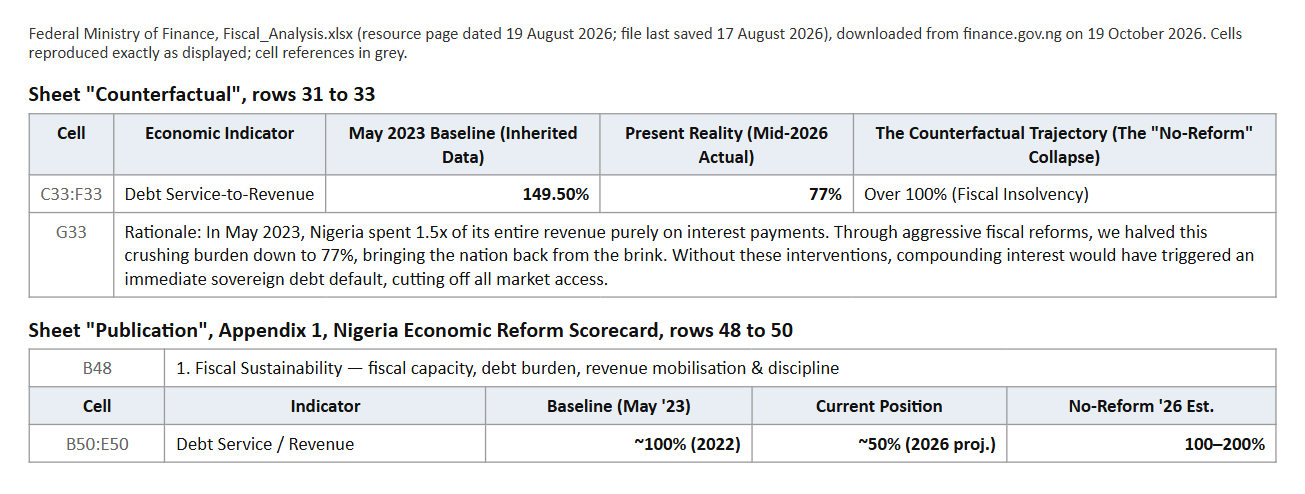
Taken together, the ministry's own documents give three figures for where the ratio stood before the reforms (97 per cent, about 100 per cent for 2022, and 149.50 per cent for May 2023) and four for the period since (below 60 per cent for 2025, 77 per cent at mid-2026, about 50 per cent projected for 2026, and the 46 per cent it attributes to the World Bank). The figures may rest on different definitions of debt service, of revenue and of the period covered. None of the documents says which. The workbook's 77 per cent is itself a mid-year reading, the kind of measure the 18 October statement sets aside: "Debt sustainability is assessed on a full-year basis, not over six months." On the workbook's own numbers, the fall from 149.50 to 77 per cent is 72.5 points, and 77 is 51.5 per cent of 149.50, close to the halving the sheet describes.
The government's published accounts do not yet show a full-year figure for 2025. The most recent budget implementation report Vero Record found on the Budget Office of the Federation's website covers January to September 2025. Its Table 3.9, compiled with the Office of the Accountant-General of the Federation, gives aggregate Federal Government revenue of N18,632.82 billion for the nine months (N4,954.33 billion, N5,974.99 billion and N7,703.50 billion by quarter) and debt service of N12,524.74 billion (N4,733.10 billion, N4,407.33 billion and N3,384.31 billion). Debt service therefore took 67.2 per cent of revenue over the nine months, or 67.8 per cent once the N108.17 billion sinking fund is added. Vero Record found no implementation report on the site for the last quarter of 2025 or for any part of 2026, so whether the full year came in below 60 per cent cannot be checked against a published federal account.
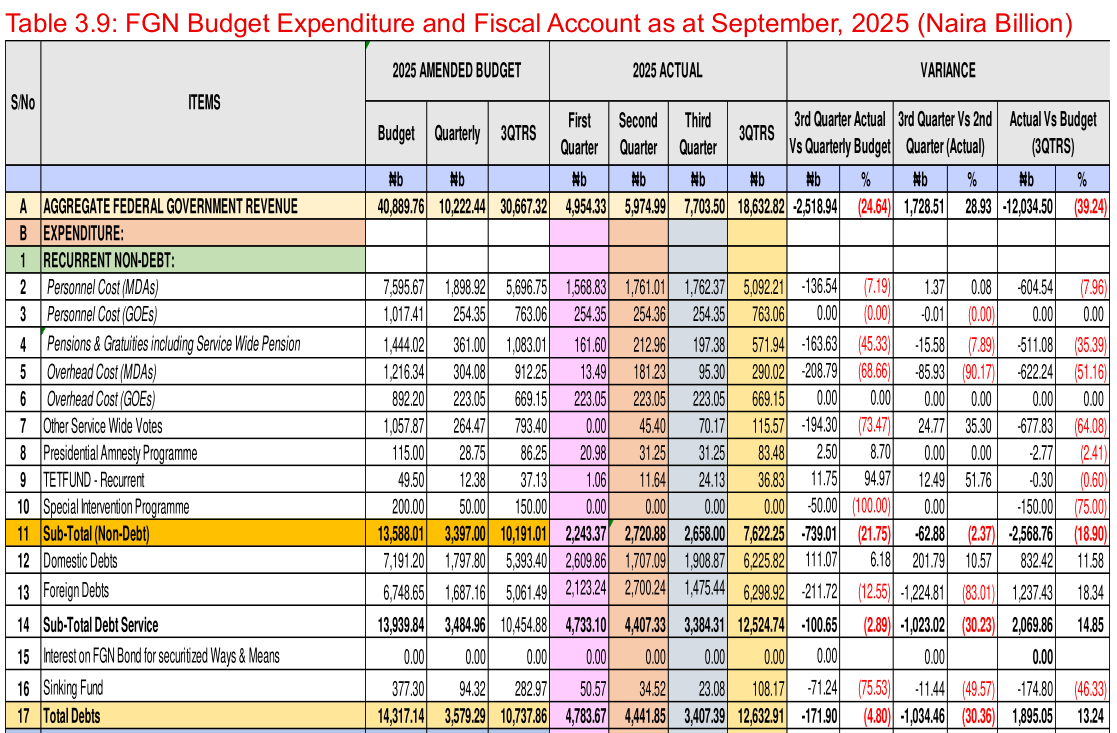
The same table supports part of the ministry's second objection, that the revenue figure behind the 124 per cent is incomplete. For the first half of 2025 the Budget Office counts aggregate federal revenue of N10,929.32 billion, about three times the N3.6 trillion the World Bank counts for the same six months. The Bank's fiscal annex explains that its revenues are net of collection costs and deductions and leave out education tax and the revenues of government-owned enterprises other than dividends, "as these cannot be used by the FGN for its own spending". On the Budget Office's wider measure, debt service, principal included, took 83.6 per cent of revenue in the first half of 2025 (N9,140.43 billion against N10,929.32 billion), well below the 156 per cent the statement gives for interest alone on the Bank's narrower base. Which base is more useful depends on the question being asked; the Bank's note gives its reason for leaving the extra revenue out.
On the direction of travel, the documents support the ministry. The World Bank's report says debt-service pressures "have moderated from earlier peaks", and its figures and the ministry's agree that revenue grew almost twice as fast as interest in the first half of 2026. Within 2025, the Budget Office's quarterly ratio fell from 95.5 per cent in the first quarter (N4,733.10 billion against N4,954.33 billion) to 43.9 per cent in the third (N3,384.31 billion against N7,703.50 billion). When a minister used the same pairing of 97 and 60 per cent on 3 October, Vero Record found that the Budget Office's tables put 2024 at 60.2 per cent and gave no full year at 97 per cent; 2022 was 72.9 per cent and the first quarter of 2023 was 131.0 per cent, on a measure that adds Ways and Means interest.
The statement makes two further claims that these documents do not test. It says the revenue base excludes "independent revenue already earned by government agencies and enterprises but not yet remitted to the Treasury", and that "every naira borrowed by the Federal Government falls within the limits approved by the National Assembly under the 2026 Appropriation Act and the approved borrowing plan." Neither comes with a figure. The workbook's Debt sheet lists, for "2026 (Jan - Jun)", a budget deficit of N31,456.63 billion and approved new borrowing of N29,218.56 billion, but it does not report how much was actually borrowed in those months.
The statement was shared on X by the minister, Taiwo Oyedele, and reproduced in full by several outlets; Vero Record found no copy on the ministry's website on 19 October. It does not say where in the World Bank's report the 46 per cent appears, or how the 97 and below 60 per cent were calculated. The figure may come from World Bank material other than the two documents published for the Annual Meetings, such as a presentation or a debt sustainability analysis, which Vero Record has not seen.
The statement closes by urging analysts "to apply the same rigour they seek to hold the government to: compare like with like, read figures in context, and seek clarification where the data is unclear." The ministry's own explainer of 12 October, Understanding Nigeria's Economic Reforms, makes a similar point: "A projection differs from an observed result", and comparisons "are strongest when they use the same series over consistent periods." On the documents published so far, the benchmark the ministry offers cannot be traced to the report it names, and its own files give four different current readings of the same ratio.
What this rests on
Downloaded and read on 19 October 2026: World Bank, Nigeria Development Update October 2026, Beyond the Federal Purse (66 pages; the copy at documents.worldbank.org is byte-identical to the one Vero Record downloaded on 12 October), pages 12, 28, 31, 32, 35, 62 and 63, with the full text searched for "46", "124", "156" and every sentence containing "debt service"; World Bank, Macro Poverty Outlook for Nigeria, Annual Meetings 2026 (2 pages), searched in full; Federal Ministry of Finance, Fiscal_Analysis.xlsx from finance.gov.ng (resource page dated 19 August 2026; file properties: created 26 July 2026, last saved 17 August 2026), sheets Counterfactual (C31:G33), Publication (B48:F50) and Debt (B60:E73); Federal Ministry of Finance, Understanding Nigeria's Economic Reforms, 12 October 2026; Budget Office of the Federation, Third Quarter 2025 Budget Implementation Report, Table 3.9 (p.28, PDF p.47), file reused from Vero Record's 3 October check. The ministry's statement of 18 October is not on finance.gov.ng; its text is taken from the full reproductions by TheCable and Sahara Reporters, which agree word for word with the passages quoted by Punch. Arithmetic re-done: 6.2 / 3.6 = +72.2 per cent; 7.7 / 5.6 = +37.5 per cent; 5.6 / 3.6 = 155.6 per cent; 7.7 / 6.2 = 124.2 per cent; 155.6 - 124.2 = 31.4 points (156 - 124 = 32 on rounded figures); 5.6 - 3.6 = N2.0 trillion; 7.7 - 6.2 = N1.5 trillion. Annex 2026 estimate: 2.5 / 10.8 = 23.1 per cent (2025: 2.6 / 9.5 = 27.4 per cent, against 27.3 per cent in the report's text, a rounding difference). Workbook: 149.50 - 77 = 72.5 points; 77 / 149.50 = 51.5 per cent. Budget Office: revenue N4,954.33bn + N5,974.99bn + N7,703.50bn = N18,632.82bn; debt service N4,733.10bn + N4,407.33bn + N3,384.31bn = N12,524.74bn (also N6,225.82bn domestic + N6,298.92bn foreign = N12,524.74bn); N12,524.74bn / N18,632.82bn = 67.2 per cent; N12,524.74bn + N108.17bn sinking fund = N12,632.91bn, the table's Total Debts, and N12,632.91bn / N18,632.82bn = 67.8 per cent; first half N4,954.33bn + N5,974.99bn = N10,929.32bn revenue and N4,733.10bn + N4,407.33bn = N9,140.43bn debt service, 83.6 per cent; N10,929.32bn / N3,600bn = 3.04; first quarter N4,733.10bn / N4,954.33bn = 95.5 per cent; third quarter N3,384.31bn / N7,703.50bn = 43.9 per cent.
What this does not establish
Where the 46 per cent comes from: it is not in the two World Bank documents read, but the Bank may have given it in material not published with them, and the ministry did not cite a page. How the ministry calculated the 97 per cent, the "below 60%" for 2025, the workbook's 149.50 and 77 per cent, or the scorecard's 100 and 50 per cent, and whether they share definitions of debt service and revenue; the documents do not say. How much of the N7.7 trillion of first-half 2026 interest the Federal Government paid on behalf of states, and how much revenue agencies had earned but not remitted. Whether federal borrowing in 2026 stayed within the limits of the 2026 Appropriation Act; actual borrowing for the period was not tested. The full-year 2025 ratio on the Budget Office's measure, since no fourth-quarter report was found. Nothing in the documents suggests wrongdoing by anyone, and none is alleged. The ministry was not asked for comment before publication.
What we did ourselves
Searched the full text of the World Bank's 66-page October 2026 Nigeria Development Update and its two-page Macro Poverty Outlook for the 46 per cent figure the Finance Ministry attributes to the Bank, and checked the report's debt-service chart and annex for any 2026 projection. Set the ministry's 18 October figures against its own Fiscal Analysis workbook, sheet by sheet, and against the Budget Office's latest published fiscal account. Re-did every ratio in the statement from the report's figures, and computed the nine-month, half-year and quarterly debt-service ratios from Table 3.9.
Sources for this report
(A) World Bank, Nigeria Development Update, October 2026, pages 28 and 31 (with footnote 8), Figure 1.24 (p.32) and the fiscal annex (pp.62 to 63); Federal Ministry of Finance, Fiscal Analysis workbook (Fiscal_Analysis.xlsx), sheets Counterfactual and Publication; Budget Office of the Federation, Third Quarter 2025 Budget Implementation Report, Table 3.9.
- Nigeria Development Update, October 2026: Beyond the Federal Purse, How Higher Revenues Shaped State Priorities (66 pages) · World Bank · October 2026
- Macro Poverty Outlook for Nigeria, Annual Meetings 2026 (2 pages) · World Bank · October 2026
- Fiscal Analysis Workbook (Fiscal_Analysis.xlsx) · Federal Ministry of Finance · 19 August 2026
- Fiscal Analysis Workbook (resource page) · Federal Ministry of Finance · 19 August 2026
- Understanding Nigeria's Economic Reforms · Federal Ministry of Finance · 12 October 2026
- Third Quarter 2025 Budget Implementation Report (Table 3.9) · Budget Office of the Federation · 2025
- FG faults World Bank's 124% interest-to-revenue ratio over inclusion of states' external loans · TheCable · 18 October 2026
- Nigeria's Finance Ministry Disputes World Bank's 124% Debt Interest-To-Revenue Figure · Sahara Reporters · 18 October 2026
- FG disputes World Bank's N7.7tn interest payments · Punch · 19 October 2026
Confidence: high. This is our own assessment of whether the event occurred as described, separate from the grade, which describes what kind of thing the claim rests on.
Not obtained: where the underlying document is named above but not linked, we did not hold a copy at the time of publication. We purchase nothing and request nothing in our own name.
Corrections
None on this report. If you find an error, it will be published here, at the same length, with the date it was found, and the original wording will remain visible above it.
Dr VeroInvestigations editor, Vero Record
Reads the Nigerian public record that others leave unread: budgets, audit reports, court files and registers. Every claim on this page carries the grade of the document behind it, and the report says what that document does not establish.
All 126 reportsHow we grade evidenceAdd Vero Record as a preferred source on Google