Tinubu's office drew 18 findings from the World Bank's October update; 16 match the report, which also projects poverty at 61.1 per cent in 2028
The State House says the World Bank's October 2026 Nigeria Development Update confirms the reforms are working. We read the 66-page report against each of the 18 figures and findings the statement attributes to it. Sixteen match. The Bank says growth will average "about 4.4 percent", not "at least", and calls the fall in inflation "interrupted", not slowed. The statement omits the report's poverty forecast, its expected widening of the deficit to 3.5 per cent of GDP, and its warning that reserves rest heavily on portfolio money.
On Sunday 11 October the State House published a statement in which President Bola Ahmed Tinubu welcomed the World Bank's October 2026 Nigeria Development Update, titled Beyond the Federal Purse, and said its findings "confirm that the administration's economic reforms are delivering results". The statement, signed by his adviser Bayo Onanuga, attributes 18 figures and findings to the report. Vero Record downloaded the 66-page report from the World Bank's documents site and checked each one against the page it comes from. Sixteen match the report. Two are worded more favourably than the Bank's own text. And the statement leaves out the report's forecast for poverty at the end of its outlook: a rate of 61.1 per cent in 2028, after a gradual decline.
Most of what the President cites is in the report as he gives it. Page 19 says: "Nigeria's economy grew 4.2 percent in H1 2026, up from 3.9 percent in H1 2025." Page 10 records that inflation fell "from 27.6 percent year-on-year (y/y) in January to 15.2 percent in December" of 2025. Page 24 puts the first-half current account surplus at US$12.0 billion, or 7.0 per cent of GDP, up from US$8.6 billion a year earlier, and gross reserves at US$45.5 billion at the end of 2025 and US$53.8 billion at the end of August 2026, a rise of US$8.3 billion, or 18.2 per cent. The annex table on page 62 gives public debt of 40.0 per cent of GDP in 2025 and 38.1 per cent in 2026, the two figures the statement quotes. The report's own verdict on page 34 is close to the President's: "Recent reforms have been crucial to restoring macroeconomic stability."
The findings on the states also hold. Page 13 says gross federation revenues "rose by 69 percent in real terms between 2023 and 2025" and that state capital expenditure "rose by 151 percent in real terms", lifting its share of state spending from 48 to 61 per cent. Table ES.1 on page 16 shows why the report calls the states the main beneficiaries: in 2019 prices, their share of federation revenues went from N3.21 trillion in 2023 to N7.37 trillion in 2025, against N3.51 trillion to N4.93 trillion for the Federal Government. Three of the statement's counts are not printed anywhere in the text; they can only be read off the charts. We counted them. Figure 2.19 on page 52 covers 33 states, of which four (Taraba, Enugu, Anambra and Ebonyi) sit in the box marked "Shift toward social spending", leaving 29 that shifted towards infrastructure. Figure 2.9 on page 46 shows real growth in internally generated revenue for 35 states, four of them below zero (Benue, Oyo, Ebonyi and Sokoto), leaving 31. Figure 2.22 on page 54 puts 21 states in the panel headed "Decline in debt to GDP ratio between 2021 and 2025". All three counts match the statement.
The first of the two departures concerns growth. The statement says the Bank "projects growth to average at least 4.4 per cent between 2026 and 2028". The report does not say "at least". Page 11 says growth "is projected to average 4.4 percent over 2026-28", and page 33 says "about 4.4 percent". The annex on page 62 gives the years behind that average: 4.3 per cent in 2026, 4.4 per cent in 2027 and 4.4 per cent in 2028. Those add to 13.1, an average of 4.37 per cent, which rounds up to 4.4. The same table gives real growth per person of 1.7 per cent in 2026 and 1.8 per cent in each of the two following years.
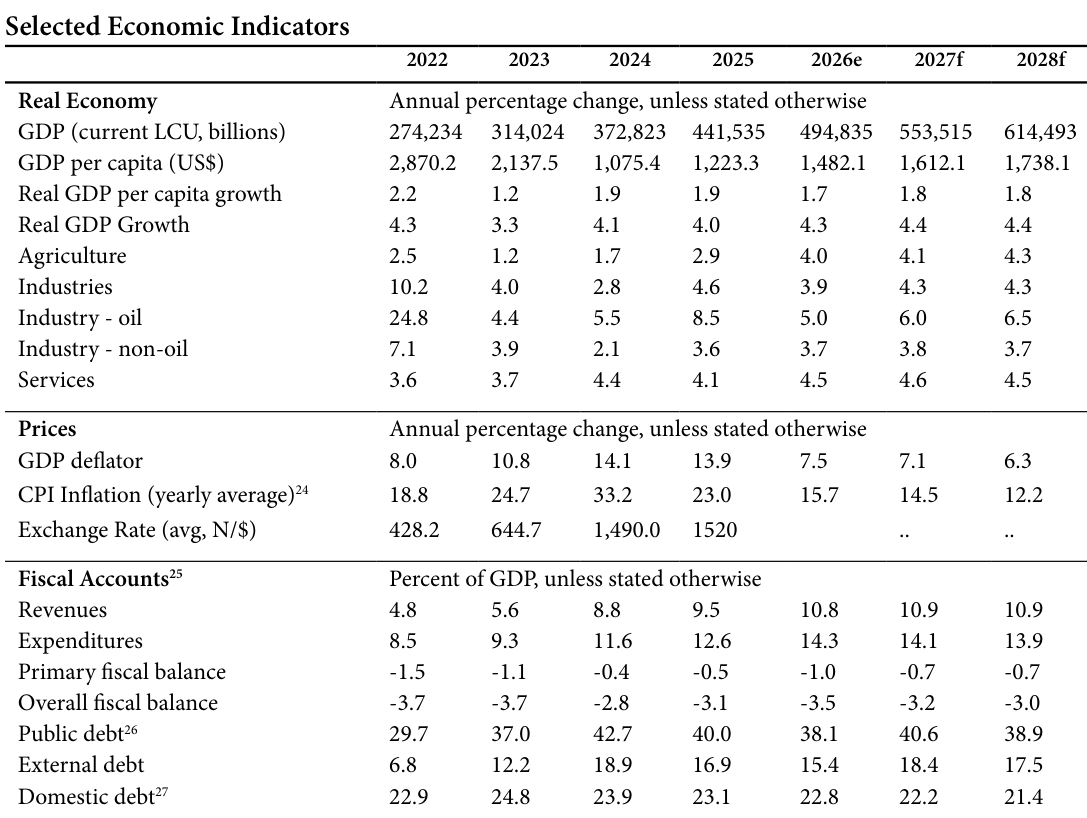
The second concerns prices. The statement says higher global fuel prices "have since slowed the decline" in inflation. The report's word, on pages 10 and 21, is "interrupted": headline and core inflation were "plateauing at around 15.5 percent y/y between January and August 2026", while food inflation "rose to an average of 20.0 percent in July and August, up from 8.9 percent in January 2026". Page 21 says domestic petrol and diesel prices rose by 52 and 130 per cent between February and May 2026. The report does expect inflation to ease to about 12 per cent by 2028, as the statement says; its annex projects yearly averages of 15.7 per cent in 2026, 14.5 per cent in 2027 and 12.2 per cent in 2028. Vero Record's check of National Bureau of Statistics data on 3 October found inflation between 15.06 and 15.93 per cent in every month of 2026 so far, which fits the Bank's description.
On poverty, the statement says the Bank found that "the poverty rate has stabilised for the first time since 2019" and expects it to decline gradually. Page 11 of the report says: "The poverty rate has leveled off after rising continuously since 2019 but remains elevated." Page 33 gives the level the statement omits: "Poverty is expected to remain elevated in the near term before declining gradually to 61.1 percent by 2028." Figure 1.26 on page 34 marks the two survey points the projection rests on, 40.1 per cent in the 2018/19 Nigeria Living Standards Survey and 56.2 per cent in the 2022/23 survey. On the Bank's own projection, the poverty rate in 2028 would be 4.9 points above the last survey and 21.0 points above 2018/19. The same chart shows the number of poor in 2025, 2026 and 2027 just above its 140 million gridline; the report prints no exact count.

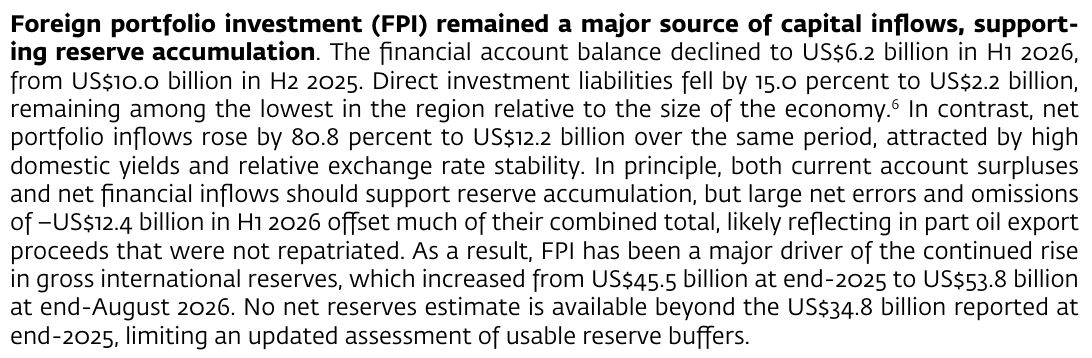
The statement also leaves out the report's fiscal warning. Page 11 says that despite a narrower federal deficit in the first half, "stronger capital spending by states alongside rising federal personnel, interest, and pre-election spending is expected to widen the consolidated fiscal deficit from 3.1 percent of GDP in 2025 to 3.5 percent in 2026, outweighing stronger revenues." Page 28 says the improved federal outturn "should be interpreted cautiously given the low reported federal capital spending". The fall in public debt to 38.1 per cent of GDP in 2026 is in the annex, but so is the next year: 40.6 per cent in 2027, then 38.9 per cent in 2028. The text on page 35 describes debt as "broadly stable at around 40 percent of GDP during 2026-28". Page 31 puts total debt service at about 49.5 per cent of revenue in 2025, with interest alone at 27.3 per cent.
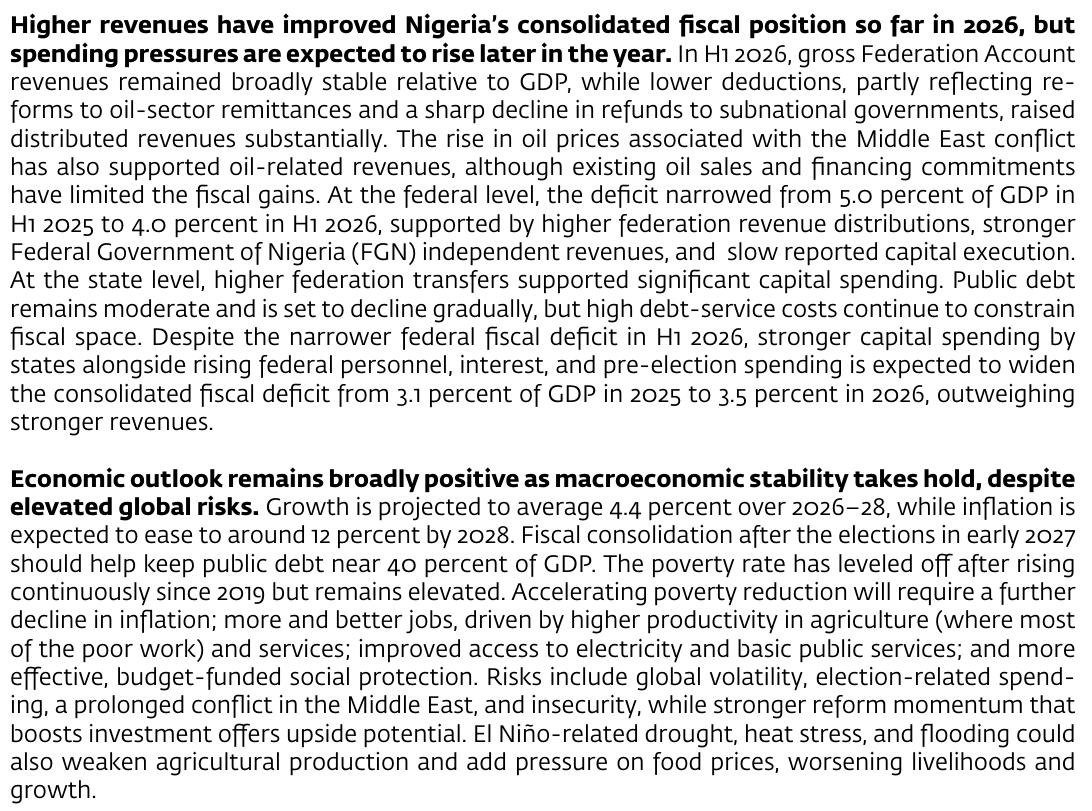
The reserves figures come with a caveat the statement does not carry. Page 24 says that a current account surplus and net financial inflows should both add to reserves, "but large net errors and omissions of -US$12.4 billion in H1 2026 offset much of their combined total, likely reflecting in part oil export proceeds that were not repatriated." The surplus of US$12.0 billion and the financial account balance of US$6.2 billion come to US$18.2 billion; the errors and omissions take US$12.4 billion of it, leaving US$5.8 billion. "As a result, FPI has been a major driver of the continued rise in gross international reserves," the report says, referring to foreign portfolio investment, which made up 45 per cent of gross inflows to the official currency market from January to August. It adds: "No net reserves estimate is available beyond the US$34.8 billion reported at end-2025", which was US$10.7 billion below gross reserves on that date. Vero Record's 3 October report, using Central Bank data, also found gross reserves at their highest since 2008 and noted that net reserves were not established.
The President's appeal to governors to spend "more prudently" has support in the report's own state figures. Page 50 says real spending grew faster than real revenue between 2023 and 2025 in 26 of the 34 states with data; six states saw revenue grow faster and two saw both grow at similar rates, which accounts for all 34. Median spending growth was "about 134 percent, compared with median revenue growth of 79 percent". Education's share of state spending fell from 14.9 per cent in 2021 to 12.1 per cent in 2025 and health's from 7.4 to 7.1 per cent, although both rose in naira. Page 46 says states' own revenue covered about 50 per cent of their recurrent costs in 2024 and 2025, and only Lagos and Enugu raised enough to cover theirs. Figure 2.22 also shows 13 states whose debt-to-GDP ratio rose between 2021 and 2025, among them Lagos, Kaduna, Edo and Bauchi; two, Jigawa and Ogun, were unchanged.
On cash transfers the report supports the figure the President gives, with a qualification about its source. Page 34 says: "The Federal Government reported disbursing N658.9 billion in direct cash transfers by September 2026, reaching 10.46 million poor and vulnerable households." That is the government's own count, as reported to the Bank. Divided evenly it comes to about N62,992 per household, though the report does not say how payments were spread. The Bank asks for more than expansion: "the next step is to move from an emergency response toward a regular, sustainable social protection system, with dedicated budget lines at the federal and state levels". The report says nothing about petrol pricing beyond the rise early in the year, and nothing about any fuel discount.
One apparent difference turns out to be a matter of measure. Vero Record's 3 October report put first-half growth at 4.16 per cent, using GDP at constant basic prices from the statistics bureau's workbook. The Bank's 4.2 and 3.9 per cent match the same workbook's GDP at constant market prices, which includes net taxes on products: N106,755,716.42 million in the first half of 2026 against N102,426,661.58 million a year earlier is growth of 4.23 per cent, and that figure against N98,537,753.61 million in the first half of 2024 is 3.95 per cent. At basic prices the two halves grew 4.16 and 3.69 per cent. On either measure growth picked up, and the State House figures are the Bank's.
Read whole, the report backs the President's central claim that the reforms have stabilised the economy and enlarged the revenue shared by every tier of government. It also says, in the same sentence as its verdict on page 34, that "further improving living standards will require faster, more inclusive growth that creates more productive jobs". The statement makes a similar point in the President's own words: "more work remains". What it does not give readers is the Bank's projected poverty rate, its expected widening of the deficit this year, or its warning that the rise in reserves rests heavily on short-term portfolio money.
What this rests on
World Bank, Nigeria Development Update, October 2026, Beyond the Federal Purse: How Higher Revenues Shaped State Priorities (66 pages; PDF created 7 October 2026), downloaded on 12 October 2026 from documents.worldbank.org and read for this report; pages cited are the printed page numbers, which equal the PDF page numbers. State House statement of 11 October 2026 signed by Bayo Onanuga, taken from the State House website feed on 12 October 2026. NBS Q2 2026 GDP workbook (Q2 2026 GDP_w.xlsx, sheet GDP_Curr_K_dfl_%Distrn, rows 125 and 127), from the bundle downloaded for the 3 October report. The 18 attributed items checked: (1) poverty stabilised since 2019, p.11; (2) gradual decline, p.33, with real GDP per capita growth of 1.7, 1.8 and 1.8 on p.62; (3) 4.2% in H1 2026 and (4) 3.9% in H1 2025, p.19; (5) average 4.4% for 2026-28, pp.11, 33, 62, worded as 'at least' by the statement; (6) 27.6% to 15.2%, pp.10, 21; (7) fuel prices 'slowed' the decline, where the report says 'interrupted', pp.10, 21; (8) about 12% by 2028, pp.11, 33; (9) current account US$12.0bn, 7.0% of GDP, from US$8.6bn, pp.10, 24; (10) reserves US$45.5bn to US$53.8bn, p.24; (11) 69% real federation revenue growth, states main beneficiaries, p.13; (12) state capital spending +151%, p.13; (13) roads and transport, agriculture, energy, housing, p.13; (14) 29 of 33 states, Figure 2.19, p.52; (15) social spending per person up in all but one state, p.51; (16) IGR up in 31 of 35, Figure 2.9, p.46; (17) 21 states cut debt-to-GDP, Figure 2.22, p.54; (18) debt 40.0% to 38.1%, p.62. Sixteen match; items 5 and 7 are worded more favourably. Arithmetic re-done: growth average (4.3 + 4.4 + 4.4) / 3 = 13.1 / 3 = 4.37. Reserves 53.8 - 45.5 = 8.3 (18.2%); gross minus net at end-2025, 45.5 - 34.8 = 10.7. Balance of payments 12.0 + 6.2 = 18.2; 18.2 - 12.4 = 5.8. Poverty 61.1 - 56.2 = 4.9 points; 61.1 - 40.1 = 21.0 points. Table ES.1 (2019 prices): states 7.37 / 3.21 = 2.296 (+129.6%; the table prints 129.49, a rounding difference from unrounded inputs); FGN 4.93 / 3.51 = 1.405 (+40.5%; table 40.77); LGs 4.12 / 2.05 = 2.010 (+101.0%; table 100.65). Chart counts: Figure 2.19, 33 states, 4 in the social-spending box, 33 - 4 = 29; Figure 2.9, 35 states, 4 negative, 35 - 4 = 31; Figure 2.22, 21 decline + 2 unchanged + 13 increase = 36. Page 50: 26 + 6 + 2 = 34 states. Cash transfers N658,900,000,000 / 10,460,000 = N62,992.35 per household. NBS GDP at constant market prices (N million): H1 2024 48,763,151.55 + 49,774,602.06 = 98,537,753.61; H1 2025 50,606,937.84 + 51,819,723.74 = 102,426,661.58; H1 2026 52,596,304.46 + 54,159,411.95 = 106,755,716.42; growth 3.95% and 4.23%. At constant basic prices: H1 2024 96,969,176.20, H1 2025 100,546,921.46, H1 2026 104,734,138.97; growth 3.69% and 4.16%.
What this does not establish
Whether the World Bank's projections will prove right; they are forecasts. The exact number of poor Nigerians in any year; the report gives rates and a chart but prints no count. Net reserves after end-2025, for which the report says no estimate is available. Whether the N658.9 billion and 10.46 million households are accurate; the report attributes them to the Federal Government and does not say it verified them, and Vero Record did not test them. How payments were spread among households. The 29, 31 and 21 state counts are our counts of the report's charts, which match the statement; the report's text does not print them. Whether any individual state's spending was imprudent; the report describes patterns, not misconduct, and nothing in these documents suggests wrongdoing by anyone. The report says nothing about any fuel discount or about current petrol pricing policy. The State House and the World Bank were not asked for comment.
What we did ourselves
Took the full text of the State House statement and listed every figure or finding it attributes to the World Bank, 18 in all. Downloaded the October 2026 Nigeria Development Update and matched each item to its page. Counted the states in three charts to test the statement's 29, 31 and 21, which the report's text does not print. Re-added the annex growth projections, the balance of payments items, the poverty differences, Table ES.1 and the page 50 state groups. Reconciled the Bank's first-half growth figures with the statistics bureau's workbook, showing they are measured at constant market prices while Vero Record's 3 October figure used basic prices.
Sources for this report
(A) World Bank, Nigeria Development Update, October 2026, Beyond the Federal Purse: How Higher Revenues Shaped State Priorities: executive summary (pp.10 to 17), Part 1 (pp.19 to 36, notably pp.19, 21, 24, 27 to 28, 31, 33 to 35), Part 2 (pp.42 to 54, Figures 2.9, 2.19 and 2.22), Annex 1 (pp.62 to 63); State House statement of 11 October 2026.
- Nigeria Development Update, October 2026: Beyond the Federal Purse, How Higher Revenues Shaped State Priorities (66 pages) · World Bank · October 2026
- President Tinubu welcomes World Bank's latest report as yet another piece of evidence that our reforms are working, reaffirms commitment to better living conditions for Nigerians · State House, Abuja (Bayo Onanuga) · 11 October 2026
- Nigerian Gross Domestic Product Report Q2 2026 (report and workbook) · National Bureau of Statistics · 31 August 2026
- 'Reform dividends becoming visible': Tinubu asks governors to use increased revenue prudently · TheCable · 11 October 2026
- Tinubu welcomes World Bank report, says economic reforms are delivering results · Channels Television · 11 October 2026
- Nigeria's state revenues rise 93% in real terms as capital spending expands: World Bank · Nairametrics · 9 October 2026
Confidence: high. This is our own assessment of whether the event occurred as described, separate from the grade, which describes what kind of thing the claim rests on.
Not obtained: where the underlying document is named above but not linked, we did not hold a copy at the time of publication. We purchase nothing and request nothing in our own name.
Corrections
None on this report. If you find an error, it will be published here, at the same length, with the date it was found, and the original wording will remain visible above it.

Dr VeroInvestigations editor, Vero Record
Reads the Nigerian public record that others leave unread: budgets, audit reports, court files and registers. Every claim on this page carries the grade of the document behind it, and the report says what that document does not establish.
All 112 reportsHow we grade evidenceAdd Vero Record as a preferred source on Google