Atiku's reply to Tinubu checked: five of eight figures hold; NNPC's accounts do not call his N11.2tn pipeline spending; the naira began at N461.06
Answering President Tinubu's Kaduna rally, Atiku Abubakar said the naira fell "from about N471 to N1,329 to the dollar". The Central Bank's daily series puts the official rate at N461.06 on 26 May 2023 and N1,361.34 on 23 October 2026, a steeper fall than he described. NNPC's audited accounts carry his N7.13 trillion of 2024 energy security costs, and the World Bank's October update carries his US$12.4 billion gap and, in a chart, about 63 per cent poverty for 2026. NNPC does not describe its N11.2 trillion claim on the Federation as pipeline spending. A US$22.5 million debt charge could not be checked.
On Saturday, 24 October 2026, Atiku Abubakar, the presidential candidate of the African Democratic Congress, replied to President Bola Tinubu, who had blamed the opposition for Nigerians' hunger at a campaign rally in Kaduna. The reply, issued by Phrank Shaibu, Director of Strategic Communication of the ADC Presidential Campaign Council, put its case as a string of questions carrying eight figures. Vero Record set each figure against the primary record it points to. Five are borne out by those records, one of them only through a chart. Two are not. The Central Bank of Nigeria's official rate on 26 May 2023, the last it published before Mr Tinubu was sworn in, was N461.06 to the dollar, not "about N471". And NNPC Ltd's audited accounts do not describe the N11.2 trillion Atiku called "pipeline related spending" in those terms. The eighth figure, US$22.5 million of "other charges", could not be checked because the Debt Management Office's website was not working.
The figures come from Vanguard's report of the statement, published that evening, which gives each question in quotation marks as Atiku's words. They read: "Which administration removed the petrol subsidy and watched the naira fall from about N471 to N1,329 to the dollar?"; "Which administration has presided over a rise in poverty that led the World Bank to estimate that 63 per cent of Nigerians will be below the national poverty line in 2026? Which administration extended the 2024 budget into 2025 while also operating a separate 2025 budget?"; "Which administration recorded N7.13 trillion under 'energy security' in 2024 and faces questions over N11.2 trillion in NNPC pipeline related spending?"; and "Which administration must explain the $12.4 billion gap flagged in Nigeria's external accounts for the first half of 2026? Which administration paid $22.5 million in 'other charges' on the Abu Dhabi financing facility?" The statement as reported does not name its sources. Vero Record worked from the Vanguard text and did not obtain the statement as issued.
The Central Bank publishes its official exchange rates as a daily series, which Vero Record downloaded from its website on 4 November and filtered for the US dollar. On Friday, 26 May 2023, the last trading day before the inauguration on Monday, 29 May, the central rate was N461.0600, with buying and selling rates of N460.5600 and N461.5600. No rate is listed for 29 May. The rate edged up to N462.8800 on 9 June and jumped to N632.2700 on 14 June, after the foreign exchange reforms of that month. The series, which runs back to December 2001, contains no official rate anywhere between N464 and N480. The World Bank's Nigeria Development Update of October 2026 gives the same starting point; a footnote on page 33 says the rate "moved from about N461/$ before the June 2023 foreign exchange reforms to around N770/$ shortly thereafter". Atiku's figure is N9.94, or 2.2 per cent, above the Central Bank's.
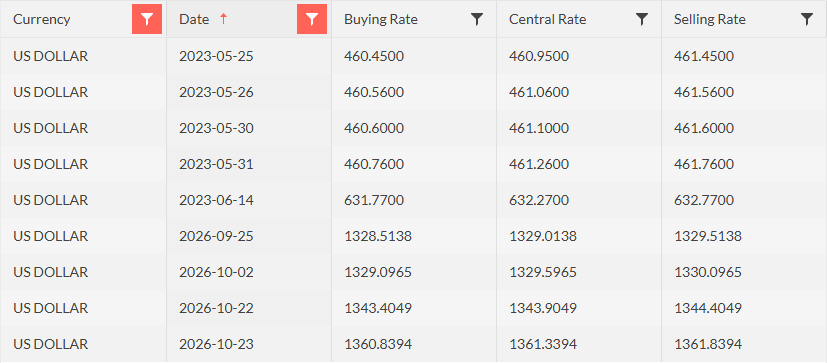
His end point is in the record. The central rate was N1,329.0138 on 25 September and N1,329.5965 on 2 October 2026. By Friday, 23 October, the last rate published before the statement, it had moved to N1,361.3394, and on 26 October it was N1,367.1057. On the Central Bank's figures, a dollar cost N461.06 before the handover and N1,361.34 on the eve of the statement, so a naira bought 66.1 per cent fewer dollars. Atiku's own pair of figures implies a fall of 64.6 per cent. The error in his starting rate makes the depreciation look smaller, not larger. The same series also shows that the official rate is well off its weakest point, N1,688.2840 on 20 November 2024, which is N359.28 more per dollar than the N1,329 Atiku cited.
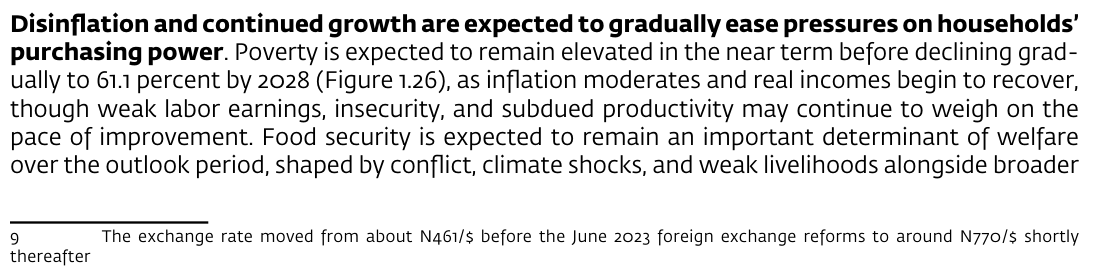
The poverty figure is in the World Bank's October update, but not in its text. Page 33 says poverty "is expected to remain elevated in the near term before declining gradually to 61.1 percent by 2028 (Figure 1.26)" and gives no number for 2026. Figure 1.26, on page 34, plots the national poverty rate year by year without printing the values. Vero Record read the plotted line from the PDF's drawing data and calibrated it on the two values the Bank does print, 40.1 per cent for the 2018/19 household survey and 61.1 per cent for 2028. On that reading the line stands at about 62.9 per cent in 2026 and about 63.3 per cent in 2025, which supports "63 per cent". This is Vero Record's measurement of a chart, not a figure the Bank states. The Bank's Macro Poverty Outlook for Nigeria, published the same month, uses international poverty lines instead and puts 69.5 per cent of Nigerians below US$4.20 a day in 2026. A Guardian report of Atiku's statement of 27 September cited a 63 per cent estimate from the IMF's June 2026 Article IV report; the IMF website refused Vero Record's download, so that report was not read.
The budget point is supported by the government's own account. The State House release on the President's presentation of the 2026 budget on 19 December 2025 quotes him as saying: "Following the extension of the 2024 capital budget execution to December 2025, a total of N2.23 trillion was released for the implementation of 2024 capital projects as of June 2025." The same release quotes him as saying that N3.10 trillion, "about 17.7% of the 2025 capital budget", had been released by the third quarter of 2025, "reflecting the emphasis on completing priority 2024 capital projects". The 2024 capital budget and the 2025 budget were therefore both being carried out during 2025, as Atiku said. The 2025 budget has since been extended in turn, to 31 December 2026, as Vero Record reported on 2 October.
The N7.13 trillion is in NNPC Ltd's audited accounts for 2025, published as part of its 2025 Annual Report. Note 24.2.1 on page 106 shows "Energy security costs in the year" of N7,130,948 million for 2024, and Note 24.2.2 says: "During the year, no energy security expense was recognised (2024: N7.13 trillion)." Accounting policy 2.6 on page 49 explains the heading. Under Section 64(M) of the Petroleum Industry Act, costs NNPC incurs as supplier of last resort "for energy security reasons" are on the account of the Federation, and the under-recovery is "the difference between the actual landing cost of the product and the regulated price" of imported petrol. On the record, then, the N7.13 trillion is the cost of selling petrol below its landing cost in 2024, charged to the Federation. The note also shows how it was settled: N4,668,938 million was defrayed in 2024, and the N8,671,574 million left at the end of that year was netted against royalties, taxes and dividends in a reconciliation concluded in September 2025.
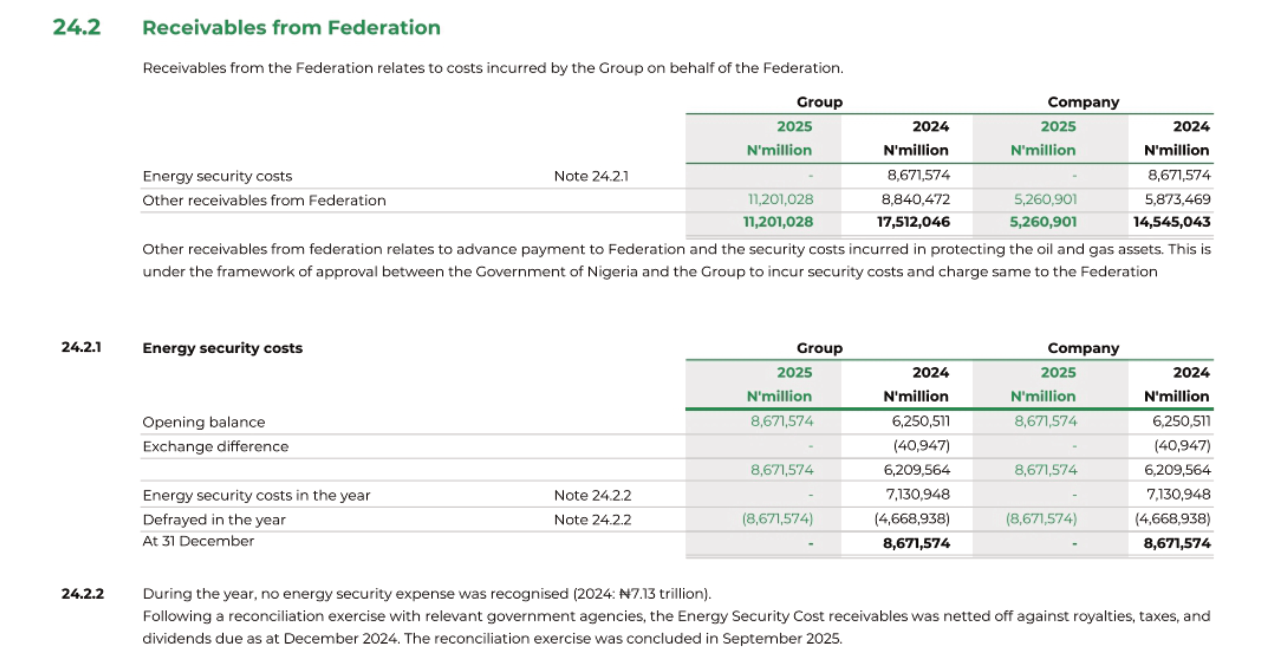
The N11.2 trillion is the line beside it. Note 24.2 lists "Other receivables from Federation" of N11,201,028 million at 31 December 2025, up from N8,840,472 million a year earlier, and says only that the line "relates to advance payment to Federation and the security costs incurred in protecting the oil and gas assets", under a framework of approval between the government and the company. The note does not say how much is advance payments and how much is security costs, and it does not mention pipelines. It is also a balance owed to NNPC at the year end, not spending in any one year. Security for oil and gas assets may include pipelines, but the accounts do not support describing the whole N11.2 trillion as "pipeline related spending".
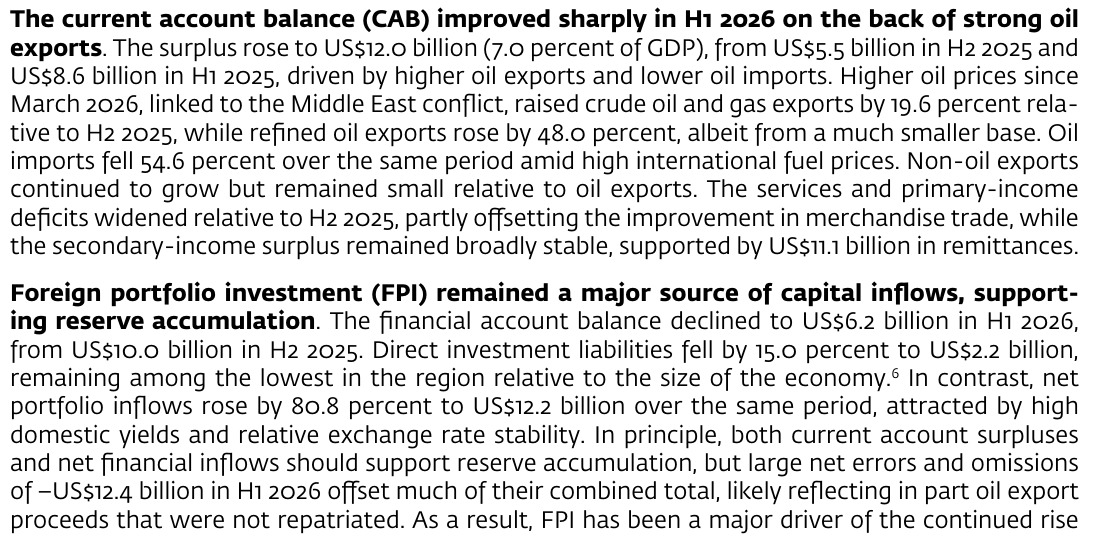
The US$12.4 billion is in the World Bank's update, on page 24. The current account surplus for the first half of 2026 was US$12.0 billion and the financial account balance US$6.2 billion, and "large net errors and omissions of -US$12.4 billion in H1 2026 offset much of their combined total, likely reflecting in part oil export proceeds that were not repatriated." The residual equals 68.1 per cent of the US$18.2 billion those two balances add up to. "Gap flagged in Nigeria's external accounts" is a fair description. The Bank's own wording, however, is "likely reflecting in part": it does not say how much, if any, is unrepatriated oil money. According to a report of its statement, published on 21 October, the Federal Ministry of Finance called the figure a statistical discrepancy, not evidence of missing funds, and said Nigeria had recorded a negative residual in seven of the previous eight years. Neither document establishes that money is missing.
The US$22.5 million could not be tested. On 4 November every page of the Debt Management Office's website, including documents Vero Record had downloaded from it in October, returned "404 Not Found", and the Internet Archive held no copy of the office's 2026 external debt service tables that Vero Record could find. Nairametrics reported on 26 September that the office's table for April to June 2026 lists "$22.50 million" in "other charges associated with a First Abu Dhabi Bank total return swap", which would match Atiku's figure. In his statement of 27 September Atiku asked the government to publish the agreement behind that charge, the amount drawn and what remains owed. Vero Record has not seen the table and does not rely on the reported figure.
Taken together, the records support Atiku on the direction and broad scale of the naira's fall, on the N7.13 trillion of 2024 energy security costs, on the US$12.4 billion residual, on the overlap of the 2024 and 2025 budgets and, read from a chart, on 63 per cent poverty in 2026. They put the naira's starting point about N10 lower than he did, and they do not describe NNPC's N11.2 trillion claim on the Federation as pipeline spending. His questions ask who received the energy security money and who must explain the external gap; the documents read here record the sums but do not answer those questions, and nothing in them suggests wrongdoing by anyone. The statement's remarks on insecurity and on the Abuja to Kaduna expressway were not tested.
What this rests on
Central Bank of Nigeria, daily official exchange rate series (US dollar rows, December 2001 to 3 November 2026), downloaded on 4 November 2026 from the data source of the Bank's Exchange Rates page (api/GetAllExchangeRates), with a screenshot of the same page filtered to the dates cited. World Bank, Nigeria Development Update, October 2026 (66 pages): p.24 (balance of payments), p.33 (poverty text and footnote 9) and p.34 (Figure 1.26). World Bank, Macro Poverty Outlook for Nigeria, October 2026, p.2. NNPC Ltd 2025 Annual Report, audited financial statements: accounting policy 2.6 (p.49) and Notes 24.2, 24.2.1 and 24.2.2 (p.106). State House release of 19 December 2025 on the 2026 budget presentation, downloaded on 4 November 2026. Arithmetic re-done: N471 - N461.06 = N9.94; N9.94 / N461.06 = 2.2 per cent. Fall in the naira's dollar value: 1 - 461.06 / 1,361.3394 = 66.1 per cent; 1 - 471 / 1,329 = 64.6 per cent; 1 - 461.06 / 1,329 = 65.3 per cent. N1,688.284 - N1,329 = N359.28. Figure 1.26 reading (red 'National poverty rate' line, PDF drawing coordinates in points): 2019 point at y = 274.467 (printed 40.1 per cent), 2028 point at y = 226.467 (printed 61.1 per cent), so 21.0 / 48.0 = 0.4375 percentage points per point; 2026 at y = 222.467 gives 40.1 + 52 x 0.4375 = 62.85 per cent; 2025 at y = 221.467 gives 40.1 + 53 x 0.4375 = 63.29 per cent; a raw reading against the axis (0 at y = 366.5, 70 at y = 206.5) gives 63.01 per cent for 2026. NNPC Note 24.2.1 (Group, N million): 6,250,511 - 40,947 = 6,209,564; 6,209,564 + 7,130,948 = 13,340,512; 13,340,512 - 4,668,938 = 8,671,574 at 31 December 2024; 8,671,574 - 8,671,574 = 0 at 31 December 2025. Note 24.2: 2024, 8,671,574 + 8,840,472 = 17,512,046; 2025, 0 + 11,201,028 = 11,201,028. World Bank p.24: US$12.0bn + US$6.2bn = US$18.2bn; US$12.4bn / US$18.2bn = 68.1 per cent; US$18.2bn - US$12.4bn = US$5.8bn. Count of figures: eight tested (N471, N1,329, 63 per cent, budget overlap, N7.13tn, N11.2tn, US$12.4bn, US$22.5m); five supported (N1,329, 63 per cent by chart reading, budget overlap, N7.13tn, US$12.4bn), two not (N471, N11.2tn as pipeline spending), one not checked (US$22.5m); 5 + 2 + 1 = 8.
What this does not establish
What source Atiku used for each figure; the statement as reported names none, and Vero Record did not obtain the statement as issued. Where "about N471" comes from: it matches no official Central Bank rate; Vero Record did not check parallel-market or other window rates for May 2023. The exact 2026 poverty value in the World Bank's chart, which the Bank does not print; 62.9 per cent is Vero Record's measurement. The IMF's 63 per cent estimate, as the IMF report could not be downloaded. How much of NNPC's N11,201,028 million is advance payments and how much is security costs, and whether any of it relates to pipelines. How much, if any, of the US$12.4 billion residual is unrepatriated oil money; neither the World Bank nor the Finance Ministry quantifies it, and the ministry's statement was seen only as reported. The US$22.5 million charge on the First Abu Dhabi Bank facility, because the Debt Management Office's website was unavailable on 4 November; the figure rests only on a press report. The remarks on insecurity and the Abuja to Kaduna expressway were not tested. Nothing in the records read suggests wrongdoing by any person or body.
What we did ourselves
Took the eight figures from Vanguard's report of Atiku's statement of 24 October and traced each to the record it rests on. Downloaded the Central Bank's full official exchange rate series and checked the US dollar rate for every day around the May 2023 handover and in September and October 2026, searched the whole series back to 2001 for any rate near N471, and recomputed the naira's fall on both his figures and the Bank's. Read the World Bank's October update and measured the 2026 value of its national poverty line from the PDF's drawing data, calibrated on the two values the Bank prints. Read NNPC's accounting policy and receivables notes and re-added the energy security movement. Re-added the World Bank's balance of payments figures. Tried and failed to retrieve the Debt Management Office's 2026 external debt service tables and the IMF's 2026 Article IV report.
Sources for this report
(A) Central Bank of Nigeria official daily exchange rate series (US dollar); World Bank, Nigeria Development Update, October 2026, pp.24, 33 and 34, and Macro Poverty Outlook for Nigeria, October 2026, p.2; NNPC Ltd 2025 Annual Report, audited financial statements, accounting policy 2.6 (p.49) and Notes 24.2 to 24.2.2 (p.106); State House release of 19 December 2025.
- Kaduna rally: Atiku challenges Tinubu over hunger, hardship · Vanguard · 24 October 2026
- Exchange Rates (official daily series, US dollar) · Central Bank of Nigeria · data to 3 November 2026
- Exchange rates data series (GetAllExchangeRates) · Central Bank of Nigeria · retrieved 4 November 2026
- Nigeria Development Update, October 2026: Beyond the Federal Purse, How Higher Revenues Shaped State Priorities · World Bank · October 2026
- Macro Poverty Outlook for Nigeria, October 2026 · World Bank · October 2026
- NNPC Limited 2025 Annual Report (audited financial statements) · NNPC Ltd · September 2026
- President Tinubu Presents N58.18 Trillion 2026 Appropriation Bill, Vows Stronger Discipline In Budget Execution · State House · 19 December 2025
- Atiku accuses Tinubu of excessive borrowing as debt hits N166.79tn · The Guardian · 27 September 2026
- Nigeria's external debt service falls to $870.7 million in Q2 2026 · Nairametrics · 26 September 2026
- Nigeria Denies Missing $12.4bn in Oil Revenue, Cites Statistical Discrepancy · Nigeria Housing Market · 21 October 2026
- Nigeria's Actual External Debt Service Payments in 1st Quarter, 2026 (site returned 404 on 4 November 2026) · Debt Management Office · 2026
Confidence: high. This is our own assessment of whether the event occurred as described, separate from the grade, which describes what kind of thing the claim rests on.
Not obtained: where the underlying document is named above but not linked, we did not hold a copy at the time of publication. We purchase nothing and request nothing in our own name.
Corrections
None on this report. If you find an error, it will be published here, at the same length, with the date it was found, and the original wording will remain visible above it.
Dr VeroInvestigations editor, Vero Record
Reads the Nigerian public record that others leave unread: budgets, audit reports, court files and registers. Every claim on this page carries the grade of the document behind it, and the report says what that document does not establish.
All 169 reportsHow we grade evidenceAdd Vero Record as a preferred source on Google