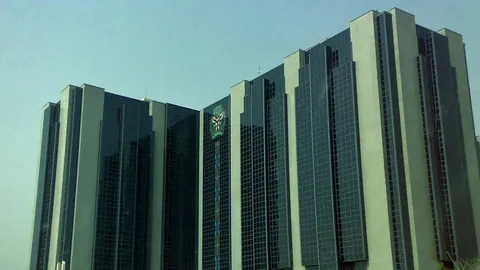
Fitch keeps Nigeria at 'B' and turns its Outlook to Positive; its debt forecast fell from about 38 to 32 per cent between April and October
Fitch's 9 October commentary affirms Nigeria at 'B' and moves the Outlook to Positive, citing expected policy continuity after the 2027 elections, stronger reserves, lower inflation and higher oil output. The Finance Ministry's statement quotes Fitch's figures accurately. But Fitch's own April review expected a 2026 deficit of nearly 5 per cent of GDP and debt of about 38 per cent; October's forecasts are 3.6 per cent and a 2026 to 2028 average of 32 per cent. The World Bank's October update agrees with the new deficit forecast but puts public debt near 40 per cent, on a wider definition.
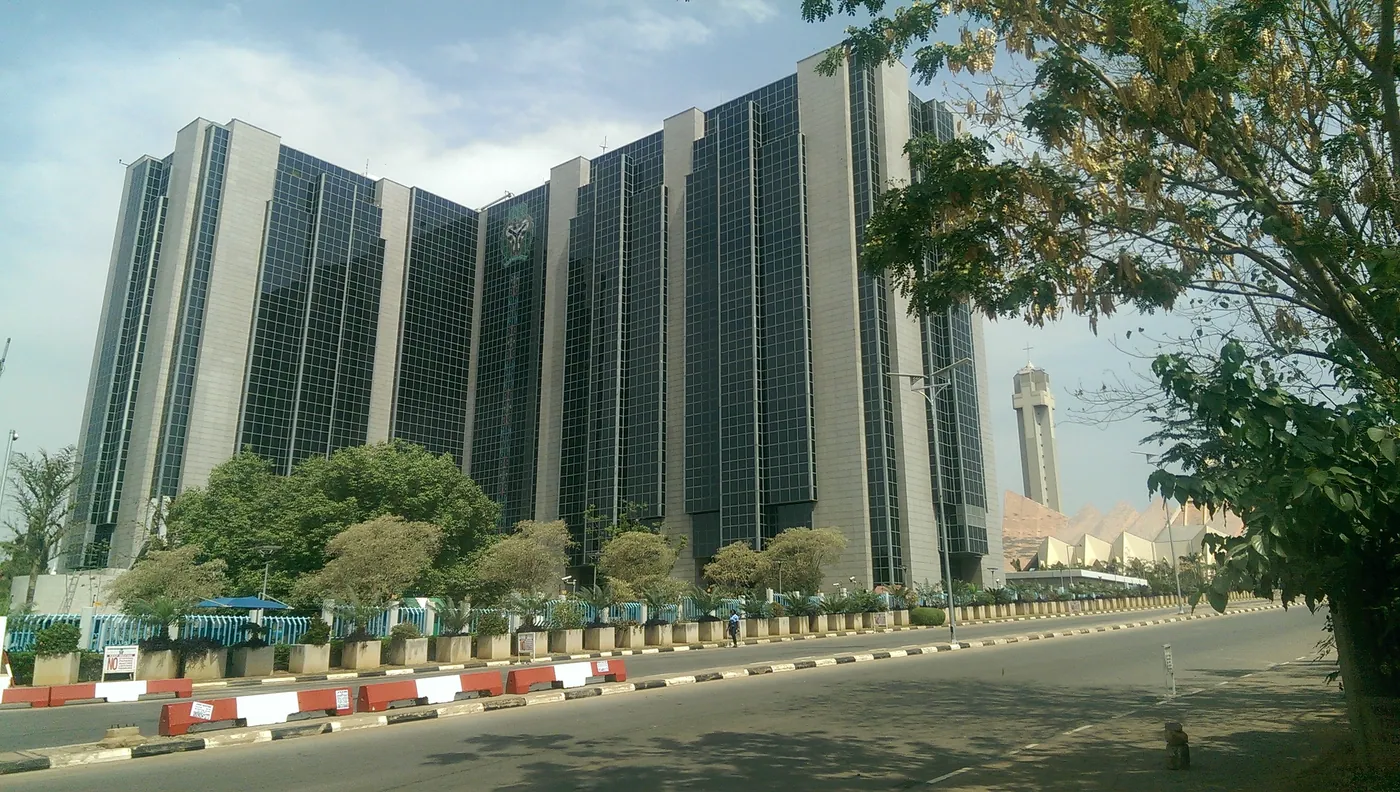
When Fitch Ratings changed its Outlook on Nigeria to Positive on 9 October 2026, the rating itself did not move. It stays at 'B', five steps below the lowest investment grade. What moved, in the 182 days since Fitch's previous review on 10 April, were the agency's own forecasts. In April it expected the general government deficit to widen to "nearly 5%" of GDP in 2026 and debt to stay at about 38 per cent of GDP. In October it puts the 2026 deficit at 3.6 per cent and writes that debt "will decline and average 32% in 2026-2028". The Federal Ministry of Finance quoted the 32 per cent figure in its statement of 12 October, accurately, as part of the case that reform is working. The World Bank's Nigeria Development Update, published days earlier, projects public debt of 38.1, 40.6 and 38.9 per cent of GDP for the same three years.
The rating action commentary, published in London at 17:02 New York time on 9 October, affirms all six of Nigeria's Fitch ratings at 'B': the long-term and short-term issuer default ratings in foreign and local currency, the Country Ceiling and the senior unsecured bonds, which carry a Recovery Rating of 'RR4'. Fitch's rating definitions page classes 'BB' to 'D' as speculative grade and 'AAA' to 'BBB' as investment grade; from 'B', the steps up to 'BBB-' are 'B+', 'BB-', 'BB', 'BB+' and 'BBB-'. An Outlook is not a rating. The commentary sets out what could lead to an upgrade and what could lead to a downgrade. The ministry's own statement describes it fairly: "A Positive Outlook signals that the rating could be raised if current trends are sustained."
Fitch gives four reasons for the Outlook revision, all with "Medium" weight. The first is "Expected Policy Continuity": "The incumbents are well positioned to win the early 2027 elections due to the ruling party's control of the majority of Nigeria's 36 states and a fragmented opposition." The others are stronger external buffers, a restrictive monetary stance with lower inflation, and higher oil production and refining. Gross reserves, it writes, rose to USD54.9 billion on 25 September 2026 from USD32 billion in mid-April 2024, a rise of USD22.9 billion. Crude production excluding condensates "has met Nigeria's 1.5mbpd OPEC target since May 2026, averaging 1.52mbpd". It credits the Dangote refinery's ramp-up and the rehabilitation of other facilities with reducing refined oil imports and demand for foreign exchange.
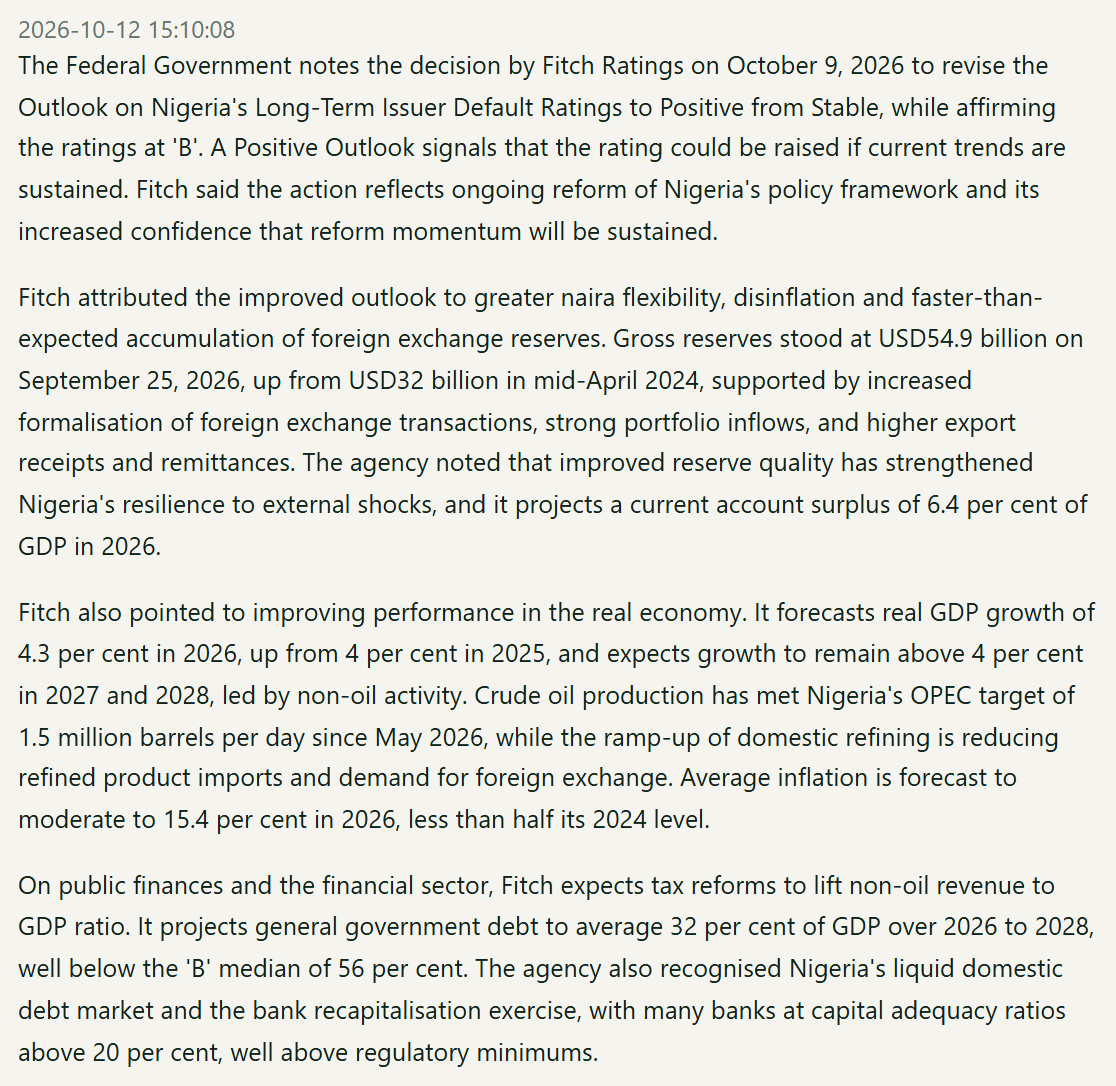
Set against the commentary claim by claim, the ministry's statement holds up. Its figures for reserves (USD54.9 billion), the 2026 current account surplus (6.4 per cent of GDP), growth (4.3 per cent in 2026 after 4 per cent in 2025), oil output, inflation (15.4 per cent), debt (32 per cent against a 'B' median of 56 per cent) and bank capital (many banks above 20 per cent) all match Fitch's text. It also names three of Fitch's constraints: inflation above peers, low revenue, and interest costs that "absorb a high share of that revenue". One sentence differs. The ministry writes that Fitch has "increased confidence that reform momentum will be sustained". Fitch's sentence ends "will not be disrupted by upcoming elections", and its first driver is its reading of the election. The statement does not mention the election, the deficit forecast, the USD5 billion total return swap, or Fitch's estimate that the federal government's interest bill stays above 50 per cent of its revenue.
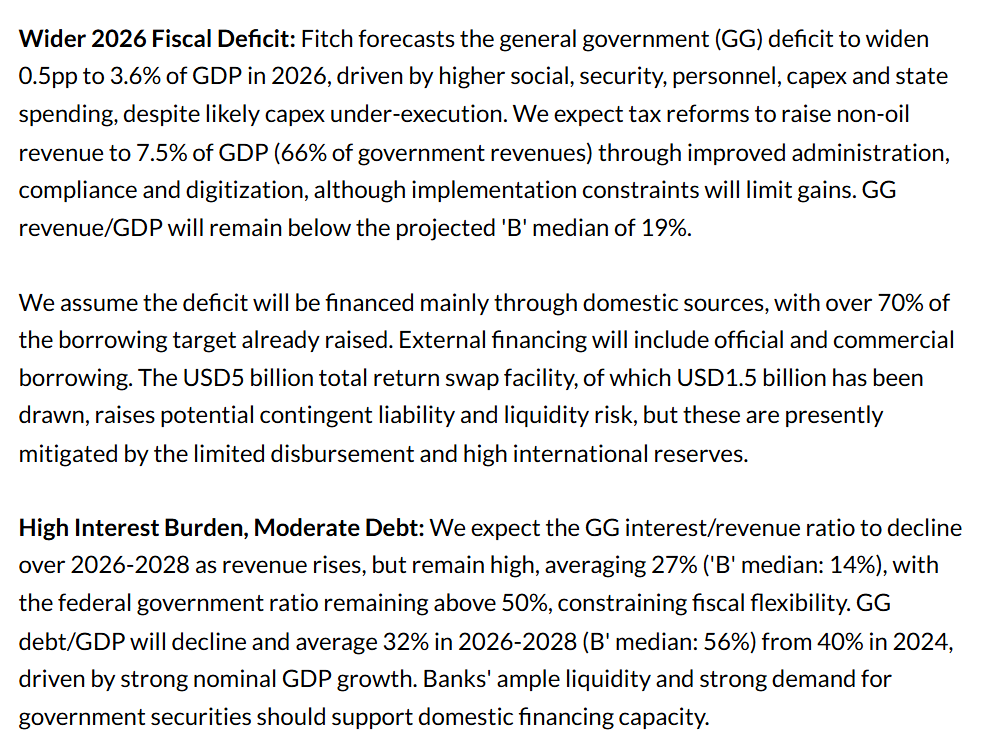
The April commentary is still on Fitch's website, and the two read differently on public finances. In April, Fitch forecast the general government deficit to "widen to nearly 5% in 2026"; in October, to "widen 0.5pp to 3.6%". In April, it expected debt, "which declined 0.7pp to 38% in 2025, to remain at a similar level in 2026"; in October, it expects debt to "average 32% in 2026-2028" from 40 per cent in 2024, "driven by strong nominal GDP growth". The interest-to-revenue forecast fell from an average of 33 per cent to 27 per cent. Growth for 2026 rose from 4.1 to 4.3 per cent, and average inflation fell from "about 16%" to 15.4 per cent. The 'B' medians Fitch compares Nigeria with moved as well: debt from 51 to 56 per cent, revenue from 17.4 to 19 per cent, interest from 12 to 14 per cent of revenue and inflation from 5.5 to 5.6 per cent.
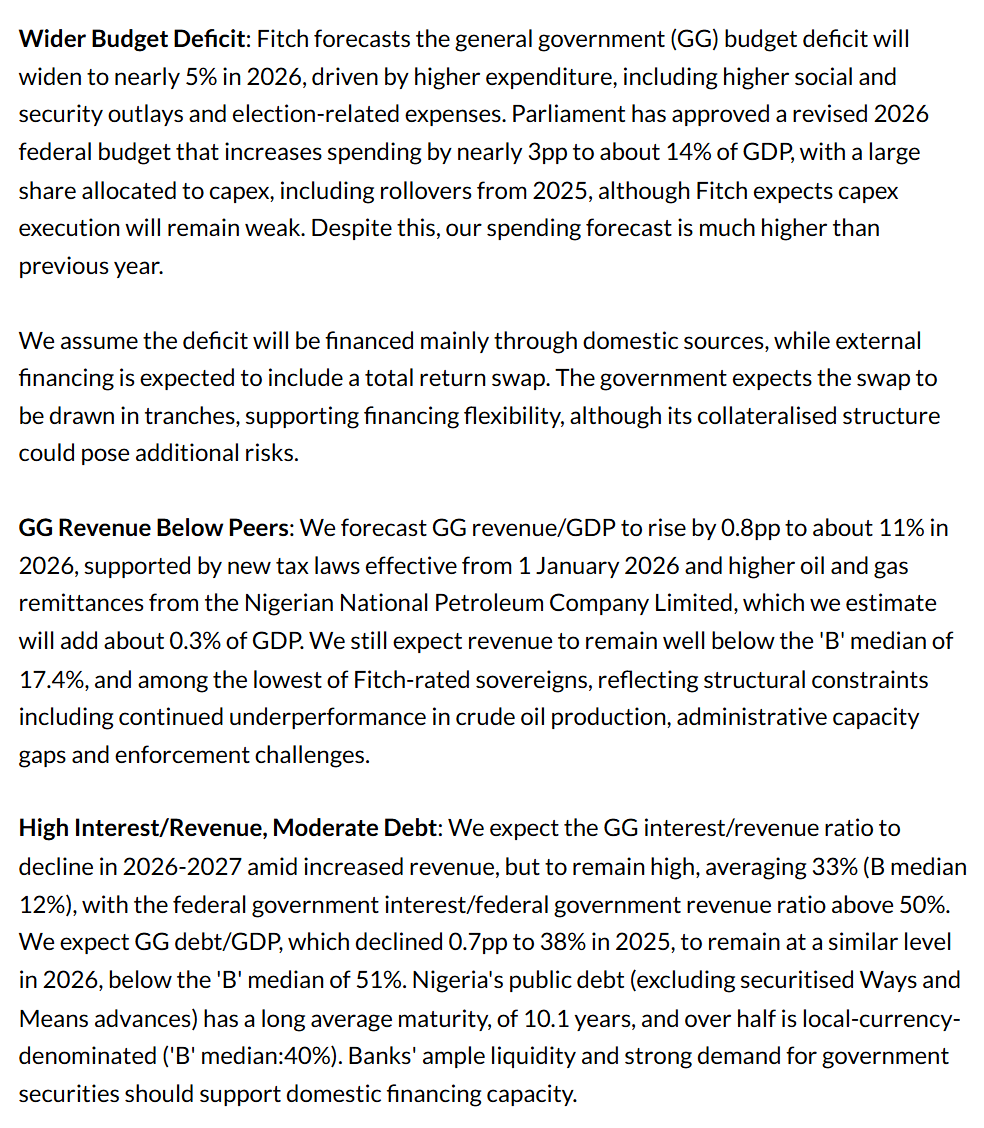
The October commentary does not give the year-by-year path behind the 32 per cent average, and it does not explain the change from April. For three years to average 32 per cent, the ratio has to sit, on average, six points below the 38 per cent Fitch gave for 2025. The two commentaries also start from slightly different places: April's "declined 0.7pp to 38%" implies roughly 38.7 per cent for 2024, while October gives 40 per cent for 2024. Rounding may explain part of that gap, but not all of it. Fitch states in both commentaries why it has to make such estimates at all: "Nigeria does not publish consolidated fiscal data on a general government basis", so the agency builds its own figures from federal, state and local data published by the NNPC, the Central Bank, the Debt Management Office, the Budget Office and the National Bureau of Statistics.
The World Bank builds its own consolidated figures too, and on debt it reaches a different answer. Annex 1 of its October update gives public debt of 42.7 per cent of GDP in 2024, 40.0 per cent in 2025 and 38.1, 40.6 and 38.9 per cent in 2026 to 2028, an average of 39.2 per cent, 7.2 points above Fitch's 32. Its text says public debt "is expected to stay broadly stable at around 40 percent of GDP during 2026-28". The two measures are not the same. The Bank's footnote says its figure "includes remaining ways and means stock, AMCON liabilities, and explicit guarantees including the electricity subsidy arrears"; Fitch's October commentary does not define what its general government debt covers. The gap between them was about two points for 2025 (40.0 against 38) and is about seven for 2026 to 2028. Both sets of figures sit well below the 'B' median of 56 per cent that Fitch and the ministry cite.
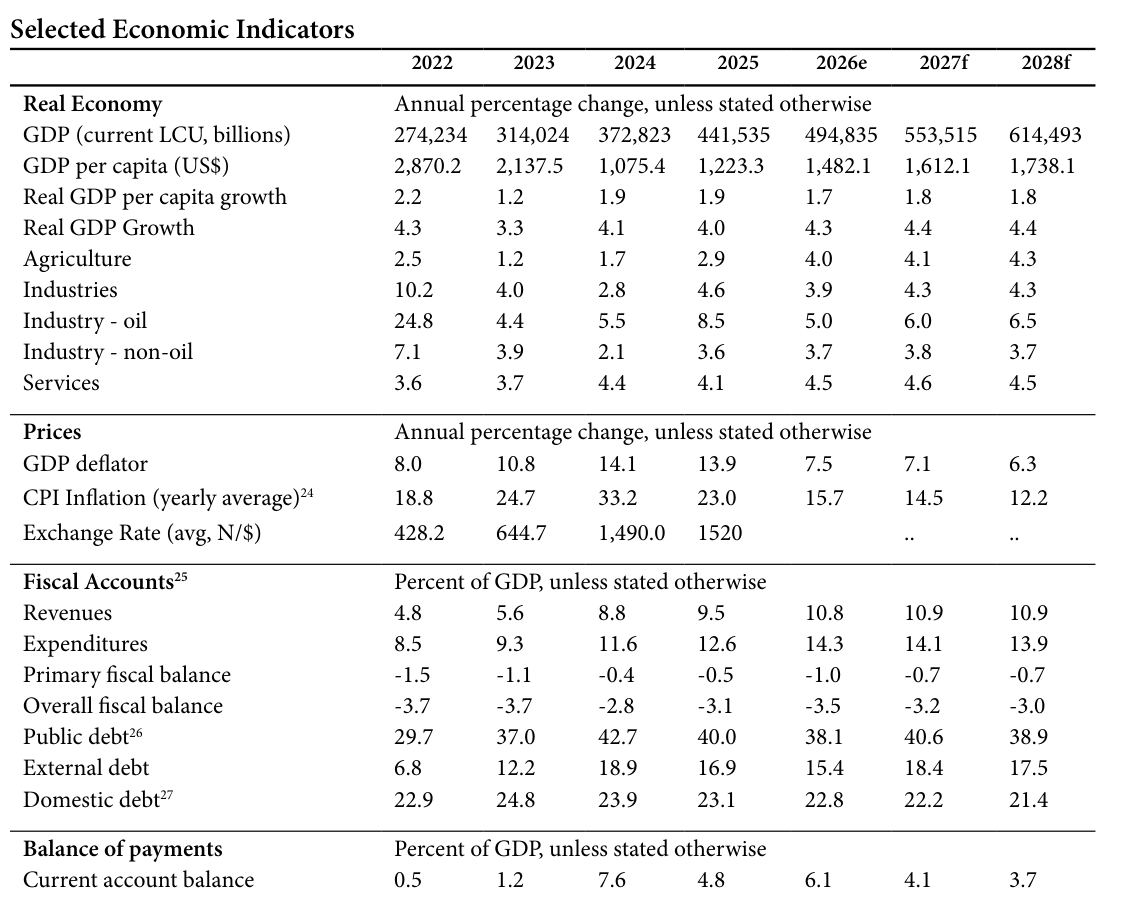
On most other figures, the World Bank's update supports Fitch's October numbers, and with them the ministry's. It projects a consolidated deficit widening "from 3.1 percent of GDP in 2025 to 3.5 percent in 2026", against Fitch's 3.6 per cent, also up from 3.1. It projects growth of 4.3 per cent in 2026, the same as Fitch, average inflation of 15.7 per cent against Fitch's 15.4, a current account surplus of 6.1 per cent of GDP against 6.4, and revenue of 10.8 per cent of GDP; Fitch's October figures imply about 11.4 per cent (non-oil revenue of 7.5 per cent of GDP being 66 per cent of the total). The Bank recorded gross reserves of USD53.8 billion at end-August, consistent with Fitch's USD54.9 billion on 25 September. Against both, Fitch's April deficit forecast of nearly 5 per cent is the outlier.
On reserves, Fitch's April forecast was USD47 billion at end-2026; the USD54.9 billion of 25 September is USD7.9 billion above it, which is what the commentary means by "faster-than-expected FX reserve accumulation". On net reserves the documents stop at the end of 2025. Fitch writes that the Central Bank "stated net FX reserves at USD34.8 billion at end-2025", and the World Bank that "No net reserves estimate is available beyond the US$34.8 billion reported at end-2025". Nairametrics reported on 10 October that the Central Bank Governor, Olayemi Cardoso, had put net reserves at USD46 billion, which would be USD11.2 billion more; neither Fitch's commentary nor the World Bank's update contains that figure, and it has not been checked against a Central Bank publication for this report. Both documents flag the same weakness: Fitch calls large net errors and omissions "a source of uncertainty", and the Bank puts them at minus USD12.4 billion in the first half of 2026.
One comparison in the commentaries needs care. In April, Fitch expected inflation to average about 16 per cent in 2026 "from 23% in 2024". In October, it describes 15.4 per cent as "less than half the 2024 level", and the ministry repeats the comparison. The World Bank's table, which uses the re-referenced consumer price series, gives 33.2 per cent for 2024 and 23.0 per cent for 2025. On those figures the October claim holds, since half of 33.2 is 16.6. The April commentary's 23 per cent matches the Bank's figure for 2025, not 2024. Oil figures are also measured differently: Fitch counts crude without condensates, at 1.52 million barrels a day since May, while the Bank counts crude and condensates together, at 1.63 million barrels a day in the first half of 2026 against 1.68 million a year earlier.
The Outlook also follows a change in Fitch's model. In April, its Sovereign Rating Model scored Nigeria at 'B-', and the rating committee added one notch for "improved confidence in the authorities' broad commitment to improving policy coherence and credibility" to reach 'B'. In October, the model alone scores Nigeria at 'B', and Fitch "has removed the +1 notch" because the score "now fully captures the impact of macroeconomic policy improvements". The model uses 18 variables on three-year centred averages, including one year of forecasts, so revised forecasts feed into the score. The commentary does not say which variables moved. The rating is the same 'B'; what holds it there has shifted from the committee's judgement to the model's output.
Fitch's list of risks is longer than the ministry's. Among its downgrade triggers is a "sustained widening of the fiscal deficit that significantly increases debt/GDP burden". It warns that "persistently high inflation, further pump price increases and heightened security risk could weaken household income", which bears on this week's argument over fuel prices. It describes the USD5 billion total return swap, of which USD1.5 billion has been drawn, as raising "potential contingent liability and liquidity risk", mitigated for now by limited drawing and high reserves. It places Nigeria at the 20th percentile of the World Bank's governance indicators. Among its upgrade triggers are "reforms that strengthen the structure and transparency of public finances including stronger mobilization of domestic non-oil revenue". The ministry's statement mentions the revenue part of that trigger, but not the transparency part.
The documents do not establish why Fitch's debt and deficit forecasts changed so much between April and October, what its general government debt figure covers, or how much of the seven-point gap with the World Bank is down to definitions. Fitch, the ministry and the World Bank were not asked for comment for this report; the figures above are their own, set against each other. Fitch's full rating definitions report, which sets out formally what an Outlook means, sits behind a registration page and was not read. The ministry's statement that S&P upgraded Nigeria in May and Moody's moved its Outlook to Positive in August was not checked against those agencies' own texts.
What this rests on
Four primary texts, each retrieved and read for this report on 13 October 2026: Fitch Ratings, "Fitch Revises Nigeria's Outlook to Positive; Affirms at 'B'" (rating action commentary, London, 9 October 2026), and "Fitch Affirms Nigeria at 'B'; Outlook Stable" (10 April 2026), both rendered in full from fitchratings.com without logging in and saved as text; the Federal Ministry of Finance statement on the Fitch decision, signed by Taiwo Oyedele and posted on finance.gov.ng at 15:10 on 12 October 2026; and the World Bank's Nigeria Development Update, October 2026 (66 pages), executive summary p.11, pp.19, 24, 31 and 35 and Annex 1 p.62; plus Fitch's rating definitions page for the investment and speculative grade bands. Arithmetic re-done: 10 April to 9 October 2026 is 20 + 31 + 30 + 31 + 31 + 30 + 9 = 182 days. Reserves USD54.9bn - USD32bn = USD22.9bn; USD54.9bn - USD47bn (April end-2026 forecast) = USD7.9bn. Net reserves reported for Cardoso USD46bn - USD34.8bn = USD11.2bn. Deficit: 3.1 + 0.5 = 3.6 per cent (Fitch October); World Bank 3.1 to 3.5 per cent. Fitch April implied 2024 debt: 38 + 0.7 = 38.7 per cent, against 40 per cent in the October text. Average gap: 38 - 32 = 6 points. World Bank public debt 2026 to 2028: 38.1 + 40.6 + 38.9 = 117.6, divided by 3 = 39.2 per cent; 39.2 - 32 = 7.2 points; 2025 gap 40.0 - 38 = 2.0 points. World Bank external plus domestic debt: 2025 16.9 + 23.1 = 40.0; 2027 18.4 + 22.2 = 40.6; 2028 17.5 + 21.4 = 38.9; 2026 15.4 + 22.8 = 38.2 against 38.1 printed (rounding). Fitch implied revenue 7.5 / 0.66 = 11.36 per cent of GDP. Inflation: half of 33.2 = 16.6, above 15.4. Steps from 'B' to 'BBB-': B+, BB-, BB, BB+, BBB- = 5. Fitch April against October: deficit nearly 5 against 3.6; debt 38 (2026) against 32 (2026 to 2028 average); interest/revenue 33 against 27; growth 4.1 against 4.3; inflation about 16 against 15.4; 'B' medians debt 51 against 56, revenue 17.4 against 19, interest 12 against 14, inflation 5.5 against 5.6. Sovereign Rating Model: April 'B-' plus one notch; October 'B' with no adjustment.
What this does not establish
Why Fitch's forecasts for the 2026 deficit and for debt fell between April and October, what its general government debt figure includes, and how much of the gap with the World Bank's figure (which includes the remaining Ways and Means stock, AMCON liabilities and explicit guarantees) is a matter of definition. The year-by-year path behind Fitch's 32 per cent average. Which of the 18 model variables moved Nigeria's model score from 'B-' to 'B'. Whether the Central Bank's reported net reserves of USD46 billion are correct; that figure comes from a press report and was not found in either Fitch's or the World Bank's text. The ministry's statements about S&P and Moody's, which were not checked against those agencies' own publications. Fitch's formal Outlook definition, which is in a report behind a registration page. Whether Fitch will raise the rating; an Outlook is not a rating change. Nothing in the documents suggests wrongdoing by anyone, and none is alleged. Fitch, the ministry and the World Bank were not asked for comment.
What we did ourselves
Rendered both Fitch commentaries from Fitch's public site and set the October text against the April text, driver by driver and figure by figure. Compared each claim in the Finance Ministry's statement with the October commentary's wording. Set Fitch's October figures against the World Bank's October 2026 annex for debt, deficit, growth, inflation, current account, revenue and reserves, re-added the Bank's debt components and three-year average, and checked the two commentaries' 2024 starting points for debt and inflation against each other and against the Bank's series. Compared the Sovereign Rating Model disclosures in both commentaries.
Sources for this report
(A) Fitch Ratings, rating action commentary "Fitch Revises Nigeria's Outlook to Positive; Affirms at 'B'", 9 October 2026, and "Fitch Affirms Nigeria at 'B'; Outlook Stable", 10 April 2026; Federal Ministry of Finance statement on the Fitch decision, 12 October 2026; World Bank, Nigeria Development Update October 2026, Annex 1 (p.62) and pp.11, 19, 24, 31 and 35.
- Fitch Revises Nigeria's Outlook to Positive; Affirms at 'B' (rating action commentary) · Fitch Ratings · 9 October 2026
- Fitch Affirms Nigeria at 'B'; Outlook Stable (rating action commentary) · Fitch Ratings · 10 April 2026
- Fitch Revises Nigeria's Outlook to Positive, Affirms 'B' Rating, Citing Reform Momentum, Stronger External Buffers and Disinflation · Federal Ministry of Finance (Taiwo Oyedele) · 12 October 2026
- Nigeria Development Update, October 2026 (66 pages) · World Bank · October 2026
- Rating Definitions · Fitch Ratings · accessed 13 October 2026
- Fitch revises Nigeria's credit outlook to positive, affirms 'B' rating · Nairametrics · 10 October 2026
- Citing Policy Reforms, Stronger External Buffers, Fitch Revises Nigeria's Outlook to Positive, Affirms 'B' Rating · ThisDay · 11 October 2026
- Fitch Revises Nigeria's Credit Outlook To Positive · Voice of Nigeria · 10 October 2026
Confidence: high. This is our own assessment of whether the event occurred as described, separate from the grade, which describes what kind of thing the claim rests on.
Not obtained: where the underlying document is named above but not linked, we did not hold a copy at the time of publication. We purchase nothing and request nothing in our own name.
Corrections
None on this report. If you find an error, it will be published here, at the same length, with the date it was found, and the original wording will remain visible above it.

Dr VeroInvestigations editor, Vero Record
Reads the Nigerian public record that others leave unread: budgets, audit reports, court files and registers. Every claim on this page carries the grade of the document behind it, and the report says what that document does not establish.
All 115 reportsHow we grade evidenceAdd Vero Record as a preferred source on Google