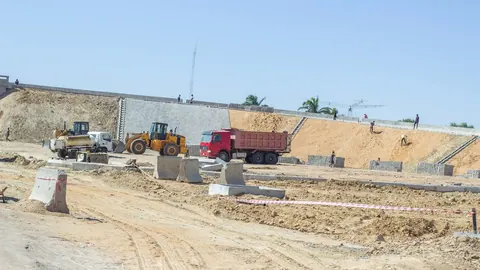
Onanuga says investors are returning mainly as FDI. The latest NBS capital table puts FDI at US$135.08m, 1.30 per cent of US$10.37bn
On 16 October the President's adviser wrote that investors were coming back "not mainly as portfolio investors" but as foreign direct investment. The National Bureau of Statistics' latest capital importation report puts portfolio money at 95.09 per cent of the US$10.37 billion that came in during the first quarter of 2026, and direct investment at 1.30 per cent. The same post put the reserves "close to $60 billion"; the central bank's count that day was US$55.09 billion, US$4.91 billion short. His stock market figure holds.
Shortly after midnight on 16 October, Bayo Onanuga, President Tinubu's Special Adviser on Information and Strategy, posted a defence of the government's economic record on X. Answering television presenters who, he said, were "parroting the old narrative", he wrote: "Investors are coming back, not mainly as portfolio investors, as some anchors claim, even though Nigerians dominate the stock market, accounting for almost 90 per cent. These investors belong in the category of FDI. They bring money into our economy and create jobs." The most recent official count of money coming into Nigeria is the National Bureau of Statistics report on capital importation for the first quarter of 2026, published in June. On page 4 it puts the total at US$10,371.90 million: portfolio investment US$9,862.34 million, or 95.09 per cent, other investment US$374.48 million, or 3.61 per cent, and foreign direct investment US$135.08 million, or 1.30 per cent. The three parts add to the total.
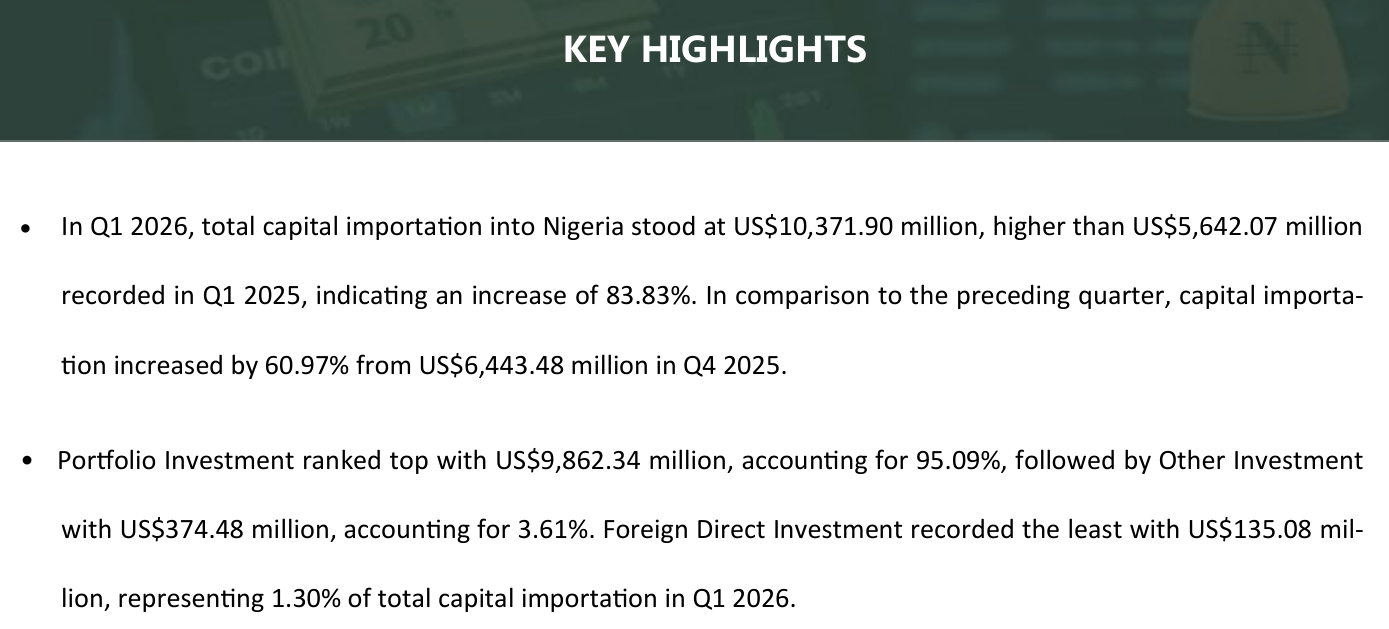
The bureau's breakdown on page 5 shows what the portfolio money bought. Of the US$9,862.34 million, US$6,504.52 million went into money market instruments, US$3,226.01 million into bonds and US$131.81 million into shares; the three add to US$9,862.34 million. Money market instruments alone made up 62.71 per cent of all the capital imported in the quarter. The foreign direct investment figure of US$135.08 million is US$120.34 million of equity and US$14.74 million of other capital, and it was 62.25 per cent lower than in the last quarter of 2025. Portfolio inflows in the quarter were 73.01 times the direct investment inflows.
The pattern is not confined to one quarter. Table 1 of the workbook published with the report gives every quarter since 2013. Across the eleven quarters from July 2023, the first full quarter of the Tinubu administration, to March 2026, capital importation came to US$47,658.18 million. Foreign direct investment accounted for US$1,976.54 million of it, or 4.15 per cent, and portfolio investment for US$38,382.61 million, or 80.54 per cent. In none of the eleven quarters did direct investment exceed portfolio investment; its highest share was 16.90 per cent, in the last quarter of 2023, and its lowest 1.15 per cent, in the second quarter of 2024. When this report was prepared, the bureau's catalogue listed no capital importation report later than the first quarter of 2026.
The same table supports part of what Mr Onanuga says. Direct investment inflows have risen in each full year of the administration: US$377.38 million in 2023, US$674.71 million in 2024 and US$923.01 million in 2025, the last being the sum of four quarters of US$126.29 million, US$142.67 million, US$296.25 million and US$357.80 million. The first quarter of 2026 was 6.96 per cent above the first quarter of 2025. The bureau also notes, on page 3, that its figures capture "fresh capital coming into the economy reported by commercial banks (does not include other components of FDI such as reinvested earnings)", so direct investment measured on a wider definition may be larger. Many of the 19 investments Mr Onanuga listed on X on 24 October, as reported by Naija News, are commitments or decisions still to come, which no inflow table would yet record. On the bureau's own measure, though, the investors arriving so far have come overwhelmingly as portfolio investors, and direct investment in 2025 was well under half the US$2,277.04 million recorded in 2014.
The 16 October post also said: "Our reserves are close to $60 billion." The Central Bank of Nigeria publishes its gross external reserves for each working day on its website, under a heading that describes the series as a 30-day moving average. It put the reserves at US$55,089,305,676.07 on 15 October, the day before the post, and at US$55,093,661,502.41 on 16 October. That is US$4,910,694,323.93 short of US$60 billion; the reserves would have had to rise by a further 8.91 per cent to reach it. The highest figure in the series up to 29 October was US$55,264,277,158.76, on 27 October.
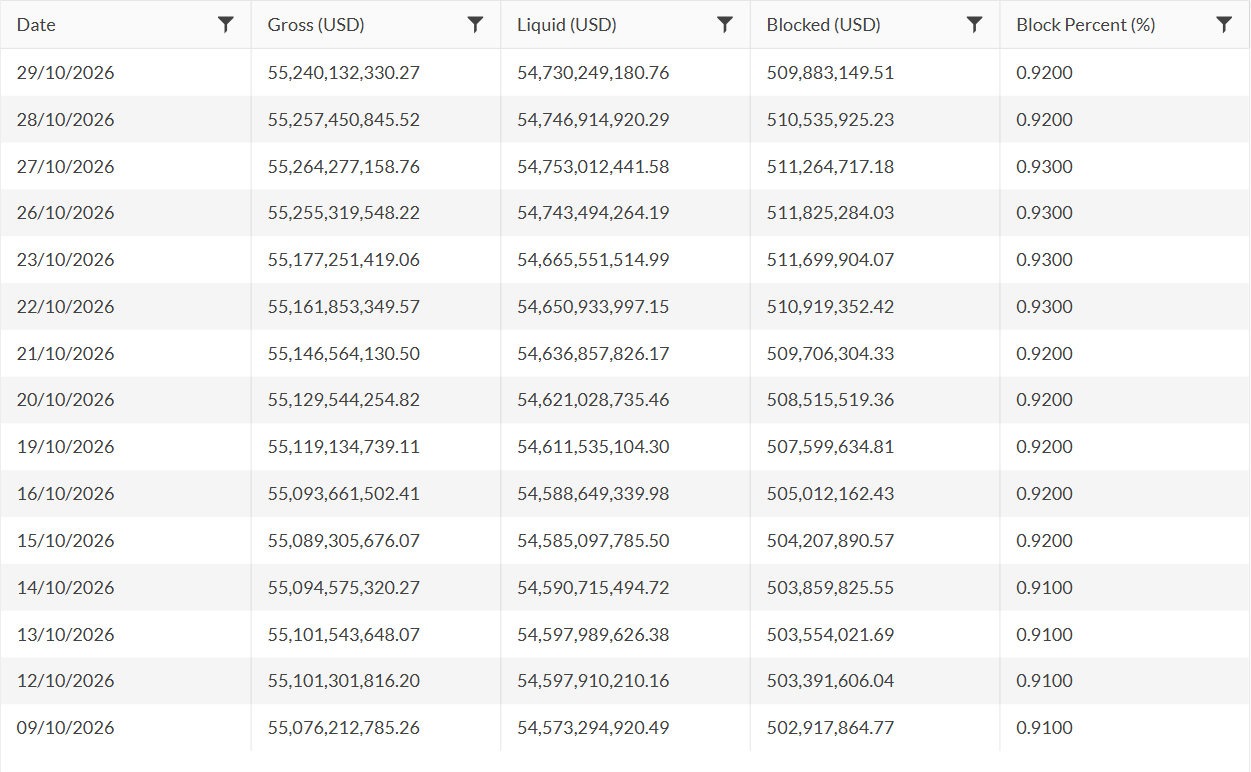
Mr Onanuga's own office used the central bank's figure thirteen days later. A State House statement of 29 October, issued over his name and summarising an essay by the President, says "gross external reserves rose to $55.1 billion as of October 9, 2026, including about $46 billion in net reserves". The central bank's series gives US$55,076,212,785.26 for 9 October, which rounds to US$55.1 billion. The statement's gross figure matches the record; the net figure of about US$46 billion does not appear in the central bank's daily series, which shows only gross, liquid and blocked amounts.

On the reserves themselves, the record is on the government's side. The last figure before the inauguration of 29 May 2023 was US$35,147,391,756.74, on 26 May 2023; the figure for 15 October 2026 is US$19,941,913,919.33, or 56.74 per cent, higher. A year earlier, on 15 October 2025, the series stood at US$42,669,615,589.17, so the reserves rose by US$12,419,690,086.90, or 29.11 per cent, in twelve months. They passed US$55 billion on 7 October 2026 for the first time since 18 December 2008. The last day the series stood at US$60 billion or more was 12 November 2008.
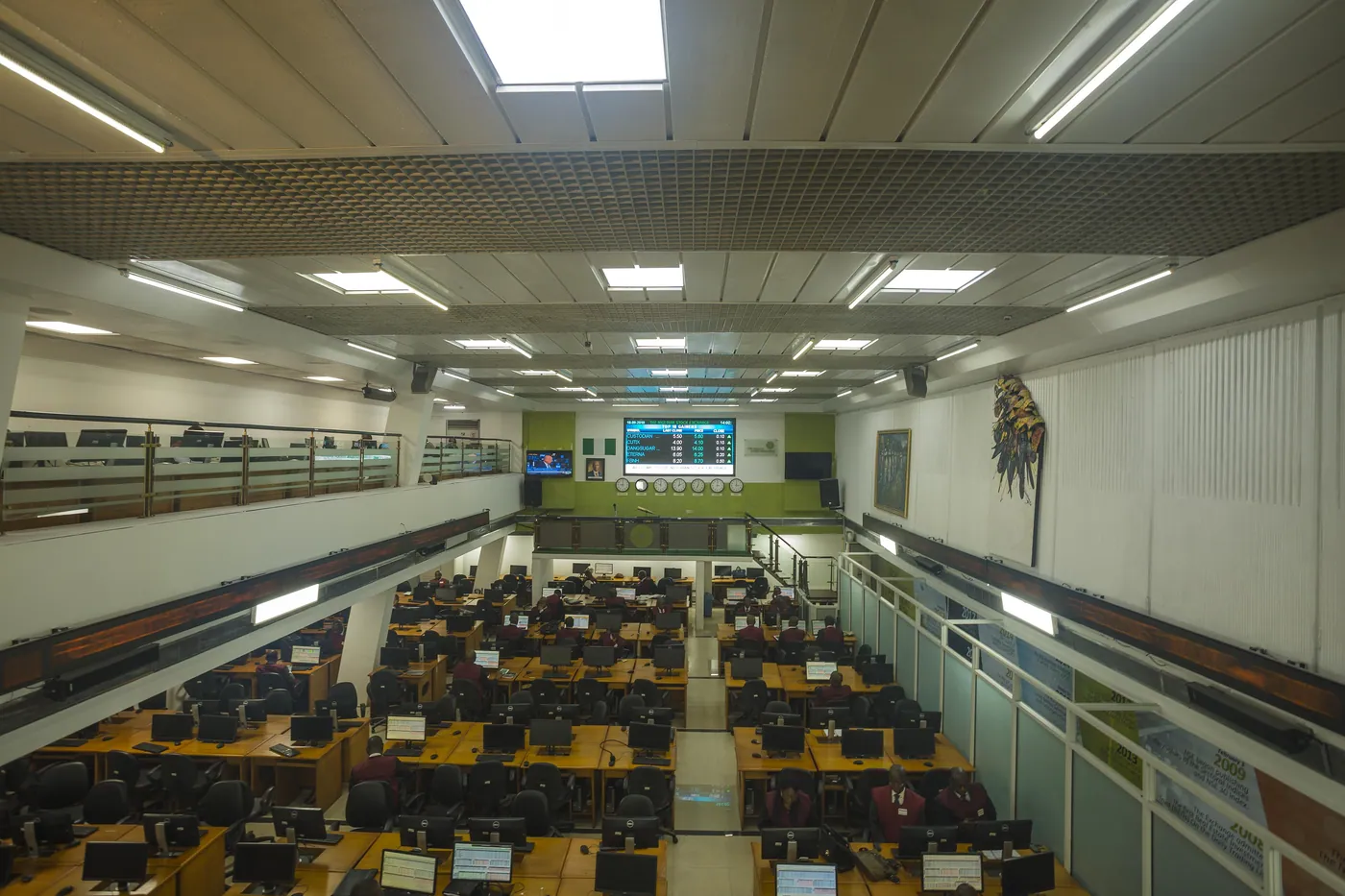
The stock market figure in the post is also borne out. The Nigerian Exchange's Domestic and Foreign Portfolio Investment Report for August 2026, the latest available when Mr Onanuga wrote, puts total equity trading from January to August at N13.24570 trillion. Domestic investors accounted for N11.89088 trillion of it, or 89.77 per cent, and foreign investors for N1.35482 trillion, or 10.23 per cent; the two add to the total. In the same months of 2025 the domestic share was 78.99 per cent. Most of the change came from domestic trading, which grew 2.18 times, from N5.46350 trillion; foreign trading fell 6.76 per cent, from N1.45310 trillion.
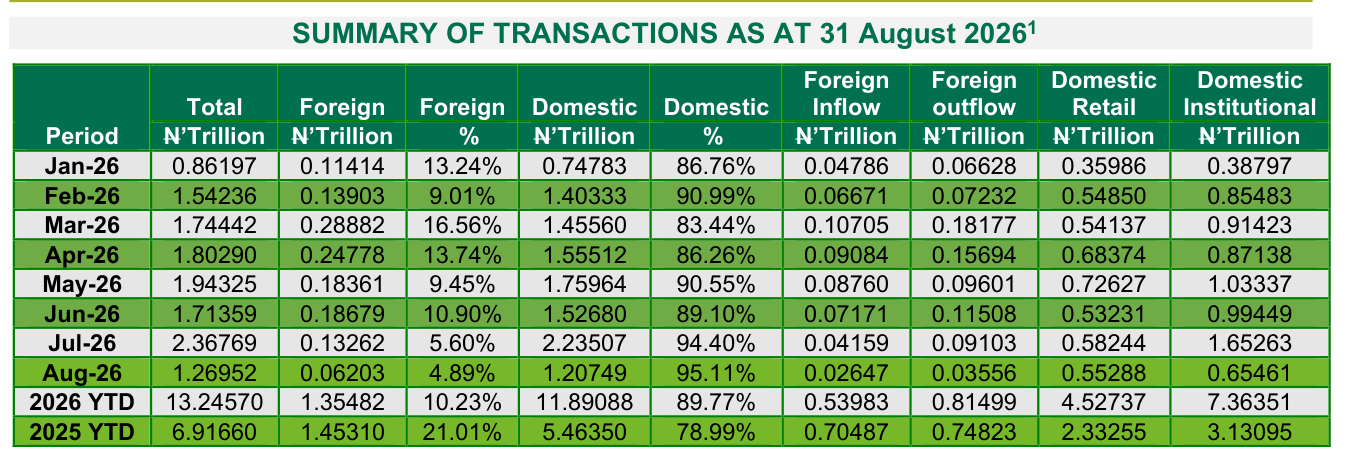
The same table records that foreign investors sold more Nigerian shares than they bought. Foreign outflows from January to August were N0.81499 trillion and inflows N0.53983 trillion, leaving net foreign selling of N0.27516 trillion. That fits the bureau's figures, in which only US$131.81 million of the first quarter's US$9,862.34 million in portfolio money went into shares. The two records measure different things, one equity trades on the exchange and the other money reported by banks as it enters the country, and they cannot be added together. Both point the same way: the large foreign inflows of 2026 have gone mainly into money market instruments and bonds rather than into shares or into new businesses.
Other claims in the post were not tested. Mr Onanuga wrote that a favourite brand of rice that once sold for N120,000 a bag "has crashed below N50k" and sells for N45,000 in his hometown, that Nigerians can now use naira cards abroad, that businesses can now buy the foreign exchange they need, and that "Thirty-three governors cannot be wrong" in supporting the President. His defence of the inflation data does stand on the bureau's record: its September 2026 consumer price report gives headline inflation of 14.63 per cent, against 20.98 per cent in September 2025, the same two figures the 29 October statement uses.
Taken together, the documents back two of the three measurable claims in the post and contradict the third. Reserves have risen by more than half since May 2023, though to about US$55.1 billion rather than close to US$60 billion, and domestic investors do account for almost 90 per cent of trading on the exchange. The claim that returning investors "belong in the category of FDI" and are not mainly portfolio investors is not supported by the government's own statistics: in the latest quarter the bureau records, foreign direct investment was 1.30 per cent of the capital that came in, and portfolio investment 95.09 per cent.
The documents do not show how much direct investment Nigeria receives on the balance of payments measure, which includes reinvested earnings, or what the second quarter of 2026 will show when the bureau publishes it. They do not establish the net reserves figure of about US$46 billion, or how much of the gross reserves is borrowed or committed. Vero Record did not put questions to Mr Onanuga before publication; the figures above are the government's and the exchange's own, set against his words.
What this rests on
Five records, each read for this report: (1) Bayo Onanuga's post on X, status 2110873180210352249, timestamped 23:19 UTC on 15 October 2026 (00:19 WAT, 16 October), full text retrieved through the fxtwitter mirror and saved. (2) National Bureau of Statistics, Nigeria Capital Importation Q1 2026 (9 pages, report dated June 2026; zip from microdata catalogue 143, download 1417, dated 3 June 2026), pages 3, 4 and 5, and its workbook Capital_importation_Q1_2026_Tables.xlsx, Table 1 (source: Trade and Exchange, CBN). (3) Central Bank of Nigeria, Movement in Foreign Reserves, page and full data series (api/GetAllReserves), downloaded 2 November 2026. (4) State House statement of 29 October 2026, signed Bayo Onanuga, 'President Tinubu defends borrowing plans, says investments will expand opportunities for future generations'. (5) Nigerian Exchange Limited, Domestic & Foreign Portfolio Investment Report, August 2026 (4 pages, PDF created 22 September 2026), summary table p.2. Also NBS CPI September 2026 report p.6 (copy on file from 15 October, re-read). Arithmetic re-done. Q1 2026: 9,862.34 + 374.48 + 135.08 = 10,371.90; 135.08 / 10,371.90 = 1.30%; 9,862.34 / 10,371.90 = 95.09%; portfolio parts 6,504.52 + 3,226.01 + 131.81 = 9,862.34; 6,504.52 / 10,371.90 = 62.71%; FDI 120.34 + 14.74 = 135.08; 9,862.34 / 135.08 = 73.01; 135.08 / 357.80 = 0.3775, a fall of 62.25%; 135.08 / 126.29 = 1.0696, a rise of 6.96%. Q3 2023 to Q1 2026 (Table 1, eleven quarters), FDI / portfolio / other / total in US$ million: Q3 2023 59.77 / 87.11 / 507.77 / 654.65; Q4 2023 183.97 / 309.76 / 594.75 / 1,088.48; Q1 2024 119.18 / 2,075.59 / 1,181.25 / 3,376.01; Q2 2024 29.83 / 1,404.70 / 1,169.97 / 2,604.50; Q3 2024 103.82 / 899.31 / 249.53 / 1,252.66; Q4 2024 421.88 / 3,999.17 / 668.10 / 5,089.16; Q1 2025 126.29 / 5,204.61 / 311.17 / 5,642.07; Q2 2025 142.67 / 4,200.03 / 777.80 / 5,120.50; Q3 2025 296.25 / 4,853.96 / 864.57 / 6,014.77; Q4 2025 357.80 / 5,486.03 / 599.65 / 6,443.48; Q1 2026 135.08 / 9,862.34 / 374.48 / 10,371.90. Sums: FDI 1,976.54; portfolio 38,382.61; other 7,299.04; total 47,658.18 (parts add to 47,658.19, a rounding difference of 0.01). 1,976.54 / 47,658.18 = 4.15%; 38,382.61 / 47,658.18 = 80.54%. FDI share highest 16.90% (Q4 2023), lowest 1.15% (Q2 2024); FDI below portfolio in all eleven quarters. Annual FDI: 2023 377.38; 2024 674.71; 2025 126.29 + 142.67 + 296.25 + 357.80 = 923.01; 2014 2,277.04; 2,277.04 / 923.01 = 2.47. Reserves (CBN gross, US$): 15 Oct 2026 55,089,305,676.07; 16 Oct 55,093,661,502.41; 60,000,000,000 - 55,089,305,676.07 = 4,910,694,323.93; 60,000,000,000 / 55,089,305,676.07 = 1.0891, so 8.91% more needed. 9 Oct 55,076,212,785.26, rounds to 55.1 billion. High to 29 Oct: 55,264,277,158.76 on 27 Oct. 26 May 2023 35,147,391,756.74: 55,089,305,676.07 - 35,147,391,756.74 = 19,941,913,919.33; ratio 1.5674, +56.74%. 15 Oct 2025 42,669,615,589.17: difference 12,419,690,086.90; ratio 1.2911, +29.11%. First day at or above 55 billion since 2008: 7 Oct 2026 (55,054,060,322.61); previous: 18 Dec 2008 (55,059,481,324.06); last day at or above 60 billion: 12 Nov 2008 (60,200,839,145.02). Days: 16 October to 29 October = 13 days. NGX Jan-Aug 2026 (N trillion): 11.89088 + 1.35482 = 13.24570; 11.89088 / 13.24570 = 89.77%; 1.35482 / 13.24570 = 10.23%; 2025 period domestic 78.99%; 11.89088 / 5.46350 = 2.18; 1.35482 / 1.45310 = 0.9324, a fall of 6.76%; foreign outflow 0.81499 - inflow 0.53983 = 0.27516 net selling; monthly foreign figures 0.11414 + 0.13903 + 0.28882 + 0.24778 + 0.18361 + 0.18679 + 0.13262 + 0.06203 = 1.35482. CPI: NBS September 2026 report p.6, 14.63% against 20.98% in September 2025.
What this does not establish
Foreign direct investment on the balance of payments measure, which includes reinvested earnings; the bureau's capital importation series excludes them, so the direct investment share on a wider definition may be higher than 1.30 per cent. What the second quarter of 2026 shows: the bureau had not listed it in its catalogue when this report was prepared. Whether any of the 19 investments Mr Onanuga listed on 24 October have arrived as inflows; that list was read only as reported by Naija News. The net reserves figure of about US$46 billion, and how much of the gross reserves is borrowed or committed in swaps or forwards; the central bank's daily series shows gross, liquid and blocked amounts only, as a 30-day moving average. The rice prices, the use of naira cards abroad, access to foreign exchange and the support of 33 governors were not tested. Nothing in the documents suggests wrongdoing by anyone, and none is alleged. Mr Onanuga was not asked for comment.
What we did ourselves
Retrieved the full text of Mr Onanuga's 16 October post and took its three measurable claims in turn. Downloaded the bureau's latest capital importation report and workbook, re-added the first quarter's components and summed every quarter from July 2023 to March 2026 by type of investment. Pulled the central bank's full reserves series, read the figures for the day of the post, the date his office cited on 29 October, the inauguration and a year earlier, and found the last dates the series stood at US$55 billion and US$60 billion. Downloaded the exchange's August portfolio report, re-added the domestic and foreign shares and the foreign inflows and outflows, and set the equity flows against the bureau's breakdown of portfolio inflows.
Sources for this report
(A) National Bureau of Statistics, Nigeria Capital Importation Q1 2026, pp.3 to 5, and Table 1 of its workbook; Central Bank of Nigeria daily gross external reserves series, 9 to 29 October 2026 and history to 2006; State House statement of 29 October 2026 signed by Bayo Onanuga; Nigerian Exchange Limited, Domestic and Foreign Portfolio Investment Report, August 2026, p.2; Bayo Onanuga's post on X of 16 October 2026.
- Post on X by Bayo Onanuga ("TV anchors keep pushing the opposition's narrative...") · Bayo Onanuga, Special Adviser to the President (Information and Strategy) · 16 October 2026
- Nigeria Capital Importation Q1 2026 (report and tables, zip) · National Bureau of Statistics · 3 June 2026
- Nigeria Capital Importation, related materials (catalogue 143) · National Bureau of Statistics · accessed November 2026
- Movement in Foreign Reserves · Central Bank of Nigeria · data to 29 October 2026
- Reserves data series (GetAllReserves) · Central Bank of Nigeria · data to 29 October 2026
- President Tinubu defends borrowing plans, says investments will expand opportunities for future generations · State House, Abuja (Bayo Onanuga) · 29 October 2026
- NGX Domestic and Foreign Portfolio Investment Report for August 2026 · Nigerian Exchange Limited · September 2026
- Consumer Price Index September 2026 (report and workbook, zip) · National Bureau of Statistics · 15 October 2026
- Onanuga Releases 'Evidence', Says Nigeria Is Better With Tinubu As President · Naija News · 16 October 2026
- 'Thirty-three governors cannot be wrong,' Onanuga says of Tinubu's support · Vanguard · October 2026
- 2027: Presidency Lists Investment Under Tinubu, Challenges Opposition Claims · Naija News · 24 October 2026
- Domestic investors account for 89.74% of NGX trades, says report · The Guardian (Nigeria) · October 2026
- File:Stock-exchange-trading-floor.jpg · Wikimedia Commons (S.aderogba, CC BY-SA 4.0) · 18 September 2018
Confidence: high. This is our own assessment of whether the event occurred as described, separate from the grade, which describes what kind of thing the claim rests on.
Not obtained: where the underlying document is named above but not linked, we did not hold a copy at the time of publication. We purchase nothing and request nothing in our own name.
Corrections
None on this report. If you find an error, it will be published here, at the same length, with the date it was found, and the original wording will remain visible above it.

Dr VeroInvestigations editor, Vero Record
Reads the Nigerian public record that others leave unread: budgets, audit reports, court files and registers. Every claim on this page carries the grade of the document behind it, and the report says what that document does not establish.
All 163 reportsHow we grade evidenceAdd Vero Record as a preferred source on Google