Atiku said "no law" bars public officers from business. The 1979 Constitution barred full-time officers from running one for 51 months of his Customs career
In July 2022 Atiku Abubakar told Arise Television that no law stops a public officer from engaging in a legitimate business. The Code of Conduct in the 1979 Constitution, in force from October 1979 to December 1983, barred full-time public officers from the "management or running of any private business", and counted farming as a business. His memoir dates his farm and his port company to those years. The documents show what the rule said. They do not show that he broke it: the rule barred running a business, not owning one, he says he did not run the company, and no authority has ever charged him.

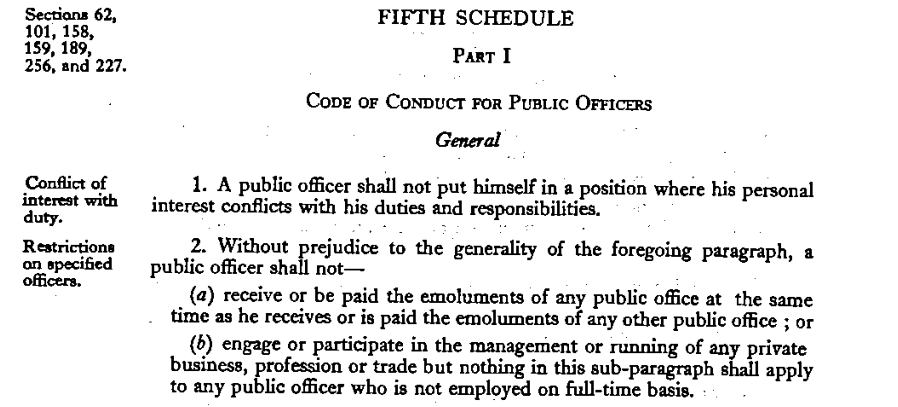
Asked on Arise Television in July 2022 how he made his money, Atiku Abubakar said: "There is no law which says you cannot engage in a legitimate business because you are a public officer. No law." For four years and three months of his Customs career, the Constitution of Nigeria said otherwise. The Code of Conduct for Public Officers in the Fifth Schedule of the 1979 Constitution, in force from the return to civilian rule on 1 October 1979 until the military took power on 31 December 1983, provided that a public officer "shall not ... engage or participate in the management or running of any private business, profession or trade", unless he was not employed full time. It defined "business" to include "farming". His own memoir puts the start of his commercial farm and of the port company that became Intels in those years. The documents establish what the rule said. They do not establish that he broke it, and no authority has ever said that he did.
Mr Abubakar, 79, is the African Democratic Congress candidate on the Independent National Electoral Commission's final list for the presidential election of January 2027. This report draws on The Atiku Files, File 03 of Vero Record's dossiers, published today: 465 pages and 511 numbered findings, each graded. The finding below does not rest on the dossier. It rests on three primary documents, each read again for this report: a scan of the 1979 Constitution, his memoir My Life, published in 2013, and the 2010 staff report of the United States Senate Permanent Subcommittee on Investigations. The 1999 Constitution is used for comparison.
His words come from the interview, which the ICIR's FactCheckHub says aired on 22 July 2022. Its report of 27 August 2022 prints them in full, together with his preceding sentence, "The fact that you are a public officer does not stop you from engaging in business", and says he was explaining that he ran a private transport business while he was a Customs official. TheCable Fact Check, on 30 July 2022, summarised the claim as "There is no law stopping public officers from doing business in Nigeria" and rated it false under the 1999 Constitution and section 6(b) of the Code of Conduct Bureau and Tribunal Act. Vero Record has not heard the recording and relies on those published accounts for his words.
The 1979 text is on printed page 112 of the Constitution. Paragraph 1 of the Code reads: "A public officer shall not put himself in a position where his personal interest conflicts with his duties and responsibilities." Paragraph 2 continues: "Without prejudice to the generality of the foregoing paragraph, a public officer shall not ... (b) engage or participate in the management or running of any private business, profession or trade but nothing in this sub-paragraph shall apply to any public officer who is not employed on full-time basis." Part II, on printed page 117, lists the offices to which the Code applied. Item 10 is "Secretary to the Government, Head of the Civil Service, Permanent Secretaries and all other persons in the civil service of the Federation or of the States."
The interpretation paragraph, paragraph 21 on printed page 116, reads: "'business' means any profession, vocation or trade and includes (a) any adventure or concern in the nature of trade; and (b) farming". Here the 1979 text differs from the one in force today. Paragraph 2(b) of the Code in the 1999 Constitution bars a full-time public officer from the "management or running of any private business, profession or trade" in almost the same words, but ends: "but nothing in this sub-paragraph shall prevent a public officer from engaging in farming." The farming exception often cited for public officers came later. Under the 1979 text, a commercial farm was a business for the purposes of the Code.

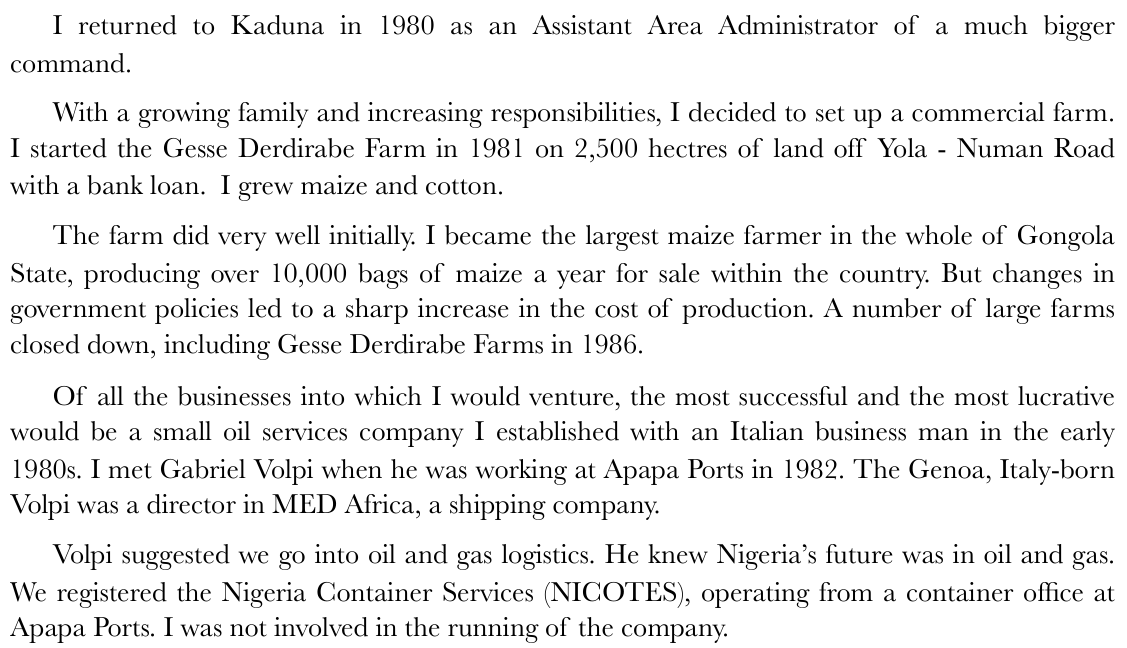
His memoir sets out what he did while he served. He joined the Department of Customs and Excise in June 1969 after a recruitment drive by the Federal Civil Service Commission (pp.19 to 20). In 1974 he "obtained a Federal Staff Housing Loan" of N31,000, built a bungalow in Yola and "rented it out immediately"; "within a few years I had built eight houses in choice areas of Yola", and later more in Kaduna (pp.24 to 25). "I returned to Kaduna in 1980 as an Assistant Area Administrator", he writes, and "I started the Gesse Derdirabe Farm in 1981", on 2,500 hectares with a bank loan, "producing over 10,000 bags of maize a year for sale within the country" until it closed in 1986. He met Gabriele Volpi at Apapa Ports in 1982, and "We registered the Nigeria Container Services (NICOTES), operating from a container office at Apapa Ports. I was not involved in the running of the company" (p.25). He retired as a Deputy Director on 30 April 1989 (p.36).
Set side by side, the two documents settle one point. On his own dates, the farm and NICOTES both began while the 1979 Code was in force and while he was a full-time officer. As a description of the law in those years, "No law" does not match the Constitution's text. Nor does it match the law today: the 1999 text carries the same bar for full-time officers, with farming excepted. A narrower statement, that a public officer may own a lawful business without running it, would have been closer to both texts.
Most of what he describes falls outside the bar, or cannot be placed inside it on the record. The Code forbade "management or running", not ownership. He says he was not involved in running NICOTES. Building houses and letting them is, on a plain reading, an investment rather than the running of a trade; that is Vero Record's reading, and the Yola building began in 1974, five years before the Code existed. The farm is the one item the 1979 text names, but the memoir does not say who ran it from day to day, and only its first three years, 1981 to 1983, fell under the Code. The transport business he mentioned in 2022 is not dated in any document read for this report.
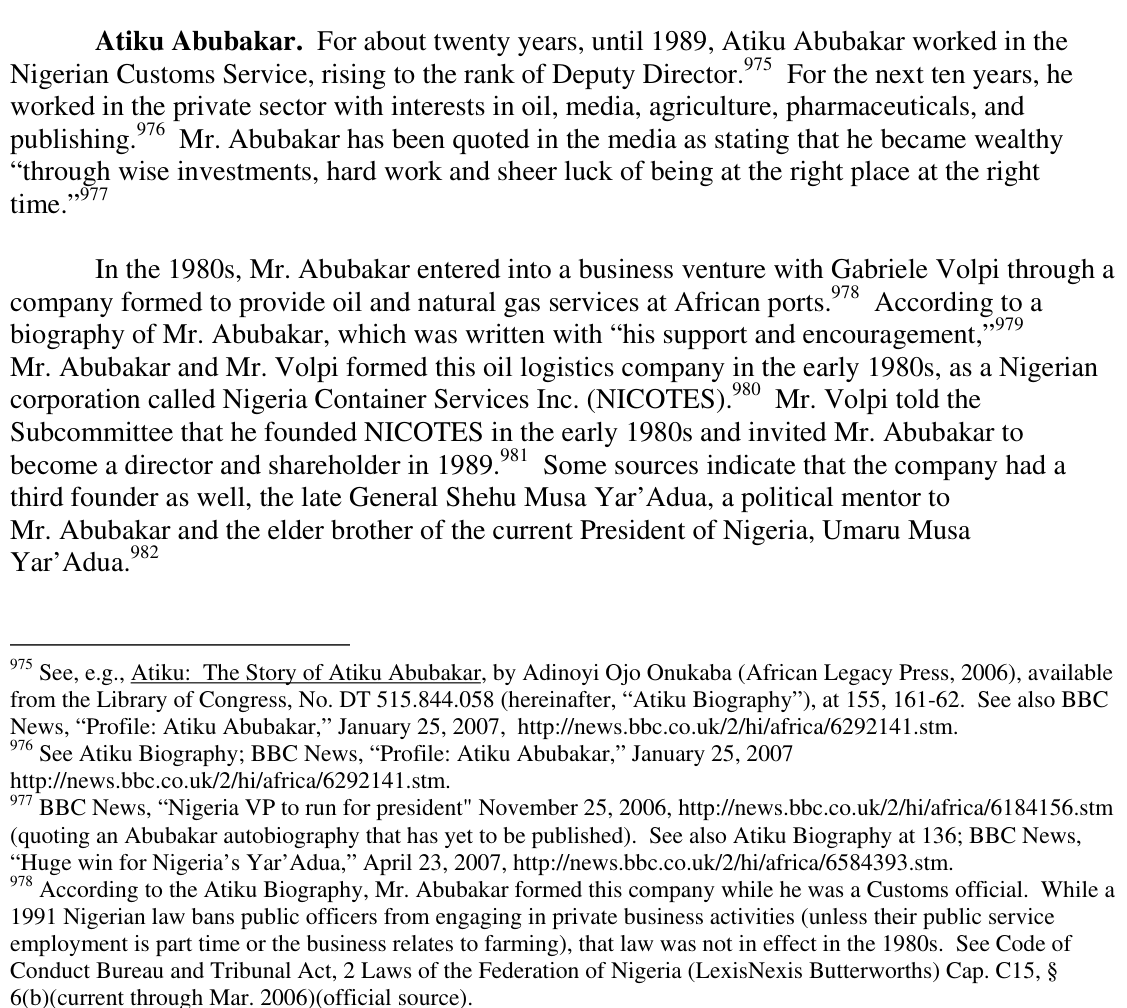
The Senate subcommittee's record adds a different date for NICOTES. Its staff report, published for a hearing on 4 February 2010, says on page 177: "Mr. Volpi told the Subcommittee that he founded NICOTES in the early 1980s and invited Mr. Abubakar to become a director and shareholder in 1989", citing a letter from Mr Volpi's lawyers of 29 January 2010. If that account is right, his stake began in 1989, more than five years after the period of the 1979 Code and in the year he retired. Footnote 978 on the same page says: "While a 1991 Nigerian law bans public officers from engaging in private business activities (unless their public service employment is part time or the business relates to farming), that law was not in effect in the 1980s." That is accurate about the 1991 law. The footnote does not mention the 1979 Code, which contained a similar bar, without the farming exception, for 51 months of the 1980s.
Three limits apply. First, that a Customs officer was one of the "persons in the civil service of the Federation" is Vero Record's reading of Part II, not a ruling. His recruitment by the Federal Civil Service Commission, his "Federal Staff" loan and his memoir's note that the Finance Minister "supervised the Department of Customs and Excise" (p.31) point that way, but no court or tribunal has decided it. Second, the 1979 Code covered 51 of the roughly 239 months he served, about a fifth. Third, the rules that governed him before October 1979 and after December 1983, including the Civil Service Rules, the military decrees that suspended parts of the Constitution, and the Code of Conduct legislation of 1989 and 1991, were not obtained, and could have been stricter or looser.
No authority applied the 1979 Code to him, then or later. His memoir describes a service file with "No queries. No sanctions" (p.31). The dossier found no record of a Customs query, a panel finding, a prosecution or a civil claim about his private business while he served, and no court has found that he breached the Code of Conduct. A lawyer quoted by TheCable in 2022, Timi Olagunju, said he had yet to see a public officer convicted for running a business while in office.
Requests for comment were sent to Atiku Abubakar's side in August 2026 and several times in September 2026, while The Atiku Files was being prepared. Any answer will be published in full.
What this rests on
Constitution of the Federal Republic of Nigeria 1979, Fifth Schedule, Part I (Code of Conduct for Public Officers), para 1 and para 2(b), printed p.112 (PDF p.119); para 21 'business' includes '(b) farming', printed p.116 (PDF p.123); Part II item 10, printed p.117 (PDF p.124); scan published by ConstitutionNet, read from the page images. Constitution of Nigeria 1999 (rev. 2011), Fifth Schedule, Part I, para 2(b), Constitute Project edition, PDF p.132. Atiku Abubakar, My Life (2013, atiku.org, copy retrieved via the Internet Archive), PDF pp.19 to 20 (joined Customs June 1969 via the Federal Civil Service Commission), pp.24 to 25 (1974 Federal Staff Housing Loan of N31,000; eight houses in Yola; Kaduna 1980; farm 1981 to 1986; met Volpi 1982; NICOTES; 'I was not involved in the running of the company'; handover on 1 October 1979), p.31 (coup of 31 December 1983; Finance Minister supervised Customs; 'No queries. No sanctions'), p.36 (retired 30 April 1989). US Senate Permanent Subcommittee on Investigations, Keeping Foreign Corruption Out of the United States: Four Case Histories, staff report for the hearing of 4 February 2010, p.177 (PDF p.182), main text and footnotes 978 and 981. His 2022 words: ICIR FactCheckHub, 27 August 2022, and TheCable Fact Check, 30 July 2022 (grade B, not heard by Vero Record). Arithmetic: 1 October 1979 to 31 December 1983 is 4 years and 3 months, 51 months, 1,553 days counted inclusively (92 days in 1979 + 366 in 1980 + 365 x 3 for 1981 to 1983 = 1,553). Service from June 1969 to 30 April 1989 is 19 years and 11 months, 239 months, if counted from 1 June 1969 (the memoir gives the month only); 51 / 239 = 21.3 per cent, about a fifth. Farm 1981 to 1986 is six calendar years; 1981, 1982 and 1983 fall under the 1979 Code, three of six. Yola houses from 1974 began 5 years before 1979. Grades: (A) for the 1979 and 1999 texts, the memoir and the Senate report, all read for this report; (B) for his 2022 words as published; (C) for reading a Customs officer as a person 'in the civil service of the Federation' and for treating let houses as investment.
What this does not establish
That Atiku Abubakar broke the 1979 Code of Conduct or any other rule: the Code barred the 'management or running' of a business, not ownership, and nothing read shows him managing or running NICOTES, the farm or any other business. Who ran the Gesse Derdirabe farm day to day. The date in the early 1980s, if any, on which he acquired an interest in NICOTES: his memoir implies the early 1980s, Mr Volpi's lawyers told the Senate subcommittee 1989, and neither is a company record. Whether a Customs officer counted as a person 'in the civil service of the Federation' under Part II of the 1979 Code; no court has ruled on it. The dates and nature of the private transport business mentioned in 2022, and of the Kaduna houses. The text of the rules in force before 1 October 1979 and after 31 December 1983 (Civil Service Rules, military decrees, the Code of Conduct Bureau and Tribunal legislation of 1989 and 1991); none was obtained. The exact commencement clause of the 1979 Constitution was not read in the scan; the dates rest on the memoir and the historical record. Vero Record did not hear the 2022 recording. No authority ever charged him under the Code, and no court has found a breach; nothing in this report suggests a crime.
What we did ourselves
Read the Code of Conduct in the 1979 Constitution from the page images of the ConstitutionNet scan and found that it barred full-time public officers from running a private business and defined business to include farming, with no farming exception. Set it against the 1999 text, which adds that exception. Dated every private activity in his own memoir against the Code's period in force, 1 October 1979 to 31 December 1983, and counted the overlap: 51 months of about 239 months of service, and three of the farm's six years. Set the memoir's account of NICOTES against Mr Volpi's account to the Senate subcommittee, and read the subcommittee's footnote 978 against the 1979 text. Builds on Parts 176 to 183 and 423 of The Atiku Files, published by Vero Record today.
Sources for this report
(A) Constitution of the Federal Republic of Nigeria 1979, Fifth Schedule (Code of Conduct for Public Officers), printed pp.112, 116 and 117; Atiku Abubakar, My Life (2013), pp.19 to 20, 24 to 25, 31 and 36; US Senate Permanent Subcommittee on Investigations staff report, Keeping Foreign Corruption Out of the United States (2010), p.177 and footnote 978; Constitution of Nigeria 1999, Fifth Schedule, para 2(b).
- The Atiku Files (File 03): 465-page dossier on Atiku Abubakar, Parts 176 to 183 and 423 · Vero Record · 30 October 2026
- Constitution of the Federal Republic of Nigeria 1979 (scan), Fifth Schedule, printed pp.112 to 117 · Federal Republic of Nigeria (ConstitutionNet copy) · 1979
- My Life (memoir) · Atiku Abubakar (atiku.org, retrieved via the Internet Archive) · November 2013
- Constitution of Nigeria 1999 (rev. 2011), Fifth Schedule, Part I · Federal Republic of Nigeria (Constitute Project edition) · 1999, revised 2011
- Keeping Foreign Corruption Out of the United States: Four Case Histories (majority and minority staff report) · US Senate Permanent Subcommittee on Investigations · 4 February 2010
- Five false claims made by Atiku in the last two years · ICIR FactCheckHub · 27 August 2022
- FACT CHECK: Atiku made several claims in Arise TV interview, but how many are factual? · TheCable Fact Check · 30 July 2022
Confidence: high. This is our own assessment of whether the event occurred as described, separate from the grade, which describes what kind of thing the claim rests on.
Not obtained: where the underlying document is named above but not linked, we did not hold a copy at the time of publication. We purchase nothing and request nothing in our own name.
Corrections
None on this report. If you find an error, it will be published here, at the same length, with the date it was found, and the original wording will remain visible above it.

Dr VeroInvestigations editor, Vero Record
Reads the Nigerian public record that others leave unread: budgets, audit reports, court files and registers. Every claim on this page carries the grade of the document behind it, and the report says what that document does not establish.
All 154 reportsHow we grade evidenceAdd Vero Record as a preferred source on Google