
Tinubu's Independence Day economic claims hold on official data: first-half growth of 4.16 per cent, reserves highest since 2008; the inflation fall crosses a change of index
In his 1 October broadcast, President Tinubu said the economy had grown by over 4 per cent this year, inflation had fallen substantially from its peak, reserves had been rebuilt, the exchange market had stabilised and foreign direct investment rises each year. Vero Record tested those five claims against National Bureau of Statistics reports and Central Bank of Nigeria data. All five hold in substance. Growth averaged 4.16 per cent in the first half on our arithmetic, with only two quarters published. The 34.80 per cent inflation peak was measured on an older index, and inflation has stayed between 15.06 and 15.93 per cent all year.
On 1 October 2026, President Bola Ahmed Tinubu marked the 66th anniversary of independence with a national broadcast that the State House published under the title "From Reform to Prosperity". One passage made a run of economic claims: "Our economy has grown by over 4 per cent this year. Both oil and non-oil sectors have contributed to the renewed period of stable growth. Oil theft is down. Inflation has fallen substantially from its peak. Our foreign reserves have been rebuilt, our foreign exchange market has stabilised, and in 2025 this country recorded its highest revenue from non-oil exports in its history, exceeding $6 billion." He went on to say that "foreign direct investment continues to rise each year." Vero Record examined the broadcast's lines on pensions and on budget rollovers on 2 October. This report deals with the economic passage. We tested five of its statements against the National Bureau of Statistics' reports and workbooks and the Central Bank of Nigeria's published data series, all downloaded on 3 October. On those records all five hold in substance. Two of them need a qualification that the speech does not give.
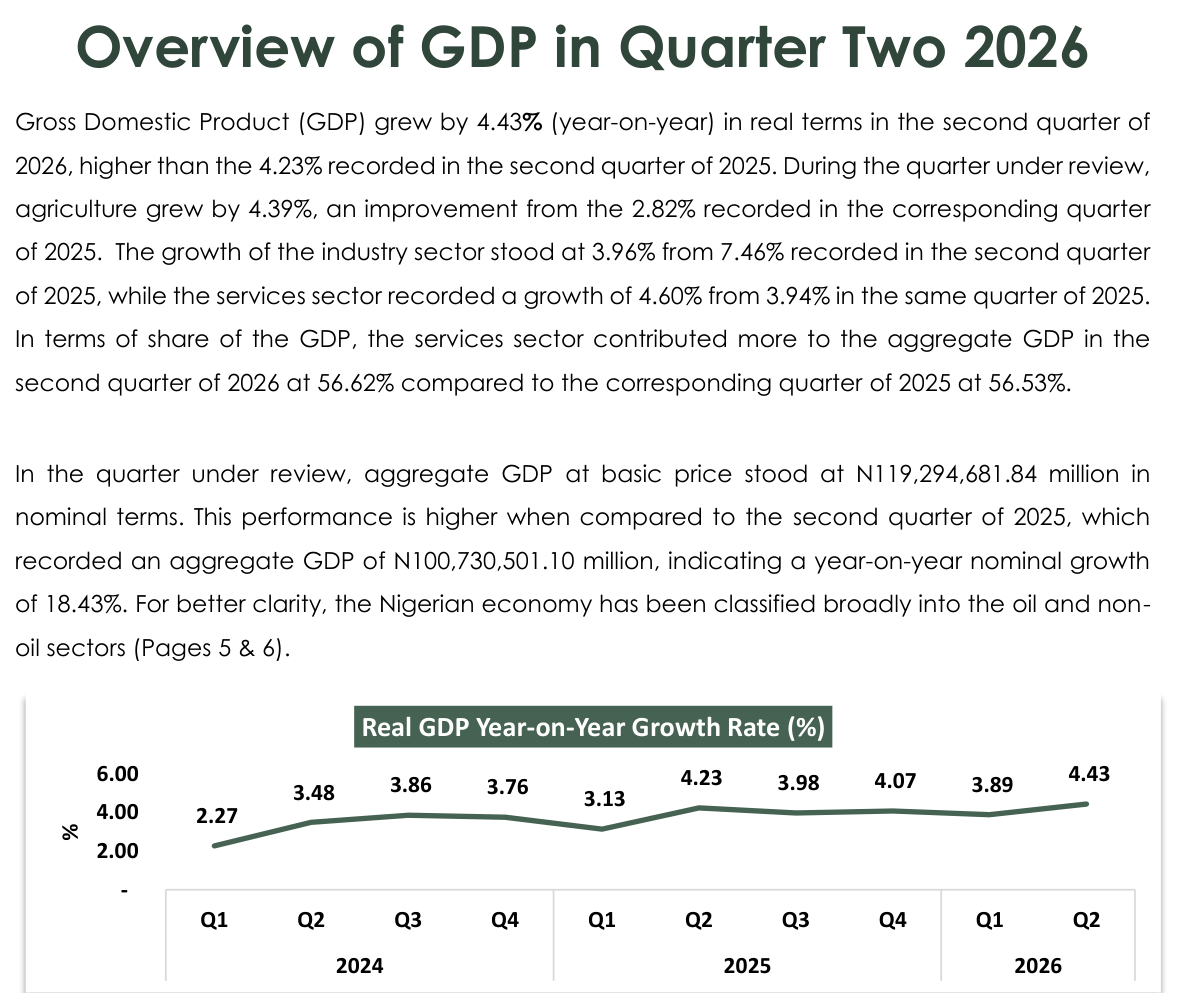
Growth first. The bureau's report for the second quarter of 2026, dated 31 August, says gross domestic product "grew by 4.43% (year-on-year) in real terms in the second quarter of 2026, higher than the 4.23% recorded in the second quarter of 2025." The first-quarter report, dated 25 May, gives 3.89 per cent, against 3.13 per cent a year earlier. Those are the only two quarters of 2026 the bureau has published. The simple average of the two rates is 4.16 per cent. Working from the bureau's own workbook, real GDP at 2019 constant basic prices was N104,734,138.98 million in the first half of 2026 against N100,546,921.46 million in the first half of 2025, which is also growth of 4.16 per cent. Both are our arithmetic, not a figure the bureau states. On that basis the first half of the year grew by more than 4 per cent, as the President said, although the first quarter on its own did not. The same workbook gives 3.87 per cent for the whole of 2025. Whether 2026 as a whole exceeds 4 per cent cannot be known until the third and fourth quarters are published.
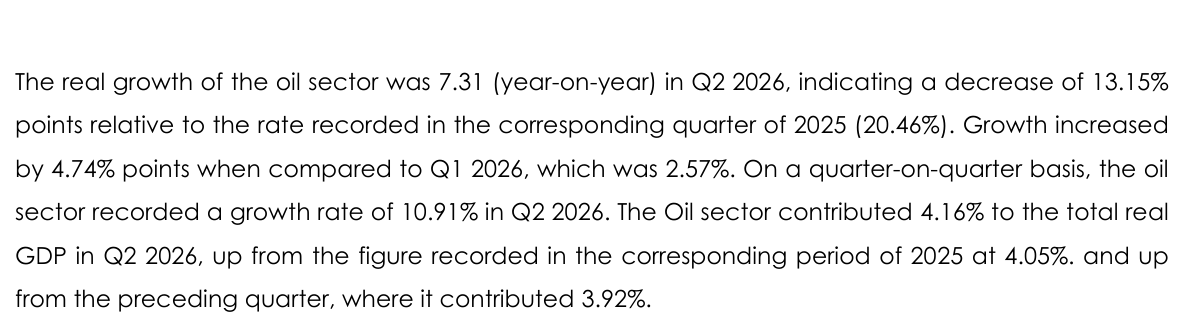
The claim that both sectors contributed also holds. The oil sector grew 2.57 per cent in the first quarter and 7.31 per cent in the second; the non-oil sector grew 3.94 per cent and 4.31 per cent. Oil accounted for 3.92 per cent and 4.16 per cent of real GDP in those quarters, so most of the growth came from outside oil. Production gives a mixed picture. The bureau puts average output at 1.72 million barrels a day in the second quarter, up from 1.68 million a year earlier and 1.55 million in the first quarter. But the first-quarter figure of 1.55 million was lower than the 1.62 million of the first quarter of 2025, even though the oil sector's value added grew that quarter. The report does not explain the difference.
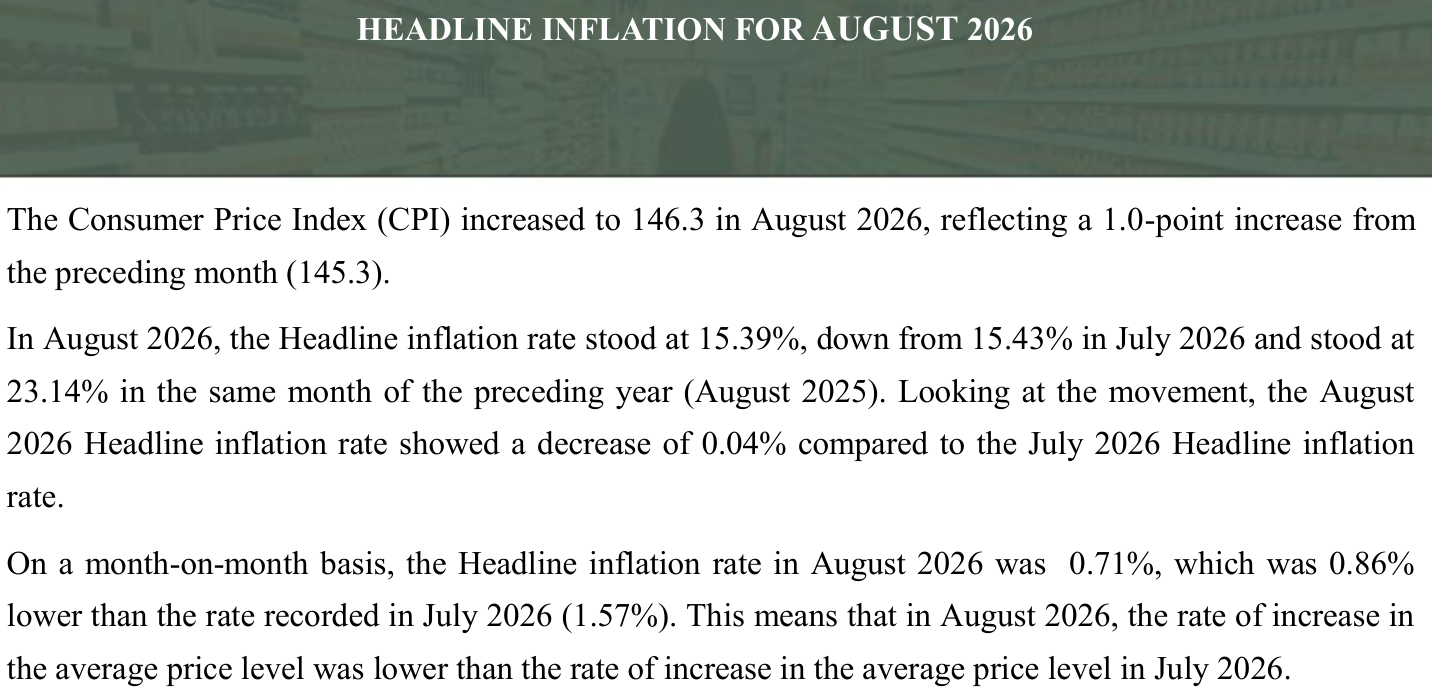
On inflation the record supports the President. The bureau's August 2026 report, its latest, gives headline inflation of 15.39 per cent, down from 15.43 per cent in July and from 23.14 per cent in August 2025. The highest year-on-year rate in the bureau's current workbook is 34.80 per cent, for December 2024, so the August figure is 19.41 percentage points below that peak. The twelve-month average rate, which peaked at 33.24 per cent in December 2024, stood at 16.30 per cent in August. A fall of that size can fairly be called substantial.
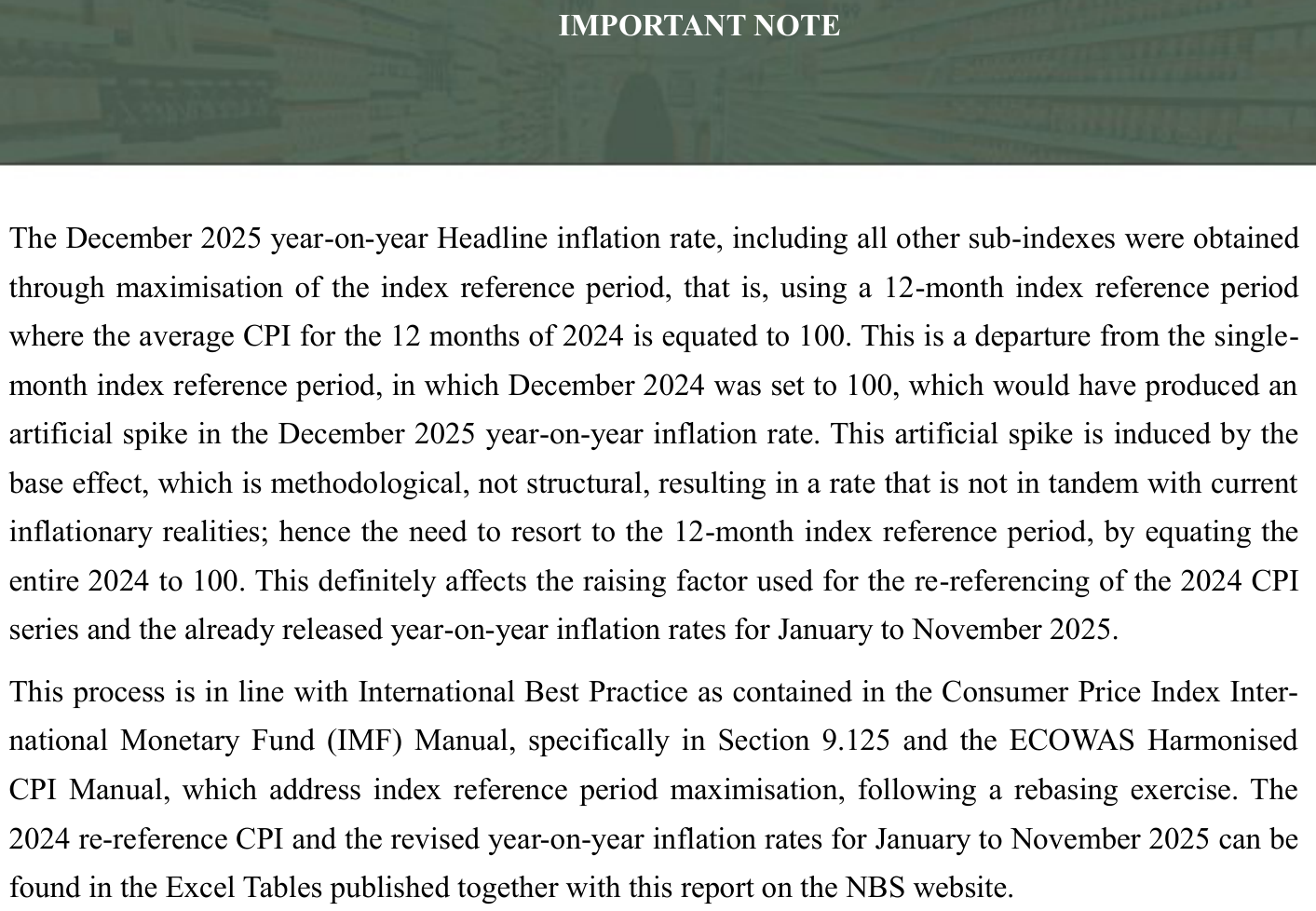
Two qualifications apply. First, the 34.80 per cent peak was measured on the old index, with November 2009 as its base. Since January 2025 the bureau has used a rebased index, with prices referenced to 2024 and a new basket, and its own monthly reports say comparisons with 2024 rates are made "though with a different base year". Second, the path of inflation through 2025 has been revised. In its December 2025 report the bureau switched to using the average of 2024 as its reference and said the change "definitely affects" the "already released year-on-year inflation rates for January to November 2025". Comparing the November and December 2025 workbooks, the rate for January 2025 went from 24.48 per cent to 27.61 per cent and the rate for August 2025 from 20.12 per cent to 23.14 per cent. The index values for 2025 did not change, so the 2026 rates are not affected. They show a different picture of this year: headline inflation has stayed between 15.06 per cent (February) and 15.93 per cent (May) in every month of 2026. It has fallen a long way from the peak, but not further this year.
The reserves claim is supported by the central bank's own daily series. The last figure before the inauguration on 29 May 2023 is gross external reserves of US$35,147,391,756.74 on 26 May 2023. Reserves fell to a low of US$32,106,860,592.87 on 19 April 2024 and then rose to US$54,926,412,135.01 on 30 September 2026, an increase of US$19.78 billion, or 56.3 per cent, on May 2023. The last time the series stood higher was 18 December 2008, at US$55,059,481,324.06. The series records gross reserves and a small "blocked" portion, US$502,045,473.21 on 30 September. It does not show how much of the total is borrowed or committed to swaps and forward contracts, so it does not establish the net position.
The exchange rate has also stabilised on the central bank's official series, at a much weaker level. The bank's central rate for the dollar was N461.06 on 26 May 2023. It moved to N645.49 by 16 June 2023, after the foreign exchange windows were unified, and reached N1,688.284 on 20 November 2024. During 2024 the rate ranged from N853.271 to N1,688.284, a top 97.9 per cent above the bottom. In 2025 the range was N1,421.2343 to N1,629.4366, or 14.6 per cent. In 2026 so far it has run from N1,430.3479 on 2 January to N1,315.1717 on 3 September, or 8.8 per cent, and on 30 September it was N1,328.66, so a dollar cost 7.1 per cent fewer naira than at the start of the year. A dollar still costs 2.88 times as many naira as in May 2023; put the other way, a naira buys about 35 per cent of the dollars it bought then. These are official rates, not parallel market rates.
The investment claim holds on the bureau's capital importation figures, which are compiled from central bank data. Foreign direct investment inflows were US$377.38 million in 2023, US$674.71 million in 2024 and US$923.01 million in 2025, a rise in each year since 2023. The first quarter of 2026 brought US$135.08 million, up 6.96 per cent on the US$126.29 million of the first quarter of 2025. The same table puts the increase in context. The 2023 figure was the lowest annual total in the table, which gives full years from 2014, and followed three straight years of decline from US$1,027.68 million in 2020. The 2025 total is still below 2019 (US$934.34 million) and 2020 (US$1,027.68 million) and well under half the US$2,277.04 million of 2014. It was 3.97 per cent of the US$23,220.83 million of capital imported in 2025, most of which was portfolio money. The bureau notes that the series counts fresh capital reported by banks and excludes reinvested earnings.
The non-oil export figure matches what the government's own export agency has published. In an article dated 24 February 2026, the Nigerian Export Promotion Council said non-oil exports reached US$6.1 billion in 2025, an 11.5 per cent increase over US$5.46 billion in 2024, and called it "the highest formally documented non-oil export value in Nigeria's history". The President's "exceeding $6 billion" matches that figure. Vero Record did not test it against the underlying export records. The council's own claim is limited to "formally documented" exports, while the speech says "in its history".
Three statements in the passage were not tested. No primary record on crude oil theft was retrieved, so "Oil theft is down" is not checked here. The speech's earlier line that "By 2023, poverty was rising" was also not tested, and the conclusions it attributes to international observers and multilateral institutions were not examined.
Taken together, the government's own statistics give the following results. Growth of over 4 per cent this year: supported for the first half of 2026 on our arithmetic (4.16 per cent); the full year is not yet measured, and the first quarter was 3.89 per cent. Oil and non-oil sectors both contributing: supported. Inflation fallen substantially from its peak: supported, from 34.80 to 15.39 per cent, though the comparison crosses a change of index and the rate has not fallen further in 2026. Reserves rebuilt: supported, at US$54.93 billion gross, the highest since December 2008. Exchange market stabilised: supported for 2025 and 2026, at about a third of the naira's May 2023 value against the dollar. Foreign direct investment rising each year: supported on the capital importation measure for 2024 and 2025, from a 2023 low. Non-oil exports above US$6 billion: consistent with the export council's published figure, not independently tested. Oil theft and poverty: not checked.
What this rests on
NBS, Nigerian Gross Domestic Product Report Q2 2026 (p.3, PDF p.5; p.5, PDF p.7; p.6, PDF p.8) and workbook Q2 2026 GDP_w.xlsx (sheet GDP_Curr_K_dfl_%Distrn, row 125; sheet real gdp growth rate %, rows 16 and 63); NBS GDP Report Q1 2026 (p.3, PDF p.5; p.5, PDF p.7; p.6, PDF p.8) and its workbook, which carries the same Q1 2026 real GDP (N51,261,306.14 million). NBS CPI reports for August 2026 (pp.6 and 7) and December 2025 (Important Note, p.6, and p.7), with the workbooks for August 2026, December 2025, November 2025 and July 2025 (Table 1); NBS CPI February 2025 report (p.6). NBS Capital Importation Q4 2025 report (pp.3 and 4) and Q4 2025 and Q1 2026 tables (Table 1). CBN GetAllReserves and GetAllExchangeRates data series (US dollar central rate). NEPC article of 24 February 2026. State House text of the broadcast. All downloaded and read on 3 October 2026. Arithmetic re-done: H1 2026 real GDP N51,261,306.14m + N53,472,832.84m = N104,734,138.98m; H1 2025 N49,344,269.74m + N51,202,651.72m = N100,546,921.46m; ratio 1.04164, growth 4.16%; simple average (3.89 + 4.43) / 2 = 4.16. CPI 34.80 - 15.39 = 19.41 points; revisions 27.61 - 24.48 = 3.13 points (January 2025), 23.14 - 20.12 = 3.02 points (August 2025). Reserves US$54,926,412,135.01 - US$35,147,391,756.74 = US$19,779,020,378.27, or 56.3%. Exchange rate N1,328.66 / N461.06 = 2.88; N461.06 / N1,328.66 = 34.7%; (N1,430.3479 - N1,328.66) / N1,430.3479 = 7.1%; N1,688.284 / N853.271 = 1.979; N1,629.4366 / N1,421.2343 = 1.146; N1,430.3479 / N1,315.1717 = 1.088. FDI quarters: 2023, 47.60 + 86.03 + 59.77 + 183.97 = 377.37 (table total 377.38, rounding); 2024, 119.18 + 29.83 + 103.82 + 421.88 = 674.71; 2025, 126.29 + 142.67 + 296.25 + 357.80 = 923.01; total capital importation 2025, 5,642.07 + 5,120.50 + 6,014.77 + 6,443.48 = 23,220.82 (table 23,220.83, rounding); 923.01 / 23,220.83 = 3.97%; 135.08 / 126.29 = +6.96%. Oil output differences as printed by NBS (0.05 and 0.06 mbpd) differ by 0.01 from the rounded figures, which unrounded values would account for. The CBN reserves series contains one obviously mis-keyed entry (US$508,999,556,525.92 on 20 November 2007), which was disregarded.
What this does not establish
Whether growth for the whole of 2026 will exceed 4 per cent; only two quarters are published. Net reserves, and how much of the gross US$54.93 billion is borrowed or committed in swaps and forwards. Parallel market exchange rates, which were not examined. Foreign direct investment on the balance of payments measure, which includes reinvested earnings; only the capital importation measure was used. The underlying records behind the export council's US$6.1 billion. Whether oil theft has fallen, and whether poverty was rising by 2023; neither was tested. Why first-quarter 2026 oil output fell year on year while oil value added grew. The broadcast text used is the State House version; the delivered broadcast was not compared against it. Nothing in this report suggests wrongdoing by anyone.
What we did ourselves
Took the economic passage from the State House text of the broadcast. Downloaded the NBS GDP reports and workbooks for both published quarters of 2026 and computed first-half growth two ways, from the quarterly rates and from real GDP levels. Read the August 2026 CPI report and compared the inflation tables in four NBS workbooks, finding the December 2025 revision of the 2025 rates. Pulled the central bank's full daily reserves and exchange rate series and measured them against 26 May 2023, the low points, and the ranges in each year. Re-added NBS foreign direct investment quarters into annual totals for 2014 to 2025. Traced the US$6 billion export figure to the export council's own publication.
Sources for this report
(A) National Bureau of Statistics GDP reports and workbooks for Q1 and Q2 2026; NBS CPI reports and workbooks for August 2026, December 2025, November 2025 and July 2025; NBS capital importation reports and tables for Q4 2025 and Q1 2026; Central Bank of Nigeria daily gross external reserves and official exchange rate series.
- From Reform to Prosperity: Independence Day Address to the Nation by President Bola Ahmed Tinubu, 1st October 2026 · State House, Abuja · 1 October 2026
- Nigerian Gross Domestic Product Report Q2 2026 (report and workbook) · National Bureau of Statistics · 31 August 2026
- Nigerian Gross Domestic Product Report Q1 2026 (report and workbook) · National Bureau of Statistics · 25 May 2026
- August 2026 CPI Report (report and workbook) · National Bureau of Statistics · 15 September 2026
- December 2025 CPI Report (report and workbook) · National Bureau of Statistics · January 2026
- November 2025 CPI Report (report and workbook) · National Bureau of Statistics · December 2025
- February 2025 CPI Report · National Bureau of Statistics · March 2025
- Nigeria Capital Importation Q4 2025 (report and tables) · National Bureau of Statistics (data from the Central Bank of Nigeria) · 25 March 2026
- Nigeria Capital Importation Q1 2026 (report and tables) · National Bureau of Statistics (data from the Central Bank of Nigeria) · 3 June 2026
- Gross external reserves, daily series · Central Bank of Nigeria · to 30 September 2026
- Official exchange rates, daily series (US dollar central rate) · Central Bank of Nigeria · to 2 October 2026
- Nigeria's Historic Non-Oil Export Performance Signals a New Era of Economic Possibility · Nigerian Export Promotion Council · 24 February 2026
Confidence: high. This is our own assessment of whether the event occurred as described, separate from the grade, which describes what kind of thing the claim rests on.
Not obtained: where the underlying document is named above but not linked, we did not hold a copy at the time of publication. We purchase nothing and request nothing in our own name.
Corrections
None on this report. If you find an error, it will be published here, at the same length, with the date it was found, and the original wording will remain visible above it.