
A court ordered Peter Obi's party struck from the register; INEC reopened its candidate portal anyway
The Federal High Court in Abuja ordered INEC to cancel the registration of the Nigeria Democratic Congress and remove it from the register of political parties, finding it was never validly registered. Months earlier the NDC had ratified Peter Obi as its 2027 presidential candidate, and after the ruling INEC restored the party's access to its nomination portal. The records point in opposite directions.

INEC’s own final list of candidates for the 2027 presidential election - not a newspaper’s reprint of it, but the signed commission document, which we downloaded from inecnigeria.org and read - carries this candidacy on page 3 of three. The entry is printed surname first, as "OBI PETER GREGORY", against NDC, age 65, with MUSA MOHAMMED RABIU KWANKWASO (69) as running mate. The list is signed on every page by Rose Oriaran-Anthony, Secretary of the Commission. It names eighteen presidential candidates, two more than most published summaries of the field. The qualifications filed with the commission are printed as St. Augustines Primary School; Anambra Christ the King College (C.K.C); WASC; UNN B.A..
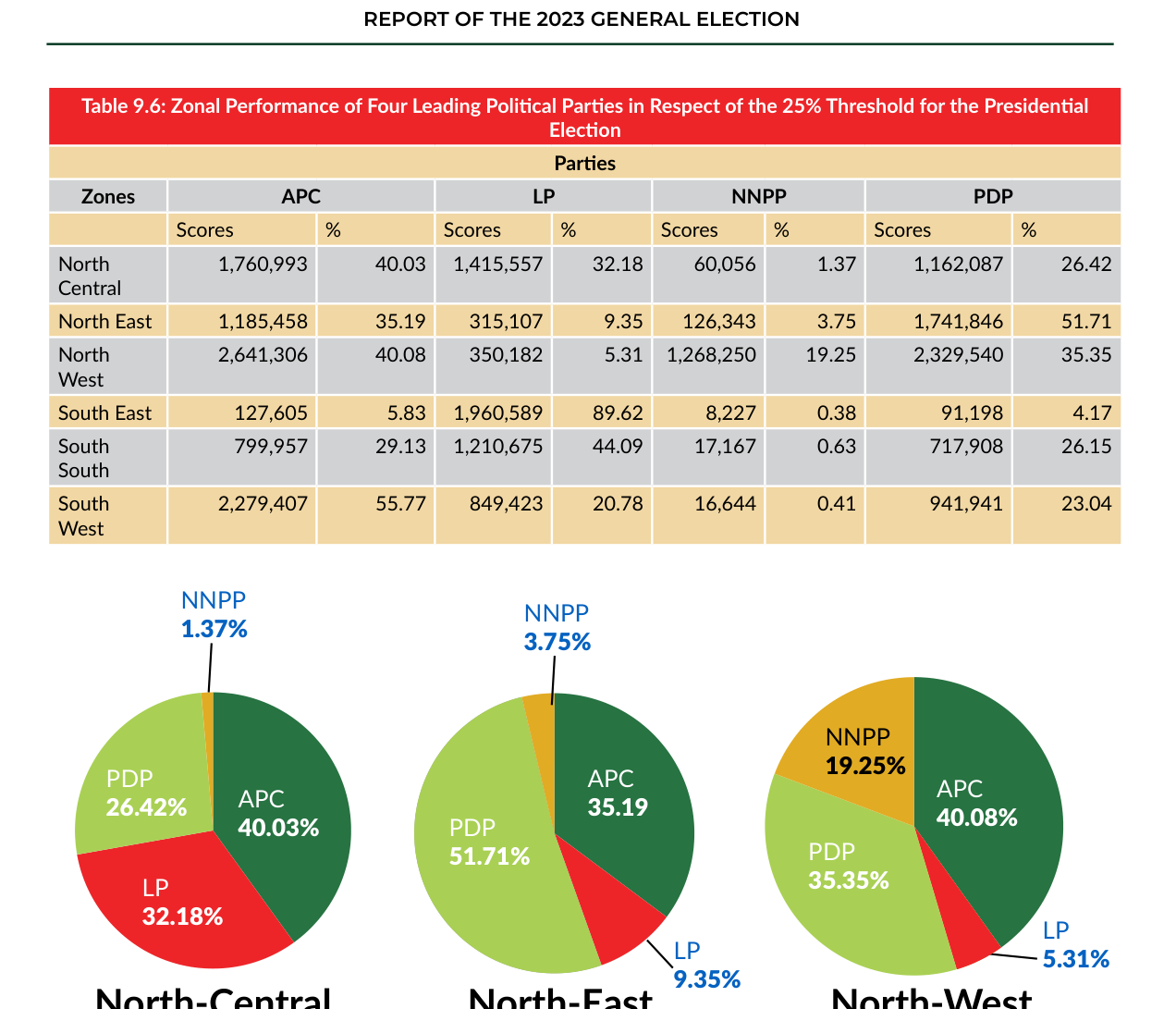
For the 2023 result, we went to INEC’s own 526-page Report of the 2023 General Election rather than to press tallies. The commission’s live site no longer serves it - the file 404s - so we retrieved it from an Internet Archive capture of INEC’s own URL, which leaves it INEC’s document. Table 9.6, at printed page 163, gives the Labour Party’s vote by geopolitical zone: 1,415,557 in the North Central, 315,107 in the North East, 350,182 in the North West, 1,960,589 in the South East, 1,210,675 in the South South and 849,423 in the South West.
Those six numbers are INEC’s. The total they make is ours: they sum to 6,101,533, which is the figure reported as Obi’s national vote. We separate the two deliberately, because the commission never prints a national total for him anywhere in the report, and an arithmetic step we performed is not the same class of fact as a line we read. The same table shows why the zonal picture mattered: 89.62 per cent in the South East against 5.31 per cent in the North West.
One thing INEC’s report does not contain is a list of the states any candidate won, and we could not obtain the document that would carry it. The commission has never published the 2023 national declaration as a downloadable file; a sweep of every archived PDF on its domain turns up declarations for 2013, 2014 and 2015 but nothing for the 2023 presidential result. Its result-viewing portal is effectively dead - the interface still loads, but the server it calls no longer resolves in DNS - and what it held were per-polling-unit scans, not a summary.
On his governorship, the most-quoted figures about Anambra are the ones we could least verify. The handover claims now circulating - a net balance of some N86.67bn, foreign investments of $156m - exist in press reproductions; neither outlet hosts a scan, and Anambra’s own document library begins in 2020, so the 2006-2014 accounts are not online. Those figures stay unverified here. What we could retrieve is the federal record of the same period: the Debt Management Office’s table of state external debt as at 31 December 2013 puts Anambra at $30,323,574.40, and its domestic debt table for the same date puts the state at N3,025,797,046.67 - among the lowest domestic debt stocks of the 36 states. Obi handed over on 17 March 2014, about ten weeks later.
Start with the judgment. A Federal High Court in Abuja, per Justice Mohammed Umar, directed INEC to cancel the registration of the Nigeria Democratic Congress and to remove its name from the register of political parties. The stated ground was that INEC had failed to comply with the Constitution and the Electoral Act in registering the party — in effect, that the NDC had never been validly registered at all.
Set against that the timeline. INEC registered the NDC on 5 February 2026, and the party ratified Peter Obi as its 2027 presidential candidate on 29 May 2026. The court's order therefore does not land on a dormant shell; it lands on the platform of a declared presidential candidate who left the Labour Party for it, at a point when his candidacy was already public.
Then the contradiction sharpens. After the nullification, the NDC's national leadership announced that Obi's name had been uploaded to INEC's nomination portal, and reporting indicates INEC restored the party's access to that portal. An electoral commission under a court order to strike a party from the register was, at the same time, processing that party's presidential candidate through its own systems.
This is a live inconsistency, not a settled outcome, and the distinction matters in Nigeria more than almost anywhere. Party-registration and candidate-eligibility cases routinely move between the Federal High Court and the Court of Appeal, and portal access is granted, halted and restored at different stages of that journey. The ADC faced a parallel deregistration order in the same period that the Court of Appeal later voided — a reminder that a first-instance order is a stage, not a full stop.
Vero places the four dates on one line — registration, candidate ratification, court nullification, portal reopening — because laid out that way they show a conflict between a judicial order and an administrative act that no single press report captured. What the timeline does not show is a resolution: the suit number was not confirmed, the appellate status is open, and the reopening may reflect a stay or a later order we have not retrieved.
So the report stops where the record stops. It does not say the NDC is finally deregistered, that Obi is disqualified, or that INEC acted in bad faith. It says two official actions point in opposite directions at the same moment, and that until the appellate courts speak, the status of a major candidate's party is genuinely unsettled.
What this rests on
INEC’s own election report, read on the page, for the zonal vote; the Debt Management Office’s own published tables for the Anambra debt position. The candidacy, the printed name, the age, the running mate and the filed qualifications rest on INEC’s own signed final list, read on the page. The Federal High Court judgment (Justice Umar) and INEC's registration/portal records. Verify via the certified judgment and INEC's register of political parties.
What this does not establish
INEC prints no national total for any candidate; the 6,101,533 figure is our addition of the commission’s six zonal numbers, not a line we read. No document establishes which states he won. The Anambra handover figures - the N86.67bn balance and the investment sums - are not established by any record we hold, and we did not confirm them. The 2023 election petition judgment is in our hands only as an unsearchable scan hosted by a third party and watermarked by an opposing legal team, so we quote nothing from it. It does not establish that the NDC is finally deregistered, that Obi is disqualified, or that the ruling survived appeal - the suit number and appellate status were not confirmed. It does not prove INEC acted in bad faith; the reopening may reflect a stay or later order we have not retrieved.
What we did ourselves
We rebuilt his 2023 vote from INEC’s own zonal table instead of repeating a national figure, and marked the addition as ours. We then replaced the unverifiable Anambra handover claims with the federal debt records for the same date, which are published and checkable.
Sources for this report
(A) INEC, Report of the 2023 General Election, Table 9.6, printed p.163 (PDF p.202): Labour Party zonal scores 1,415,557 / 315,107 / 350,182 / 1,960,589 / 1,210,675 / 849,423. Debt Management Office, state external debt as at 31 December 2013: Anambra $30,323,574.40; DMO total domestic debt of the 36 states for 2013 (revised): Anambra N3,025,797,046.67. INEC, "Presidential and National Assembly Elections for Jan, 2027 - Presidential: Final List of Candidates", signed by Rose Oriaran-Anthony, Secretary, INEC; published at inecnigeria.org and downloaded by Vero on 26 September 2026, page 3: "OBI PETER GREGORY", NDC, age 65. Federal High Court (Abuja) judgment per Justice Mohammed Umar ordering INEC to cancel NDC registration; INEC registration of NDC dated 5 Feb 2026; INEC portal reinstatement reporting.
Check it yourself:
- inecnigeria.org/documents/press/2027%20PRESIDENTIAL%20FINAL%20LI…
- inecnigeria.org/parties
- www.pulse.ng/story/breaking-court-nullifies-ndc-registration-mon…
- tribuneonlineng.com/ndc-seven-quick-facts-about-peter-obis-new-p…
- web.archive.org/web/20260214132338id_/https://inecnigeria.org/wp…
- dmo.gov.ng/debt-profile/sub-national-debts
Not obtained: where a document is named above but not linked, we did not hold a copy at publication. We purchase nothing and request nothing in our own name.
Corrections
Corrected on 14 October 2026: This report contained four errors, and its original wording remains visible above. First, it attributed the ruling against the Nigeria Democratic Congress to Justice Mohammed Umar of the Federal High Court in Abuja and said the court found INEC had not complied with the Constitution and the Electoral Act. The ruling was given on 26 June 2026 by Justice Isah Dashen of the Federal High Court in Lokoja, in Suit No. FHC/LKJ/CS/49/2025. It set aside that court's own judgment of 10 December 2025, which had directed INEC to register the party, and returned the suit to the stage it had reached before judgment. Its stated ground, in the text of the certified true copy as reproduced by Vanguard on 28 June 2026, was that the Peace Movement Party, which claimed the party's two-finger logo, had not been heard. The separate suit before Justice Umar, FHC/ABJ/CS/1115/2026, was adjourned for hearing on 29 June 2026, and we have found no report of a judgment in it. Second, the report said the appellate position was open. On 18 September 2026, eight days before we published, the Court of Appeal in Abuja allowed the party's appeal by a majority of two to one, set aside the Lokoja ruling and restored the party's registration; Justice Okon Abang dissented. By the date of publication, therefore, the conflict between a court order and INEC's handling of the party that the headline describes was no longer live. Third, the party ratified Peter Obi as its presidential candidate at a special convention in Abuja on Saturday 30 May 2026, not on 29 May, which was the date of its primary. Fourth, Mr Obi did not join the party from the Labour Party. He announced his move from the Labour Party to the African Democratic Congress on 31 December 2025, and left the African Democratic Congress for the Nigeria Democratic Congress on 3 May 2026. This report was graded (A) and listed a judgment as its primary record; it rested on a press account of that judgment, not on a ruling we held, and should have been graded (B). The reports behind each correction are listed on our corrections page.

Dr VeroInvestigations editor, Vero Record
Reads the Nigerian public record that others leave unread: budgets, audit reports, court files and registers. Every claim on this page carries the grade of the document behind it, and the report says what that document does not establish.
All 196 reportsHow we grade evidenceAdd Vero Record as a preferred source on Google