
The Electoral Act's last day to take a name off the 16 January presidential ballot is today, 18 October; INEC's timetable closed it on 22 August
G100 convener Salihu Lukman says opposition parties could name a single presidential candidate "a few days to the election". Section 31 of the Electoral Act 2026 lets a candidate withdraw only if his party tells INEC not later than 90 days before polling, which for 16 January 2027 is today. INEC's signed timetable set 22 August. INEC's final list carries 18 presidential tickets, and after the deadline the Act keeps every name on the ballot. The ADC says its talks are not about a single candidate.

Speaking on Channels Television's Hard Copy, in remarks reported on 17 and 18 October, the G100 convener Salihu Lukman said the opposition parties his group has been working with would name one direction for the presidential race in their own time: "So it could be two months, some weeks to the election, or a few days to the election; they will come out and tell Nigerians this is the direction, and everybody will queue." The Electoral Act 2026 sets a fixed limit on what such an announcement can change. Section 31 lets a candidate withdraw only if his party conveys the withdrawal to INEC "not later than 90 days to the election". For the presidential and National Assembly election on Saturday, 16 January 2027, the ninetieth day before polling is today, Sunday, 18 October 2026. INEC's own signed timetable set the last day earlier still, on 22 August. Every timing Mr Lukman described falls after both dates.
Mr Lukman, a former National Vice Chairman of the All Progressives Congress, said six parties were involved and were "reaching out to other parties". Asked which platform a joint candidate might use, he said, as ThisDay reported: "ADC, it could be any other party, or it could be an alliance that will produce a new party." He also said: "Politicians can lie to themselves, and at the end of the day let the candidates continue to hang on to their candidature; at the end of the day only one person will be president of the Federal Republic of Nigeria." The African Democratic Congress gives a different account of the talks. Its National Publicity Secretary, Bolaji Abdullahi, told Premium Times on Saturday: "Discussions are going on, but it's not about a single presidential candidate or any such thing. It's about opposition political parties forming a common alliance towards the election." Vero Record does not choose between the two accounts. It tested only what the law and INEC's records allow on the calendar.
Section 31, on page A21 of the Act as gazetted on 2 March 2026, sets out the only route by which a nominated candidate leaves the race while alive: "A candidate may withdraw his candidature by notice in writing signed by him together with a sworn affidavit delivered personally by the candidate to the political party that nominated him for the election and the political party shall convey such withdrawal and the sworn affidavit to the Commission not later than 90 days to the election." Section 33 adds that a party "shall not be allowed to change or substitute its candidate" except on death or withdrawal, and that after a withdrawal it must, "within 14 days of the occurrence of the event, hold another primary election to produce and submit a new candidate".

Counting back from 16 January 2027, leaving out polling day itself, the 90 days are 18 to 31 October (14 days), November (30), December (31) and 1 to 15 January (15): 14 + 30 + 31 + 15 = 90, which puts the last day at 18 October. This is the method the Policy and Legal Advocacy Centre used in its March 2026 factsheet on the electoral calendar, which gives 18 October 2026 as the 90-day outer limit for the January elections, and the method earlier Vero Record reports used to give 8 November for the 6 February governorship elections. A reader who counts 90 clear days would put the last day one day earlier, on 17 October. The Act says nothing about a deadline that falls on a Sunday.
INEC fixed its own date well before that. Its Revised Timetable and Schedule of Activities for the 2027 General Election, signed by the commission's chairman, Joash Amupitan, and dated 26 February 2026, was posted as three page images on INEC's X account the same day. Item 7 reads: "Last day for withdrawal by candidate(s)/replacement of withdrawn candidate(s) by Political Parties", with "22nd August, 2026" for the presidential and National Assembly elections and "19th September, 2026" for governorship and State Assembly elections. Its remark column cites the statute it rests on: "Section 31 of the Electoral Act, 2026 provides not later than 90 days to the election." 22 August is 147 days before 16 January, and 57 days before today. 19 September is 140 days before 6 February, and 50 days before 8 November. The PLAC factsheet lists the same INEC dates and says INEC's early scheduling "likely reflects administrative considerations, such as allowing time for verification and scrutiny, candidate substitutions and ballot production and logistics". The timetable itself gives no reason.

Whether INEC could close the window earlier than the Act has been argued in court. According to reports in May, two Federal High Court judges in Abuja, M. G. Umar in a suit by the Youth Party and James Omotosho in a suit by the Social Democratic Party (FHC/ABJ/CS/720/2026), held that INEC could not abridge the 90-day period in section 31. Reports say the Court of Appeal set aside the Youth Party judgment on 16 July, finding that the party lacked standing, and that on 24 September the Supreme Court dismissed an SDP appeal and struck out a Youth Party appeal as filed one day late. Vero Record has not obtained any of those judgments. The one Supreme Court judgment from that day it has read, INEC v. Zenith Labour Party (SC/CV/495/2026), deals with item 2 of the timetable and the party register rules in section 77, not with item 7. The documents read therefore do not settle which date binds. They do show that on either reading the window closes no later than today.
What stands now is INEC's final list for the presidential election, three signed pages over the name of Rose Oriaran-Anthony, Secretary to the Commission. It carries 18 tickets. Among them are the APC's Tinubu Bola Ahmed with Shettima Kashim, the ADC's Abubakar Atiku with Amaechi Chibuike Rotimi, the NDC's Obi Peter Gregory with Musa Mohammed Rabiu Kwankwaso, and the PDP's Onor Sandy Ojang with Umaru Babangida. INEC's timetable set 12 September for its publication, and INEC's statement of 13 October says it was published that day; the file's own data record its creation on 11 September. 12 September is 126 days before polling, well ahead of the Act's requirement in section 32(1) that the list appear "at least 60 days before the day of the election", which would have allowed INEC until 17 November. On this point the record supports INEC.
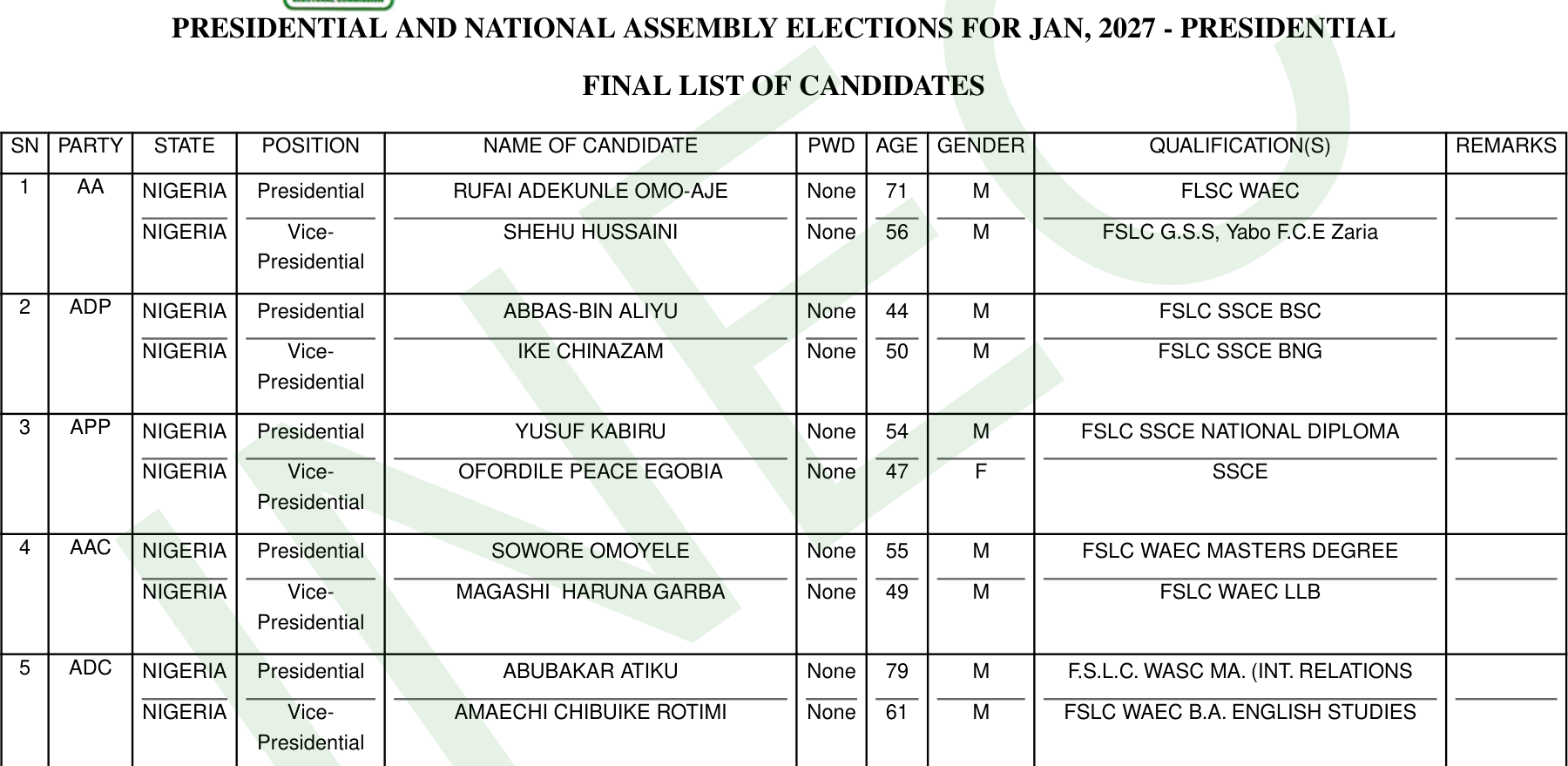
Once the withdrawal window shuts, the Act leaves those names in place. Section 37 provides that if, "after the latest time for the delivery of nomination papers and the withdrawal of candidates for an election under this Act more than one person remains validly nominated, a poll shall be taken". Section 38 requires a poll for the office of President "whether or not only one person is validly nominated". No provision of the Act read for this report lets a candidate who steps aside after the deadline transfer his place, or the votes cast for him, to another candidate. Section 34 deals with a change after that point only on a candidate's death.
The other routes Mr Lukman mentioned have earlier statutory gates. Section 81(2) requires that "Political parties intending to merge shall each give to the Commission nine months' notice of their intention to do so before a general election"; nine months before 16 January 2027 was 16 April 2026, which is 185 days before today. Section 75(1) requires an application to register a new political party to be submitted "not later than 12 months before a general election", which for this election was 16 January 2026. Mr Lukman did not say that a new party would be on the January ballot, and the Act does not stop parties from merging or forming new ones for later elections.

The record also shows what remains open. Nothing in the sections read for this report stops a candidate from campaigning for a rival, endorsing one or urging supporters to vote for one, and none of them regulates the kind of cooperation Mr Abdullahi described, including protecting votes. Mr Lukman's own account of the work, a "minimum programme of action" that a post-2027 government would carry out, needs no change to the ballot. What the documents establish is narrower: after today at the latest, any single candidate the opposition parties settle on would appear on the presidential ballot alongside the others, unless a court orders otherwise.
For the governorship and State Assembly elections the same rule gives a later date. For 6 February 2027, section 31's 90 days end on 8 November 2026, while INEC's timetable closed withdrawals and replacements on 19 September. Vero Record did not put questions to Mr Lukman, the ADC, the G100 or INEC for this report. Nothing in it suggests wrongdoing by any person, by any party or by the commission.
What this rests on
Electoral Act 2026 (Official Gazette No. 40, Vol. 113, 2 March 2026): s.31 and s.32(1), p.A21; s.33 and s.34, p.A22; s.37 and s.38, p.A23; s.75(1), p.A33; s.81(1) and (2), p.A36. INEC, Revised Timetable and Schedule of Activities for 2027 General Election, signed by Joash Amupitan, dated 26 February 2026, three page images posted on INEC's X account on 26 February 2026 (item 7 on page 2; items 9 and 14 on page 3). INEC, Presidential and National Assembly Elections for Jan, 2027, Presidential Final List of Candidates, 3 pages signed by Rose Oriaran-Anthony (file metadata: created 11 September 2026, 17:14 UTC). INEC press statement of 13 October 2026 (publication on 12 September). Supreme Court, INEC v. Zenith Labour Party, SC/CV/495/2026, 24 September 2026 (caption and orders read). PLAC, The 2027 Electoral Calendar: Factsheet, March 2026, pp.2, 5 and 7. All read for this report on 18 October 2026. Arithmetic: 18 October 2026 to 15 January 2027 inclusive = 14 (18 to 31 Oct) + 30 (Nov) + 31 (Dec) + 15 (1 to 15 Jan) = 90 days, so 18 October is the 90th day before 16 January (Python: 16 Jan 2027 minus 90 days = 18 Oct 2026, a Sunday); 90 clear days would give 17 October. 8 November 2026 to 5 February 2027 inclusive = 23 + 31 + 31 + 5 = 90. 22 August 2026 to 16 January 2027 = 9 (23 to 31 Aug) + 30 + 31 + 30 + 31 + 16 = 147 days; 22 August to 18 October = 9 + 30 + 18 = 57 days. 19 September 2026 to 6 February 2027 = 11 + 31 + 30 + 31 + 31 + 6 = 140 days; 19 September to 8 November = 11 + 31 + 8 = 50 days. 12 September 2026 to 16 January 2027 = 18 + 31 + 30 + 31 + 16 = 126 days; 16 January 2027 minus 60 days = 17 November 2026. Nine calendar months before 16 January 2027 = 16 April 2026; 16 April to 18 October 2026 = 14 + 31 + 30 + 31 + 31 + 30 + 18 = 185 days. Twelve months before 16 January 2027 = 16 January 2026. Final list tickets: 5 (p.1) + 7 (p.2) + 6 (p.3) = 18. All date differences rechecked in Python.
What this does not establish
Which deadline binds: INEC's 22 August or section 31's 18 October. The Federal High Court, Court of Appeal and Supreme Court decisions on the SDP and Youth Party suits are known to Vero Record only through press reports, which do not say clearly how the appeal courts treated the section 31 point; the judgments were not obtained. Whether a withdrawal delivered on Monday 19 October, the day after a Sunday deadline, would be accepted. Whether any presidential or National Assembly candidate withdrew between 22 August and 18 October; INEC has published no list of withdrawals. Which six parties Mr Lukman meant, and whether any candidate has agreed to step aside. The full Hard Copy interview was not viewed; Mr Lukman's words are taken from ThisDay and Tribune reports, and Mr Abdullahi's from Premium Times as quoted in other reports. How section 77(5), which limits primaries to members on a party's register, would apply to a substitution primary under section 33. Whether the names on the final list will be printed unchanged on the ballot papers. Nothing in this report suggests wrongdoing by any person, by any party or by INEC.
What we did ourselves
Took Mr Lukman's words from ThisDay's and Tribune's reports of his Hard Copy interview and the ADC's from Premium Times as quoted elsewhere. Read sections 29 to 39, 75, 77 and 81 of the gazetted Electoral Act 2026 and counted the 90-day, nine-month and 12-month limits back from 16 January and 6 February 2027. Retrieved the three signed pages of INEC's revised timetable from the commission's X post of 26 February 2026 and set item 7 against section 31, which the item itself cites. Counted the 18 tickets on INEC's signed presidential final list and checked its file data and publication date against the timetable and INEC's 13 October statement. Checked the Supreme Court's INEC v. Zenith Labour Party judgment to see whether it ruled on item 7; it does not.
Sources for this report
(A) Electoral Act 2026, sections 31, 33, 37, 38, 75 and 81; INEC Revised Timetable and Schedule of Activities for 2027 General Election (26 February 2026), item 7; INEC Presidential Final List of Candidates for the January 2027 election.
- Electoral Act, 2026 (Official Gazette No. 40, Vol. 113) · Federal Republic of Nigeria (INEC copy) · 2 March 2026
- Revised Timetable and Schedule of Activities for 2027 General Election (three signed pages) · INEC · 26 February 2026
- Issuance of Revised Timetable and Schedule of Activities for the 2027 General Election (press statement) · INEC · 26 February 2026
- Presidential and National Assembly Elections for Jan, 2027: Presidential Final List of Candidates · INEC · 12 September 2026
- Clarification on the omission of some candidates from the final list for the 2027 governorship election · INEC · 13 October 2026
- INEC v. Zenith Labour Party, SC/CV/495/2026, judgment · Supreme Court of Nigeria · 24 September 2026
- The 2027 Electoral Calendar: Factsheet (Electoral Act Series, Part 9) · Policy and Legal Advocacy Centre · March 2026
- 2027: Opposition to Name Single Presidential Candidate Before Polls, Says Lukman · ThisDay · 18 October 2026
- 2027: Consensus candidate could emerge a few days to election, G100 convener · Tribune · 18 October 2026
- 2027: G100 alliance talks not about consensus presidential candidate, ADC · Premium Times · 17 October 2026
- 2027 polls: Your timetable must comply with statutory timeframe, court tells INEC · Vanguard · May 2026
- 2027: Court voids INEC's timetable for parties' primaries, nomination of candidates · Premium Times via allAfrica · 22 May 2026
- Court of Appeal upholds INEC's 2027 election guidelines, overturns High Court ruling · Nigerian Democratic Report · 16 July 2026
- Election Guidelines: Supreme Court okays INEC's appeal, dismisses SDP, YP's suit · Sagagist (reporting the Supreme Court) · 24 September 2026
- File:Inec Awka.jpg · Wikimedia Commons (Celetex, CC BY-SA 3.0) · 5 August 2022
Confidence: high. This is our own assessment of whether the event occurred as described, separate from the grade, which describes what kind of thing the claim rests on.
Not obtained: where the underlying document is named above but not linked, we did not hold a copy at the time of publication. We purchase nothing and request nothing in our own name.
Corrections
None on this report. If you find an error, it will be published here, at the same length, with the date it was found, and the original wording will remain visible above it.

Dr VeroInvestigations editor, Vero Record
Reads the Nigerian public record that others leave unread: budgets, audit reports, court files and registers. Every claim on this page carries the grade of the document behind it, and the report says what that document does not establish.
All 124 reportsHow we grade evidenceAdd Vero Record as a preferred source on Google