
Okwori proposes 40 per cent women on every NDP list. Her party's National Assembly lists have 15 women among 92 candidates
Two days after INEC published the final 2027 candidate lists, the National Democratic Party's presidential candidate and national chairman said the party was proposing at least 40 per cent women on all its executive and candidate lists. INEC's own records put the NDP at 16.3 per cent on the National Assembly ballot, with one woman among the five national officers the commission lists. That is still a higher share than most parties.
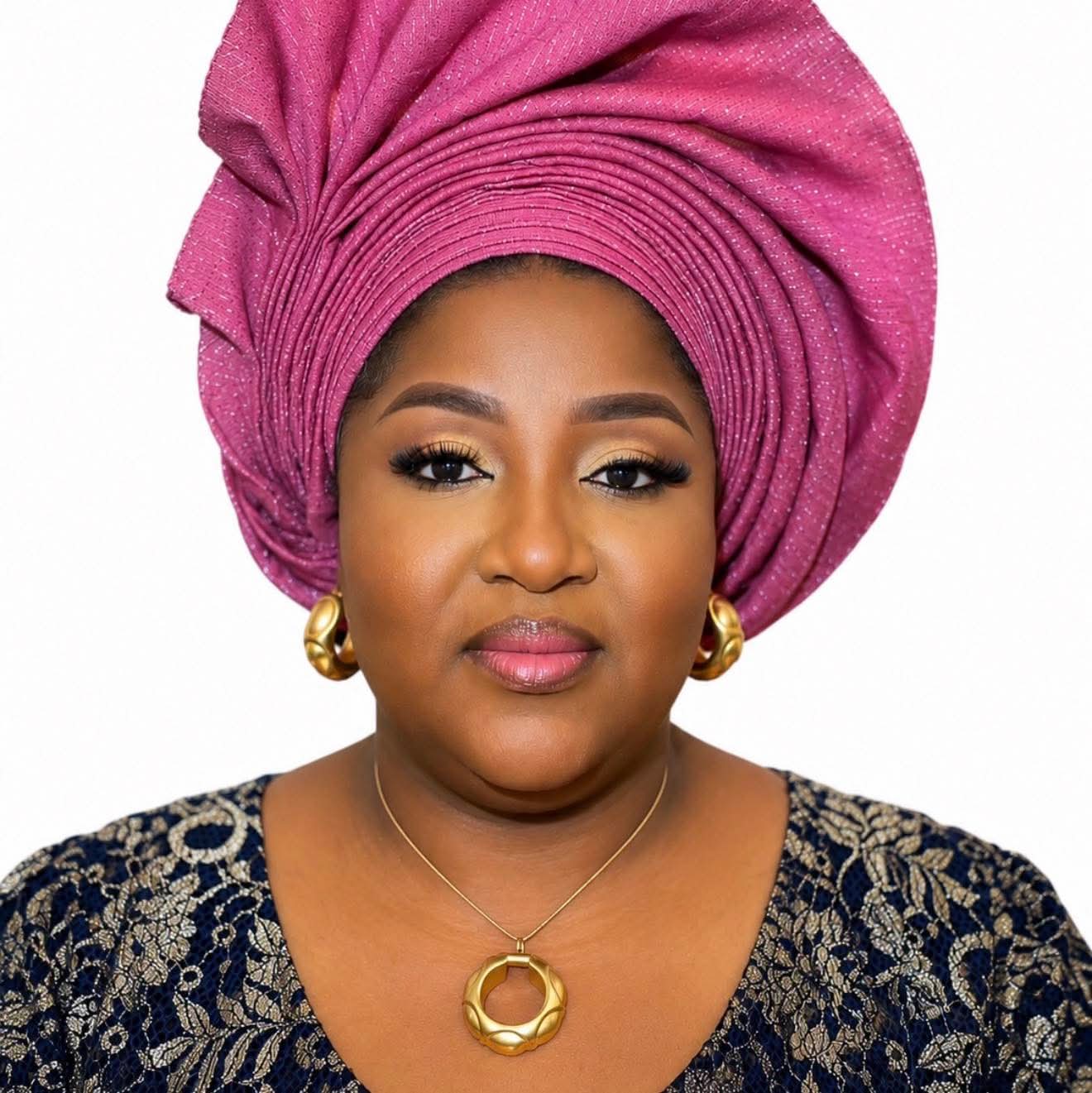
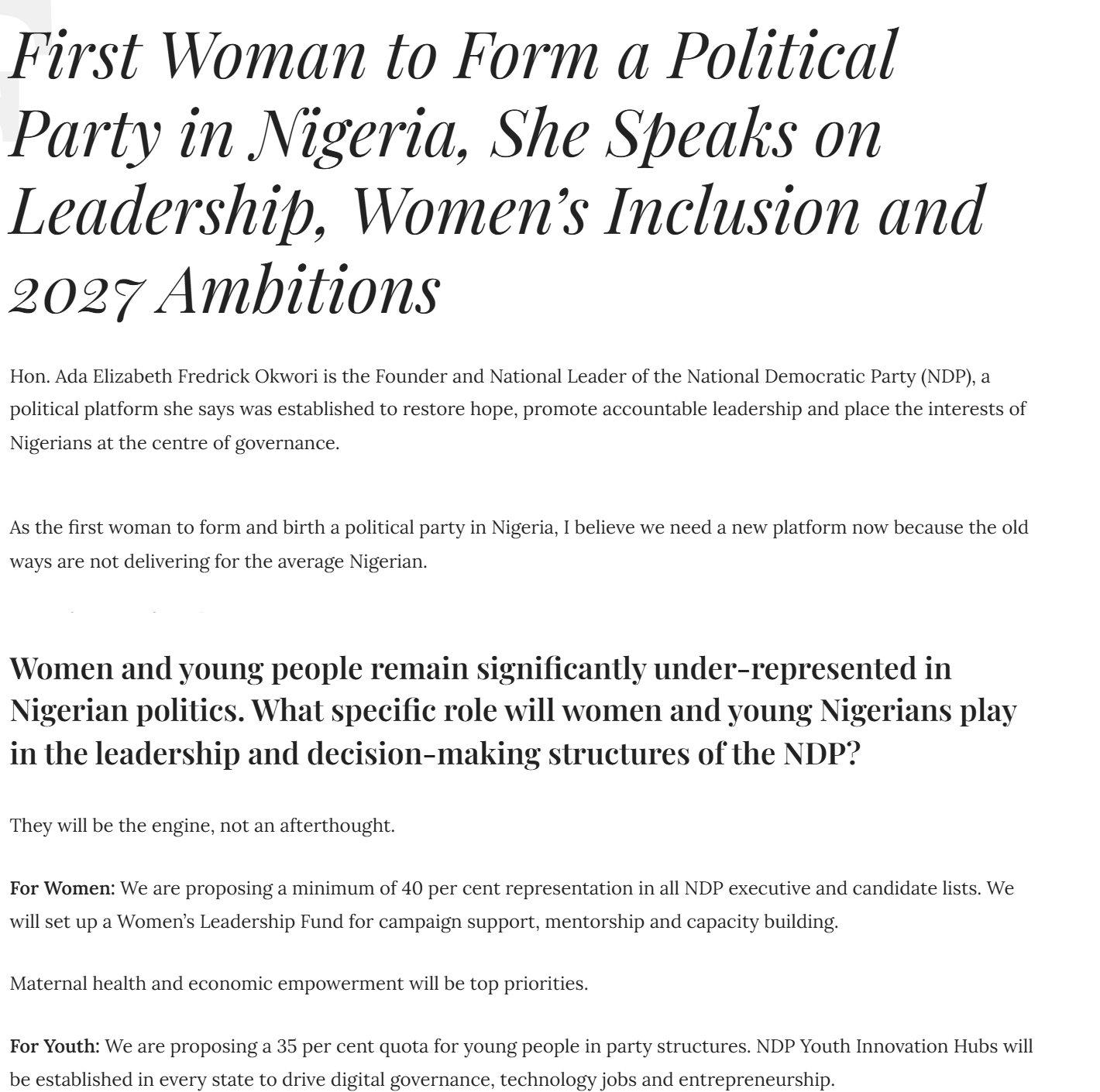
On 14 September 2026, Women News Today published a long interview with Ada Elizabeth Fredrick Okwori, the National Democratic Party's presidential candidate. Asked what role women would play in the party's leadership and decision-making structures, she answered: "For Women: We are proposing a minimum of 40 per cent representation in all NDP executive and candidate lists. We will set up a Women's Leadership Fund for campaign support, mentorship and capacity building." INEC's register of political parties lists her as the party's national chairman, "(By Court Order)".
That pledge can be checked against records the party has already filed. INEC has published signed final lists of candidates for the Senate and the House of Representatives in the January 2027 elections. The PDF files were created on 11 September 2026, and Vanguard reported that the lists were published on 12 September. Vero downloaded both lists from inecnigeria.org and read every row. Each row gives the candidate's name, constituency, party, age and a gender column filled in by the commission. Every page is signed by Rose Oriaran-Anthony, Secretary of the Commission.
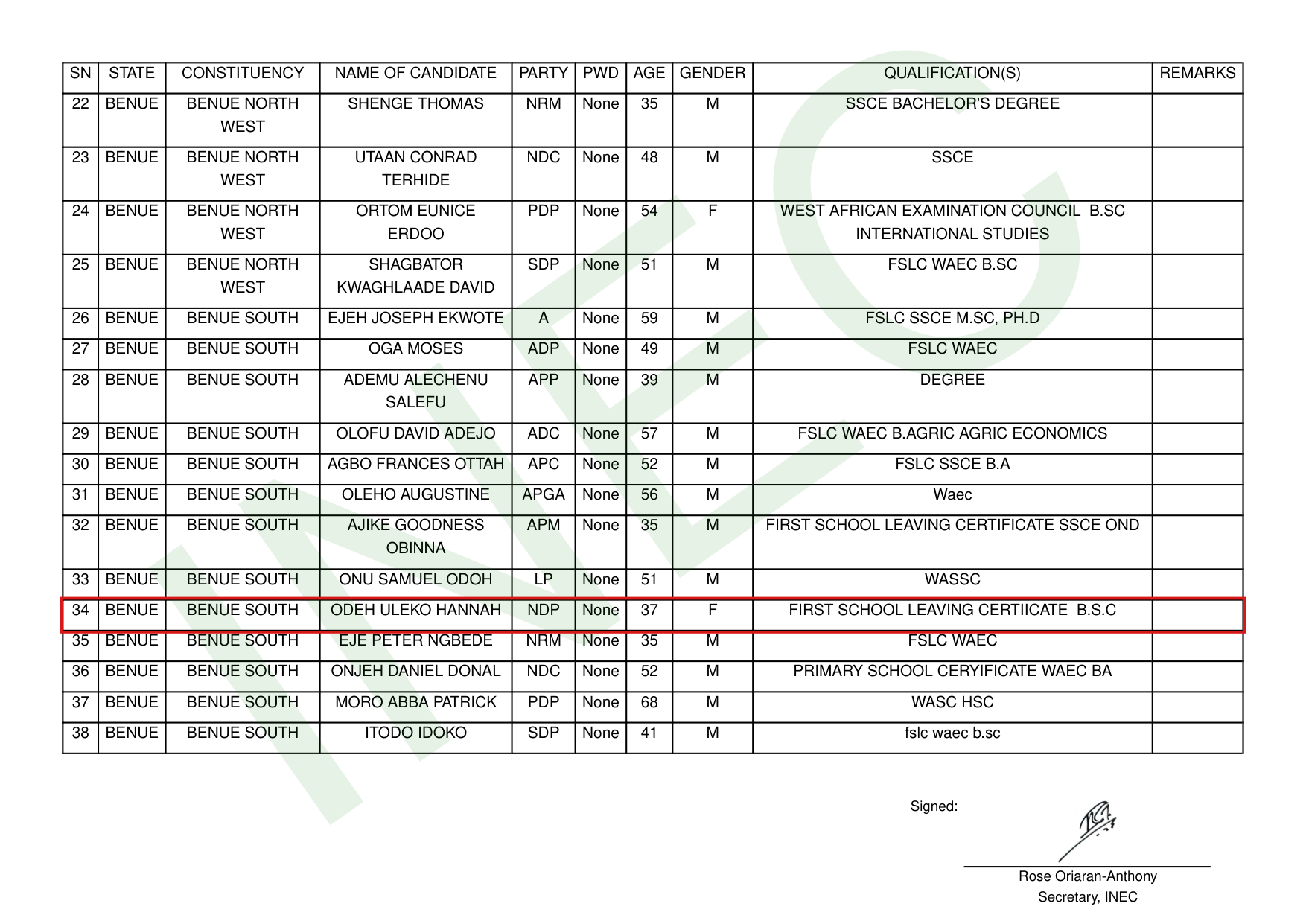
In the Senate, the NDP is fielding 32 candidates. INEC records three of them as women: Odeh Uleko Hannah, 37, in Benue South; Muhammed Jamila, 45, in Kano North; and Adediji-Ogunsanya Funmilayo Ayonade, 51, in Oyo Central. The other 29 are recorded as men.
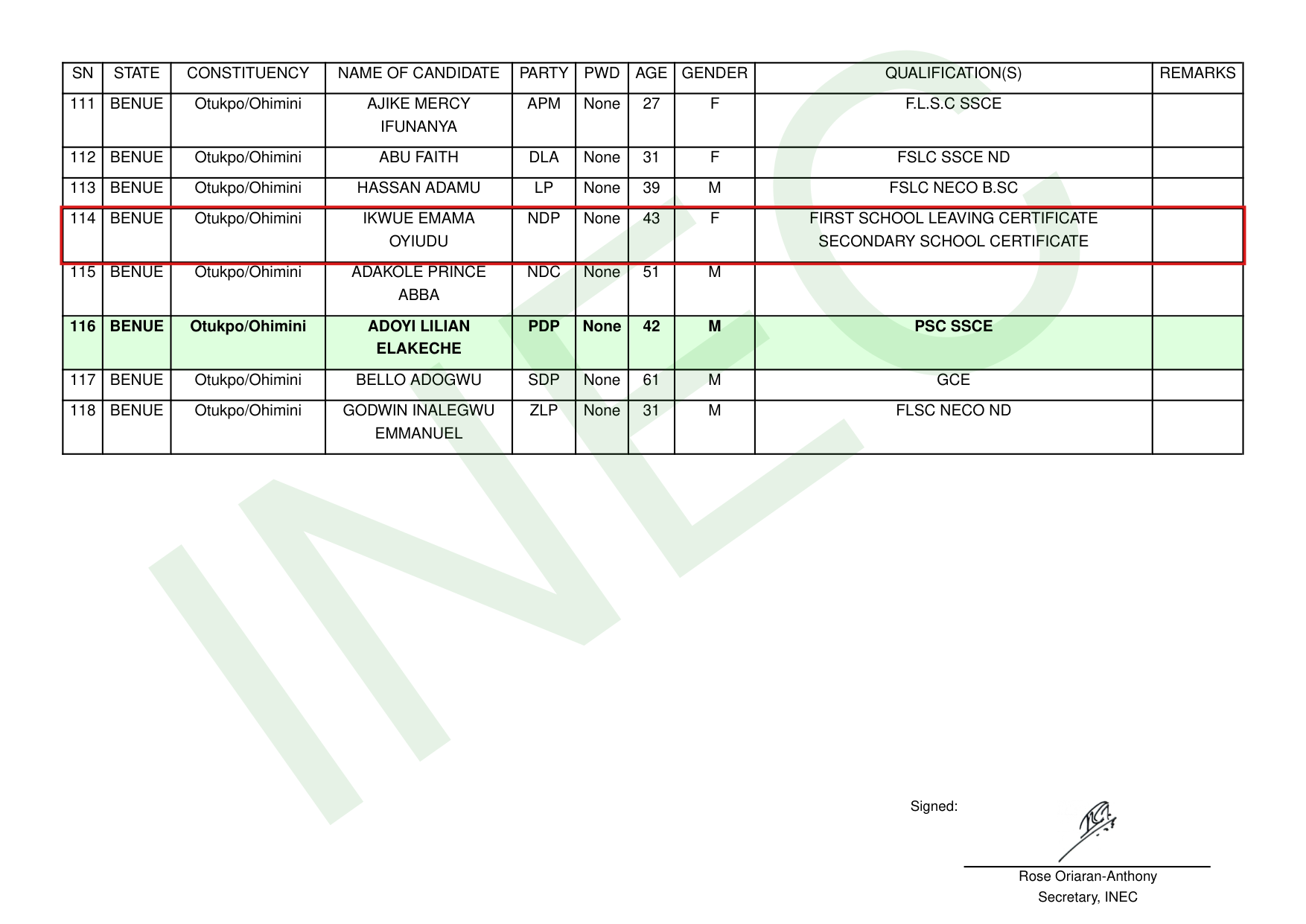
For the House of Representatives, the NDP is fielding 60 candidates, and INEC records 12 of them as women. Two are in Anambra (Awka North/Awka South and Orumba North/Orumba South), five in Benue (Ado/Ogbadigbo/Okpokwu, Apa/Agatu, Kwande/Ushongo, Oju/Obi and Otukpo/Ohimini), two in Imo, one in Rivers and two in Sokoto. The other 48 are recorded as men.
Taken together, that is 15 women among 92 National Assembly candidates, or 16.3 per cent. This is Vero's own arithmetic from INEC's rows. To meet a 40 per cent minimum, the same 92 slots would need at least 37 women, 22 more than the lists carry. Adding the presidential ticket, where Okwori runs with Chukwuemeka Uchenna Anthony, the figure is 16 women among 94 NDP candidates, or 17.0 per cent.
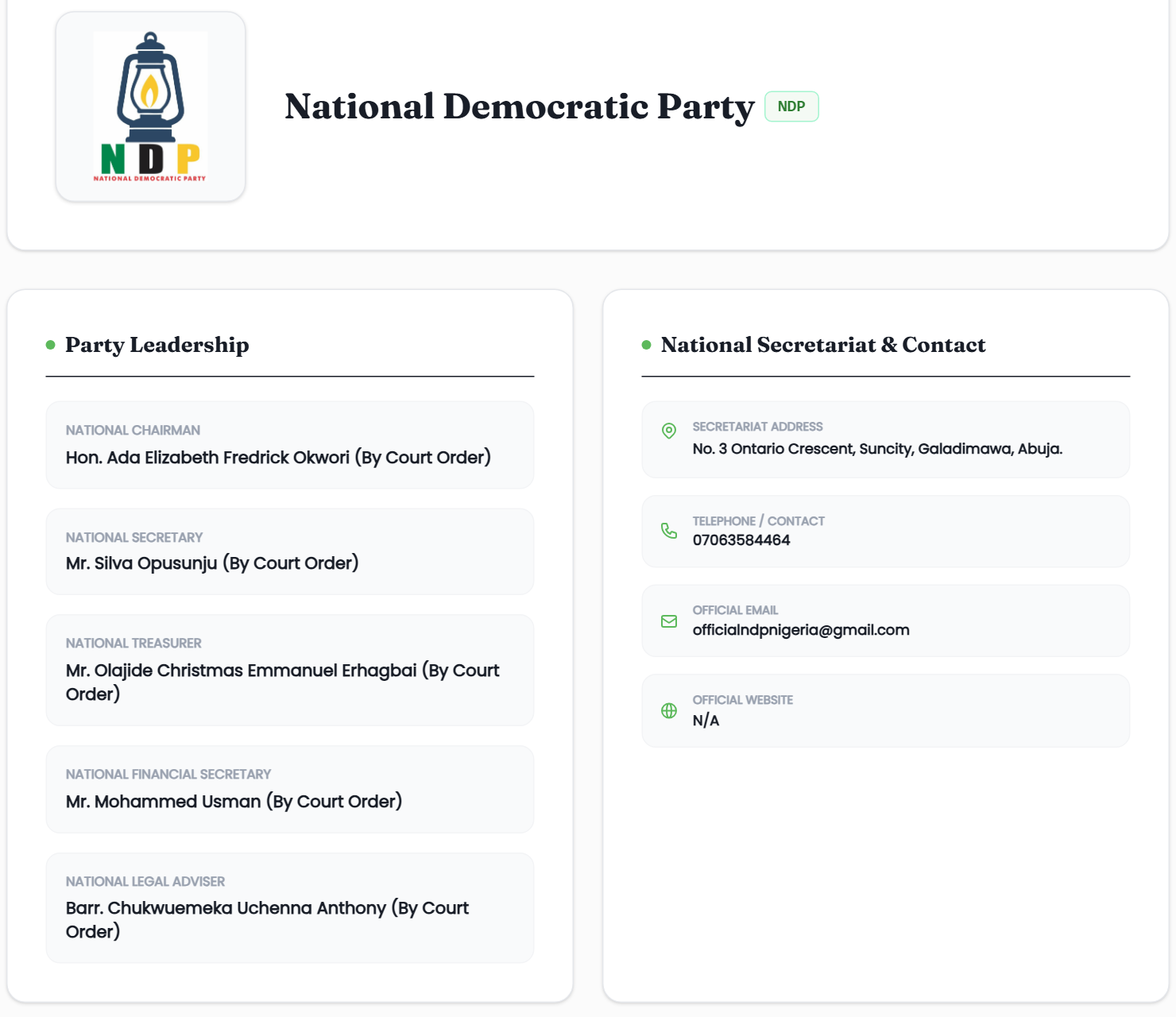
The executive side of the pledge is harder to test, because INEC publishes only five national officers for each party. For the NDP, the commission's party page lists them all "(By Court Order)": Hon. Ada Elizabeth Fredrick Okwori, national chairman; Mr. Silva Opusunju, national secretary; Mr. Olajide Christmas Emmanuel Erhagbai, national treasurer; Mr. Mohammed Usman, national financial secretary; and Barr. Chukwuemeka Uchenna Anthony, national legal adviser. The legal adviser is also her running mate on INEC's presidential list. One of the five is a woman, which is 20 per cent. We found no public record of who sits on the party's wider national or state executives, so we cannot measure the pledge against those bodies.
The timing matters, and so does her wording. The interview came out two days after the commission published the final lists, so the NDP's first set of candidates was already fixed when she spoke. She said the party was "proposing" the 40 per cent minimum, and that can reasonably be read as a rule for future lists rather than a description of the current ones. We are not saying she misdescribed the lists her party filed. The record shows how far the lists now on the ballot fall short of the standard she set out.
The same record also counts in her favour. Across all 4,863 rows on the two National Assembly lists, INEC records 469 women, or 9.6 per cent. The NDP's 16.3 per cent ranks fifth of the 22 parties. In the House of Representatives, its 20.0 per cent is the highest of any party. The next is the African Action Congress at 18.0 per cent. For comparison, the All Progressives Congress is at 7.0 per cent across both chambers, the Peoples Democratic Party at 7.2 per cent, the Nigeria Democratic Congress at 5.8 per cent, the African Democratic Congress at 5.7 per cent and the Labour Party at 12.2 per cent. In the Senate, the NDP's 9.4 per cent is almost exactly the field average of 9.4 per cent (123 women among 1,303 candidates).
Most of the NDP's women are concentrated in one place. Five of its six House candidates in Benue, Okwori's home state, are women, including Ikwue Emama Oyiudu, 43, in Otukpo/Ohimini. Outside Benue, the party has seven women among 54 House candidates, or 13.0 per cent.
The law gives a party limited room to impose a quota. Section 84(2) of the Electoral Act 2026 says candidates are nominated by direct primaries or consensus. Section 87 requires that a consensus candidate have the written consent of every cleared aspirant. Section 85 says a party "shall not impose nomination, qualification or disqualification criteria, measures, or conditions on any aspirant or candidate" beyond those in the Constitution. Whether a 40 per cent minimum for women could be enforced within those provisions is a legal question, and we do not answer it. It is one reason a party's list may not match what its leaders intend. Apart from press reports that Okwori herself emerged by consensus, we found no public record of how the NDP ran its primaries.
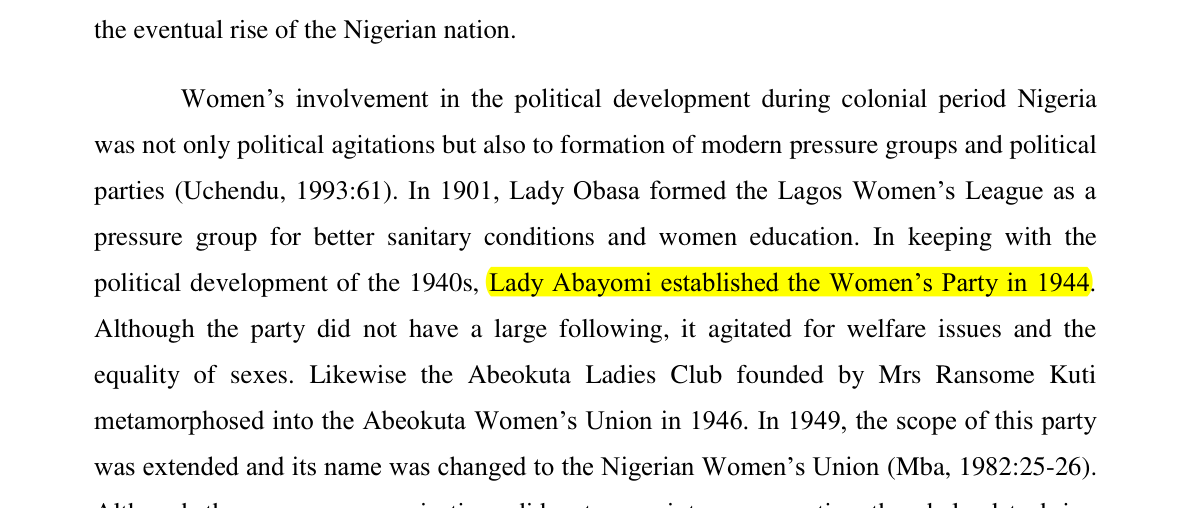
The interview also carries a second claim, and it runs in the headline Women News Today gave the piece: "First Woman to Form a Political Party in Nigeria". In the text, Okwori says: "As the first woman to form and birth a political party in Nigeria, I believe we need a new platform now." A conference paper on women and Nigerian politics by Titilope Olusegun Olalere of McPherson University, held in INEC's own online library of conference papers, says: "Lady Abayomi established the Women's Party in 1944." The paper adds that the party did not have a large following. This is a historian's account, not a 1940s record, and we have not examined colonial-era sources. The claim might be meant more narrowly, for example as the first woman to found a party registered by INEC under the present constitution. The interview does not say that, and we have not been able to confirm whether that narrower version is true.
The NDP exists as a registered party because of a court case that Okwori led. The Guardian and TheCable report that on 16 February 2026, Justice M. G. Umar of the Federal High Court in Abuja ruled in suit FHC/ABJ/CS/2796/2025, filed by Okwori and three others. The court set aside INEC's letter of 18 December 2025 refusing registration and ordered the commission to register the party. INEC's register now lists the NDP as a recognised party.
Our counts depend on INEC's gender column, and that column has flaws. Elsewhere in the lists, some rows record a gender that looks inconsistent with the candidate's first names. For example, on page 59 of the House list, the Peoples Democratic Party's Otukpo/Ohimini candidate, Adoyi Lilian Elakeche, is recorded as M. We checked each of the NDP's 92 rows by name and found none that suggested an error, but the totals for the whole field rest on the commission's entries. The Guardian has reported a different overall figure of 443 women among 4,408 National Assembly candidates. Our totals come from the lists as they stood on inecnigeria.org on 1 October 2026, and we cannot say which version The Guardian counted.
We have not yet put these figures to Okwori or the NDP. INEC's register gives the party's contact as a telephone number and a Gmail address. This report will be updated with any response.
Here is what this record does not establish. It does not show that Okwori or the NDP broke any law or party rule. No statute requires a party to field a set share of women, and the pledge was stated as a proposal. It does not tell us who sits on the NDP's executives beyond the five national officers INEC lists. It also does not explain why the lists came out as they did. What it does show is that the lists INEC has published for Okwori's party contain 15 women among 92 National Assembly candidates, well below the 40 per cent she proposed and still above the average for the field.
What this rests on
Two things are set side by side. The first is the candidate's own words in a published interview (press, grade B): "a minimum of 40 per cent representation in all NDP executive and candidate lists". The second is INEC's signed Senate and House final lists and its party register, which Vero downloaded and read in full (grade A). The counts of women (15 of 92, 1 of 5 officers), the field comparison (469 of 4,863), the party ranking and the Benue split are Vero's own arithmetic from INEC's gender column (grade C, labelled as ours). The 1944 Women's Party point rests on a secondary academic paper hosted by INEC (B). The court background rests on press reports (B).
What this does not establish
The record does not show any breach of law or party rule. The 40 per cent figure was stated as a proposal, and no statute requires a gender share on party lists. It does not show who sits on the NDP's wider national or state executives. It does not explain why the lists turned out as they did, or how the NDP ran its primaries. It does not settle whether a quota could lawfully be enforced under section 85 of the Electoral Act 2026. It does not prove or disprove a narrower reading of the 'first woman to form a political party' claim, and we have not examined 1940s primary sources on Lady Abayomi's Women's Party. INEC's gender column has visible errors elsewhere in the lists. NDP rows were checked by name, but the field totals rely on INEC's entries. The candidate and party have not yet been asked to respond.
What we did ourselves
We downloaded INEC's signed Senate and House final lists (1,303 and 3,560 rows), extracted every row and counted by party and gender. We checked all 92 NDP rows by name, set the result against the candidate's own interview pledge and INEC's register of NDP national officers, and ranked all 22 parties. Along the way we found that a 1944 women's party is recorded in a paper in INEC's own conference-paper library, and we set it against her 'first woman to form a political party' claim.
Sources for this report
(B) INEC, "Presidential and National Assembly Elections for Jan, 2027 - Senatorial District: Final List of Candidates" and "- House of Representatives: Final List of Candidates", signed by Rose Oriaran-Anthony, Secretary, INEC (PDFs created 11 September 2026), downloaded from inecnigeria.org/documents/press/ on 1 October 2026. NDP rows: Senate 32 candidates, 3 recorded F; House 60 candidates, 12 recorded F. INEC party register page for the National Democratic Party: five national officers, one woman. INEC presidential final list, entry 11. Electoral Act 2026, sections 84, 85 and 87. The pledge comes from Women News Today, 14 September 2026 (press, B).
- Presidential and National Assembly Elections for Jan, 2027 - Senatorial District: Final List of Candidates · Independent National Electoral Commission · 2026-09-11
- Presidential and National Assembly Elections for Jan, 2027 - House of Representatives: Final List of Candidates · Independent National Electoral Commission · 2026-09-11
- Presidential and National Assembly Elections for Jan, 2027 - Presidential: Final List of Candidates · Independent National Electoral Commission · 2026-09-11
- INEC statutory notices index for the 2027 final lists · Independent National Electoral Commission
- National Democratic Party - Registered Political Party · Independent National Electoral Commission · 2026-10-01
- Meet Female Founder, National Democratic Party - Ada Elizabeth Fredrick Okwori · Women News Today · 2026-09-14
- Electoral Act, 2026 · National Assembly of Nigeria · 2026
- Women and Nigerian Politics: An Appraisal of 2015 General Elections (Titilope Olusegun Olalere) · INEC conference papers (author: McPherson University) · 2015-07
- 2027: Meet two women in race against Tinubu, Atiku, Obi · Vanguard · 2026-09-19
- Meet the women seeking Nigeria's presidency · Daily Trust · 2026-08-25
- 2027: Only Two Women Among 18 Presidential Candidates · The Guardian (Nigeria) · 2026-09-28
- NDP hails court ruling ordering INEC to register party · The Guardian (Nigeria) · 2026-02-20
- Court orders INEC to register National Democratic Party · TheCable · 2026-02-19
Confidence: high. This is our own assessment of whether the event occurred as described, separate from the grade, which describes what kind of thing the claim rests on.
Not obtained: where the underlying document is named above but not linked, we did not hold a copy at the time of publication. We purchase nothing and request nothing in our own name.
Corrections
None on this report. If you find an error, it will be published here, at the same length, with the date it was found, and the original wording will remain visible above it.