Campaigns for 2027 opened legally on 19 August and 9 September: the Electoral Act's 150-day rule puts APC governors' planned outings inside the window
On 4 October the Progressive Governors' Forum chairman, Hope Uzodimma, was reported as saying APC governors would begin campaign outings almost immediately. Vero Record counted the days in section 98 of the Electoral Act 2026 against the election dates on INEC's own calendar. Public campaigning for the 16 January 2027 presidential and National Assembly polls has been lawful since 19 August 2026, and for the 6 February 2027 governorship and State Assembly polls since 9 September 2026. Outings now fall inside the legal window. INEC's revised timetable document itself could not be retrieved for this check.
On Sunday, 4 October 2026, the chairman of the Progressive Governors' Forum, Imo State Governor Hope Uzodimma, was reported as saying that governors elected on the platform of the All Progressives Congress (APC) would begin campaign outings almost immediately. The Independent National Electoral Commission (INEC) was reported the same day as saying it would keep Nigerians updated as the 100-day countdown to the 2027 general election began. Vero Record did not hear either statement and relies on press accounts for the wording. The question tested here is narrower: on the documents, when does the law allow public campaigning to begin?
The answer is in section 98(1) of the Electoral Act 2026, on page 44 of the Act as published by INEC. It reads: "For the purpose of this Act, the period of campaigning in public by every political party shall commence 150 days before polling day and end 24 hours prior to that day." The rule is a count backwards from each polling day, so it gives two different opening dates for 2027, one for each round of elections.

INEC's election calendar page, as saved from inecnigeria.org on 4 October 2026, lists two upcoming general election dates. The first is 16 January 2027, for the round the page labels "Presidential / House Of Assembly Election", nationwide. INEC's statutory notices for that round are headed "Presidential and National Assembly Elections for Jan, 2027" and cover the presidential, Senate and House of Representatives contests, so this is the presidential and National Assembly round; the words "House Of Assembly" on the calendar page appear to be a labelling slip. The second date is 6 February 2027, for the governorship and State House of Assembly elections.
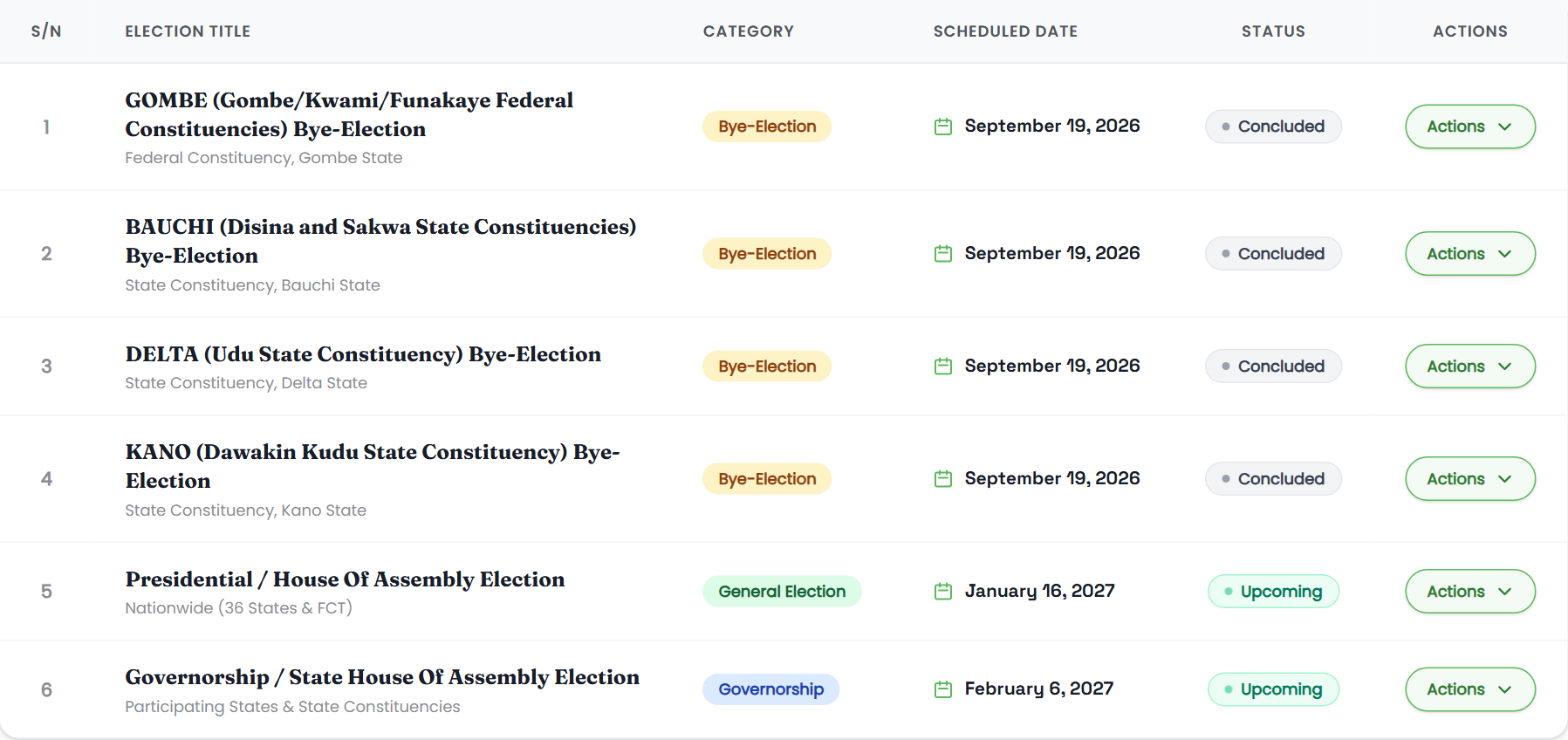
Counting 150 days back from 16 January 2027 gives 19 August 2026. The count, month by month: 12 days from 19 to 31 August, 30 in September, 31 in October, 30 in November, 31 in December and 16 in January, a total of 150. Counting back from 6 February 2027 gives 9 September 2026: 21 days from 9 to 30 September, then 31, 30, 31 and 31 days for October to January, and 6 in February, again 150.
On those counts, public campaigning for the presidential and National Assembly elections had been lawful for 46 days as of 4 October 2026 (12 days in August, 30 in September and 4 in October). For the governorship and State Assembly elections it had been lawful for 25 days (21 in September and 4 in October). Campaign outings by governors, or by any party, from 4 October onward therefore fall inside the period section 98(1) allows. On timing, the record supports what Mr Uzodimma was reported to have announced.
The window closes 24 hours before each polling day. For the 16 January polls, campaigning must stop by the start of 15 January 2027, which makes 14 January the last full day; for the 6 February polls, 4 February is the last full day. The factsheet published in March 2026 by the Policy and Legal Advocacy Centre (PLAC), "The 2027 Electoral Calendar", gives the same four dates: commencement on 19 August 2026 and 9 September 2026, and last day of campaigns on 14 January 2027 and 4 February 2027.
The "100-day countdown" is a round figure. From 4 October 2026 to 16 January 2027 is 104 days: 27 days to the end of October, 30 in November, 31 in December and 16 in January. To 6 February 2027 it is 125 days.
One provision complicates a simple reading. The interpretation section of the Act, on page 70, defines "campaigning in public" as "the campaign that commences after the publication of the notice of election by the Commission under section 28 of this Act". The definition says it applies to the phrase as used in section 99, although the phrase actually appears in section 98. INEC has published statutory notices for the January 2027 elections on its website. Vero Record did not establish the date each notice was first published, and so cannot say whether the notices came before or after 19 August and 9 September. By 4 October, on the material seen, both the 150-day mark and the notices for the January round were in place.

The 150-day rule is not new. PLAC's factsheet records that the Electoral Act 2022 set the same period in its section 94(1), and that the 2026 Act retained it in section 98(1). PLAC's criticism is of the sequence: under the 2026 Act campaigns may open 150 days before polling day while nominations close 120 days before it, so campaigning can begin before the last nomination deadline. That is a point about the law's design, not about any party's conduct.
On penalties, the Act as written attaches no fine to section 98(1) itself. Section 98(2) makes it an offence for a registered party, through anyone acting for it, to advertise on broadcast facilities or procure a newspaper advertisement promoting or opposing a candidate in the 24 hours before polling day, punishable on conviction by "a maximum fine of N2,000,000". Section 100 separately makes it an offence for any person or medium to publish campaign material within 24 hours before or on polling day, with a fine of between N3,000,000 and N5,000,000 for a body corporate, and for an individual the same fine or six months' imprisonment or both. Section 99(1) requires parties and candidates to campaign under rules and regulations set by INEC.
No party is shown by these documents to have campaigned outside the legal period, and none is accused of doing so here. What the documents establish is that, on the election dates INEC has fixed, the statutory window for public campaigning is already open for every office on the 2027 ballot.
What this rests on
Electoral Act 2026 s.98(1), p.44: campaigning in public starts 150 days before polling day, ends 24 hours before. INEC calendar page (saved 4 Oct 2026): 16 Jan 2027 and 6 Feb 2027. 16 Jan 2027 minus 150 days = 19 Aug 2026 (12 + 30 + 31 + 30 + 31 + 16 = 150). 6 Feb 2027 minus 150 days = 9 Sep 2026 (21 + 31 + 30 + 31 + 31 + 6 = 150). Days lawful by 4 Oct: 12 + 30 + 4 = 46 (January round); 21 + 4 = 25 (February round). 4 Oct 2026 to 16 Jan 2027 = 27 + 30 + 31 + 16 = 104 days; to 6 Feb 2027 = 104 + 15 + 6 = 125. Last full campaign days 14 Jan and 4 Feb 2027, matching PLAC's factsheet. Penalties quoted from s.98(2) and s.100(3) as printed.
What this does not establish
INEC's Revised Timetable and Schedule of Activities for the 2027 General Election was not retrieved; only INEC's 27 March 2026 release referring to it was seen, so any campaign-start date INEC itself printed is not confirmed here. The publication dates of INEC's section 28 notices were not established. The Electoral Act 2022 text was not read directly; the comparison rests on PLAC's factsheet. The wording of Mr Uzodimma's and INEC's 4 October statements comes from press accounts not independently checked. The documents do not establish whether any specific event was or will be lawful under INEC campaign regulations or other laws.
What we did ourselves
Counted the 150-day period backwards from each INEC polling date, month by month; counted days elapsed and days remaining from 4 October 2026; read the Act's penalty clauses and definition of campaigning in public; set the result against PLAC's independent calendar.
Sources for this report
(A) Electoral Act 2026, sections 98 to 100 and interpretation section (INEC copy); INEC Full Election Calendar and Timetable page, inecnigeria.org/elections/calendar, saved 4 October 2026.
- Electoral Act 2026 · National Assembly (INEC copy) · 2026
- Full Election Calendar and Timetable · INEC · 2026-10-04
- Re: Revised Timetable and Schedule of Activities for 2027 General Election · INEC · 2026-03-27
- Presidential and National Assembly Elections for Jan, 2027 - Presidential (statutory notice) · INEC
- The 2027 Electoral Calendar: Factsheet (Electoral Act Series, Part 9) · Policy and Legal Advocacy Centre · 2026-03
- File:CITY SCAPE, OWERRI.jpg · Wikimedia Commons (Emeka Okechukwu, CC BY-SA 4.0)
Confidence: high. This is our own assessment of whether the event occurred as described, separate from the grade, which describes what kind of thing the claim rests on.
Not obtained: where the underlying document is named above but not linked, we did not hold a copy at the time of publication. We purchase nothing and request nothing in our own name.
Corrections
None on this report. If you find an error, it will be published here, at the same length, with the date it was found, and the original wording will remain visible above it.

Dr VeroInvestigations editor, Vero Record
Reads the Nigerian public record that others leave unread: budgets, audit reports, court files and registers. Every claim on this page carries the grade of the document behind it, and the report says what that document does not establish.
All 93 reportsHow we grade evidenceAdd Vero Record as a preferred source on Google