The N1,350 petrol ceiling is set on landing cost, the yardstick NNPC used for N7.13tn of under-recovery charged to the Federation in 2024
The speech the Finance Ministry published on 8 October says the government is negotiating a N1,350 a litre ceiling on the ex-gantry or landing cost of petrol, with refiners and importers carrying any shortfall and recovering it later. NNPC's 2025 accounts define the old petrol subsidy as the gap between landing cost and the regulated price, charged to the Federation under Section 64(m) of the Petroleum Industry Act and netted against royalties, taxes and dividends. The speech does not say whether NNPC's own share would be treated that way. The 30-day limit applies to an NNPC pump discount, not to the ceiling, and the 2026 budget and its framework provide nothing for either, consistent with the minister's account.
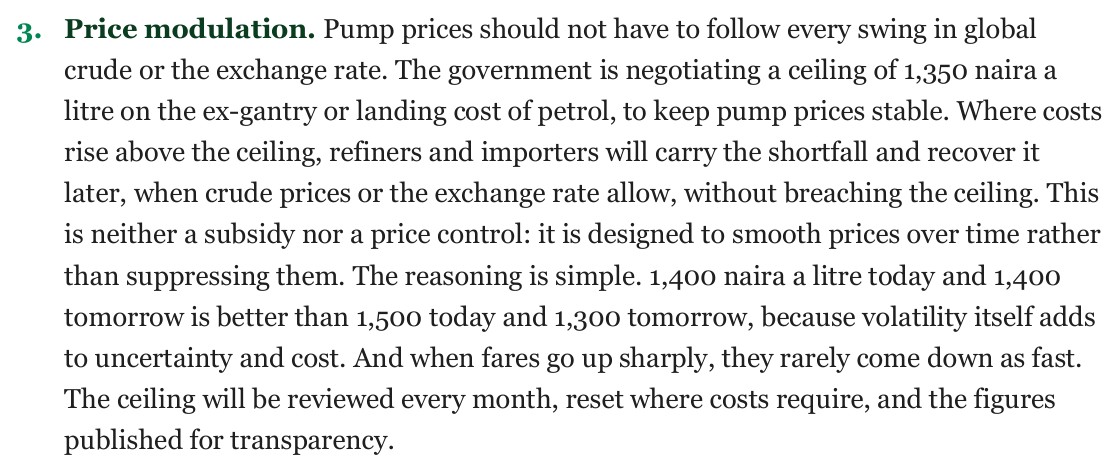
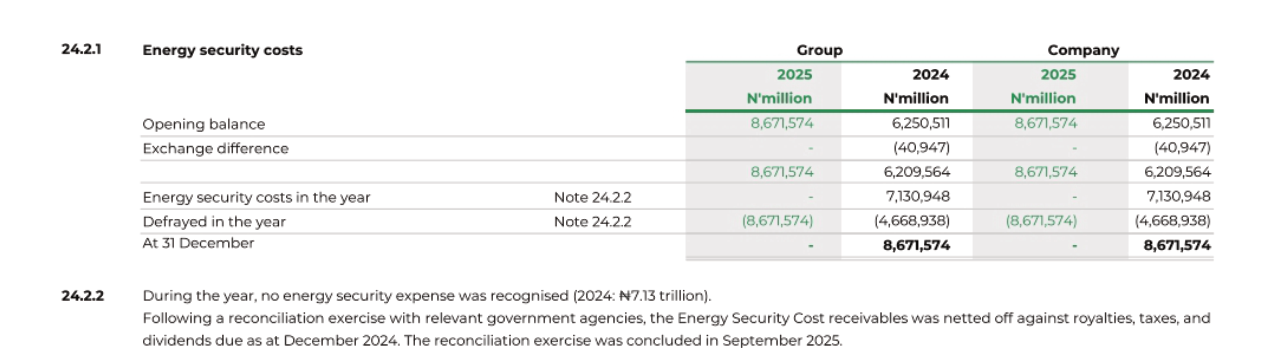
On Thursday the Minister of Finance, Taiwo Oyedele, said the Federal Government is negotiating a ceiling of N1,350 a litre "on the ex-gantry or landing cost of petrol". Where costs rise above it, says the speech his ministry published the same evening, "refiners and importers will carry the shortfall and recover it later, when crude prices or the exchange rate allow, without breaching the ceiling. This is neither a subsidy nor a price control." NNPC Ltd's audited accounts for 2025 measure the petrol subsidy of earlier years against the same yardstick. Their accounting policy defines under-recovery as "the difference between the actual landing cost of the product and the regulated price", a cost the Petroleum Industry Act places on the account of the Federation. In 2024 NNPC recognised N7,130,948 million of it, about N19.48 billion a day. Both arrangements deal with the same gap between landing cost and selling price. What separates them is who carries that gap and who pays it back, and the speech answers only part of that question.
The ministry posted the seven-page speech, "Fuel Prices and the Subsidy Question", and a 19-slide presentation on finance.gov.ng on 8 October; both files were created that evening. Vero Record downloaded and read them, and set them against five primary records: NNPC Ltd's 2025 Annual Financial Report, the Petroleum Industry Act 2021 as printed in the Official Gazette, the 2026 Appropriation Act, and the Budget Office's Medium-Term Expenditure Frameworks for 2026 to 2028 and for 2023 to 2025.
The speech is precise about the mechanism and silent on its terms. The ceiling is not yet in force: the text says the government "is negotiating" it, and slide 16 describes "A negotiated N1,350 a litre ceiling on ex-gantry or landing cost, reviewed monthly". Neither document names the parties to the negotiation, a start date, the volumes covered, the body that would administer the ceiling or the instrument under which it would operate. The ceiling applies to the cost at the depot gantry or at landing, not to the pump price, so a published headline saying the government had fixed the "petrol price at N1,350/L" goes further than the text. Nor is the ceiling limited to 30 days. The 30 days in the speech belong to a separate measure, "a discount on petrol dispensed by NNPC Limited for the next 30 days, with priority for public transporters nationwide", whose size is not stated. The ceiling has no end date; it "will be reviewed every month, reset where costs require, and the figures published for transparency."
The government's reasoning is set out in the same passage. The ceiling is "designed to smooth prices over time rather than suppressing them", because "1,400 naira a litre today and 1,400 tomorrow is better than 1,500 today and 1,300 tomorrow", and "when fares go up sharply, they rarely come down as fast." Read as written, the mechanism is a deferral, not a payment. While costs are above N1,350, buyers at the gantry would pay less than cost; when costs fall below it, suppliers would recover the difference. The text does not say how, but the words "without breaching the ceiling" indicate that recovery would come through prices at or below N1,350. No public money appears in that description, and on that design the minister's statement that the ceiling is not a subsidy is consistent with his own text.
The speech does not estimate how large the carried shortfall could become, but its own figures give a scale. Nigeria consumes "roughly 50 million litres of petrol a day", the minister said. If the ceiling covered all of that volume, every N1 a litre by which landing costs exceeded N1,350 would add N50 million a day to what refiners and importers carry, or N1.5 billion over a 30-day review period. A gap of N50 a litre would come to N2.5 billion a day and N75 billion a month. The speech does not say what happens to a balance that has not been recovered when the ceiling is reset, or if costs do not fall.
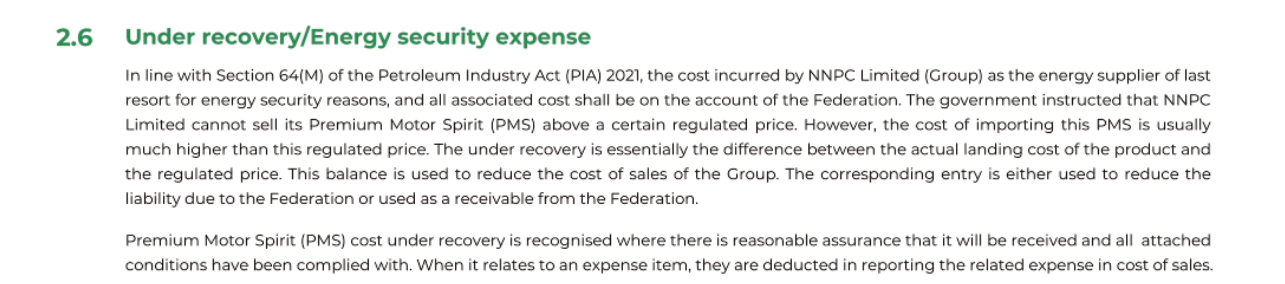
NNPC's accounts show how the earlier gap was handled. Accounting policy 2.6, on page 49 of the 2025 Annual Financial Report, says that "the government instructed that NNPC Limited cannot sell its Premium Motor Spirit (PMS) above a certain regulated price", that "the cost of importing this PMS is usually much higher than this regulated price", and that the under-recovery is "either used to reduce the liability due to the Federation or used as a receivable from the Federation." The policy rests on Section 64(m) of the Petroleum Industry Act, which on page A175 of the Gazette lists among NNPC Ltd's objects to "make NNPC Limited supplier of last resort for security reasons and all associated costs shall be for the account of the Federation."
Note 24.2.1 on page 106 follows that receivable through 2024: an opening balance of N6,250,511 million, an exchange difference of minus N40,947 million, N7,130,948 million of energy security costs added in the year and N4,668,938 million defrayed, leaving N8,671,574 million. Note 24.2.2 records that no such expense was recognised in 2025 and that the balance "was netted off against royalties, taxes, and dividends due as at December 2024", in a reconciliation concluded in September 2025. The gap was, in the end, settled out of money due to the Federation. That is the route the minister's design is meant to avoid, and on paper it does, by assigning the shortfall to "refiners and importers". But NNPC Ltd is itself an importer and seller of petrol, and the speech does not say whether NNPC's share of any shortfall under the ceiling would stay on its own books or, as in 2024, be charged to the Federation under Section 64(m).
The speech cites no provision of the Petroleum Industry Act. Section 205(1), on page A259, provides that "wholesale and retail prices of petroleum products shall be based on unrestricted free market pricing conditions." Under Section 205(2), the Nigerian Midstream and Downstream Petroleum Regulatory Authority may regulate a licensee's prices only where it "determines that a particular licenced activity is a monopoly service or a service by an excessively dominant supplier", and Section 207 then requires it to let the seller "recover reasonably and prudently incurred costs". Section 206 leaves wholesale prices to be negotiated "directly between the parties on an arm's length basis". On the Act's wording, a ceiling that refiners and importers agree to, as the speech describes, would not need a determination under Section 205(2); a ceiling imposed on them would. The speech does not say which it will be, or whether the Authority will issue any instrument.
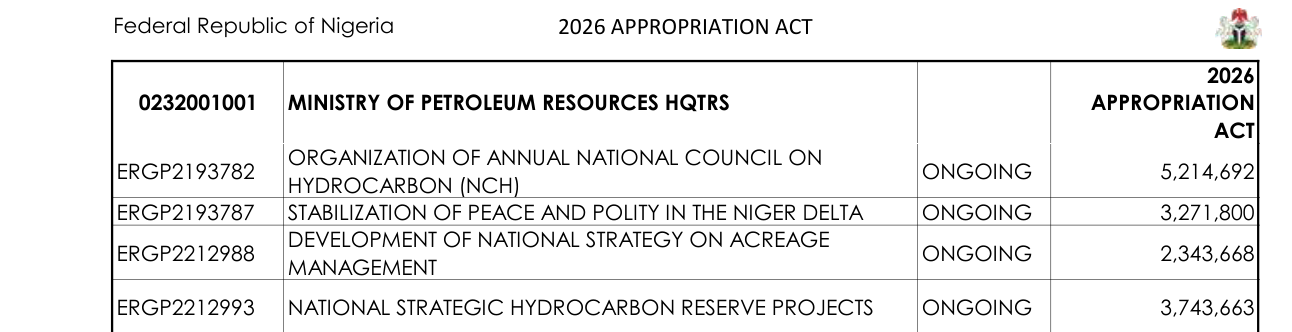
Nothing in the 2026 budget provides for the ceiling, which is consistent with a design that keeps it off the public account. The Service Wide Vote in the 2026 Appropriation Act, N12,827,451,533,171 in total, has no line for petrol price support, under-recovery or price modulation; its general contingency lines are N36,000,000,000 for overheads and N200,000,000,000 for capital. The Ministry of Petroleum Resources receives N73,187,986,053 (N52,228,859,051 for personnel, N5,839,381,814 for overheads and N15,119,745,188 for capital). The only line in the Act that names a strategic petroleum reserve is in that ministry's headquarters budget on page 1457: "National Strategic Hydrocarbon Reserve Projects", N3,743,663. The ninth of the minister's ten further steps says "the Federal Government is investing in a National Strategic Fuel Reserve", without saying how it will be paid for. The Act does not require it to be budgeted: Section 209 lets the regulator impose the keeping of strategic stock on licensees as a public service obligation, "for which the Authority shall approve a tariff to be paid by the consumers."
The framework on which the 2026 budget rests assumed no petrol subsidy, and prices well below today's. The 2026-2028 Medium-Term Expenditure Framework expects the pump price to "hover on average around N910.00 per litre and N970.00 per litre" from 2026 to 2030 (page 49), sets the 2026 oil benchmark at US$64.90 a barrel (page 23) and projects an exchange rate averaging about N1,442 to the dollar (page 28). The minister now puts the average pump price at about N1,400, which is N430 to N490 above that range, and Brent at over US$100, at least 54 per cent above the benchmark. Table 6.2 on page 30 deducts a "Transfer to NBET (Electricity Subsidy)" of N1,200,000,000,000 from the Federation Account in each of 2026, 2027 and 2028, and N3,600,000,000,000 a year of "Other FAAC Deductions"; it has no line for petrol. The 2023-2025 framework, by contrast, modelled a case in which "the subsidy on PMS (amounting to N6.72 trillion) will be fully provided by the Federation in 2023" (page 25).
On several points the record supports the minister. The current framework budgets nothing for a petrol subsidy, as his account of subsidy removal requires, and it does provide for the electricity subsidy he says the government still pays. His estimate of what a return to subsidy would cost also holds on his own inputs: 50 million litres a day is 18.25 billion litres a year, and selling at N500 a litre against an average near N1,400 leaves N900 a litre, or N16.43 trillion a year, in line with his "over 16 trillion naira". That is more than twice the N6.72 trillion the 2023-2025 framework modelled and the N7.13 trillion NNPC recognised for 2024. The speech also says subsidy removal released N15.8 trillion to the Federation Account between June 2023 and December 2025. It does not say how that figure treats the N8,671,574 million of 2024 energy security costs that NNPC netted against royalties, taxes and dividends due to the Federation.
Opposition campaigns have read the package differently. In a statement issued by Phrank Shaibu, director of strategic communication of the African Democratic Congress presidential campaign, the party's candidate Atiku Abubakar asked "What happens on Day 31?" and rejected what he called a "calendar-scheduled, election-laced subsidy package", The Sun reported. He has called for capped and budgeted production support tied to petrol refined in Nigeria; the speech argues that such a proposal is "a consumption subsidy by another route, with the same bill attached." The documents bear on the duration only in part: the 30-day limit attaches to the NNPC discount, while the ceiling is open-ended and reviewed monthly. Whether the package is timed for the 2027 elections is a political judgement the documents cannot settle.
The documents do not establish the size of the NNPC discount or when it starts, the parties to and volumes under the ceiling, whether NNPC's share of any shortfall would be charged to the Federation, how and over what period suppliers would recover what they carry, or how the National Strategic Fuel Reserve will be financed. The N7,087,360,005,919 "Special Intervention" line in the Service Wide Vote and the N3.6 trillion of other FAAC deductions are not itemised, so the absence of a petrol line does not rule out the use of money from those heads. The Ministry of Finance was not asked for comment before publication; the figures above are its own, set against the government's other published records.
What this rests on
Federal Ministry of Finance, "Press Briefing: Fuel Prices and the Subsidy Question" by Taiwo Oyedele, 8 October 2026 (7 pages, PDF created 8 October 2026 19:05 UTC) and the accompanying 19-slide presentation, both downloaded from finance.gov.ng on 9 October 2026 and read in full: ceiling, recovery and review on p.6 of the speech and slides 16 and 18; NNPC discount on p.5; 50 million litres a day and the N20tn and N16tn estimates on p.3; N1,400 average and Brent over US$100 on pp.1 to 2; N15.8tn on p.3. NNPC Ltd 2025 Annual Financial Report (audited): accounting policy 2.6 (p.49), Notes 24.2.1 and 24.2.2 (p.106). Petroleum Industry Act 2021, Official Gazette No. 142, Vol. 108, 27 August 2021: Section 64(m) (p.A175), Sections 205 (p.A259) and 206, 207 and 209 (p.A260). 2026 Appropriation Act: Service Wide Vote (pp.908 and 935 to 937), Ministry of Petroleum Resources (pp.1454 to 1457). 2026-2028 MTEF and Fiscal Strategy Paper: pp.23, 28, 30 (Table 6.2) and 49. 2023-2025 MTEF: p.25. Arithmetic re-done: ceiling exposure 50,000,000 litres x N1 = N50,000,000 a day; x 30 = N1,500,000,000; at N50 a litre 50,000,000 x 50 = N2,500,000,000 a day and x 30 = N75,000,000,000. NNPC Note 24.2.1 (N million): 6,250,511 - 40,947 = 6,209,564; 6,209,564 + 7,130,948 = 13,340,512; 13,340,512 - 4,668,938 = 8,671,574; 2025: 8,671,574 - 8,671,574 = 0. 7,130,948 / 366 days (2024) = 19,483.46 million, about N19.48bn a day. Speech estimate: 50,000,000 x 365 = 18,250,000,000 litres; (1,400 - 500) x 18,250,000,000 = N16.425tn; N20tn / 18.25bn litres = N1,095.89 a litre. N16.43tn / N6.72tn = 2.44; N16.43tn / N7.13tn = 2.30. 2026 Act: Service Wide Vote 2,180,567,982,112 + 1,523,297,383,264 + 9,123,586,167,795 = 12,827,451,533,171; Ministry of Petroleum Resources 52,228,859,051 + 5,839,381,814 + 15,119,745,188 = 73,187,986,053; its headquarters 1,462,705,649 + 4,092,043,445 = 5,554,749,094 recurrent, + 12,725,174,185 capital = 18,279,923,279, as printed. MTEF: 1,400 - 970 = 430 and 1,400 - 910 = 490; 100 / 64.90 = 1.5408, so at least 54 per cent above benchmark.
What this does not establish
The size of the NNPC discount and its start date; the parties to the ceiling negotiation, the volumes it would cover, and whether it has been agreed. Whether NNPC Ltd's share of any shortfall under the ceiling would be carried on its own books or charged to the Federation under Section 64(m). How, and over what period, refiners and importers would recover what they carry, and what happens to an unrecovered balance at a monthly reset. Whether the ceiling would be agreed voluntarily or imposed, and whether the regulator would issue an instrument. How the National Strategic Fuel Reserve will be financed; the N3,743,663 line is the only strategic reserve line found in the 2026 Appropriation Act, but the reserve could be funded through a consumer tariff under Section 209 or through NNPC. Whether the unitemised N7,087,360,005,919 Special Intervention line or the N3.6tn of other FAAC deductions will carry any petrol-related cost. How the speech's N15.8tn figure treats the N8,671,574 million netted off by NNPC. A N60 reduction mentioned in one newspaper headline does not appear in the speech or slides. The NLC's reported two-week ultimatum was not found in a primary or verifiable source and is not reported here. Nothing in the documents suggests wrongdoing by anyone, and none is alleged. The Ministry of Finance was not asked for comment.
What we did ourselves
Downloaded the Finance Ministry's speech and slides from finance.gov.ng and read them against the terms the ceiling would need: duration, volume, payer, recovery and legal basis. Set the speech's definition of the ceiling against NNPC's audited definition of under-recovery and traced the 2024 receivable through Notes 24.2.1 and 24.2.2. Read the pricing, supplier-of-last-resort and strategic stock sections of the Petroleum Industry Act in the Gazette text. Searched the 2026 Appropriation Act's Service Wide Vote and the Ministry of Petroleum Resources budget for any petrol price support, under-recovery or reserve line, and the 2026-2028 framework for its pump price, benchmark and Federation Account deductions. Recomputed the minister's subsidy cost estimate from his own inputs and the scale of the ceiling exposure per naira a litre.
Sources for this report
(A) Federal Ministry of Finance, Press Briefing: Fuel Prices and the Subsidy Question, 8 October 2026 (speech, p.6, and slides 16 and 18); NNPC Ltd 2025 Annual Financial Report, accounting policy 2.6 (p.49) and Notes 24.2.1 and 24.2.2 (p.106); Petroleum Industry Act 2021, Sections 64(m), 205 to 207 and 209; 2026 Appropriation Act, Service Wide Vote and Ministry of Petroleum Resources (p.1457); 2026-2028 MTEF and Fiscal Strategy Paper, Table 6.2 and monetary assumptions.
- Press Briefing: Fuel Prices and the Subsidy Question (speech, 7 pages) · Federal Ministry of Finance · 8 October 2026
- Fuel Prices and the Subsidy Question: Press Briefing Slides (19 slides) · Federal Ministry of Finance · 8 October 2026
- NNPC 2025 Annual Financial Report · NNPC Ltd · 2026
- Petroleum Industry Act 2021 (Official Gazette No. 142, Vol. 108) · Federal Government Printer · 27 August 2021
- 2026 Appropriation Act (copy published by PLAC) · National Assembly of the Federal Republic of Nigeria · April 2026
- 2026-2028 Medium-Term Expenditure Framework and Fiscal Strategy Paper · Budget Office of the Federation, Ministry of Budget and Economic Planning · December 2025
- 2023-2025 Medium-Term Expenditure Framework and Fiscal Strategy Paper · Budget Office of the Federation, Federal Ministry of Finance, Budget and National Planning · 2022
- Opposition attacks 30-day offer as FG insists on sale at cost · The Sun · 9 October 2026
- EXPLAINER: Federal Government's 10 Steps To Ease Petrol Price Pain · Leadership · October 2026
- FG Bows To NLC Threat? Govt Fixes Petrol Price At N1,350/L, Offers Discount At NNPCL Stations · People&Politics · 8 October 2026
- FG proposes N1,350 petrol price ceiling, announces 30-day NNPC discount · ICIR · 8 October 2026
Confidence: high. This is our own assessment of whether the event occurred as described, separate from the grade, which describes what kind of thing the claim rests on.
Not obtained: where the underlying document is named above but not linked, we did not hold a copy at the time of publication. We purchase nothing and request nothing in our own name.
Corrections
None on this report. If you find an error, it will be published here, at the same length, with the date it was found, and the original wording will remain visible above it.

Dr VeroInvestigations editor, Vero Record
Reads the Nigerian public record that others leave unread: budgets, audit reports, court files and registers. Every claim on this page carries the grade of the document behind it, and the report says what that document does not establish.
All 103 reportsHow we grade evidenceAdd Vero Record as a preferred source on Google