
NBS trade reports confirm Atiku's N56.13 billion farm trade deficit, and show cocoa beans alone fell N901.23 billion
Atiku Abubakar says Nigeria's agricultural trade swung from a N740.27 billion surplus in the first half of 2025 to a N56.13 billion deficit a year later. The National Bureau of Statistics' four quarterly reports give exactly those balances. They also show that farm imports fell, that the deficit arose in the second quarter of 2026 alone, and that cocoa beans account for N901.23 billion of the N985.14 billion fall in agricultural exports.
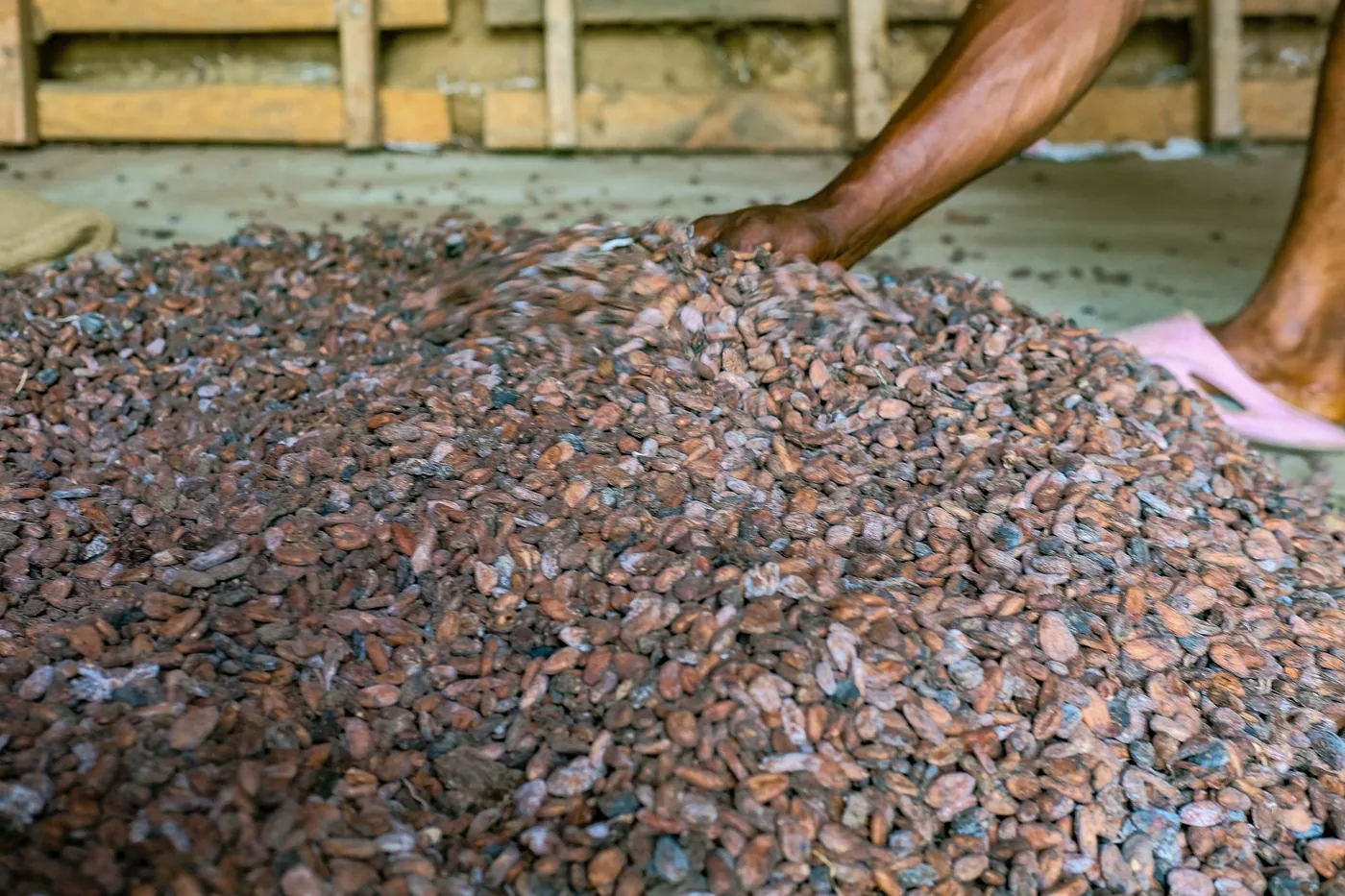
Nigeria earned N901.23 billion less from cocoa beans in the first half of 2026 than in the first half of 2025. That one fall is larger than the whole N796.40 billion reversal in the country's agricultural trade balance that Atiku Abubakar, the African Democratic Congress presidential candidate, set before the public this week. His figures for the reversal are correct: the four quarterly trade reports of the National Bureau of Statistics give a farm trade surplus of N740.27 billion for January to June 2025 and a deficit of N56.13 billion for January to June 2026. What the same reports show about the cause is narrower than his statement, and in one respect it supports him more than the headlines written about it.
The claim came in a statement issued on Wednesday 7 October by Phrank Shaibu, Director of Strategic Communication of the ADC Presidential Campaign Council. According to the accounts of it in Vanguard, The Sun and ThisDay, it said agricultural trade moved from a N740.27 billion surplus in the first half of 2025 to a N56.13 billion deficit in the same period of 2026, a N796.40 billion reversal, and that agricultural exports fell by 33.3 per cent. Vanguard and The Sun both quote him, in identical words: "The excuse that Nigerians simply imported too much will not stand. Tinubu's government must answer for the collapse in what Nigeria sold to the world." The Sun and ThisDay also quote him: "A trade deficit alone does not explain every problem on our farms." Vero Record did not find the statement on Atiku's X account; the words above are as the newspapers printed them. The same half-year figures had appeared in a Nairametrics analysis of the Bureau's data on 26 September.
Vero Record downloaded the Bureau's Foreign Trade in Goods Statistics reports and tables for the first and second quarters of 2025 and of 2026 from its microdata portal. Each report gives agricultural exports and imports on pages 3 and 4 and again in section 4.1. Exports were N1,704.15 billion in the first quarter of 2025 (page 20 of that report), N1,256.36 billion in the second, N1,172.37 billion in the first quarter of 2026 and N802.99 billion in the second. Imports were N1,035.81 billion, N1,184.42 billion, N827.72 billion and N1,203.76 billion. None of the four quarters has been revised: each later report repeats the earlier figures to the hundredth of a billion.
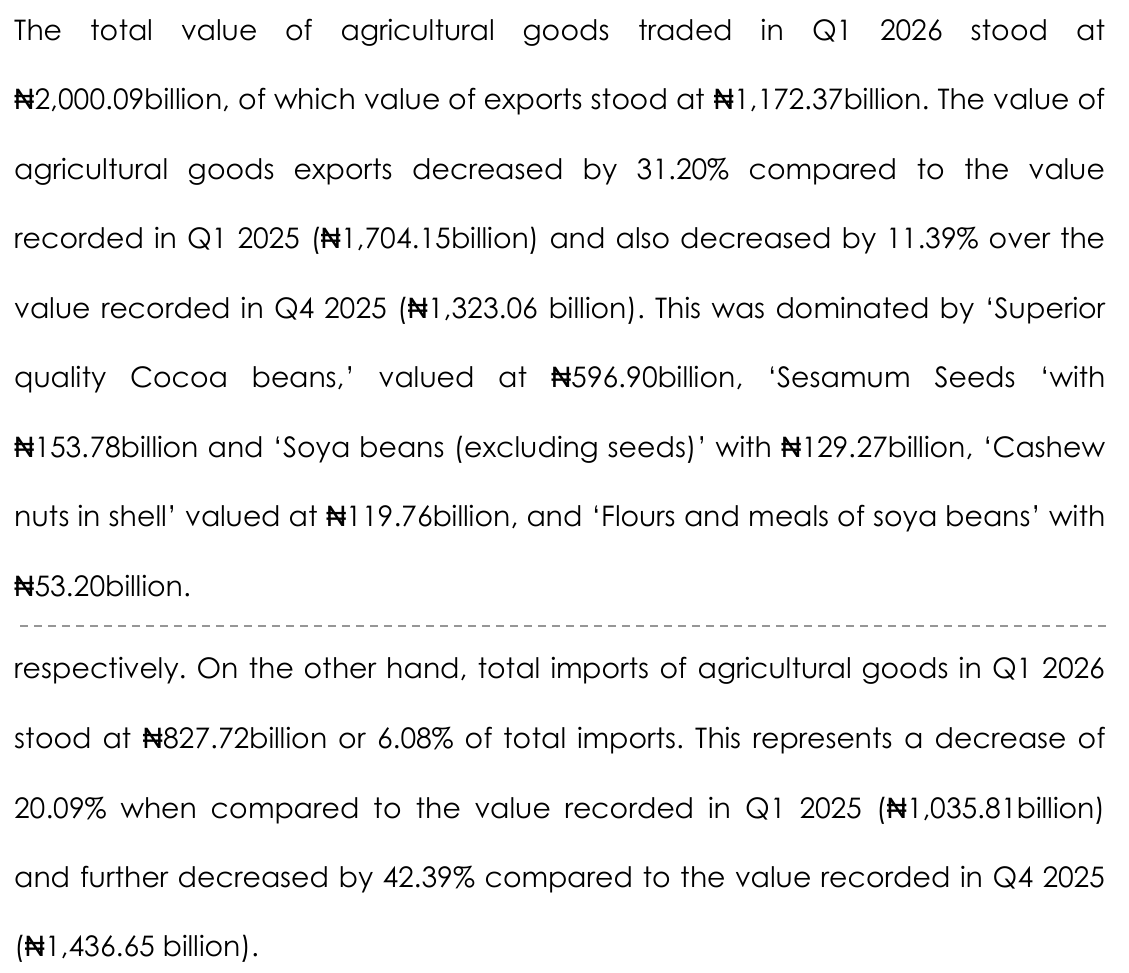
Added up, the first half of 2025 gives exports of N2,960.51 billion against imports of N2,220.23 billion, and the first half of 2026 gives exports of N1,975.36 billion against imports of N2,031.48 billion. On those rounded figures the balances are a surplus of N740.28 billion and a deficit of N56.12 billion. Table 10 of each workbook carries the same totals in millions of naira, and from those the balances are N740,274.89 million and minus N56,126.15 million, which round to the N740.27 billion and N56.13 billion in Atiku's statement. The one hundredth of difference is rounding, not error. The reversal is N796.40 billion either way.
The record also bears out the direction of his argument. Agricultural exports fell by N985.14 billion, or 33.28 per cent, which is the 33.3 per cent he cited. Agricultural imports did not rise over the half year; they fell by N188.74 billion, or 8.50 per cent. Headlines on his statement spoke of food imports, but in the Bureau's figures the swing comes from what Nigeria sold, not from what it bought, which is the point his own statement makes.
The timing is sharper than a half-year total suggests. The first quarter of 2026 still showed a farm trade surplus of N344.65 billion, against N668.34 billion a year earlier. The deficit belongs to the second quarter alone: exports of N802.99 billion against imports of N1,203.76 billion, a gap of N400.78 billion, after a surplus of N71.94 billion in the second quarter of 2025. Second quarter imports were 45.43 per cent higher than the first quarter's and 1.63 per cent higher than a year earlier, according to page 3 of the latest report.


Cocoa is the core of the change. Table 13 of each workbook lists the leading agricultural exports. Standard and superior quality cocoa beans together came to N1,713.66 billion in the first half of 2025 (N719.90 billion, given as N719.91 billion in the report's text, and N508.27 billion in the first quarter, N208.47 billion and N277.02 billion in the second) and to N812.43 billion in the first half of 2026 (N2.40 billion and N596.90 billion, then N154.31 billion and N58.82 billion). That is a fall of N901.23 billion, or 52.59 per cent, and 91.48 per cent of the whole fall in agricultural exports. Natural cocoa butter, a processed product, fell from N185.13 billion to N69.29 billion, down 62.57 per cent.
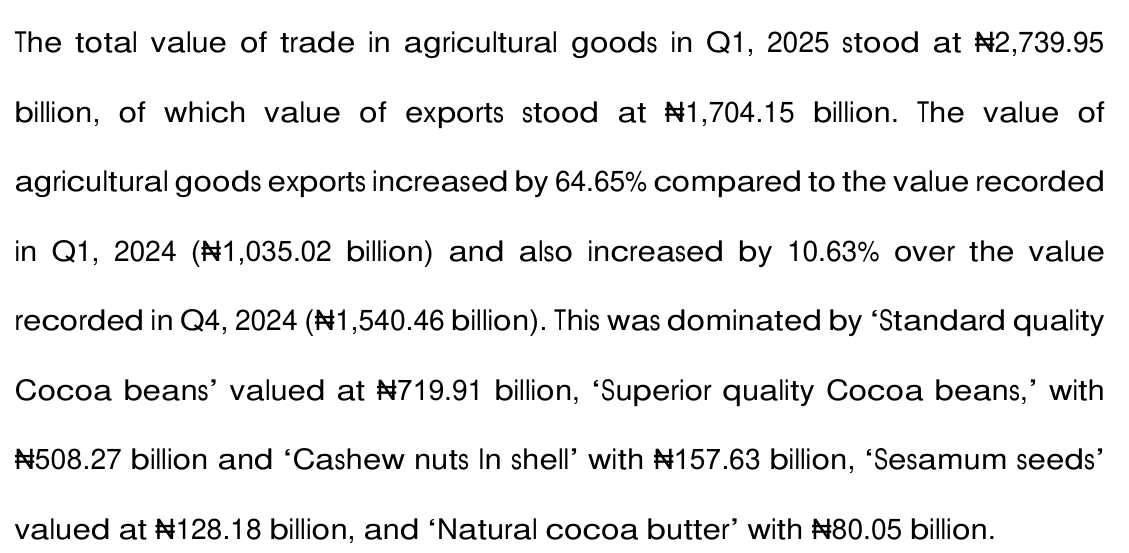
Cashew went the same way. Cashew nuts in shell, which Atiku named alongside cocoa beans as raw produce leaving the country unprocessed, fell from N510.31 billion to N388.38 billion, down 23.89 per cent, though they were still the largest agricultural export of the second quarter of 2026 at N268.62 billion, most of it to Vietnam and India. Shelled cashew fell further, from N115.40 billion to N26.24 billion.
Two crops moved the other way. Sesame seed exports rose from N206.18 billion to N249.81 billion, up 21.16 per cent, with China the largest buyer in both quarters of 2026. Soya beans (excluding seed) reached N179.49 billion in the first half of 2026, N113.86 billion of it to India in the first quarter; in neither quarter of 2025 did they rank among the 20 largest agricultural exports, which puts them below N1.26 billion for that half. Soya bean flour and meal rose from N47.95 billion to N89.61 billion. These gains softened the fall but came nowhere near offsetting cocoa.
On the import side the largest single line is durum wheat. The Bureau's product rankings put it at N298.33 billion and N503.72 billion in the two quarters of 2025 and N340.07 billion and N404.70 billion in the two quarters of 2026, so N802.05 billion against N744.77 billion: down N57.28 billion, and about 36 per cent of agricultural imports in both halves. In the second quarter of 2026, when farm imports rose N19.35 billion on a year earlier, wheat fell N99.01 billion; the rise came from other lines, among them frozen blue whiting and herring, crude palm oil from Liberia worth N51.10 billion and frozen crustaceans from China worth N46.56 billion, which Table 15 lists among the top agricultural imports.
Classification matters for one product often cited in food import debates. Cane sugar for refining, Nigeria's largest food related import in the first quarter of 2025 at N305.73 billion, is not counted as an agricultural good: the Bureau lists it under raw material goods in Table 18. Its imports from Brazil fell from N463.32 billion in the first half of 2025 to N183.50 billion in the first half of 2026, so sugar is neither inside the balance Atiku cited nor a source of rising imports. Within cocoa, the split between grades swings sharply from quarter to quarter (standard quality beans were N719.91 billion in the first quarter of 2025 and N2.40 billion a year later), so only the two grades combined are comparable. The second quarter 2025 report also labels its first quarter comparison "Q1, 2024" on page 21 when the figure, N1,035.81 billion, is the first quarter of 2025, as its own page 3 shows.
The reports do not show why cocoa earnings fell. They record values in naira only, with no tonnages and no dollar values, so they cannot separate a smaller crop or lower shipments from a change in world cocoa prices or in the exchange rate, and they say nothing about government policy. Agriculture was also a small part of the whole: agricultural goods were 2.97 per cent of Nigeria's exports in the second quarter of 2026, a quarter in which total exports rose 18.77 per cent on a year earlier. On the Bureau's figures, Atiku's numbers for the agricultural trade balance stand, and so does his point that falling exports rather than rising imports drove it. Whether the fall in cocoa earnings is the government's doing is a judgement the documents do not settle. The campaign and the Bureau were not asked for comment; the figures above are the Bureau's own, set against the statement.
What this rests on
NBS Foreign Trade in Goods Statistics reports and tables workbooks for Q1 2025, Q2 2025, Q1 2026 and Q2 2026, downloaded from microdata.nigerianstat.gov.ng (catalog 84) and read for this report; the Q2 2026 files reused from an earlier download. Agricultural totals: Q1 2025 report pp.3, 4, 20; Q2 2025 report pp.3, 4, 21; Q1 2026 report pp.3, 4, 21; Q2 2026 report pp.3, 4, 21; Table 10 of each workbook in N million. Products: Table 13 (agricultural exports), Table 15 (agricultural trade by direction), Table 18 (raw material imports, cane sugar), Product Ranking (durum wheat, cane sugar). Arithmetic: H1 2025 exports 1,704.15 + 1,256.36 = 2,960.51bn; imports 1,035.81 + 1,184.42 = 2,220.23bn; balance 740.28bn. In millions: 1,704,145.08 + 1,256,355.25 = 2,960,500.34; 1,035,806.56 + 1,184,418.89 = 2,220,225.45; balance 740,274.89 (N740.27bn). H1 2026 exports 1,172.37 + 802.99 = 1,975.36bn; imports 827.72 + 1,203.76 = 2,031.48bn; balance -56.12bn. In millions: 1,172,373.43 + 802,986.04 = 1,975,359.46; 827,721.38 + 1,203,764.24 = 2,031,485.62; balance -56,126.15 (N56.13bn deficit). Swing 740,274.89 + 56,126.15 = 796,401.04 (N796.40bn) = export fall 985,140.88 (33.28% of 2,960,500.34) minus import fall 188,739.84 (8.50% of 2,220,225.45). Quarterly balances: Q1 2025 1,704,145.08 - 1,035,806.56 = 668,338.53; Q2 2025 1,256,355.25 - 1,184,418.89 = 71,936.36 (sum 740,274.89); Q1 2026 1,172,373.43 - 827,721.38 = 344,652.05; Q2 2026 802,986.04 - 1,203,764.24 = -400,778.20 (sum -56,126.15). Cocoa beans (standard + superior, Table 13, N million): H1 2025 719,905.00 + 508,271.85 + 208,470.62 + 277,015.76 = 1,713,663.22; H1 2026 2,403.63 + 596,896.03 + 154,313.69 + 58,817.45 = 812,430.79; fall 901,232.43 (52.59%), 91.48% of 985,140.88, and larger than 796,401.04. Cocoa butter 80,053.77 + 105,073.35 = 185,127.12 to 41,688.75 + 27,599.76 = 69,288.51 (-62.57%). Cashew in shell 157,634.95 + 352,673.64 = 510,308.59 to 119,763.41 + 268,615.27 = 388,378.68 (-121,929.91, -23.89%). Shelled cashew 14,691.95 + 100,705.26 = 115,397.20 to 16,690.14 + 9,552.87 = 26,243.01. Sesame 128,180.17 + 77,995.73 = 206,175.90 to 153,776.35 + 96,031.72 = 249,808.07 (+43,632.17, +21.16%). Soya beans excl. seed 129,273.36 + 50,219.17 = 179,492.53 in H1 2026; 2025 below the 20th-ranked lines, 819.94 + 431.70 = 1,251.65. Soya flour 27,302.62 + 20,642.55 = 47,945.17 to 53,197.98 + 36,409.09 = 89,607.07. Durum wheat (Product Ranking): 298,332.34 + 503,716.69 = 802,049.03 to 340,068.81 + 404,703.10 = 744,771.91 (-57,277.12); share of agricultural imports 36.12% and 36.66%. Q2 agricultural imports 1,203,764.24 - 1,184,418.89 = +19,345.34; Q2 wheat 404,703.10 - 503,716.69 = -99,013.59. Cane sugar from Brazil (Table 18): 304,358.23 + 158,959.29 = 463,317.52 to 106,022.70 + 77,475.79 = 183,498.49.
What this does not establish
Why cocoa and cashew earnings fell: the reports give naira values only, with no volumes or dollar values, so price, quantity and exchange rate effects cannot be separated, and nothing in them links the change to any government policy. Whether any of the fall reflects produce leaving the country outside recorded channels. The full value of products below each quarter's top 20 agricultural exports (for example other quality and roasted cocoa beans), which are inside the sector totals but not itemised. Why the split between standard and superior cocoa grades swings between quarters. Total cane sugar imports from all origins in Q2 2026 (only the Brazil line is published). The original text of the ADC statement: Vero Record did not find it on Atiku Abubakar's X account and quotes it as printed by Vanguard and The Sun. Nothing in the documents suggests wrongdoing by anyone, and none is alleged. Neither the campaign nor the Bureau was asked for comment.
What we did ourselves
Downloaded the Bureau's four quarterly trade reports and workbooks and rebuilt the agricultural export, import and balance figures for each half year from Table 10 in millions of naira, which reproduces the statement's N740.27 billion and N56.13 billion exactly and explains the one hundredth gap with the rounded billions in the reports' text. Checked that no quarter was revised between reports. Split the swing into exports and imports and by quarter, and traced the export fall product by product through Table 13 (cocoa beans by grade, cocoa butter, cashew, sesame, soya) and the import side through the product rankings and Tables 15 and 18 (durum wheat, cane sugar classification).
Sources for this report
(A) National Bureau of Statistics, Foreign Trade in Goods Statistics reports and tables for Q1 2025, Q2 2025, Q1 2026 and Q2 2026: section 4.1 and pages 3 to 4 of each report; Tables 10, 13, 15 and 18 and the Product Ranking sheet of each workbook. Set against the ADC Presidential Campaign Council statement of 7 October 2026 issued by Phrank Shaibu, as printed by Vanguard and The Sun.
- Foreign Trade in Goods Statistics Q1 2025 (report, 30 pages) · National Bureau of Statistics · 2025
- Q1 2025 Foreign Trade Statistics Tables (xlsx) · National Bureau of Statistics · 2025
- Q2 2025 Foreign Trade in Goods Statistics Report and Tables (zip) · National Bureau of Statistics · September 2025
- Q1 2026 Foreign Trade in Goods Statistics Report and Tables (zip) · National Bureau of Statistics · June 2026
- Q2 2026 Foreign Trade in Goods Statistics Report and Tables (zip) · National Bureau of Statistics · September 2026
- Tinubu imports food, abandons farmers, Atiku · Vanguard · 7 October 2026
- Tinubu presiding over agric export collapse, Atiku · The Sun · 8 October 2026
- Atiku Accuses Tinubu Govt of Abandoning Farmers, Importing Food · ThisDay · 7 October 2026
- Nigeria's agriculture trade swings from N740 billion surplus to N56 billion deficit in H1 2026 · Nairametrics · 26 September 2026
Confidence: high. This is our own assessment of whether the event occurred as described, separate from the grade, which describes what kind of thing the claim rests on.
Not obtained: where the underlying document is named above but not linked, we did not hold a copy at the time of publication. We purchase nothing and request nothing in our own name.
Corrections
None on this report. If you find an error, it will be published here, at the same length, with the date it was found, and the original wording will remain visible above it.

Dr VeroInvestigations editor, Vero Record
Reads the Nigerian public record that others leave unread: budgets, audit reports, court files and registers. Every claim on this page carries the grade of the document behind it, and the report says what that document does not establish.
All 103 reportsHow we grade evidenceAdd Vero Record as a preferred source on Google