
ADC's 570% petrol rise matches NBS figures, N238.11 to N1,596.25; two-fifths came from March to May 2026, and NBS has published no later month
The African Democratic Congress said on 7 November that average petrol prices rose from N238.11 a litre in May 2023 to N1,596.25 by May 2026, about 570 per cent. Both figures are the National Bureau of Statistics' own, and the rise is 570.4 per cent. The Bureau's tables also show that N544.78 of the N1,358.14 increase, two-fifths of it, came from March to May 2026, which the Finance Minister blames on a Gulf conflict. May 2026 is still the latest month the Bureau has published, though its calendar listed four more reports by 22 October.

On Saturday, 7 November 2026, the African Democratic Congress urged voters to reject the All Progressives Congress at the presidential election on 16 January, and pointed to the price of petrol. In a statement by its National Publicity Secretary, Bolaji Abdullahi, the party said average petrol prices had risen "from N238.11 per litre in May 2023 to N1,596.25 by May 2026, translating to about a 570 per cent increase". Vero Record set those figures against the National Bureau of Statistics' monthly Premium Motor Spirit (Petrol) Price Watch. Both numbers are the Bureau's own, to the kobo, and the percentage is right: the rise is 570.4 per cent. The same reports show that two-fifths of the increase in naira came in three months, from March to May 2026, and that May 2026 is still the latest month for which the Bureau has published an average.
Vero Record worked from the statement as reported on 7 November, and did not obtain it as issued. Tribune Online and New Telegraph quote the price sentence in the same words; The Whistler paraphrases it with the same figures. The party compared Nigeria with the United States midterm elections: "On Tuesday, American voters were responding to fuel-price increases of about 37 per cent. Nigerians have experienced a far steeper increase", it said, before giving the two prices. It added that "Every Nigerian household is paying the price for the APC and Tinubu's failed policies", and the reports present the 570 per cent as the rise since the fuel subsidy was removed in May 2023. The statement, as reported, does not name its source. The American figure and the wider claims about transport, food and small businesses were not tested here.
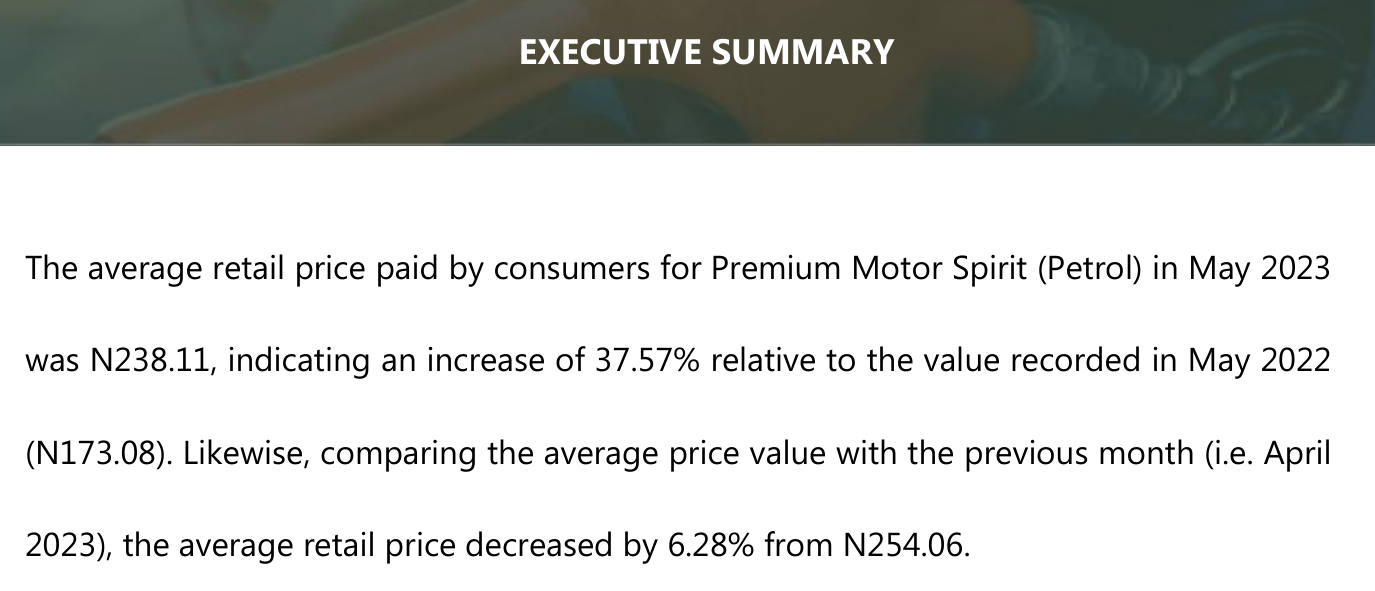
The starting figure is in the Bureau's report for May 2023, a nine-page PDF created on 20 June 2023 and downloaded from its e-library. The executive summary on page 3 reads: "The average retail price paid by consumers for Premium Motor Spirit (Petrol) in May 2023 was N238.11", 37.57 per cent above May 2022 (N173.08) and 6.28 per cent below April 2023 (N254.06). State averages that month ran from N195.00 in Abuja to N300.00 in Imo. The report does not say on which days of May the prices were collected. The jump appears in the next month: the Bureau's July 2023 release gives the June 2023 average as N545.83, 2.29 times the May figure, and July's as N600.35. As a starting point for prices since the subsidy ended, May 2023 is the last month before that jump.
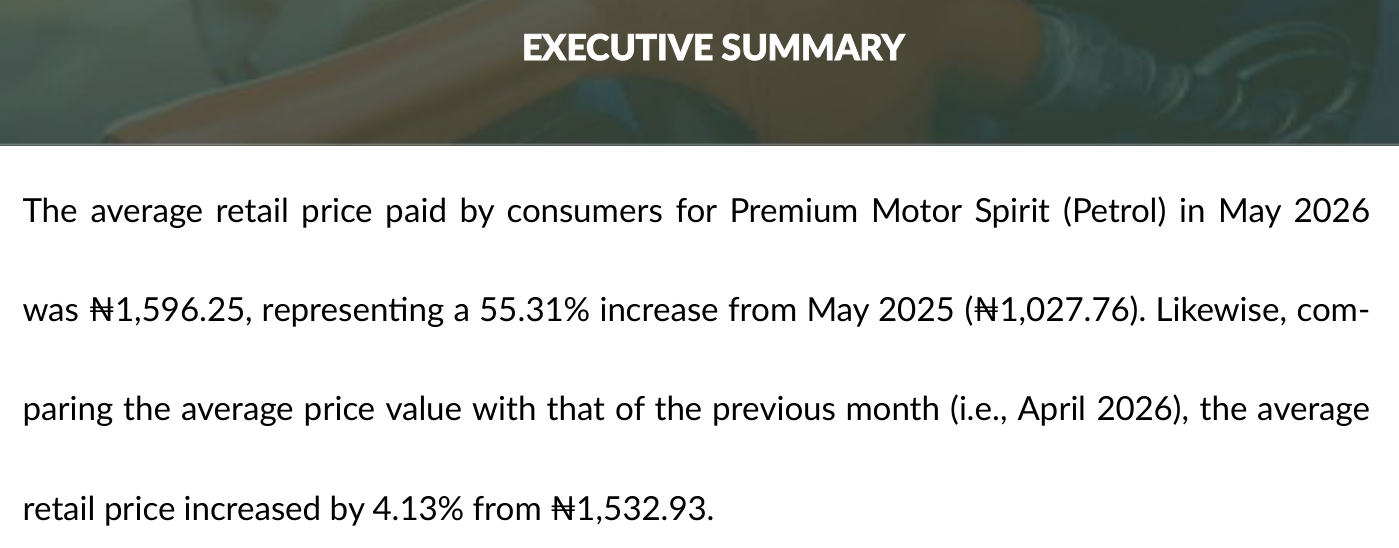
The end figure is in the report for May 2026, which the Bureau's data catalogue dates 24 June 2026. Page 4 reads: "The average retail price paid by consumers for Premium Motor Spirit (Petrol) in May 2026 was N1,596.25, representing a 55.31% increase from May 2025 (N1,027.76)." The same paragraph puts it 4.13 per cent above April's N1,532.93. Edo had the highest state average, N1,722.91, and Adamawa the lowest, N1,469.83.
The arithmetic holds. N1,596.25 less N238.11 is N1,358.14, and N1,358.14 divided by N238.11 is 5.704, a rise of 570.4 per cent; the May 2026 price is 6.70 times the May 2023 one. In both reports the national figure is the simple average of the 37 state figures printed in the appendix on page 8, and re-adding them gives N238.11 and N1,596.25 exactly. One row of the 2026 appendix is wrong: it puts the South West zone at N838.41 for April and N1,024.81 for May, a fall of 1.99 per cent on the year, while the zone's six states range from N1,537.00 in Osun to N1,639.97 in Oyo. The spreadsheet the Bureau published with the report gives the zone N1,588.96, the average of those six states. The national figure the ADC used is not affected.
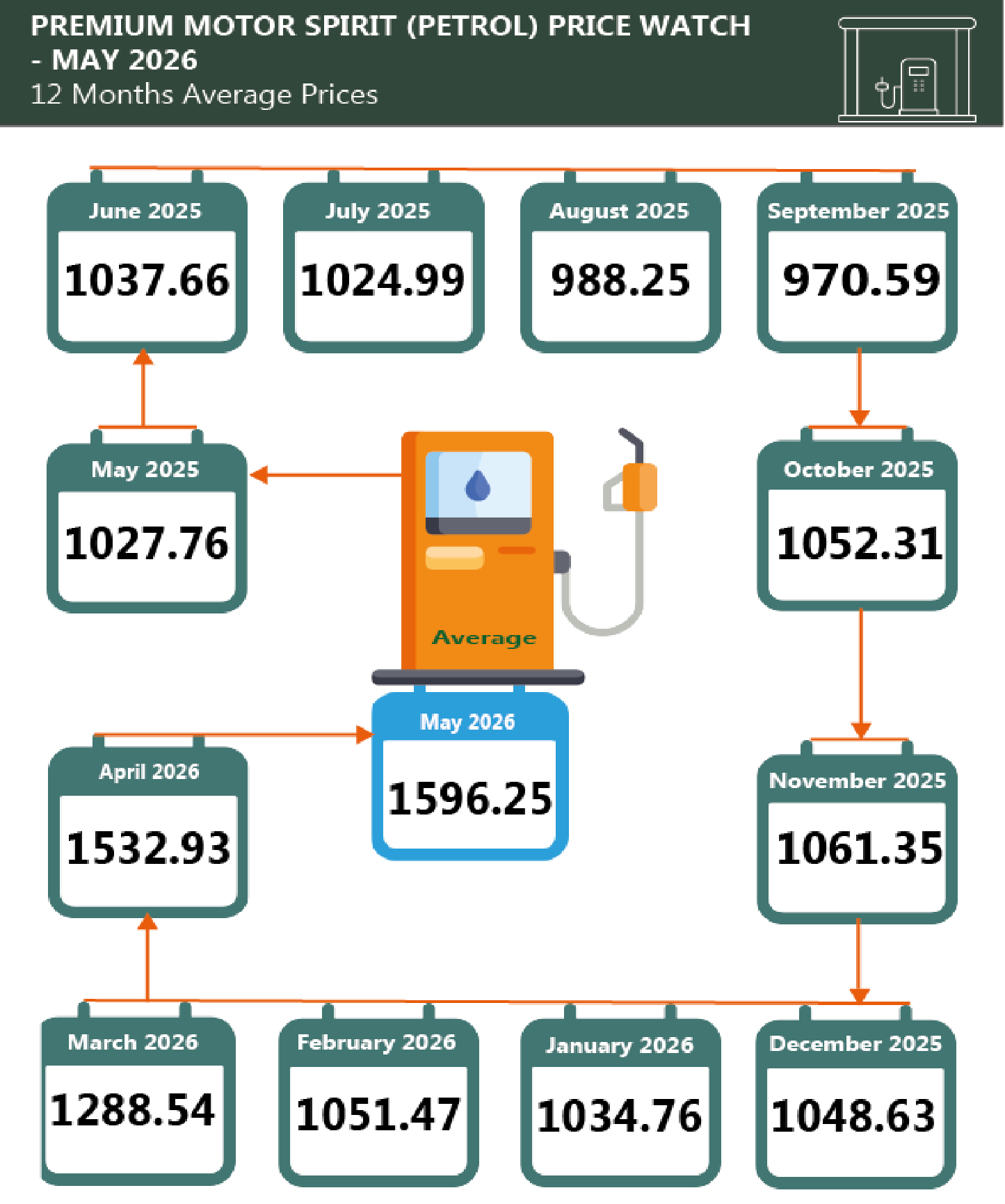
The 2026 report's page of 12-month averages, page 7, shows when the increase came. From June 2025 to February 2026 the national average stayed between N970.59 (September 2025) and N1,061.35 (November 2025); it was N1,051.47 in February 2026. It then rose to N1,288.54 in March, N1,532.93 in April and N1,596.25 in May, 51.8 per cent in three months. Split at those points, the N1,358.14 rise since May 2023 breaks down into N307.72 in the first month, to June 2023 (22.7 per cent of the total), N505.64 from June 2023 to February 2026 (37.2 per cent) and N544.78 from February to May 2026 (40.1 per cent). Measured only to February 2026, the rise since May 2023 was 341.6 per cent.
The government puts the 2026 surge down to events abroad. In a press briefing on 8 October, published on the Federal Ministry of Finance's website, the Minister of Finance, Taiwo Oyedele, said the pressure on fuel prices "began far from our shores, in the Gulf, a conflict now in its eighth month", with Brent crude above 100 dollars a barrel. On page 2 of his text he said: "Before the conflict, with crude near 70 dollars a barrel, petrol sold for about 830 naira a litre. Today it averages about 1,400 naira. That increase was caused by a global conflict in which we had no say. Ironically, without the removal of subsidy, the impact would have been far greater." The ADC statement, as reported, does not mention the conflict and lays the rise at the government's door. The Bureau's reports record prices, not their causes, and settle neither argument.

The minister's figures are not on the Bureau's basis, and his briefing does not say what they measure. His "about 830 naira" before the conflict is N204.76 below the Bureau's January 2026 average of N1,034.76 and N221.47 below February's N1,051.47; no month in the Bureau's 12-month table is lower than N970.59. Taken at face value, his "about 1,400 naira" for October would be N196.25 below the May average and would put the rise since May 2023 at about 488 per cent rather than 570. Because his starting point sits more than N200 below the Bureau's, Vero Record does not treat his October figure as a reading of the national average on the Bureau's method.
No later figure from the Bureau exists to settle that. On 9 November its data catalogue listed "PMS Report May 2026" as the newest of its petrol price reports, and the panel on its home page gave the May 2026 average, N1,596.25, beside a consumer price index for September 2026. The Bureau's own release calendar had scheduled the June 2026 report for 22 July, July's for 22 August, August's for 22 September and September's for 22 October. Vero Record found none of them on the catalogue or the home page; the first was due 110 days before this report. The ADC therefore used the most recent average the Bureau has published. It is also the highest of the 13 monthly averages in the Bureau's latest table.
The figures in the statement are accurate as written. Both prices are the Bureau's, the months are the ones the party named, and 570 per cent is the correct rounding of the change between them. The record also supports the party's broader point that the rise since May 2023 is large on any official measure in these documents: even stopping at February 2026, before the surge the minister attributes to the Gulf conflict, the Bureau's average had risen 341.6 per cent.
Two questions remain open. The first is timing. The party wrote "by May 2026", and that is the month the Bureau last measured, but it is five months old. The minister's "about 1,400 naira" for October, though not on the Bureau's basis, points to a lower price since then, by an amount the Bureau's series cannot yet show. The second is cause. The 570 per cent folds together the step taken when the subsidy ended, a net N505.64 over the next 32 months and the N544.78 added from March to May 2026. The government attributes that last part to the conflict; the party's statement lays the whole rise at the government's door.
Put side by side, the records support the ADC's two numbers and its arithmetic, and show that it used the latest official average. They add that two-fifths of the naira increase came in the three months to May 2026, that the official series stops at that peak, and that the Finance Minister's figure for the months before the surge is more than N200 below the Bureau's own averages.
What this rests on
National Bureau of Statistics, Premium Motor Spirit (Petrol) Price Watch (May 2023), 9 pages, file "PMS MAY 2023 REPORT.pdf", created 20 June 2023, downloaded on 9 November 2026 from nigerianstat.gov.ng/download/1241340: executive summary (p.3) and appendix of state averages (p.8). NBS, Premium Motor Spirit (Petrol) Price Watch (May 2026), 9 pages, created 24 June 2026, with the workbook Fuel_MAY_2026.xlsx, downloaded on 9 November 2026 as PMS_Report_MAY_2026.zip from the NBS microdata catalogue (study 157, download 1424): executive summary (p.4), 12 months average prices (p.7), appendix (p.8). NBS e-library release for July 2023 (elibrary/read/1241363), which gives the June 2023 average of N545.83 and July's N600.35. NBS microdata catalogue downloads page for study 157 and the NBS home page, both read on 9 November 2026 (newest petrol report: May 2026; home page panel PMS May-2026, CPI Sept-2026); the NBS data release calendar embedded in its e-library pages (PMS reports for June, July, August and September 2026 scheduled for 22 July, 22 August, 22 September and 22 October 2026). Federal Ministry of Finance, Press Briefing: Fuel Prices and the Subsidy Question, by Taiwo Oyedele, 8 October 2026, 7 pages (pp.1 and 2), and its 19 slides (slide 5); downloaded from finance.gov.ng in October 2026 and re-read for this report. Arithmetic re-done: N1,596.25 - N238.11 = N1,358.14; N1,358.14 / N238.11 = 5.704, so +570.4 per cent; N1,596.25 / N238.11 = 6.70 times. Breakdown: N545.83 - N238.11 = N307.72 (22.7 per cent of N1,358.14); N1,051.47 - N545.83 = N505.64 (37.2 per cent); N1,596.25 - N1,051.47 = N544.78 (40.1 per cent); N307.72 + N505.64 + N544.78 = N1,358.14. N544.78 / N1,051.47 = +51.8 per cent from February to May 2026; (N1,051.47 - N238.11) / N238.11 = +341.6 per cent to February 2026; N545.83 / N238.11 = 2.29 times. NBS's own percentages re-checked: (N1,596.25 - N1,027.76) / N1,027.76 = +55.31 per cent; (N1,596.25 - N1,532.93) / N1,532.93 = +4.13 per cent; (N238.11 - N173.08) / N173.08 = +37.57 per cent; (N238.11 - N254.06) / N254.06 = -6.28 per cent. Simple average of the 37 state figures in each appendix: May 2023 = N238.11, April 2023 = N254.06, May 2022 = N173.08; May 2026 = N1,596.25, April 2026 = N1,532.93, May 2025 = N1,027.76, each equal to the printed national figure. South West, May 2026: (N1,598.56 + N1,561.22 + N1,598.32 + N1,598.70 + N1,537.00 + N1,639.97) / 6 = N1,588.96, as in the workbook, against N1,024.81 printed in the PDF appendix. Minister's figures: N1,034.76 - N830 = N204.76; N1,051.47 - N830 = N221.47; N1,596.25 - N1,400 = N196.25; N1,400 / N238.11 = 5.880, about +488 per cent. Days: 22 July 2026 to 9 November 2026 = 9 + 31 + 30 + 31 + 9 = 110 days; June 2023 to February 2026 = 32 months.
What this does not establish
What source the ADC used; the statement as reported does not name the Bureau, and Vero Record did not obtain the statement as issued. The United States fuel price figure of about 37 per cent and the party's claims about transport, food prices and small businesses were not tested. On which days of May 2023 the Bureau collected prices, and so how many, if any, were collected after the subsidy ended. Why the Bureau has not published petrol averages for June to September 2026, or whether it will; the national average for any month after May 2026 is unknown on the Bureau's measure. What the Finance Minister's "about 830" and "about 1,400" naira measure (a city, a set of stations, a pump price or an average); his briefing does not say. Why the national figure in both reports equals the simple average of the 37 state figures, when the methodology page describes weights from household spending on fuel. The NBS home page's chart data give January and February 2026 as N1,034.63 and N1,051.57, slightly different from the report's N1,034.76 and N1,051.47; this report uses the report's figures. How much of any price change was caused by the subsidy's removal, by the exchange rate, by the Gulf conflict or by anything else; the Bureau's reports record prices, not causes. Nothing in the documents suggests wrongdoing by anyone, and none is alleged. The ADC, the Bureau and the Finance Ministry were not asked for comment.
What we did ourselves
Downloaded the Bureau's May 2023 and May 2026 petrol price reports and set the ADC's two figures against them. Re-added all 37 state averages in each appendix to confirm the national figures, recomputed the Bureau's own percentage changes and the ADC's 570 per cent, and found a misprinted South West zone row in the 2026 appendix, which the Bureau's workbook corrects. Took the June 2023 average from the Bureau's July 2023 release and the June 2025 to May 2026 averages from the 2026 report, and split the N1,358.14 rise into three periods. Set the Finance Minister's 8 October figures against the Bureau's months, and checked the Bureau's catalogue, home page and release calendar for any later petrol average.
Sources for this report
(A) National Bureau of Statistics, Premium Motor Spirit (Petrol) Price Watch for May 2023 (executive summary p.3, appendix p.8) and for May 2026 (executive summary p.4, 12 months average prices p.7, appendix p.8, and workbook Fuel_MAY_2026.xlsx); NBS July 2023 release (June 2023 average); NBS microdata catalogue, home page and data release calendar as read on 9 November 2026; Federal Ministry of Finance, Press Briefing: Fuel Prices and the Subsidy Question, 8 October 2026, pp.1 to 2.
- Premium Motor Spirit (Petrol) Price Watch (May 2023), report PDF · National Bureau of Statistics · June 2023
- Premium Motor Spirit (Petrol) Price Watch (May 2023), e-library page · National Bureau of Statistics · June 2023
- Premium Motor Spirit (Petrol) Price Watch (July 2023), e-library page with June 2023 average · National Bureau of Statistics · August 2023
- PMS Report May 2026 (PMS_Report_MAY_2026.zip: report PDF and Fuel_MAY_2026.xlsx) · National Bureau of Statistics · 24 June 2026
- Premium Motor Spirit (Petrol) Price Watch, downloads page (study 157) · National Bureau of Statistics · read 9 November 2026
- NBS home page (petroleum products panel and data release calendar) · National Bureau of Statistics · read 9 November 2026
- Press Briefing: Fuel Prices and the Subsidy Question (speech, 7 pages) · Federal Ministry of Finance · 8 October 2026
- Fuel Prices and the Subsidy Question: Press Briefing Slides (19 slides) · Federal Ministry of Finance · 8 October 2026
- 2027: Cost of living will decide January polls, ADC · Tribune Online · 7 November 2026
- 2027: Reject APC For High Cost Fuel, Electricity, ADC Tells Nigerians · New Telegraph · 7 November 2026
- How Has Removal Of Subsidies Benefited Nigerians? ADC Asks Tinubu · The Whistler · 7 November 2026
- 2027: 570% petrol price hike, high cost of living enough to vote out Tinubu, ADC tells Nigerians · The Authority · 9 November 2026
Confidence: high. This is our own assessment of whether the event occurred as described, separate from the grade, which describes what kind of thing the claim rests on.
Not obtained: where the underlying document is named above but not linked, we did not hold a copy at the time of publication. We purchase nothing and request nothing in our own name.
Corrections
None on this report. If you find an error, it will be published here, at the same length, with the date it was found, and the original wording will remain visible above it.

Dr VeroInvestigations editor, Vero Record
Reads the Nigerian public record that others leave unread: budgets, audit reports, court files and registers. Every claim on this page carries the grade of the document behind it, and the report says what that document does not establish.
All 196 reportsHow we grade evidenceAdd Vero Record as a preferred source on Google