
Two Official Accounts of How a Disputed Council Entered Nigeria's 2026 Budget Have Not Been Reconciled
In July 2026 the Budget Office told the House of Representatives that a N1.3bn line for the disputed "Presidential Foreign Intervention Promotion Council" rested on genuine establishment approvals from named federal offices. In September a House ad hoc committee found the council's founding instrument forged and named officials inside those same offices as paid facilitators, a discrepancy no government body has addressed.
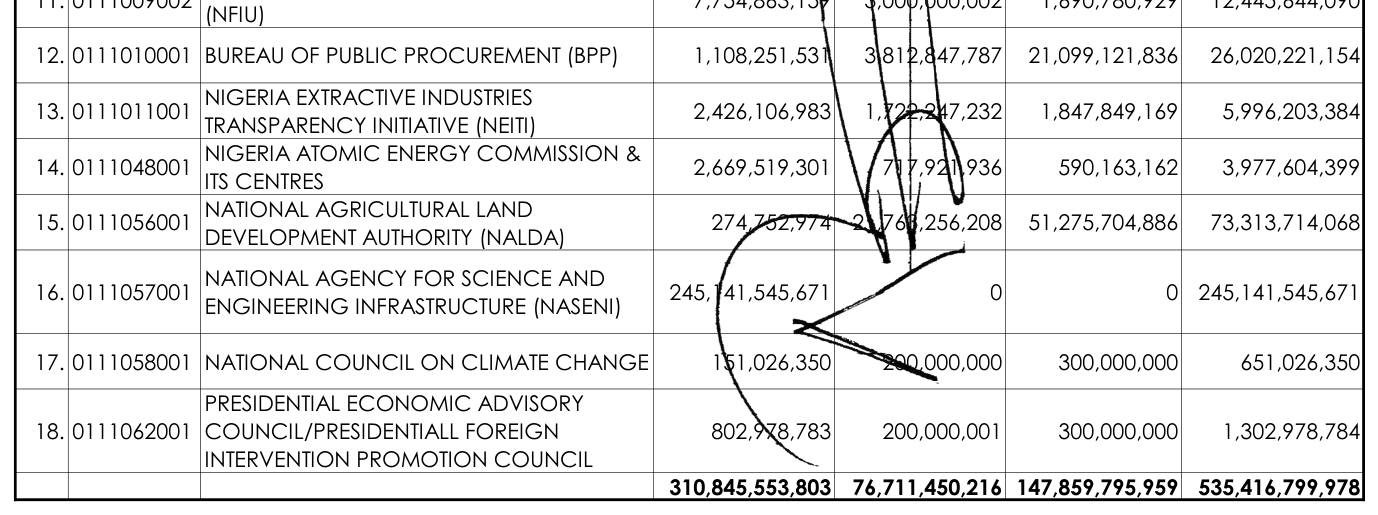
The 2026 Appropriation Act, which President Bola Tinubu signed on 17 April 2026, contains budget line 0111062001, captioned jointly "Presidential Economic Advisory Council/Presidential Foreign Intervention Promotion Council," allocating N1,302,978,784, split N802,978,783 for personnel, N200,000,001 for overhead and N300,000,000 for capital. Two months later the Presidency disowned the second name on that line: Chief of Staff Femi Gbajabiamila said on 11 June that no such appointment existed, and presidential adviser Bayo Onanuga called the council "fictitious" on 1 July, warning the public against dealing with anyone claiming to represent it.
That framing sat awkwardly with testimony the Budget Office itself gave lawmakers weeks later. On or around 24-25 July, Budget Office of the Federation Director-General Tanimu Yakubu told the House of Representatives that his office had not invented the council out of nothing. In his own words, reproduced by multiple outlets: "The Budget Office did not create the Council. It did not assign its code. It did not approve its establishment. It did not grant its recruitment waiver. It received official instruments and did what the law required of it: it measured their fiscal effect." He cited an administrative code assigned by the Office of the Accountant-General of the Federation, an establishment approval and recruitment waiver from the Office of the Head of the Civil Service of the Federation, and a salary structure, all of which he traced to Buhari-era Presidential Economic Advisory Council paperwork. He also drew a distinction the doctrine here insists on: the council had requested N3.85bn, his office cut that to N803m, and no funds were ever released because no Financial Clearance Certificate was issued. Allocated, in other words, not spent.
Parallel to this, Tinubu had ordered the ICPC to investigate, and a Federal High Court issued a bench warrant for Adeniyi Adeyemi Matthew, who had held himself out publicly as PFIPC's Director-General on the strength of a disputed appointment letter. Police arrested him in Osun State on 14 July; he remains in custody.
The two threads collided in a House of Representatives ad hoc committee report released on 2 September. It went well beyond "fictitious": investigators said they had traced 58 bank accounts and 12 associated agencies, companies and foundations to Adeyemi; examined a document styled "Presidential Executive Order No. 5" dated 24 February 2026 that purportedly gave the council legal standing, and found it was not an authentic presidential instrument, issued through no lawful process; and cleared Gbajabiamila of any role. It also named four officials as having processed paperwork inside the offices Yakubu had cited in July as the source of PFIPC's legitimate documentary trail: an assistant director in the Ministry of Budget and Economic Planning (Patricia Akhigbe), a director in the Office of the Head of the Civil Service (Mimi Abu), a senior administrative officer (Rose Achem), and an office-allocation coordinator (Aminu Abdullahi), with the committee's account, as reported, alleging Akhigbe received N500,000 and Abdullahi N3.25m from Adeyemi.
What the public record does not yet show is how these two official accounts fit together. Yakubu told lawmakers in July that the Head of Civil Service's office had granted "authorised establishment approval" and the Accountant-General's office a lawful budget code, implying the upstream paperwork, whatever came after, was genuine. The September committee findings point the other way: an official inside that same Head of Civil Service office is now named as a paid facilitator, and the instrument supposedly underlying the whole council has been found forged. No government body, not the Budget Office, not the Presidency, not the committee itself, has stated on the record whether the establishment approval and budget code Yakubu described were authentic documents that were misused, or fabricated documents that passed as genuine at every checkpoint from the Budget Office through the National Assembly's appropriations process to the President's April assent.
Adeyemi was denied bail on 3 September by Justice Obiora Egwuatu of the Federal High Court, Abuja, who instead ordered police to grant him access to lawyers; his arraignment on an eight-count forgery, fraud and impersonation charge is listed for 30 September. The Senate, separately, deferred its own probe in July pending an ICPC report whose findings, and their relationship to the Reps committee's, have not been made public.
What this rests on
News-agency and outlet reporting that quotes or paraphrases the primary documents and testimony directly, with the same figures (budget code, naira amounts, bank-account and agency counts, named officials) recurring consistently across independently-owned outlets, including one direct quoted excerpt of Yakubu's testimony. The underlying National Assembly PDF of the September committee report, the text of the disputed Executive Order No. 5, and a scan of the Appropriation Act page itself were not independently retrieved.
What this does not establish
Whether the Head of Civil Service establishment approval and Accountant-General budget code Yakubu cited were themselves forged or genuine; whether the four named officials have been formally charged, as opposed to named in committee findings; the content or timing of the ICPC's own parallel report, which the Senate says it is still awaiting; whether the 30 September arraignment proceeds as scheduled; and any Presidency, Budget Office or Head of Civil Service response specifically addressing the September committee's findings, none of which could be found.
What we did ourselves
This report sets Budget Office DG Tanimu Yakubu's July testimony, in which he traced PFIPC's paperwork to genuine-sounding approvals from the Head of Civil Service and Accountant-General offices, directly against the House committee's September findings, which name an official inside that same Head of Civil Service office as a paid facilitator and the underlying executive order as forged. No outlet reviewed had drawn these two accounts together as an unresolved contradiction.
Sources for this report
(B) 2026 Appropriation Act, assented 17 April 2026, budget code 0111062001, N1,302,978,784; Budget Office DG Tanimu Yakubu's testimony to the House of Representatives, c. 24-25 July 2026; House of Representatives ad hoc committee report on PFIPC, released 2 September 2026; Federal High Court, Abuja, order of Justice Obiora Egwuatu, 3 September 2026.
Confidence: medium. This is our own assessment of whether the event occurred as described, separate from the grade, which describes what kind of thing the claim rests on.
Not obtained: where the underlying document is named above but not linked, we did not hold a copy at the time of publication. We purchase nothing and request nothing in our own name.
Corrections
None on this report. If you find an error, it will be published here, at the same length, with the date it was found, and the original wording will remain visible above it.