
NUPRC's 2026 tables put crude output at 1.56 million barrels a day at its peak, and supply to local refiners at 590,267 a day at best
Finance Minister Taiwo Oyedele said on Friday that Nigeria produces 1.8 million barrels of crude a day and does not have 700,000 to spare for domestic refining. The upstream regulator's production table for January to August 2026 records crude oil of 1,313.69 to 1,555.22 thousand barrels a day. Its domestic supply statistics show local refiners received an average of 316,667 barrels a day in the first quarter and 590,267 in the second, below 700,000 in both. Producers offered more than 760,000 barrels a day in each quarter, on commercial terms that are not the Federation's own share.

Nigeria's finance minister says the country cannot spare 700,000 barrels of crude a day for domestic refining. On deliveries, the regulator's records bear him out: local refiners received an average of 316,667 barrels a day in the first quarter of 2026 and 590,267 in the second. The figure he started from is another matter. Taiwo Oyedele said on Channels Television on Friday that Nigeria produces 1.8 million barrels of crude oil a day. In the eight months of 2026 it has published, the Nigerian Upstream Petroleum Regulatory Commission's production table has not recorded a single month of crude oil above 1,555.22 thousand barrels a day.
The minister was answering calls for a "production subsidy" to domestic refiners. As the broadcaster reported, he said that this output "does not belong to Nigeria alone": under joint ventures and production sharing contracts the oil is shared, "roughly 45, 55", and cost oil and royalty come out before profit oil is divided. "I don't want to go into the technicalities, but the reality is that today we do not have up to 700,000 free crude to give anyone," he said, adding that as production rises "and we free up some barrels", domestic refiners would get enough, and that he hoped Nigeria would one day refine all the crude it produces. His claim has two parts that can be set against the record: how much Nigeria produces, and how much crude reaches refiners at home.
The Commission's table, "2026: Daily Average Crude Oil and Condensate Production", marked provisional and last updated on 14 September, gives crude oil, excluding condensate, of 1,459.24 thousand barrels a day in January, 1,313.69 in February, 1,382.84 in March, 1,488.54 in April, 1,530.35 in May, 1,555.22 in June, 1,505.25 in July and 1,500.19 in August. Weighted by the 243 days of those months, the average is 1,468.35 thousand barrels a day, 331.65 thousand below the minister's 1.8 million. Adding condensate, the total peaked at 1,735.40 thousand in June; August's 1,677.77 is 1,500.19 of crude, 54.74 of blended and 122.84 of unblended condensate, which add up. The Commission's note on August says crude output of 1.50 million barrels a day "represents 100% of OPEC quota".
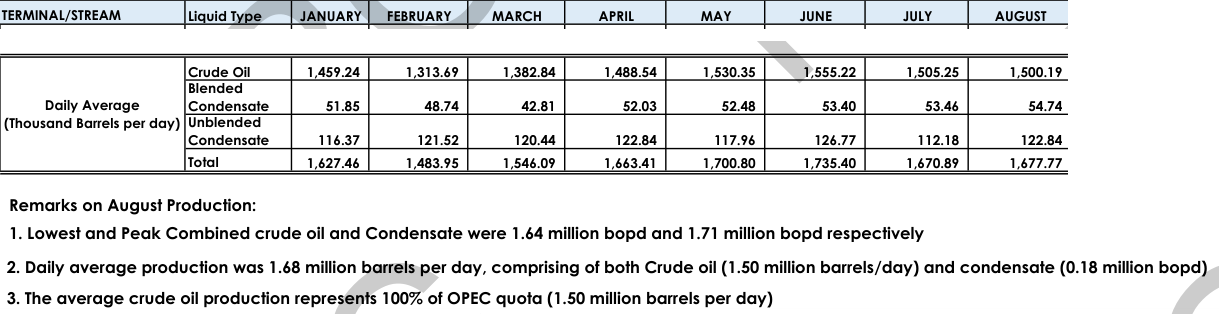
The 1.8 million figure is close to a number in the Budget Office's 2026-2028 Medium-Term Expenditure Framework, which projected production of 1.84 million barrels a day for 2026 on page 25. That projection counts two things: "Of the 1.84 mbpd, 1.5 mbpd represents the OPEC production quota, while 340 kbpd is the production of Condensates." On crude, the record meets the budget's assumption: the regulator's August crude figure is at the 1.5 million quota. Condensate, at 177.58 thousand barrels a day in August, is 162.42 thousand short of the 340 thousand assumed. If the minister meant crude and condensate together, the gap to his figure narrows to 64.60 thousand barrels a day at June's peak. NNPC Limited's own Monthly Report Summary for July 2026, which splits crude and condensate differently, shows no month from August 2025 to July 2026 above 1.73 million barrels a day combined or 1.47 million of crude.

The second record is the Commission's statistics on the Domestic Crude Supply Obligation, which Section 109 of the Petroleum Industry Act places on producers. Each month the Commission meets producers and licensed local refineries, then allocates to each producer a volume it should offer to domestic refiners. The Commission says the framework operates on a "willing buyer, willing seller" basis. It publishes three numbers a quarter: what it allocated, what producers offered and what was actually supplied.
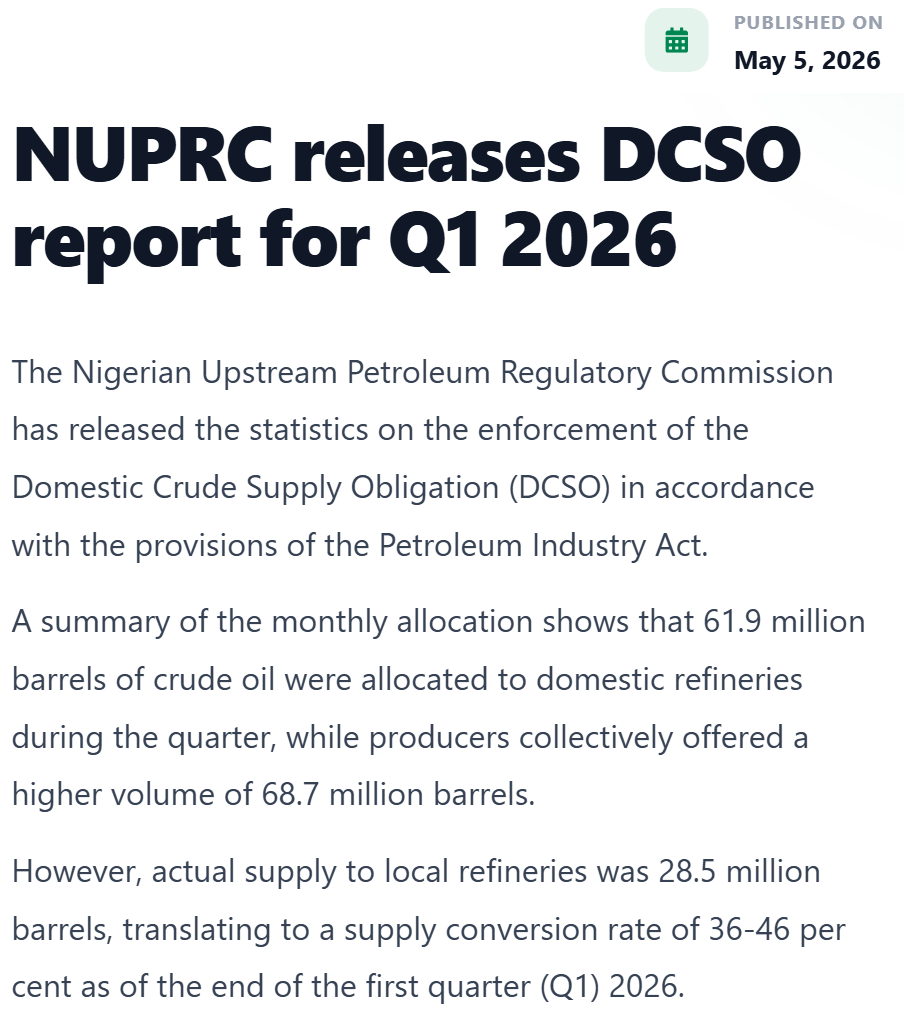
For the first quarter, the Commission's release of 5 May reports 61.9 million barrels allocated, 68.7 million offered and 28.5 million supplied. Its monthly figures add up for the first two: allocations of 22.6, 20.5 and 18.8 million make 61.9 million, and offers of 25.3, 19.8 and 23.6 million make 68.7 million. Monthly supplies of 9.2, 9.1 and 10.1 million add to 28.4 million, 0.1 million below the quarterly total the release prints. Over the 90 days of January to March (31 + 28 + 31), 61.9 million barrels allocated is 687,778 a day, 68.7 million offered is 763,333 a day, and 28.5 million supplied is 316,667 a day. The Commission put the supply conversion rate at 36 to 46 per cent; 28.5 million is 41.5 per cent of the volume offered and 46.0 per cent of the volume allocated. It attributed the gap "primarily to pricing gaps between producers and domestic refiners".
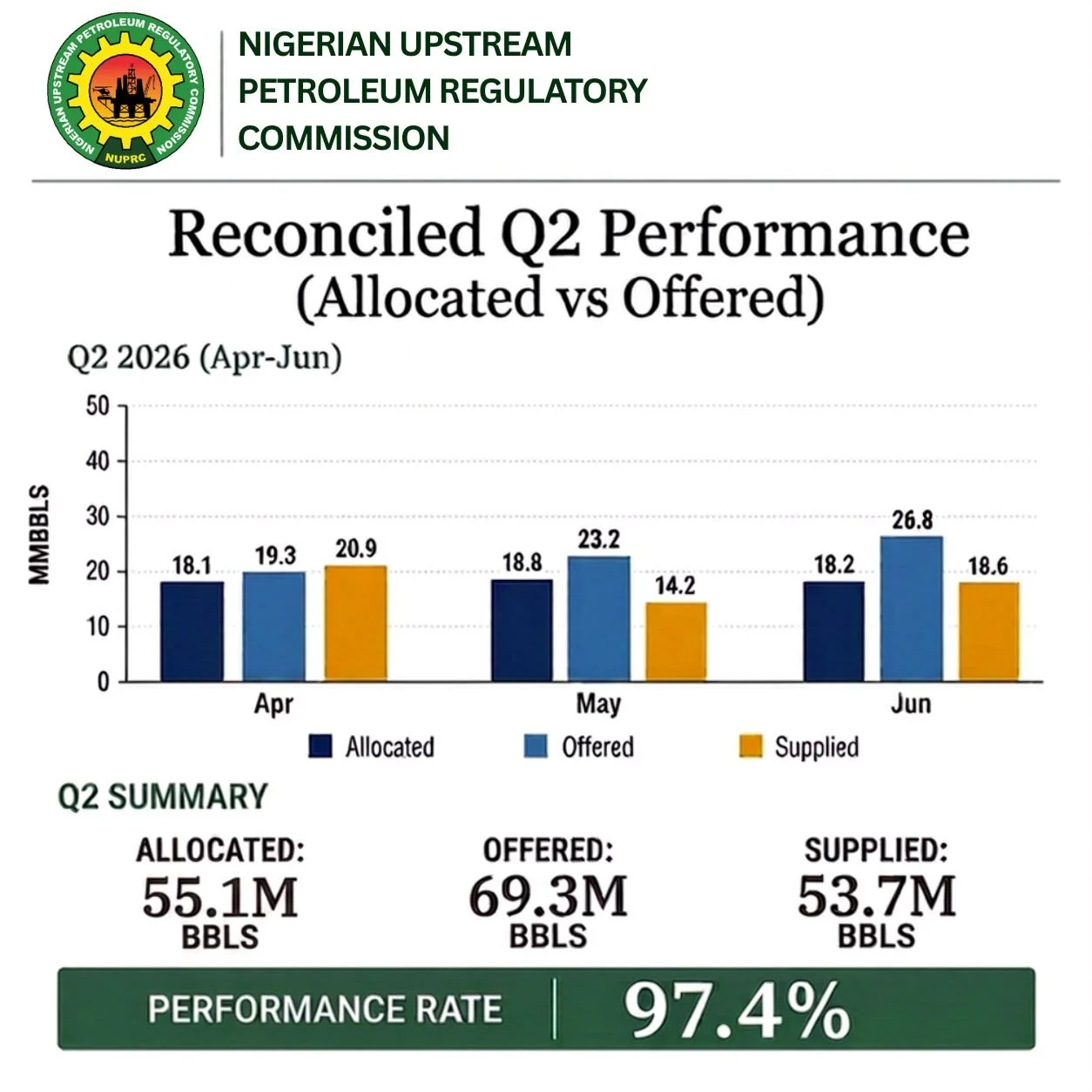
For the second quarter, the release of 10 August gives exact monthly volumes. Allocations of 18,127,638, 18,778,392 and 18,172,638 barrels add to 55,078,668. Offers of 19,312,476, 23,187,893 and 26,835,119 add to 69,335,488. Supplies of 20,879,381, 14,228,865 and 18,606,026 add to 53,714,272. The Commission's summary graphic rounds these to 55.1 million, 69.3 million and 53.7 million and gives a performance rate of 97.4 per cent; on the exact figures, supply was 97.52 per cent of allocation. Over the 91 days of April to June (30 + 31 + 30), the volumes come to 605,260 barrels a day allocated, 761,928 offered and 590,267 supplied. The release puts April's supply at 114.9 per cent of allocation; its own April figures give 115.18 per cent.
On the point that matters most to his argument, the record supports the minister. In neither quarter did domestic supply reach 700,000 barrels a day. Across the first half, 28,500,000 + 53,714,272 = 82,214,272 barrels were supplied over 181 days, an average of 454,222 a day. Even the volumes the regulator itself allocated, 687,778 a day in the first quarter and 605,260 in the second, were below 700,000. Measured against the Commission's production averages, which imply 139,930,650 barrels of crude and condensate in the first quarter and 154,689,100 in the second, domestic supply was 20.37 per cent of output in the first quarter and 34.72 per cent in the second. A lower production base than the minister cited makes his arithmetic tighter, not looser.
One figure in the same records points the other way. In both quarters, producers offered domestic refiners more than 700,000 barrels a day: 763,333 in the first quarter and 761,928 in the second. Those offers are commercial sales by all producers, including the partners in joint ventures and production sharing contracts, made on willing-buyer terms. They are not the same thing as the "free crude" the minister described, which is the share left to the Federation after partners' entitlements, cost oil and royalty. None of the documents read for this report states the size of that share, so the record neither confirms nor contradicts his 700,000 figure in that sense.
The records also leave the rest of the crude unaccounted for in their own terms. Of the 139,930,650 barrels implied for the first quarter, 111,430,650 were not supplied to local refiners under the obligation; in the second quarter the figure was 100,974,828 of 154,689,100. The production table and the supply statistics do not say where those barrels went. Export volumes, stock changes and crude used in the field are not in either document.
The regulator's own plans run in the direction the minister described. At its fifth anniversary on 6 October, the Commission's chief executive, Oritsemeyiwa Eyesan, said its focus would be on "restoring the more than 788,000 barrels per day of shut-in production identified across 63 operators" and on taking offshore projects valued at an estimated $30 billion to $50 billion to final investment decision. In its second-quarter release, the Commission said the improvement in domestic supply coincided with higher local production and the signing of long-term crude supply agreements between producers and domestic refiners.
These documents do not establish everything. The production table is provisional and stops at August. The first-quarter release describes the allocated volumes as crude oil, while the second-quarter release counts crude oil and condensate, so the two quarters may not be measured identically. The supply statistics cover only crude from Nigerian producers under the obligation; crude that domestic refiners import is outside them, and the minister himself noted that crude is imported today. The Commission had not published third-quarter supply statistics by 10 October. Nothing in the records suggests wrongdoing by any producer, refiner or official, and none is alleged.
What this rests on
Production: NUPRC, "2026: Daily Average Crude Oil and Condensate Production - Thousand Barrels Per Day (Provisional)", 2 pages, downloaded on 10 October 2026 from nuprc.gov.ng (listed on the Commission's Oil Production Report page as "2026 Oil Production Data", updated 14 September 2026), page 2 summary block and remarks. Re-added: August 1,500.19 + 54.74 + 122.84 = 1,677.77; the same check holds for every month to within 0.01 (May and June add to 1,700.79 and 1,735.39 against printed 1,700.80 and 1,735.40). Day-weighted crude average: (1,459.24 x 31 + 1,313.69 x 28 + 1,382.84 x 31 + 1,488.54 x 30 + 1,530.35 x 31 + 1,555.22 x 30 + 1,505.25 x 31 + 1,500.19 x 31) / 243 = 1,468.35; 1,800 - 1,468.35 = 331.65. Combined day-weighted average 1,639.62. Quarterly volumes: Q1 = 1,627.46 x 31 + 1,483.95 x 28 + 1,546.09 x 31 = 50,451.26 + 41,550.60 + 47,928.79 = 139,930.65 thousand barrels; Q2 = 1,663.41 x 30 + 1,700.80 x 31 + 1,735.40 x 30 = 49,902.30 + 52,724.80 + 52,062.00 = 154,689.10 thousand barrels. Condensate: August 54.74 + 122.84 = 177.58; 340 - 177.58 = 162.42. 1,800 - 1,735.40 = 64.60. Budget: Budget Office of the Federation, 2026-2028 MTEF and FSP, printed page 25 (PDF page 34): 1.84 mbpd = 1.5 mbpd OPEC quota + 340 kbpd condensates (1.5 + 0.34 = 1.84). NNPC: NNPC Limited Monthly Report Summary, July 2026, chart "Crude Oil & Condensate Production (mmbopd)", Aug-25 to Jul-26: combined 1.65, 1.61, 1.58, 1.60, 1.54, 1.64, 1.51, 1.56, 1.68, 1.73, 1.72, 1.68; crude 1.38, 1.37, 1.30, 1.36, 1.35, 1.39, 1.27, 1.32, 1.43, 1.47, 1.47, 1.44. DCSO Q1 (NUPRC release, 5 May 2026): allocated 22.6 + 20.5 + 18.8 = 61.9 million; offered 25.3 + 19.8 + 23.6 = 68.7 million; supplied 9.2 + 9.1 + 10.1 = 28.4 million against 28.5 million printed. Days 31 + 28 + 31 = 90. 61,900,000 / 90 = 687,778; 68,700,000 / 90 = 763,333; 28,500,000 / 90 = 316,667. 28.5 / 68.7 = 41.5%; 28.5 / 61.9 = 46.0%; January 9.2 / 25.3 = 36.4%. DCSO Q2 (NUPRC release and graphic, 10 August 2026): allocated 18,127,638 + 18,778,392 + 18,172,638 = 55,078,668; offered 19,312,476 + 23,187,893 + 26,835,119 = 69,335,488; supplied 20,879,381 + 14,228,865 + 18,606,026 = 53,714,272. 53,714,272 / 55,078,668 = 97.52% (printed 97.4%; 53.7 / 55.1 = 97.46%). April 20,879,381 / 18,127,638 = 115.18% (printed 114.9%); May 75.77% (printed 75.8%); June 102.38% (printed 102.4%). Days 30 + 31 + 30 = 91. 55,078,668 / 91 = 605,260; 69,335,488 / 91 = 761,928; 53,714,272 / 91 = 590,267. First half: 28,500,000 + 53,714,272 = 82,214,272 over 90 + 91 = 181 days = 454,222 a day. Shares of production: 28,500,000 / 139,930,650 = 20.37%; 53,714,272 / 154,689,100 = 34.72%. Not supplied locally: 139,930,650 - 28,500,000 = 111,430,650; 154,689,100 - 53,714,272 = 100,974,828. The minister's words are taken from Channels Television's report of 9 October 2026 on his Politics Today interview; 9 October 2026 was a Friday.
What this does not establish
The size of the Federation's own share of production after joint-venture and production-sharing partners' entitlements, cost oil and royalty, which is the "free crude" the minister referred to; none of the documents read gives it, so his 700,000 figure in that sense is neither confirmed nor contradicted. Whether the minister's 1.8 million meant crude alone or crude and condensate together. Where the crude not supplied to local refiners went: export, storage and field-use volumes are not in the production table or the supply statistics. Why monthly offers and deliveries differed beyond the Commission's own explanation of pricing gaps and the willing-buyer basis, and the terms of any individual sale. The volume of crude imported by domestic refiners, which falls outside the supply obligation. Third-quarter supply statistics, which had not been published by 10 October. Figures on new drilling and re-entry well approvals in 2026 attributed to the Commission's chief executive this week were not found in the Commission's published releases and were not tested. The production figures are provisional. Nothing in the records suggests wrongdoing by any producer, refiner or official, and none is alleged.
What we did ourselves
Downloaded the Commission's 2026 production table through its reports service and its supply-obligation releases and graphics through its news service, and set the minister's two figures, production of 1.8 million barrels a day and the 700,000 barrels a day for domestic refining, against them. Re-added every monthly production total from its crude and condensate parts and every quarterly allocation, offer and supply total from its monthly parts, and found two small differences from the printed figures (the first-quarter supply total and the second-quarter and April performance rates). Converted the quarterly volumes to barrels a day by counting the days in each quarter, and converted the production averages to quarterly volumes so that domestic supply could be expressed as a share of output. Compared the production table with the 2026 budget projection in the MTEF and with NNPC's own monthly chart. Separated the commercial offers recorded in the supply statistics from the Federation's own share, which the minister's claim concerns and which the documents do not give.
Sources for this report
(A) Nigerian Upstream Petroleum Regulatory Commission, "2026: Daily Average Crude Oil and Condensate Production - Thousand Barrels Per Day (Provisional)", January to August 2026, page 2; NUPRC releases on the Domestic Crude Supply Obligation for Q1 2026 (5 May 2026) and Q2 2026 (10 August 2026, with the "Reconciled Q2 Performance" graphic); Budget Office of the Federation, 2026-2028 Medium-Term Expenditure Framework and Fiscal Strategy Paper, page 25; NNPC Limited Monthly Report Summary, July 2026.
- 2026: Daily Average Crude Oil and Condensate Production, Thousand Barrels Per Day (Provisional), January to August · Nigerian Upstream Petroleum Regulatory Commission · 14 September 2026
- NUPRC releases DCSO report for Q1 2026 · Nigerian Upstream Petroleum Regulatory Commission · 5 May 2026
- NUPRC Releases Q2 Report on DCSO Showing 97.4% Performance · Nigerian Upstream Petroleum Regulatory Commission · 10 August 2026
- Reconciled Q2 Performance (Allocated vs Offered) graphic · Nigerian Upstream Petroleum Regulatory Commission · 10 August 2026
- Production Rises by 0.4% in August as Nigeria Meets OPEC Quota · Nigerian Upstream Petroleum Regulatory Commission · 13 September 2026
- NUPRC Announces 2026 Licensing Round, Unveils Plans to Boost Production · Nigerian Upstream Petroleum Regulatory Commission · 6 October 2026
- 2026-2028 Medium-Term Expenditure Framework and Fiscal Strategy Paper · Budget Office of the Federation · December 2025
- NNPC Ltd Monthly Report for July 2026 · NNPC Limited · 31 August 2026
- Nigeria Doesn't Have Enough Crude Oil To Service Dangote Refinery, Says Oyedele · Channels Television · 9 October 2026
Confidence: high. This is our own assessment of whether the event occurred as described, separate from the grade, which describes what kind of thing the claim rests on.
Not obtained: where the underlying document is named above but not linked, we did not hold a copy at the time of publication. We purchase nothing and request nothing in our own name.
Corrections
None on this report. If you find an error, it will be published here, at the same length, with the date it was found, and the original wording will remain visible above it.

Dr VeroInvestigations editor, Vero Record
Reads the Nigerian public record that others leave unread: budgets, audit reports, court files and registers. Every claim on this page carries the grade of the document behind it, and the report says what that document does not establish.
All 105 reportsHow we grade evidenceAdd Vero Record as a preferred source on Google