
Tinubu's office reported him promising no budget rollovers from April 2026. The 2025 budget now runs to 31 December, the day the 2026 Act expires
On 30 September President Tinubu signed the Appropriation (Amendment) (No.4) Bill, which keeps the 2025 budget alive until 31 December 2026. In December, State House had quoted him saying that all capital liabilities from previous years would be "fully funded and closed" by 31 March and that Nigeria would run a single budget from April. The signed 2026 Appropriation Act expires on the same day as the extended 2025 budget. The Budget Office told ministries that the 2027 budget would go to the National Assembly by September. As of 2 October, we can find no public record that it has been laid.
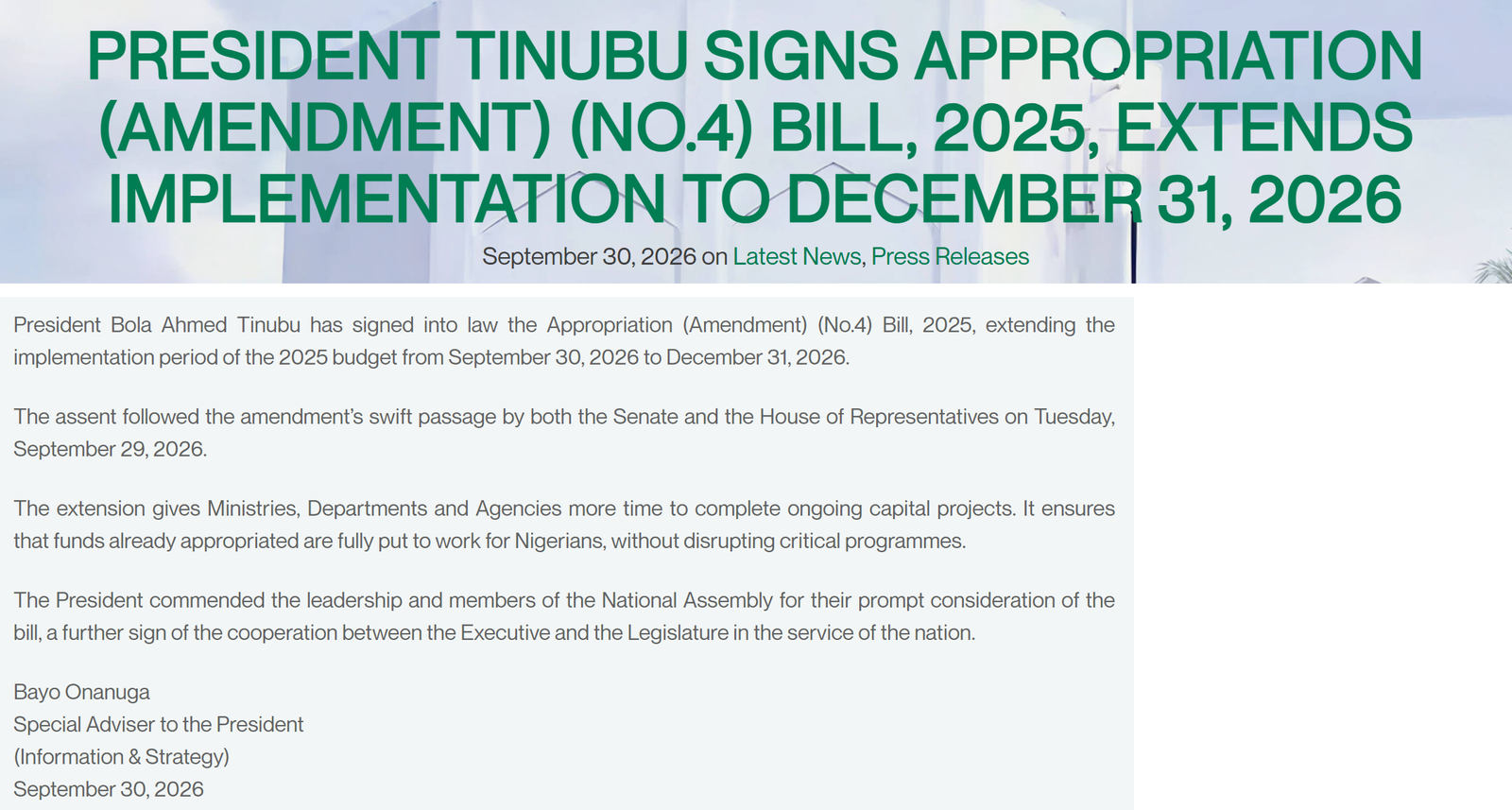
On Wednesday, 30 September 2026, the State House press office announced that President Bola Ahmed Tinubu had "signed into law the Appropriation (Amendment) (No.4) Bill, 2025, extending the implementation period of the 2025 budget from September 30, 2026 to December 31, 2026." The release is signed by Bayo Onanuga, Special Adviser to the President (Information and Strategy). It says the assent followed the bill's passage by the Senate and the House of Representatives on Tuesday, 29 September, and that the extension "gives Ministries, Departments and Agencies more time to complete ongoing capital projects." Vero Record read the release on statehouse.gov.ng and took a screenshot of it.
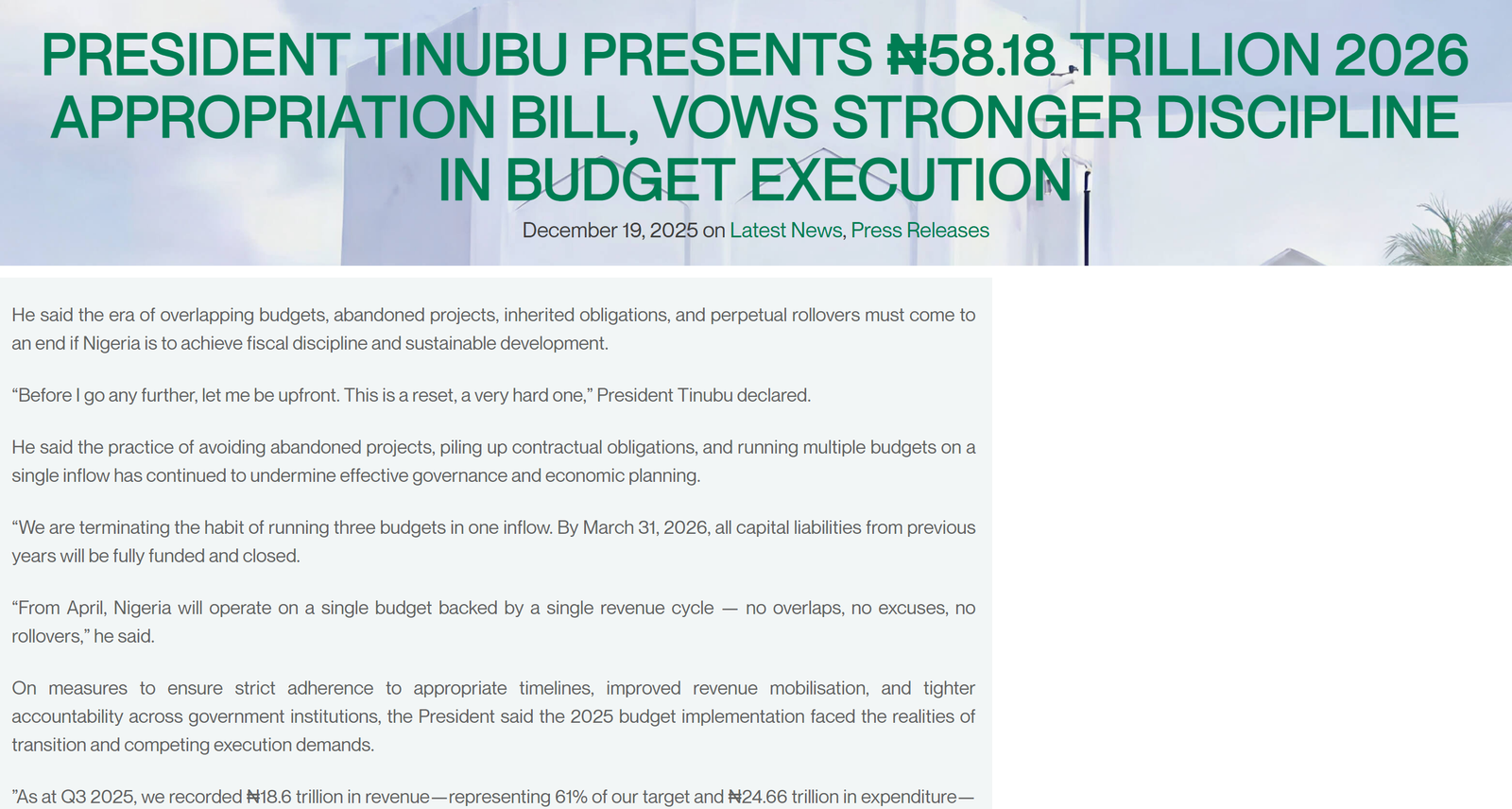
Nine months earlier the same press office published its account of the President's presentation of the N58.18 trillion 2026 Appropriation Bill to the National Assembly on 19 December 2025. That release, which is still live, puts these words in quotation marks as the President's: "We are terminating the habit of running three budgets in one inflow. By March 31, 2026, all capital liabilities from previous years will be fully funded and closed." It goes on: "From April, Nigeria will operate on a single budget backed by a single revenue cycle", followed by "no overlaps, no excuses, no rollovers". In its own words, outside quotation marks, the release also says he described "the era of overlapping budgets, abandoned projects, inherited obligations, and perpetual rollovers" as something that "must come to an end".
These sentences come from the press office's report of the address. State House posted a separate page titled "2026 Budget Speech" on the same evening, and that page does not contain them. Vero Record searched its full text for "March 31", "rollover" and "three budgets" and found none of them. We do not know whether the lines were added on delivery or whether the posted text is incomplete, and we have not seen the National Assembly's record of the sitting. What we can establish is that the Presidency's own published account has attributed these words to the President since 19 December 2025, and that it has not withdrawn them.
The record since then shows four changes to the end date of the 2025 budget. The first came days after the address. Leadership reported on 24 December 2025 that both chambers of the National Assembly had passed bills repealing and re-enacting the 2024 and 2025 Appropriation Acts, and that the re-enacted 2025 Act set 31 March 2026 as the deadline for its capital component. That is the date the 19 December release attributes to the President. On 7 January 2026 the Budget Office of the Federation published a statement on the State House website that defended the repeal and re-enactment. It said that "the Constitution does not impose an immutable expiry rule that forbids legislative extension" of an Appropriation Act.
The second change came after the 31 March date had passed. According to Vanguard, the Senate passed a bill on 30 March 2026 to move the deadline for the capital component to 30 June. On 17 April 2026 State House announced that the President had signed two bills: the N68.32 trillion 2026 Appropriation Bill, and the "Appropriation (Repeal and Enactment) (Amendment) Bill, 2026", which "extends the implementation period of the capital component of the 2025 Appropriation Act from March 31, 2026, to June 30, 2026." The same release says: "With the 2026 Appropriation Act coming into force on April 1, the Federal Government will commence full implementation". The release is dated 17 days after the 31 March deadline had passed. It does not give the date of assent, and it does not say whether the extension took effect from 31 March. We have not found the enrolled amendment Act on the Budget Office or State House websites.
The third change, from 30 June to 30 September, went through the Senate on Thursday, 11 June 2026, according to Vanguard, and through the House as bill HB. 2784, according to a Voice of Nigeria report published on 15 June. Voice of Nigeria quoted the House Leader, Julius Ihonvbere, as saying that "the extension became necessary because several capital projects captured in the 2025 budget had not been fully implemented." A search of the State House website's posts turned up no release announcing the President's assent to this third extension, so we cannot give its date. The fourth change is the 30 September assent described above. The title of that bill, "(No.4)", matches the count of four extensions given by Daily Trust on 30 September.
On 17 May 2026 the Director-General of the Budget Office, Tanimu Yakubu, set out the government's legal position in a statement titled "Fiscal Years Are Defined By Law, Not The Calendar", also published on statehouse.gov.ng. In it he wrote that where an Appropriation Act's validity is extended, "the fiscal year becomes not merely a chronological concept, but a legislatively sustained expenditure window." He gave the re-enactment of the 2025 Act and its extension to June 2026 as the main reasons why quarterly budget implementation reports had been published late.
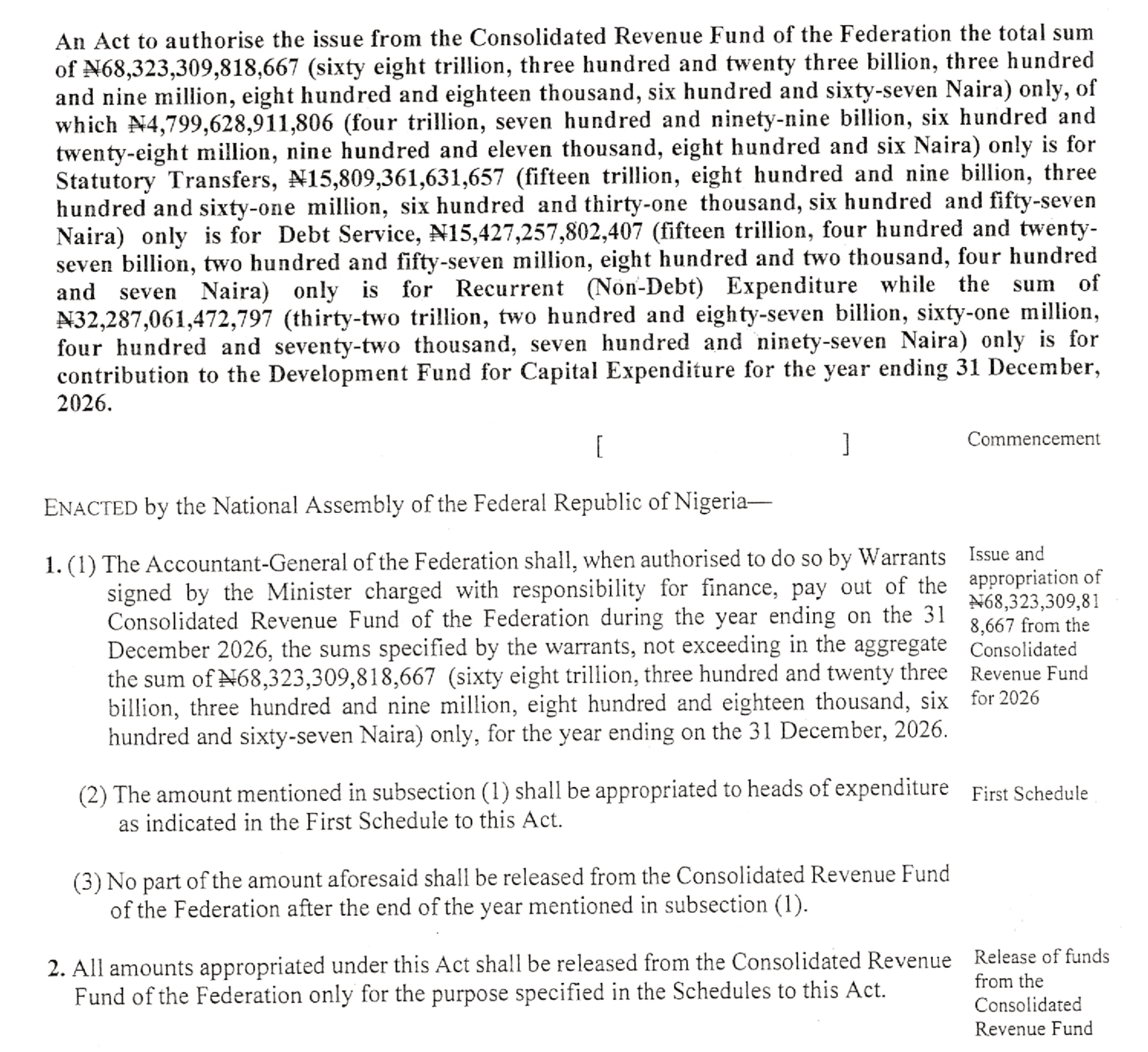
Vero Record read the opening pages of the signed 2026 Appropriation Act, from the copy the Budget Office publishes. Section 1(1) authorises the Accountant-General to pay out up to N68,323,309,818,667 "during the year ending on the 31 December 2026". The Act's long title says that N32,287,061,472,797 of that sum is for contribution to the Development Fund for Capital Expenditure. Section 1(3) reads: "No part of the amount aforesaid shall be released from the Consolidated Revenue Fund of the Federation after the end of the year mentioned in subsection (1)." Section 12, headed "Expiry", says that "this Act expires after 12 months, starting from 1 January to 31 December, 2026 when assented to." The extended 2025 budget and the 2026 Act therefore now end on the same day.
The next point is Vero Record's own reading, graded C. State House says the 2026 Act came into force on 1 April 2026, while section 12 of the Act counts its twelve months from 1 January. The 2025 capital authority now runs until 31 December 2026. Taking the State House date, that means that for the whole of the nine months from April to December, two Appropriation Acts carry live capital authority at once, and both expire together. This is the kind of overlap that the 19 December release reported the President as ending from April. Nothing in the record we have read says that this is unlawful. The Budget Office's position is that an extension passed by the National Assembly and signed by the President is valid law, and no court has found otherwise.
The 19 December release also explains part of the reason the 2025 budget has needed more time. It quotes the President as saying that only N3.10 trillion, "about 17.7% of the 2025 capital budget", "was released as of Q3" of 2025, "reflecting the emphasis on completing priority 2024 capital projects". It also says N2.23 trillion had been released for 2024 capital projects by June 2025, after the 2024 capital budget was itself extended to December 2025. The Budget Office's reviewed third-quarter 2025 implementation report, whose file is dated 21 August 2026, gives far smaller figures on its "Capital Expenditure (MDAs)" line. Vero Record reported that discrepancy separately. The two sources may be counting different lines, and no published reconciliation tells us how much of the 2025 capital budget is still unspent.
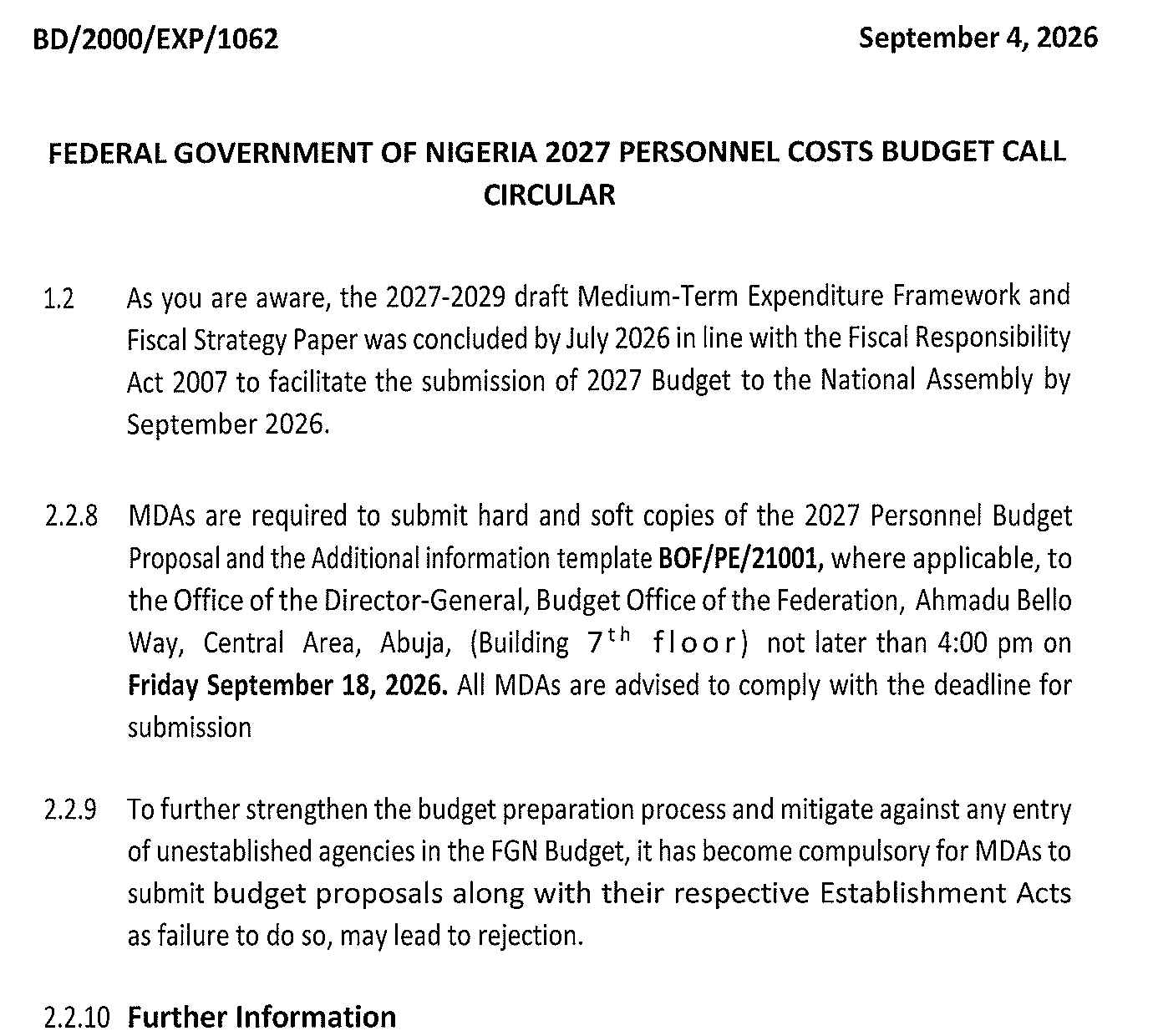
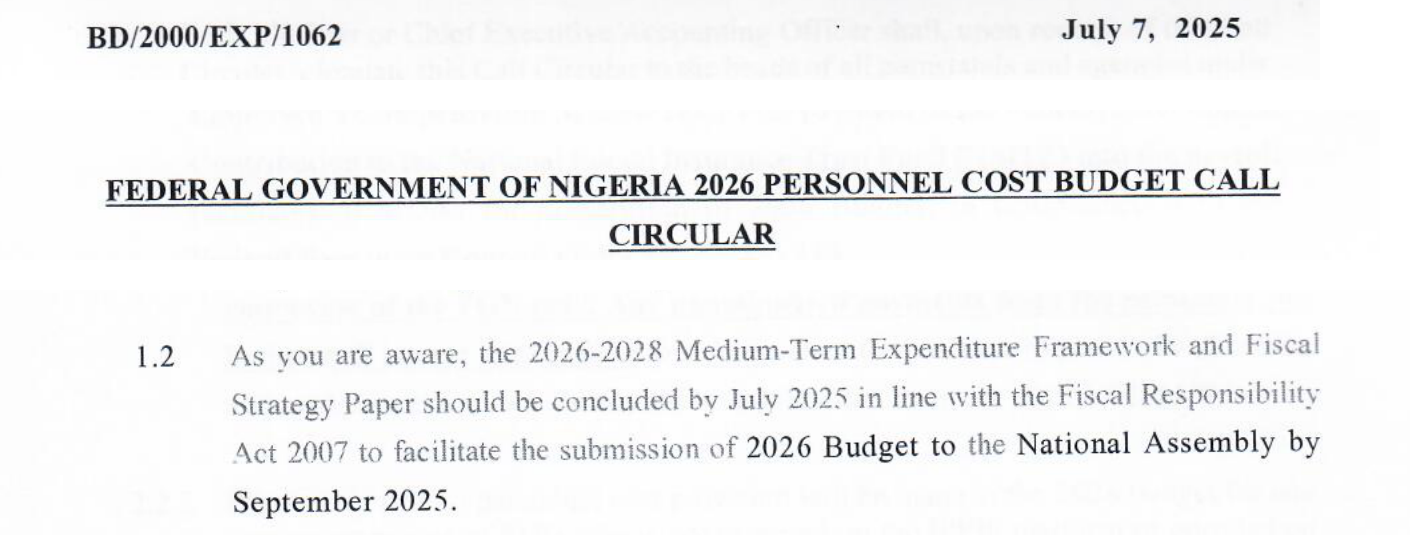
The 2027 budget was due to begin moving while all of this happened. On 4 September 2026 the Budget Office issued the "2027 Personnel Costs Budget Call Circular", reference BD/2000/EXP/1062, signed by Tanimu Yakubu. Vero Record downloaded the 11-page scanned circular from budgetoffice.gov.ng; the scan carries a creation date of 9 September and the server dates the file to 11 September. Paragraph 1.2 reads: "As you are aware, the 2027-2029 draft Medium-Term Expenditure Framework and Fiscal Strategy Paper was concluded by July 2026 in line with the Fiscal Responsibility Act 2007 to facilitate the submission of 2027 Budget to the National Assembly by September 2026." Ministries had until 4:00 pm on Friday, 18 September 2026 to return their personnel budgets. Paragraph 2.3.5 asks every ministry for a third-quarter personnel budget review "by September 30, 2026 to inform 2027 budget planning", which is the last day of the month by which the circular says the budget was to be submitted.
Last year's circular sets out the same plan. The 2026 Personnel Cost Budget Call Circular carries the same reference number, BD/2000/EXP/1062, and is dated 7 July 2025. It says the 2026-2028 framework "should be concluded by July 2025" to allow submission of the 2026 budget "by September 2025", and it gave ministries until 15 July 2025. In the event, the Federal Executive Council approved the 2026-2028 framework on 3 December 2025, according to The Guardian, and the President presented the 2026 bill on 19 December 2025, about three months after the September target. On our count, this year's circular was issued 59 days later in the cycle than last year's.
As of 2 October 2026, Vero Record had found no public record that the 2027 Appropriation Bill or the 2027-2029 framework has been laid before the National Assembly. The Budget Office's framework page lists documents up to 2026-2028 and has no 2027-2029 file. A search of State House posts since May 2026 for "2027 Appropriation" and "Medium-Term" returned nothing relevant. Tribune reported on 1 October that the September target had been missed, and that the House of Representatives is due to resume on 13 October. The circular says only that the draft framework was "concluded". Section 11(1)(b) of the Fiscal Responsibility Act 2007 requires the framework to be prepared "not later than four months before commencement of the next financial year", and section 11(2) provides that the framework, once laid, is to be considered for approval by a resolution of each House. On our reading, four months before a January start falls at the end of August. If the draft the circular describes as concluded in July is that framework, its preparation would fall within the limit; consideration by each House requires it to be laid, and we have found no record that it has been. We have not seen the 2027-2029 framework itself.
One new instruction in the 2027 circular has no equivalent in last year's. Paragraph 2.2.9 says that "to further strengthen the budget preparation process and mitigate against any entry of unestablished agencies in the FGN Budget, it has become compulsory for MDAs to submit budget proposals along with their respective Establishment Acts as failure to do so, may lead to rejection." We compared the two circulars and found no such clause in the 2026 one. The circular does not name any agency. BusinessDay, reporting the clause on 15 September, presented it as following the controversy over the Presidential Foreign Intervention Promotion Council; Nairametrics gave the same controversy as background. Vero Record has previously reported that this council has a code in the signed 2026 Act while the Presidency says it does not exist.
The documents establish the following. The Presidency's own release quotes the President promising that prior-year capital would close by 31 March 2026 and that there would be no rollovers from April. Since then a re-enactment and three amendments have moved the end of the 2025 budget to 31 December 2026, and the last of them was signed on 30 September. The signed 2026 Act, by its own section 12, expires on the same day. The Budget Office's September target for the 2027 budget appears in its own circular. The documents do not establish that any extension was unlawful, how much 2025 capital money remains unspent, why the March, June and September deadlines were missed, or when the 2027 bill will be presented. The Budget Office will be asked, through the contact details on its website, how much of the 2025 capital budget is still unreleased, whether the 2027-2029 framework has been approved and when it will be published, and when the 2027 bill will be laid. Any reply will be added to this story.
What this rests on
Eight primary documents downloaded and read in full: three State House releases, two Budget Office statements published on statehouse.gov.ng (7 January and 17 May 2026), the 2027 and 2026 personnel budget call circulars (scanned, OCR'd and checked against page images), and the long title and sections 1 to 13 of the signed 2026 Appropriation Act. Also the posted 2026 Budget Speech text on statehouse.gov.ng, and the Fiscal Responsibility Act 2007, s.11, from a published copy. Press reports (Vanguard, Voice of Nigeria, Leadership, Daily Trust, Tribune, The Guardian, BusinessDay, Nairametrics) are used for the dates of the December, March and June legislative steps, for the count of four extensions, for the FEC approval date of the 2026-2028 framework, for the missed September target and for the press link between clause 2.2.9 and the PFIPC; these are graded B. The nine-month overlap, the 59-day comparison and the four-months reading of FRA s.11 are Vero Record's own arithmetic, graded C and labelled.
What this does not establish
Whether the President actually spoke the March 31 and no-rollover lines (they are in the press office report, not in the posted speech text). The enrolled texts of the re-enactment and the three amendment Acts. The date of assent to the April extension (the release dated 17 April gives none) and whether that extension was backdated to 31 March. The assent date of the third extension (June to September). How much of the 2025 capital budget remains unreleased or unspent. Whether the 2027-2029 framework has been approved by FEC or laid before the National Assembly; we have not seen it. When the 2027 Appropriation Bill will be presented. Any illegality: none is claimed and no court has found any. The Budget Office has not yet been contacted; no response.
What we did ourselves
Placed the Presidency's December 2025 pledge next to every subsequent State House assent release and the signed 2026 Act's own end date and expiry section. Found that the pledge sentences appear in the press office report but not in the separately posted speech text. Retrieved the 2027 and 2026 personnel call circulars, OCR'd both and compared them clause by clause, which showed the same September target in both years and a new establishment-Act clause in 2027. Checked server file dates and PDF metadata, searched the State House post archive for the third extension, the 2027 bill and the 2027-2029 framework, and checked the Budget Office framework page.
Sources for this report
(A) State House releases of 19 December 2025 (2026 budget presentation, quoting the March 31 and no-rollover pledge), 17 April 2026 (assent to the 2026 Act and to the extension from 31 March to 30 June) and 30 September 2026 (assent to the Appropriation (Amendment) (No.4) Bill, 2025, to 31 December 2026); Budget Office 2027 Personnel Costs Budget Call Circular, BD/2000/EXP/1062, 4 September 2026, and the 2026 circular of 7 July 2025; long title and sections 1 and 12 of the signed 2026 Appropriation Act.
- President Tinubu Signs Appropriation (Amendment) (No.4) Bill, 2025, Extends Implementation To December 31, 2026 · State House (Bayo Onanuga) · 2026-09-30
- President Tinubu Presents N58.18 Trillion 2026 Appropriation Bill, Vows Stronger Discipline In Budget Execution · State House (Bayo Onanuga) · 2025-12-19
- 2026 Budget Speech · State House · 2025-12-19
- President Tinubu Assents To 2026 Appropriation Bill And 2025 Budget Extension · State House (Bayo Onanuga) · 2026-04-17
- On the Repeal and Re-enactment of the 2024 and 2025 Appropriation Acts and Budget Transparency · Budget Office of the Federation (Tanimu Yakubu) · 2026-01-07
- Fiscal Years Are Defined By Law, Not The Calendar · Budget Office of the Federation (Tanimu Yakubu) · 2026-05-17
- Federal Government of Nigeria 2027 Personnel Costs Budget Call Circular (BD/2000/EXP/1062) · Budget Office of the Federation (Tanimu Yakubu) · 2026-09-04
- Federal Government of Nigeria 2026 Personnel Cost Budget Call Circular (BD/2000/EXP/1062) · Budget Office of the Federation (Tanimu Yakubu) · 2025-07-07
- 2026 Appropriation Act (signed), long title and sections 1 to 13 · National Assembly / Budget Office of the Federation · 2026-04-17
- MTEF policy documents listing · Budget Office of the Federation · 2026-10-02
- Reviewed 2025 Third Quarter Budget Implementation Report · Budget Office of the Federation · 2026-08-21
- Fiscal Responsibility Act, 2007 (copy) · National Assembly (copy hosted by International Budget Partnership) · 2007-07-30
- Senate extends 2025 budget implementation to June 30 · Vanguard · 2026-03-31
- Senate extends 2025 Budget implementation to September · Vanguard · 2026-06-11
- Reps Extend 2025 Capital Budget Implementation to September · Voice of Nigeria · 2026-06-15
- National Assembly Okays Repeal, Re-enactment Of 2024, 2025 Appropriation Acts · Leadership · 2025-12-24
- N'Assembly extends 2025 budget for 4th time · Daily Trust · 2026-09-30
- FG misses September target for submission of 2027 budget to National Assembly · Tribune · 2026-10-01
- Tinubu transmits 2026-2028 MTEF/FSP to Senate for speedy approval · The Guardian · 2025-12-11
- FG clamps down on 'fake' agencies in 2027 budget prep guidelines · BusinessDay · 2026-09-15
- Fake agency: FG mandates MDAs to submit establishment acts for 2027 budget proposal approval · Nairametrics · 2026-09-14
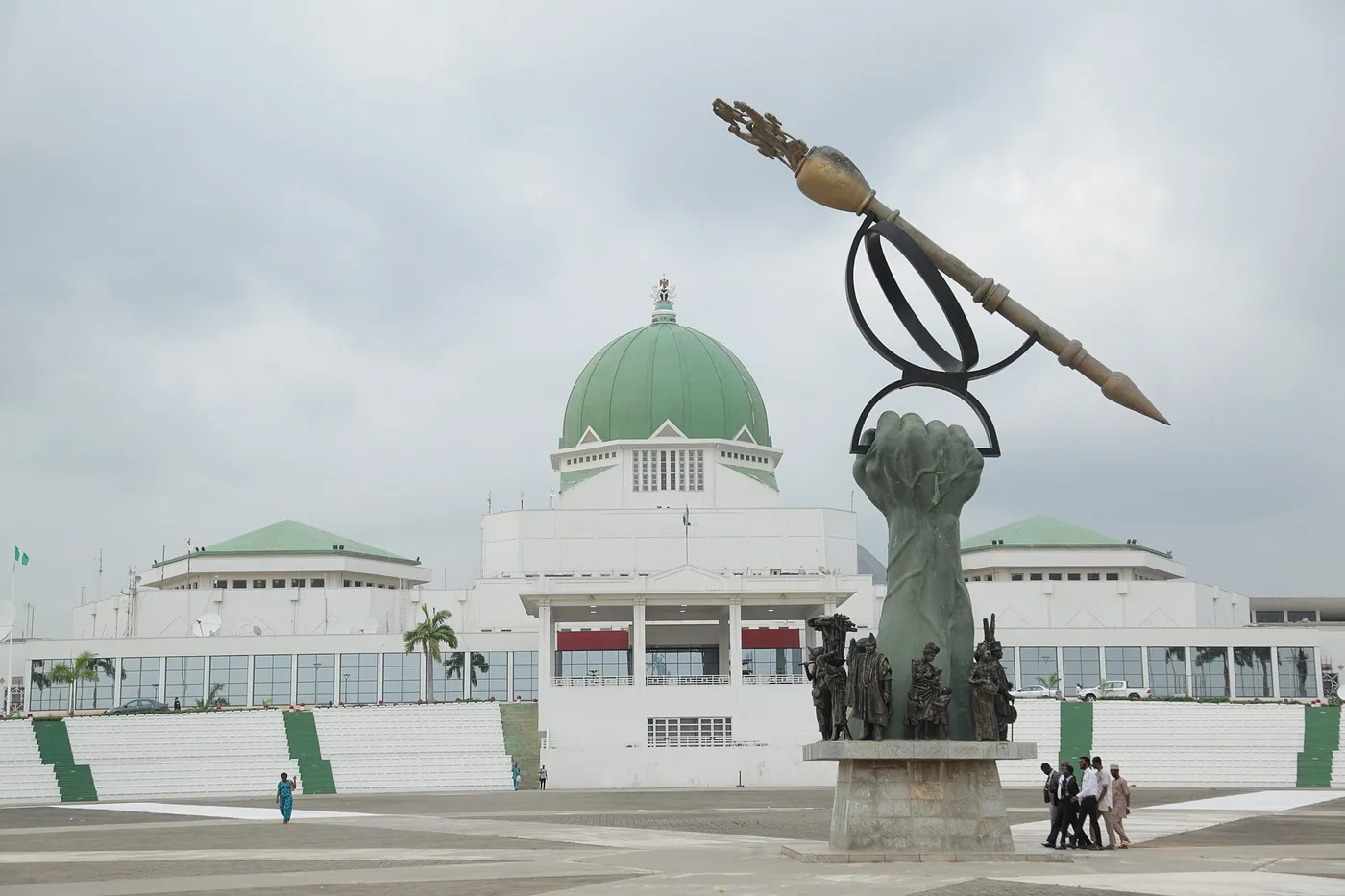
- National Assembly Building with Mace, Abuja, Nigeria (cover photo) · Kabusa16, Wikimedia Commons, CC BY-SA 4.0 · 2018-05-15

Confidence: high. This is our own assessment of whether the event occurred as described, separate from the grade, which describes what kind of thing the claim rests on.
Not obtained: where the underlying document is named above but not linked, we did not hold a copy at the time of publication. We purchase nothing and request nothing in our own name.
Corrections
None on this report. If you find an error, it will be published here, at the same length, with the date it was found, and the original wording will remain visible above it.