NERC puts the N37.06bn fall in the electricity subsidy down to lower demand; its own totals put the volume effect at about N8.33bn
The regulator's report for April to June 2026 says the Federal Government's tariff subsidy obligation fell from N358.32 billion to N321.26 billion, mainly because DisCos took 3.40 per cent less energy. On the report's own totals, energy received fell 2.32 per cent, which accounts for about N8.33 billion of the fall. Most of the rest, about N25.97 billion, came from a lower generation cost per kilowatt-hour that the report does not explain.
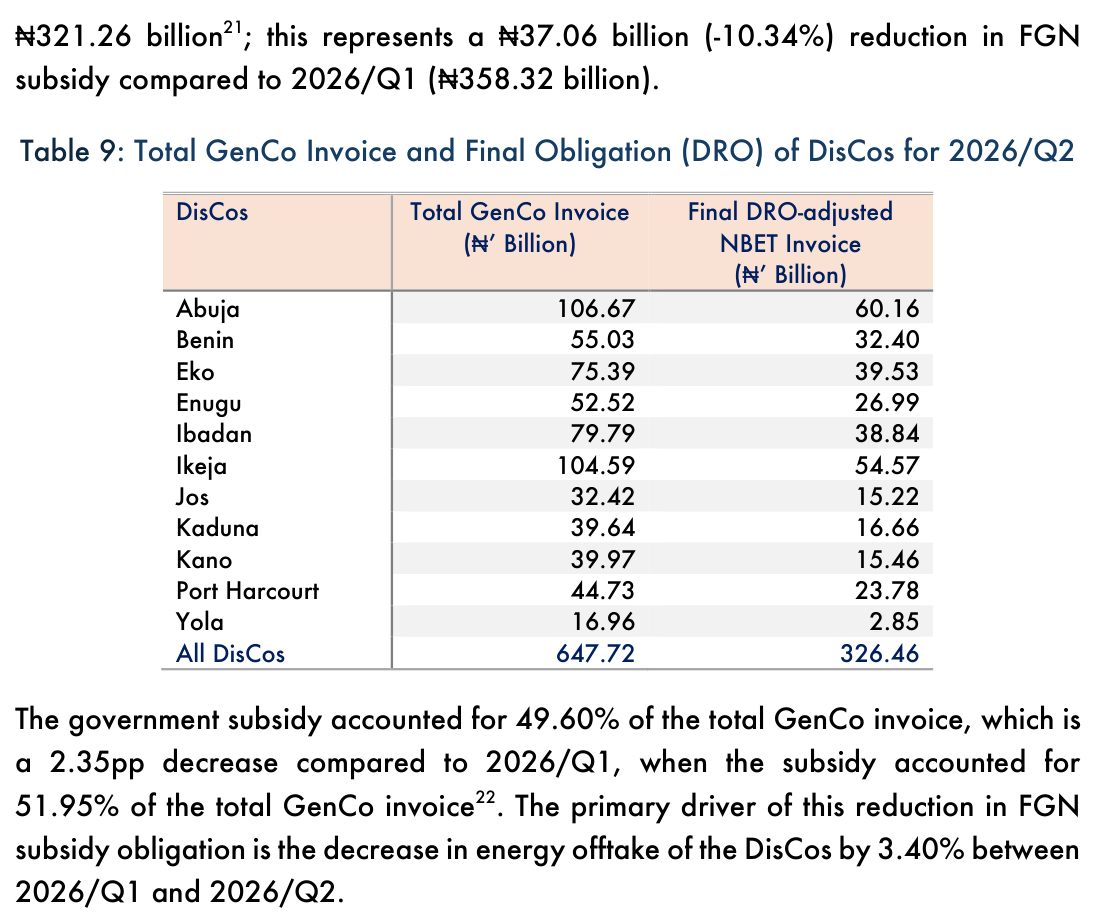
The Nigerian Electricity Regulatory Commission's quarterly report for April to June 2026 says the Federal Government incurred an electricity tariff subsidy obligation of N321.26 billion in the second quarter: N108.40 billion in April, N112.93 billion in May and N99.93 billion in June, which add to N321.26 billion. That is N37.06 billion, or 10.34 per cent, less than the N358.32 billion of the first quarter. The mechanism is set out on pages 39 and 40. GenCos invoiced N647.72 billion for the energy they delivered to the eleven distribution companies; the Nigerian Bulk Electricity Trading company billed the DisCos only the N326.46 billion their frozen tariffs can cover, and invoices the difference, N647.72 billion minus N326.46 billion, or N321.26 billion, to the Federal Ministry of Finance. The report then states: "The primary driver of this reduction in FGN subsidy obligation is the decrease in energy offtake of the DisCos by 3.40% between 2026/Q1 and 2026/Q2."
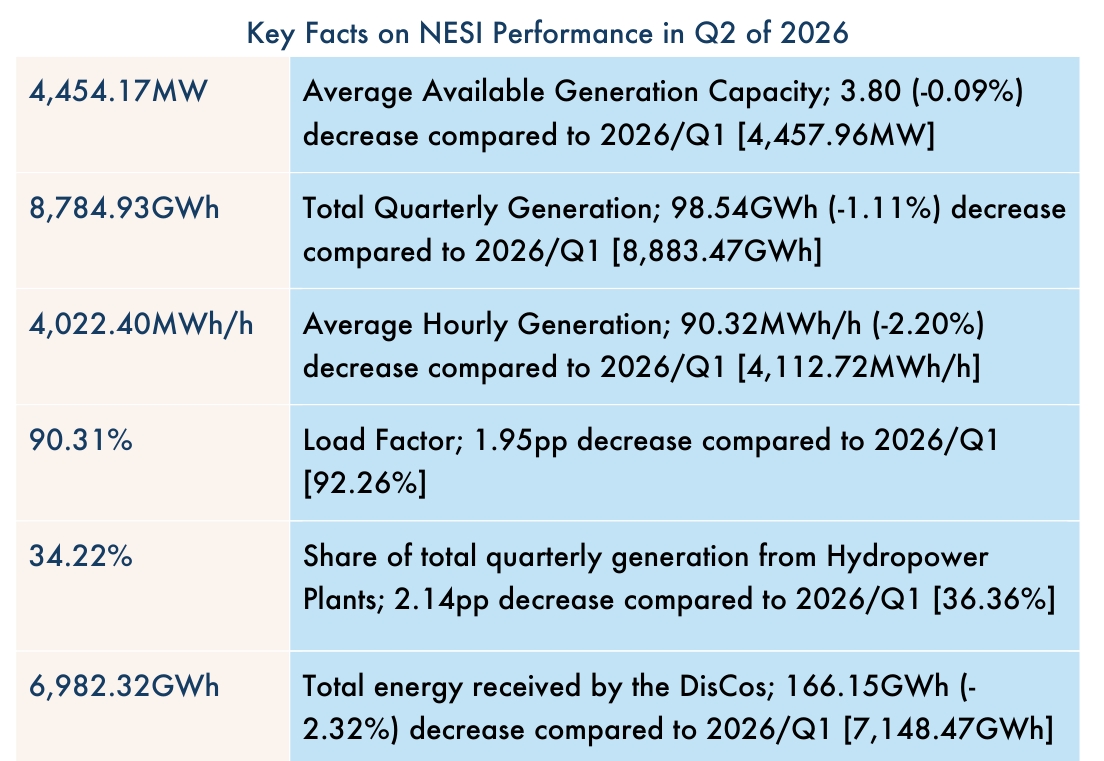
The 3.40 per cent is a fall in the average hourly offtake, from 3,309.48MWh/h to 3,197.03MWh/h. The subsidy, however, is a quarterly total, and the second quarter had 91 days against the first quarter's 90 (January 31, February 28 and March 31; April 30, May 31 and June 30). The report's own key facts table on page 12 gives the totals: the DisCos received 6,982.32GWh in the second quarter against 7,148.47GWh in the first, a fall of 166.15GWh, or 2.32 per cent. The Commission makes the same point about generation in its footnote 2, which explains that hourly and total changes differ "because the number of days in each of the quarters is not the same (90/91 days)". The hourly averages multiply back to the totals: 3,309.48 x 24 x 90 gives 7,148.48GWh and 3,197.03 x 24 x 91 gives 6,982.31GWh.
The report's own figures allow the fall to be split into its parts. In the first quarter the subsidy came to N358.32 billion on 7,148.47GWh, or N50.13 for every kilowatt-hour the DisCos received. Had that rate held, the second quarter's 6,982.32GWh would have carried a subsidy of N349.99 billion, which is N8.33 billion below the first quarter. The other N28.73 billion of the fall came from a lower subsidy per kilowatt-hour, which dropped to N46.01 (N321.26 billion on 6,982.32GWh). Measured the other way round, with the lower volume priced at the second-quarter rate, volume accounts for N7.64 billion and the rate for N29.42 billion. On either ordering, lower volume explains between a fifth and a quarter of the fall. Even applying the report's 3.40 per cent to the whole first-quarter subsidy would account for only N12.18 billion.
There is a ceiling on what lower volume could do. The GenCo invoice in the first quarter averaged N96.48 per kilowatt-hour received (N689.72 billion on 7,148.47GWh). If every one of the 166.15GWh that were not taken had carried its full generation cost and none of it had been recoverable from customers, the saving would still have been only N16.03 billion. For the lost volume to explain the whole N37.06 billion, each of those kilowatt-hours would have had to carry about N223 of subsidy, more than twice the average cost of generating it.
The rest of the fall sits in the price of the power. The total GenCo invoice per kilowatt-hour fell from N96.48 to N92.77 (N647.72 billion on 6,982.32GWh), a drop of 3.85 per cent; across the second quarter's volume that is worth N25.97 billion. What the DisCos were billed rose slightly, from N46.36 to N46.76 per kilowatt-hour (N331.40 billion and N326.46 billion of DRO-adjusted invoices), which reduced the subsidy by another N2.76 billion. The three parts add back to the total: N8.33 billion + N25.97 billion + N2.76 billion = N37.06 billion. The small rise in what the DisCos pay per unit is consistent with power shifting towards customers on higher tariffs, a change that could follow from how the DisCos allocated a smaller offtake: the naira value of energy received, which the report prices at allowed tariffs, rose from N133.62 to N135.57 per kilowatt-hour (N955.19 billion on 7,148.47GWh, and N946.57 billion on 6,982.32GWh). Counted generously, volume and this shift in mix together account for N11.09 billion, under a third of the N37.06 billion.
The report does not say why generation cost less per kilowatt-hour, and its physical indicators point the other way. Hydropower's share of generation fell from 36.36 per cent to 34.22 per cent, and the transmission loss factor rose from 7.96 per cent to 8.44 per cent. Footnote 22 of the same section lists among the risks of the open-ended subsidy "generation cost variation arising from changes in supply mix (more thermal = higher generation cost)"; in this quarter the mix moved towards thermal and the cost per unit still fell. Earlier reports did name the unit cost: the report for April to June 2025 said "the actual generation cost (N/kWh) increased by 0.59%", and the report for July to September 2025 cited "a reduction in actual generation cost (N/kWh) by 0.98%". The second-quarter 2026 report gives no such figure.
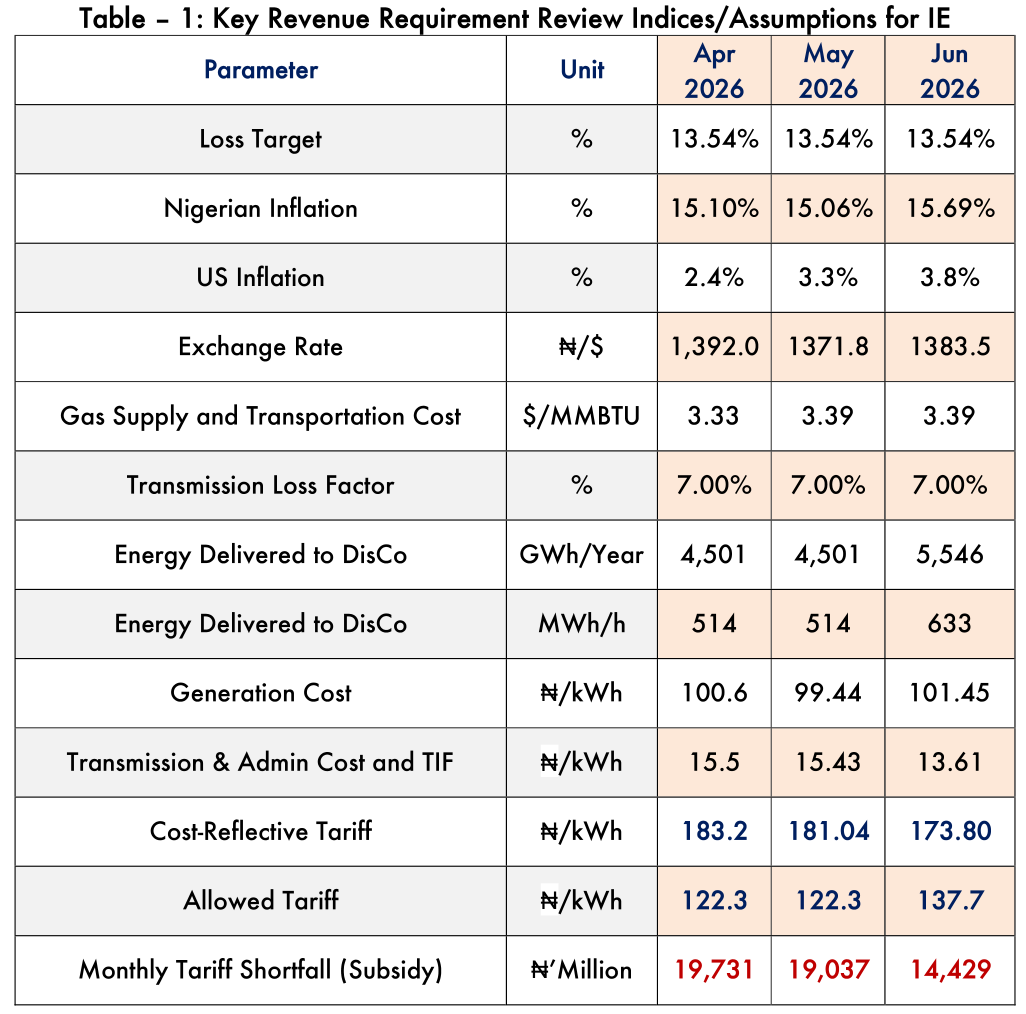
The Commission's monthly tariff orders for the DisCos carry the price inputs. In the orders for Ikeja Electric, the naira exchange rate used was N1,468.0, N1,435.5 and N1,368.3 to the dollar for January, February and March 2026, and N1,392.0, N1,371.8 and N1,383.5 for April, May and June: an average of N1,423.93 in the first quarter and N1,382.43 in the second, a stronger naira by 2.91 per cent. The generation cost used in those orders averaged N103.30 per kilowatt-hour in the first quarter (106.9, 104.5 and 98.5) and N100.50 in the second (100.6, 99.44 and 101.45), 2.71 per cent lower, even though the gas supply and transport cost rose from $3.33 to $3.39 per MMBTU in May and June. The June orders for Abuja and Eko use almost the same April to June generation costs; Abuja's, for instance, gives N100.64, N99.44 and N101.46. These are the regulator's own tariff assumptions, not the settled market invoices, but they point to price rather than volume as the larger force.
On a different quarter, NERC's explanation would hold. Between the first and second quarters of 2025, the drop in energy received from 8,169.00GWh to 7,824.43GWh, priced at the earlier quarter's subsidy per kilowatt-hour, accounts for N22.63 billion, slightly more than the whole N22.05 billion fall in the obligation. Between the last quarter of 2025 and the first quarter of 2026, lower volume (7,991.22GWh to 7,148.47GWh) accounts for N44.17 billion of a N60.47 billion fall, nearly three quarters. Volume has been the main force behind the falling subsidy in other quarters, and it did push the obligation down in the second quarter of 2026. It was not the primary driver of the N37.06 billion this time; the unexplained fall in unit cost was.
Monthly, the obligation has fallen almost without interruption across the 18 months the last six quarterly reports cover. The reports give N179 billion, N162 billion and N194 billion for January to March 2025; N175.35 billion, N176.87 billion and N162.12 billion for April to June; N163.70 billion, N153.32 billion and N141.72 billion for July to September; N153.24 billion, N142.22 billion and N123.32 billion for October to December; N126.48 billion, N116.34 billion and N115.50 billion for January to March 2026; and N108.40 billion, N112.93 billion and N99.93 billion for April to June. June 2026's N99.93 billion is the lowest of the 18, both in total and per day (N3.33 billion a day, against N3.64 billion in May), and is 38.36 per cent below June 2025 and 48.49 per cent below the March 2025 peak. June is also the month in which the orders for Ikeja and Eko raised their target share of energy for Band A customers to 55 per cent, lifting their weighted allowed tariffs from N122.3 to N137.7 and from N125.8 to N140.8 per kilowatt-hour; the orders' projected monthly shortfall for the two fell from N19,037 million to N14,429 million and from N16,427 million to N12,315 million. Those are projections, and the report does not break the actual June obligation down by DisCo.
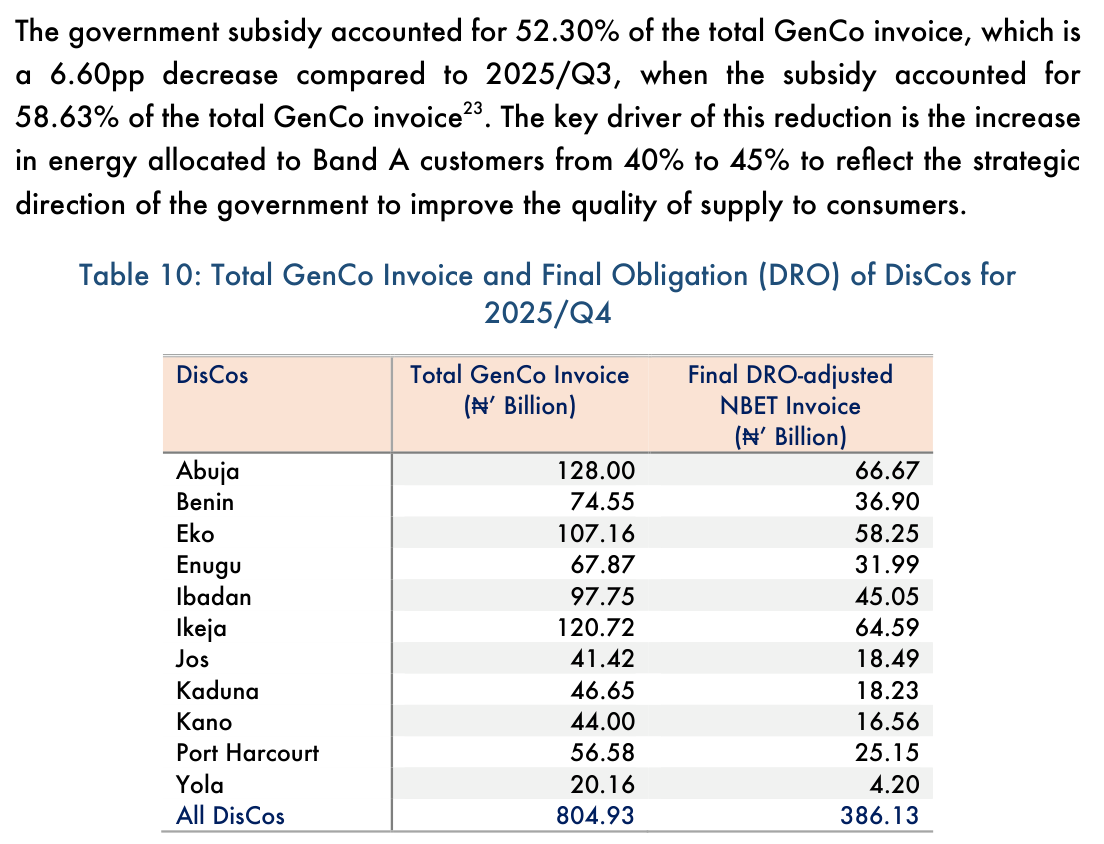
The report for October to December 2025 contains a figure that does not match its own table. It says the subsidy "accounted for 52.30% of the total GenCo invoice, which is a 6.60pp decrease compared to 2025/Q3", when the share was 58.63 per cent. Its Table 10 gives N418.79 billion of subsidy against a total GenCo invoice of N804.93 billion, which is 52.03 per cent, and 58.63 minus 52.03 is the 6.60 points the sentence states; 52.30 per cent would have been a fall of 6.33 points. The first-quarter 2026 report uses 52.03 per cent for the same quarter. The error looks like transposed digits and does not change any naira figure. In the same table the DisCo rows add to N804.86 billion and N386.08 billion, against printed totals of N804.93 billion and N386.13 billion.
Who pays is set out in the report, but how much has been paid is not. Under the DisCo Remittance Obligation regime, NBET "directly invoices the portion of GenCo costs not covered by DRO (tariff subsidy) to the Federal Ministry of Finance for immediate settlement". The report records the obligation, not the settlement. The 2026 Appropriation Act, in the copy published by the Policy and Legal Advocacy Centre, has no line described as an electricity or tariff subsidy. The nearest provision is N601,085,207,510 for the Nigerian Bulk Electricity Trading company under the Federal Ministry of Finance, of which N598,500,000,000 is a project called "Power Reform Programme"; separately, N375,000,000,000 is provided under the Ministry of Budget and Economic Planning as a tied loan for the World Bank's Power Sector Recovery Operation, additional financing. The Act does not say whether either line pays the tariff subsidy. For scale, the first-half obligation of N358.32 billion + N321.26 billion = N679.58 billion already exceeds the whole NBET appropriation.
Statements reported in the press add context that this report has not checked against primary records. On 2 February 2026 the Director-General of the Budget Office, Tanimu Yakubu, was reported as saying that from 2026 the cost of the subsidy would no longer be left to the Federal Government alone. In September the government was reported to have raised N501 billion in January and N728.9 billion in August through power sector bonds, N1.23 trillion in all, to settle verified legacy debts owed to GenCos; those debts relate to earlier periods, not to the 2026 obligation. Pulse reported in March that N76.95 billion had been released against a budget of N958 billion for electricity subsidies, without naming the document behind the figures.
The quarterly reports do not establish why the GenCo invoice per kilowatt-hour fell between the two quarters, how much of the fall came from the exchange rate, gas prices or the plant mix actually dispatched, or how the monthly obligation splits by DisCo. Nor do they say how much of the N321.26 billion, or of the N358.32 billion before it, the Ministry of Finance has paid NBET. The decomposition above uses the report's quarterly totals and treats the subsidy as the gap per kilowatt-hour between the GenCo invoice and the DRO invoice, which is how the report defines it; it is arithmetic on published figures, not the Commission's own analysis. The Commission was not asked for comment before publication.
What this rests on
Six quarterly reports of the Nigerian Electricity Regulatory Commission, downloaded from nerc.gov.ng on 3 October 2026 and read for this report: Second Quarter 2026 (93 pages; section 2.3.6.1, Table 9 and footnotes 21 to 23 on printed pp.39 to 40; key facts p.12; offtake section pp.28 to 30; billing efficiency p.33; generation and energy mix pp.3 to 4 and footnote 2), First Quarter 2026 (94 pages; Table 10, p.41), Fourth Quarter 2025 (92 pages; Table 10, p.41), Third Quarter 2025 (98 pages; Table 10, p.43), Second Quarter 2025 (96 pages; Table 9) and First Quarter 2025 (92 pages; Table 7). NERC monthly supplementary MYTO orders for Ikeja Electric (March, April and June 2026, Table 1) and the June 2026 orders for Abuja and Eko (Table 1), scanned PDFs read as images. The 2026 Appropriation Act as published by the Policy and Legal Advocacy Centre (2,604 pages; NBET entry pp.905 to 906; PSRO-AF line p.934). Arithmetic re-done: Q2 2026 months N108.40bn + N112.93bn + N99.93bn = N321.26bn; N647.72bn - N326.46bn = N321.26bn; N358.32bn - N321.26bn = N37.06bn (10.34 per cent); Q1 2026 months N126.48bn + N116.34bn + N115.50bn = N358.32bn; N689.72bn - N331.40bn = N358.32bn; Q1 2026 Table 10 rows add to N689.72bn and N331.40bn; Q2 2026 Table 9 rows add to N647.71bn and N326.46bn against N647.72bn printed. Days: Q1 2026 = 31 + 28 + 31 = 90; Q2 2026 = 30 + 31 + 30 = 91. 3,309.48MWh/h x 24 x 90 = 7,148.48GWh; 3,197.03MWh/h x 24 x 91 = 6,982.31GWh; 7,148.47 - 6,982.32 = 166.15GWh (2.32 per cent). Decomposition: subsidy per kWh Q1 = 358.32bn / 7,148.47GWh = N50.13; Q2 = 321.26bn / 6,982.32GWh = N46.01. Volume effect at Q1 rate = 166.15GWh x N50.13 = N8.33bn (Q2 at Q1 rate = N349.99bn); rate effect at Q2 volume = 6,982.32GWh x (N46.01 - N50.13) = N28.73bn; reverse ordering N7.64bn and N29.42bn. GenCo invoice per kWh: Q1 N689.72bn / 7,148.47GWh = N96.48; Q2 N647.72bn / 6,982.32GWh = N92.77 (minus 3.85 per cent); cost effect = 6,982.32GWh x N3.719 = N25.97bn. DRO per kWh: Q1 N331.40bn / 7,148.47GWh = N46.36; Q2 N326.46bn / 6,982.32GWh = N46.76; DRO effect = 6,982.32GWh x N0.396 = N2.76bn. Check: 8.33 + 25.97 + 2.76 = 37.06. Ceiling: 166.15GWh x N96.48 = N16.03bn; N37.06bn / 166.15GWh = N223 per kWh. 3.40 per cent x N358.32bn = N12.18bn. Allowed-tariff value per kWh: N955.19bn / 7,148.47GWh = N133.62; N946.57bn / 6,982.32GWh = N135.57. Volume plus mix: 8.33 + 2.76 = N11.09bn. Subsidy per day: N358.32bn / 90 = N3.98bn; N321.26bn / 91 = N3.53bn. Earlier quarters, same method: Q1 to Q2 2025 volume effect (8,169.00 - 7,824.43GWh) x (N536.40bn / 8,169.00GWh) = N22.63bn against a fall of N22.05bn (N536.40bn to N514.35bn; Table 9 of the Q2 2025 report gives N863.02bn and N348.66bn); Q4 2025 to Q1 2026 volume effect (7,991.22 - 7,148.47GWh) x (N418.79bn / 7,991.22GWh) = N44.17bn against a fall of N60.47bn. MYTO orders (Ikeja): exchange rate (1,468.0 + 1,435.5 + 1,368.3) / 3 = N1,423.93; (1,392.0 + 1,371.8 + 1,383.5) / 3 = N1,382.43; minus 2.91 per cent. Generation cost (106.9 + 104.5 + 98.5) / 3 = N103.30; (100.6 + 99.44 + 101.45) / 3 = N100.50; minus 2.71 per cent (March figure 98.5 from the April order, which revised the 99.52 in the March order). Ikeja projected shortfall May N19,037m to June N14,429m (minus N4,608m); Eko N16,427m to N12,315m (minus N4,112m). Monthly series (18 months): 179, 162, 194, 175.35, 176.87, 162.12, 163.70, 153.32, 141.72, 153.24, 142.22, 123.32, 126.48, 116.34, 115.50, 108.40, 112.93, 99.93 (N billion); the Q1 2025 months, given in whole billions, add to N535bn against the N536.40bn quarterly figure, and Q3 and Q4 2025 months add to N458.74bn and N418.78bn against N458.75bn and N418.79bn. June 2026 per day N99.93bn / 30 = N3.33bn; May N112.93bn / 31 = N3.64bn. June 2026 against June 2025: 99.93 / 162.12 = minus 38.36 per cent; against March 2025: 99.93 / 194 = minus 48.49 per cent. Q4 2025 share: N418.79bn / N804.93bn = 52.03 per cent (printed 52.30 per cent); 58.63 - 52.03 = 6.60pp; 58.63 - 52.30 = 6.33pp. Q4 2025 Table 10 rows add to N804.86bn and N386.08bn. First-half 2026: N358.32bn + N321.26bn = N679.58bn, against the NBET appropriation of N601,085,207,510.
What this does not establish
Why the GenCo invoice per kilowatt-hour fell by 3.85 per cent between the first and second quarters of 2026, and how much of that came from the exchange rate, gas prices, the plants actually dispatched or other settlement adjustments; the MYTO figures cited are the regulator's tariff assumptions for individual DisCos, not the settled invoices. Whether the Commission's statement rests on a different calculation than the one shown here; the report gives no breakdown. How the monthly obligation divides between DisCos, and whether the June 2026 changes to Band A allocation at Ikeja and Eko lowered the actual June obligation by the amounts their orders projected. How much of the 2026 obligation the Federal Ministry of Finance has paid to NBET, and whether the N598.5 billion "Power Reform Programme" line in the 2026 Appropriation Act or any other appropriation funds the tariff subsidy. The press-reported release figures and bond proceeds were not checked against primary documents. Nothing in the documents suggests wrongdoing by anyone, and none is alleged. The Commission was not asked for comment.
What we did ourselves
Downloaded six consecutive NERC quarterly reports and took the GenCo invoice, DRO invoice, subsidy and energy-received totals from each. Converted the 3.40 per cent hourly figure into quarterly totals using the day counts, and split the N37.06 billion fall into a volume effect, a generation cost effect and a tariff-mix effect, checking that the parts add back to the total and testing the alternative ordering and an upper bound. Applied the same method to earlier quarters, where the Commission's volume explanation largely holds. Read the Commission's scanned monthly tariff orders for the exchange rate, gas price and generation cost assumptions, built the 18-month monthly subsidy series from the six reports, re-added the fourth-quarter 2025 table, and searched the 2,604-page 2026 Appropriation Act for subsidy and power market lines.
Sources for this report
(A) Nigerian Electricity Regulatory Commission, Second Quarter 2026 NERC Quarterly Reports, section 2.3.6.1, Table 9 and footnotes 21 to 23 (pp.39 to 40), key facts (p.12); with the Commission's quarterly reports for the first quarter of 2026 and all four quarters of 2025, its March, April and June 2026 supplementary MYTO orders for Ikeja Electric, and the 2026 Appropriation Act.
- Second Quarter 2026 NERC Quarterly Reports (93 pages) · Nigerian Electricity Regulatory Commission · September 2026
- First Quarter 2026 NERC Quarterly Reports (94 pages) · Nigerian Electricity Regulatory Commission · July 2026
- Fourth Quarter 2025 NERC Quarterly Reports (92 pages) · Nigerian Electricity Regulatory Commission · April 2026
- Third Quarter 2025 NERC Quarterly Reports (98 pages) · Nigerian Electricity Regulatory Commission · January 2026
- Second Quarter 2025 NERC Quarterly Reports (96 pages) · Nigerian Electricity Regulatory Commission · October 2025
- First Quarter 2025 NERC Quarterly Reports (92 pages) · Nigerian Electricity Regulatory Commission · June 2025
- March 2026 Supplementary Order to MYTO, Ikeja Electric · Nigerian Electricity Regulatory Commission · March 2026
- April 2026 Supplementary Order to MYTO, Ikeja Electric · Nigerian Electricity Regulatory Commission · April 2026
- June 2026 Supplementary Order to MYTO, Ikeja Electric · Nigerian Electricity Regulatory Commission · June 2026
- June 2026 Supplementary Order to MYTO, Eko Electricity Distribution · Nigerian Electricity Regulatory Commission · June 2026
- June 2026 Supplementary Order to MYTO, Abuja Electricity Distribution · Nigerian Electricity Regulatory Commission · June 2026
- 2026 Appropriation Act (copy published by PLAC) · National Assembly of the Federal Republic of Nigeria · April 2026
- FG to share electricity subsidy costs with state governments from 2026 · Nairametrics · 3 February 2026
- FG raises N1.23 trillion to tackle N4 trillion GenCo debt · Nairametrics · 15 September 2026
- Nigeria's electricity crisis worsens as Federal Government pays just 4% of electricity subsidy budget · Pulse Nigeria · 30 March 2026
- NERC: Electricity subsidy gulped N679bn in H1 2026, down by 35% · TheCable · September 2026
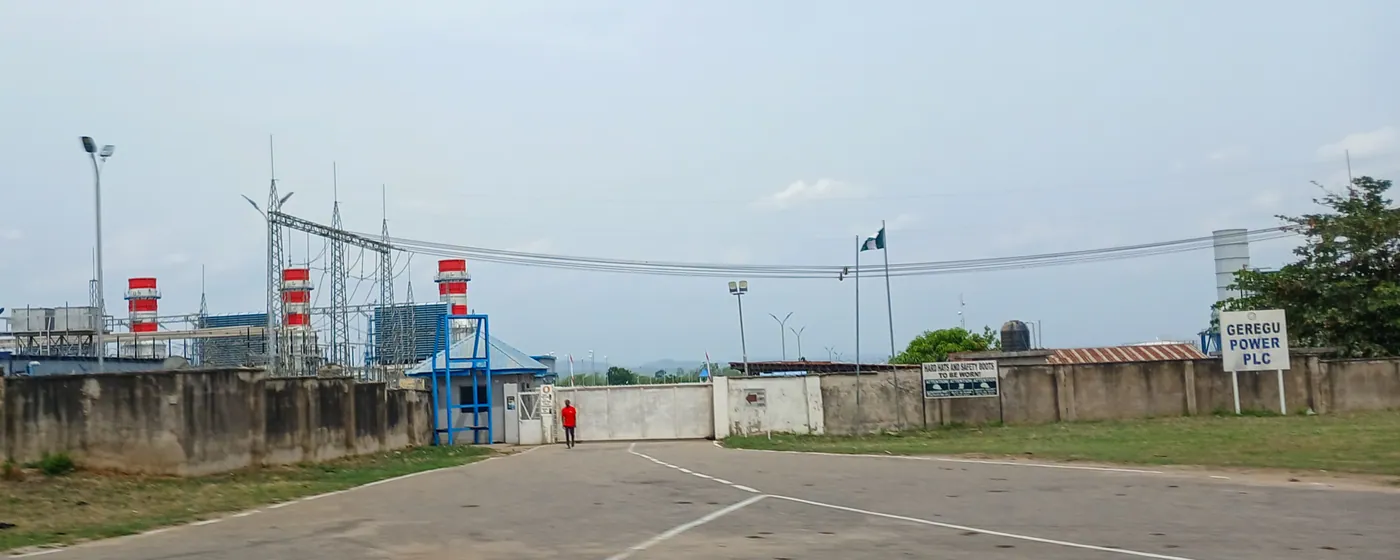
- Geregu Gas Power Plant, Lokoja Kogi State (photograph) · Wikimedia Commons · April 2025

Confidence: high. This is our own assessment of whether the event occurred as described, separate from the grade, which describes what kind of thing the claim rests on.
Not obtained: where the underlying document is named above but not linked, we did not hold a copy at the time of publication. We purchase nothing and request nothing in our own name.
Corrections
None on this report. If you find an error, it will be published here, at the same length, with the date it was found, and the original wording will remain visible above it.