The Auditor-General's N54.57tn borrowing query counts N22.719tn of Ways and Means that the DMO's own tables say the Assembly approved in May 2023
The special audit of the Debt Management Office sets N88.67 trillion of debt issued in 2020 to 2024 against N34.10 trillion of borrowing in the budgets, and says no evidence of National Assembly approval for the difference was provided. The office's reply, printed in the same report, puts N30.02 trillion of the gap down to the conversion of the central bank overdraft and N23.09 trillion to rolling over maturing debt. Its own published debt tables back the first N22.719 trillion of that, but give three different accounts of when the remaining N7.3 trillion was issued.
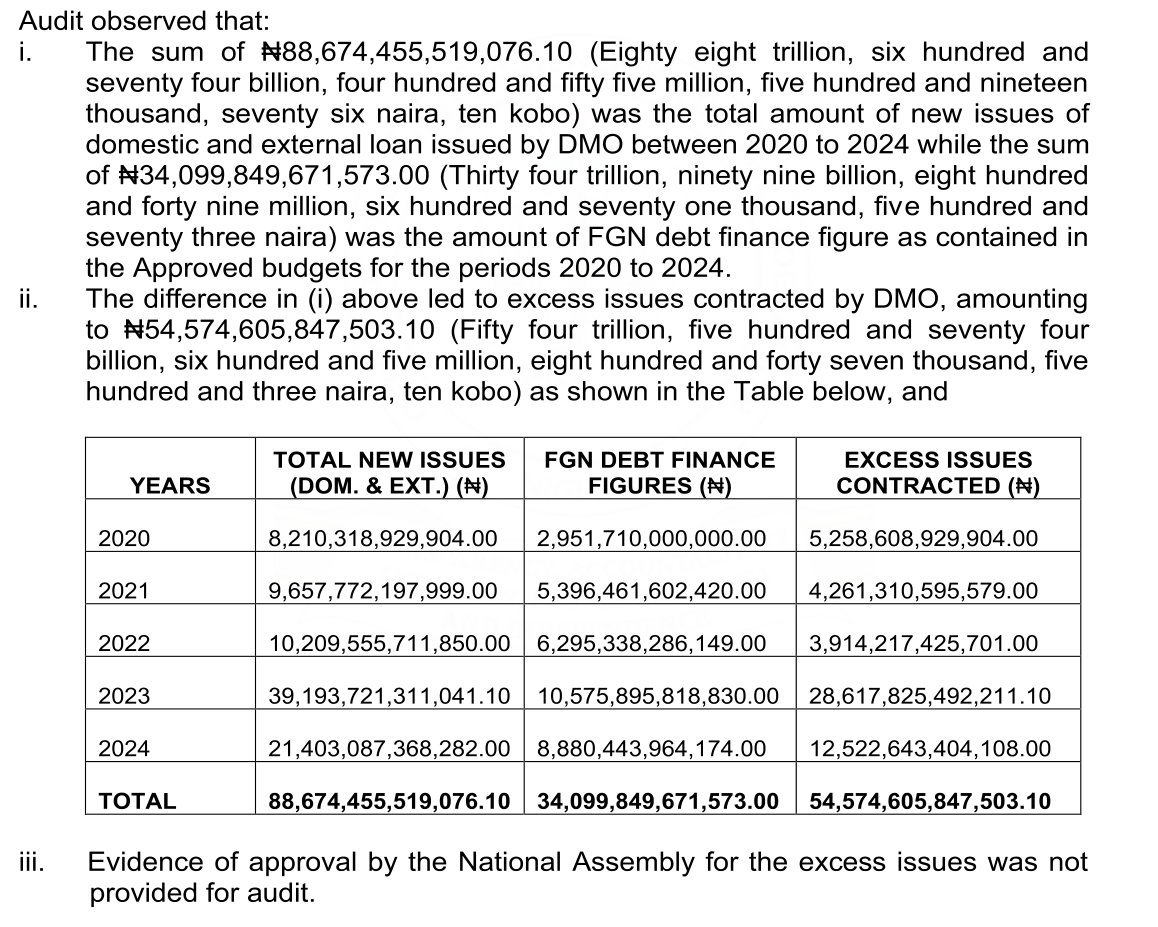
The Auditor-General for the Federation's 2024 Annual Report on Non-compliance, Volume II, contains a special audit of the Debt Management Office covering 1 January 2020 to 31 December 2024. Its third finding, on page 735, says the office issued N88,674,455,519,076.10 of new domestic and external debt in those five years, while the Federal Government's debt finance figures in the approved budgets came to N34,099,849,671,573.00. The difference, N54,574,605,847,503.10, is described as "excess issues contracted by DMO", and the report adds: "Evidence of approval by the National Assembly for the excess issues was not provided for audit." The office's answer is printed on the next two pages. It attributes N30,019.00 billion of the gap to the securitisation of Ways and Means Advances, the Federal Government's overdraft at the Central Bank of Nigeria, and N23,086.75 billion to refinancing maturing securities. Together that is N53,105.75 billion, or 97.31 per cent of the sum in the finding.
The audit's own table adds up. Its five years of issues, N8,210.32 billion, N9,657.77 billion, N10,209.56 billion, N39,193.72 billion and N21,403.09 billion, total N88,674,455,519,076.10 exactly, and its five budget figures total N34,099,849,671,573.00. Each year's excess is the difference between the two, to the kobo. The year that dominates is 2023: issues rose from N10,209.56 billion in 2022 to N39,193.72 billion, 3.84 times as much, and the 2023 excess of N28,617.83 billion is 52.44 per cent of the five-year total. The finding does not break the issues down by instrument, and it does not mention Ways and Means.
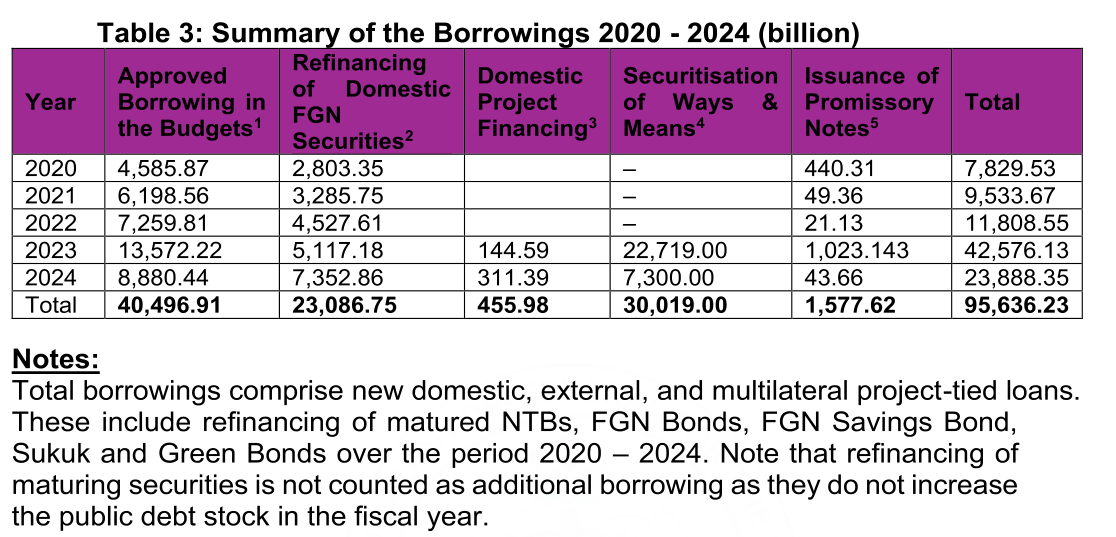
The Debt Management Office calls the finding "misleading" and says it "arose from a misclassification of borrowing components and an understatement of approved amount's". It lists three components that the Appropriation Acts do not provide for: refinancing of maturing Treasury bills, bonds, Sukuk and green bonds; the securitisation of Ways and Means Advances, "approved by Federal Executive Council (FEC) and National Assembly (NASS) in 2023 for which the sum of N22.719 trillion was securitized in 2023 and an additional N7.30 trillion in 2024 bringing a total of N30.02 trillion into the public debt stock"; and project loans approved separately, such as the Kano-Maradi rail line. Its Table 3 on page 737 sets these out year by year, with N22,719.00 billion of Ways and Means in 2023 and N7,300.00 billion in 2024. The Auditor-General's evaluation, printed below it, reads: "The Management's response to the issue has been noted; however, it is deemed unsatisfactory."
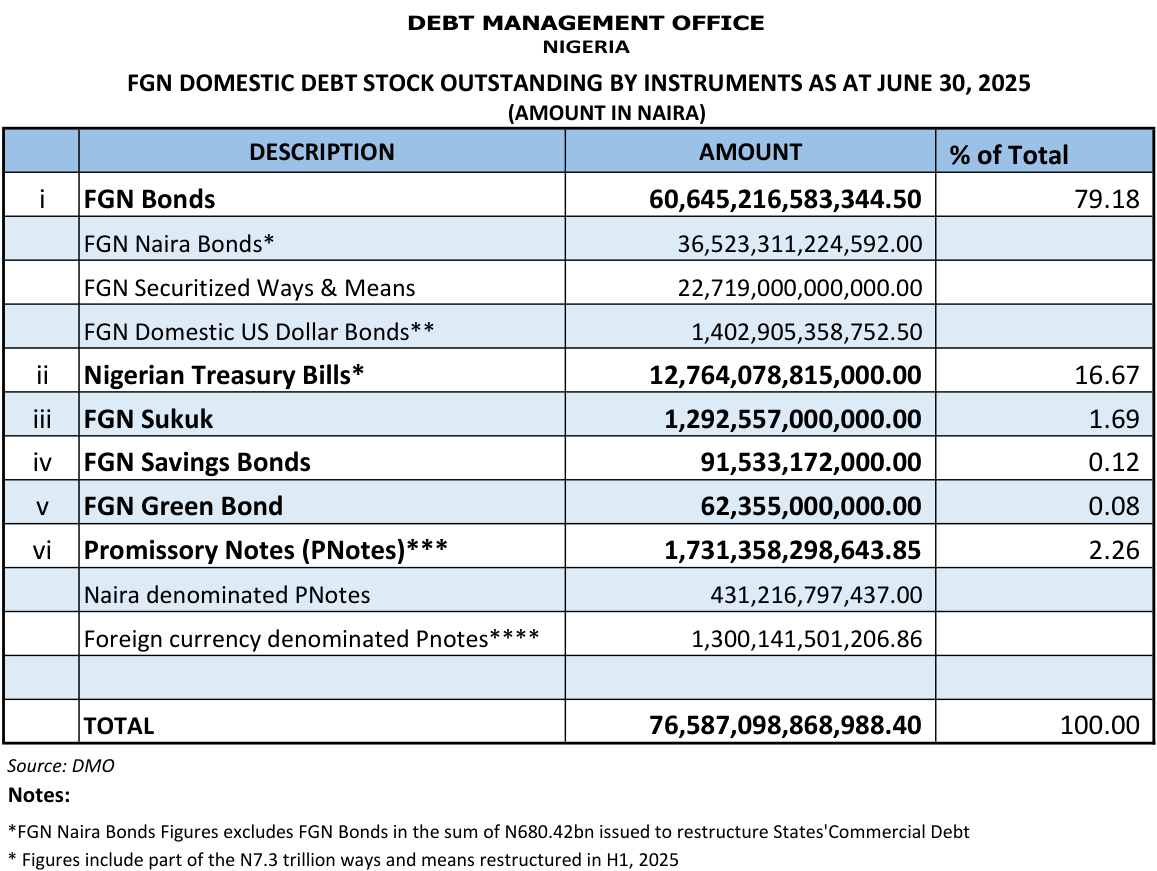
The office's own quarterly debt tables carry the first part of that answer. Its table of Federal Government domestic debt by instrument at 31 December 2024 says the figures include "Restructured Ways and Means Advance through the Issuance of FGN Bonds of N22.719 Trillion to the CBN based on the Approval by the President and the National Assembly in May, 2023." The tables for 31 March 2025 and 30 June 2025 carry the same N22.719 trillion, and the June table lists it on its own line, "FGN Securitized Ways & Means", at N22,719,000,000,000.00. That one conversion equals 41.63 per cent of the audit's N54.57 trillion. If the 2023 issues in the audit include it, as the jump in that year suggests but the report does not say, the 2023 excess falls from N28,617.83 billion to N5,898.83 billion once it is taken out.
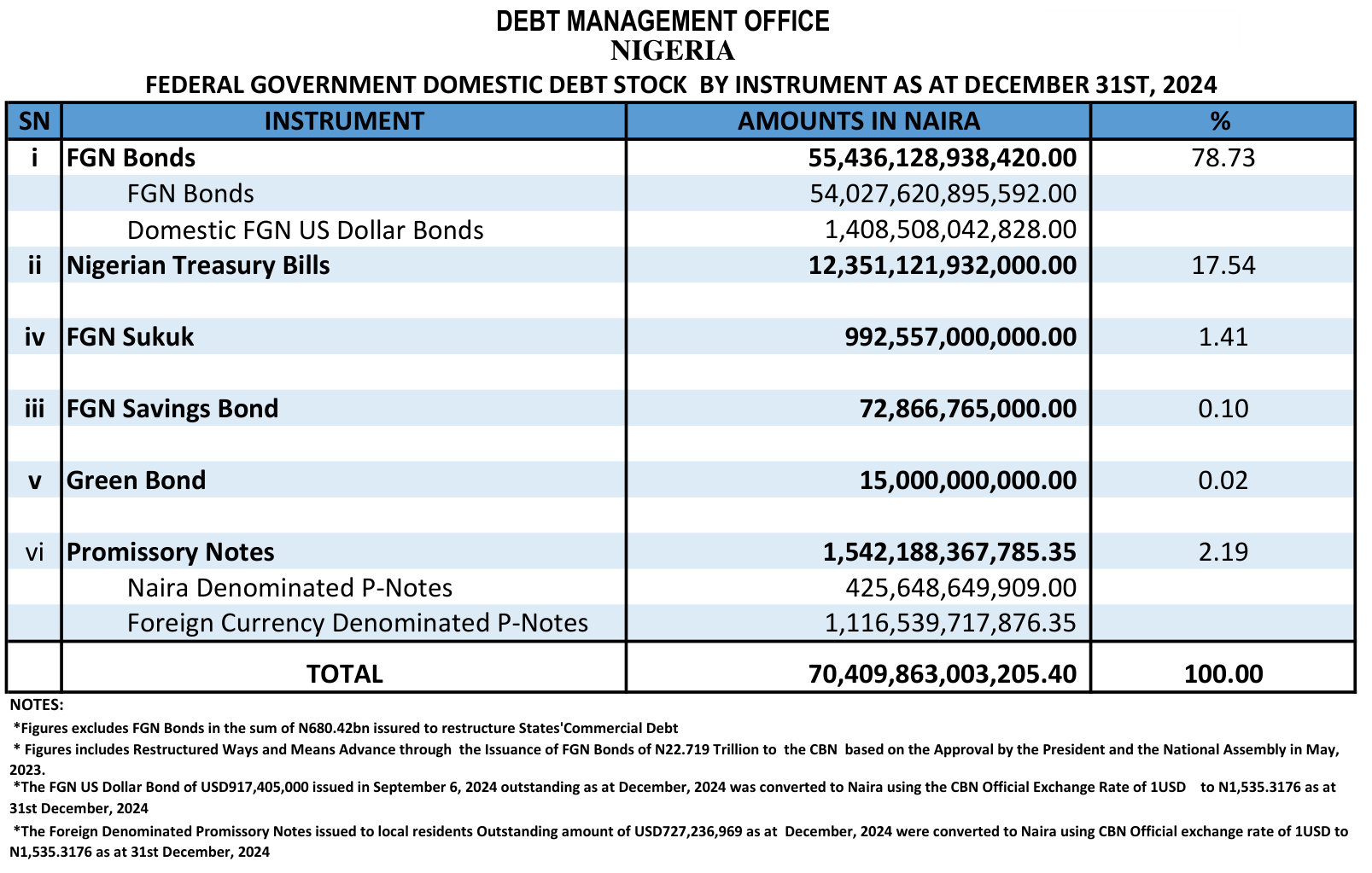
The other N7.3 trillion is less settled in the office's own records. Table 3 of its reply places all N7,300.00 billion in 2024. Table 4 of the same reply, on page 739, lists the domestic securities issuance programme and shows N2,494.91 billion under "Securitization of Ways and Means" for 2024, described as "part of the Ways and Means Advances Securitized in 2024". The debt tables for 31 December 2024 and 31 March 2025 mention only the N22.719 trillion. The table for 30 June 2025 then adds a note against Federal Government naira bonds and Treasury bills: "Figures include part of the N7.3 trillion ways and means restructured in H1, 2025." Three documents from the same office therefore place the N7.3 trillion conversion in 2024 in full, in 2024 in part (N2,494.91 billion, leaving N4,805.09 billion), and partly in the first half of 2025, which falls outside the audit period.
Refinancing is the second large item, and the reply gives two figures for it. Table 3 puts refinancing of domestic securities at N23,086.75 billion for the five years; Table 4, two pages later, puts it at N23,339.62 billion, N252.87 billion more. The two agree for 2021 (N3,285.75 billion) and 2024 (N7,352.86 billion) but differ in 2020 (N2,803.35 billion against N3,261.96 billion), 2022 (N4,527.61 billion against N3,951.87 billion) and 2023 (N5,117.18 billion against N5,487.18 billion). The reply's general point stands on its own terms: its note to Table 3 says refinancing "is not counted as additional borrowing as they do not increase the public debt stock in the fiscal year", and Treasury bills, it says, run for 91 to 364 days. The audit does not say how much refinancing its N88.67 trillion contains.
The reply also does not close against the audit's yearly totals. Table 3's five rows add to the N95,636.23 billion it prints (its promissory note column adds to N1,577.603 billion against a printed N1,577.62 billion). That is N6,961.77 billion more than the N88,674.46 billion of issues the audit counted, so the office's list of approvals is larger than what the audit says it issued. Year by year the match is uneven: in 2020 the audit's issues exceed the office's total by N380.79 billion and in 2021 by N124.10 billion, while from 2022 to 2024 the office's total is the larger, by N1,598.99 billion, N3,382.41 billion and N2,485.26 billion.
The two sides also disagree on what the budgets approved. The audit uses N34,099.85 billion; the office's Table 2 gives N40,496.91 billion, N6,397.06 billion more, and says the audit left out supplementary appropriations in some years and in some cases counted debt service provisions as new borrowing. They agree on 2024, N8,880.44 billion. They differ for 2020 (N2,951.71 billion against N4,585.87 billion), 2021 (N5,396.46 billion against N6,198.56 billion), 2022 (N6,295.34 billion against N7,259.81 billion) and 2023 (N10,575.90 billion against N13,572.22 billion). The Appropriation Acts for those years decide which is right; Vero Record has not set each of them against these figures.
The report's fourth finding, a N11,529,038,328,427.00 "non-adherence to FGN borrowing plan" on page 738, compares the same budget figures with the office's borrowing plan, which totals N45,628,888,000,000.00. Each year's plan figure matches, to rounding, the total of the domestic securities issuance programme in the office's Table 4, which includes refinancing; the budget figures cover new domestic and external borrowing together. For 2024, the year of the largest variance (N7,339.64 billion, or 82.65 per cent), N7,352.86 billion of the N16,220.08 billion plan was refinancing. The audit's arithmetic in that table is also exact: the five variances add to N11,529,038,328,427.00.
The office's stock tables allow one further check, which is Vero Record's own arithmetic. Federal Government domestic debt rose from N53,258.01 billion at 31 December 2023 to N70,409.86 billion at 31 December 2024, by N17,151.85 billion. Leaving out promissory notes and the US dollar bond first issued in September 2024, naira securities rose from N51,928.95 billion to N67,459.17 billion, by N15,530.22 billion; Treasury bills alone went from N6,522.00 billion to N12,351.12 billion. Since refinancing does not add to the stock, by the office's own note, that rise is net new borrowing. Table 4 lists N6,060.92 billion of new domestic borrowing, N311.39 billion of other approved domestic borrowing and N2,494.91 billion of Ways and Means for 2024, N8,867.22 billion in all, which leaves N6,663.00 billion of the rise unexplained. With the full N7,300.00 billion of Table 3 in place of N2,494.91 billion, the total is N13,672.31 billion and the gap N1,857.91 billion.
The record supports each side on part of the question. The audit is right that its table adds up, that the budgets' borrowing figures are far below what the office issued, and that, on its account, no evidence of Assembly approval was put in front of it. The office is right that most of the gap is made up of two things the Appropriation Acts do not cover, and its own published debt tables record the May 2023 approval for N22.719 trillion of it. The audit's language is about control weaknesses and "contracting of unapproved new debts" as a risk; neither document says any money was lost or misused, and none is alleged here.
The report asks the Director-General to justify the N54,574,605,847,503.10 to the Public Accounts Committees of the National Assembly, to forward evidence of the Assembly's approval for the excess, and to account for the sum, failing which sanctions under paragraph 3129 of the Financial Regulations (2009) should apply. The committees are where the two sets of tables can be reconciled: the approvals for both Ways and Means conversions, the dates on which the N7.3 trillion was actually issued, and the budget figures for 2020 to 2023 are all records the Assembly holds itself.
What this rests on
Two primary sources, both read for this report. (1) Office of the Auditor-General for the Federation, 2024 Annual Report on Non-compliance (Vol. II), section 17, Debt Management Office, Abuja (Special Audit), report pages 732 to 741 (PDF pages 297 to 306), a scanned PDF read by OCR and checked against page images: Issue 3 (p.735), the DMO response with Tables 2 and 3 (pp.736 to 737), Issue 4 (pp.737 to 738) and Table 4 (p.739). (2) Debt Management Office tables of Federal Government domestic debt stock by instrument at 31 December 2023 (file 4584), 31 December 2024 (file 5216), 31 March 2025 (5358) and 30 September 2025 (5725), downloaded from dmo.gov.ng on 18 October 2026, and at 30 June 2025 (5533) and 31 December 2025 (5810), already on file. Arithmetic re-done: issues 8,210,318,929,904.00 + 9,657,772,197,999.00 + 10,209,555,711,850.00 + 39,193,721,311,041.10 + 21,403,087,368,282.00 = 88,674,455,519,076.10; budget 2,951,710,000,000.00 + 5,396,461,602,420.00 + 6,295,338,286,149.00 + 10,575,895,818,830.00 + 8,880,443,964,174.00 = 34,099,849,671,573.00; difference 54,574,605,847,503.10, and each row's excess equals issues minus budget exactly. 2023 share 28,617.83 / 54,574.61 = 52.44 per cent; 39,193.72 / 10,209.56 = 3.84. Ways and Means 22,719.00 + 7,300.00 = 30,019.00 (55.01 per cent); plus refinancing 23,086.75 = 53,105.75 (97.31 per cent); 22,719 / 54,574.61 = 41.63 per cent; 28,617.83 - 22,719.00 = 5,898.83. Table 3 rows: 2020 4,585.87 + 2,803.35 + 440.31 = 7,829.53; 2021 6,198.56 + 3,285.75 + 49.36 = 9,533.67; 2022 7,259.81 + 4,527.61 + 21.13 = 11,808.55; 2023 13,572.22 + 5,117.18 + 144.59 + 22,719.00 + 1,023.143 = 42,576.133; 2024 8,880.44 + 7,352.86 + 311.39 + 7,300.00 + 43.66 = 23,888.35; columns 40,496.90 (printed 40,496.91), 23,086.75, 455.98, 30,019.00, 1,577.603 (printed 1,577.62); total 95,636.23. 95,636.23 - 88,674.46 = 6,961.77; by year 7,829.53 - 8,210.32 = -380.79, 9,533.67 - 9,657.77 = -124.10, 11,808.55 - 10,209.56 = 1,598.99, 42,576.13 - 39,193.72 = 3,382.41, 23,888.35 - 21,403.09 = 2,485.26. Table 4: refinancing 3,261.96 + 3,285.75 + 3,951.87 + 5,487.18 + 7,352.86 = 23,339.62, less 23,086.75 = 252.87; 2024 column 6,060.92 + 7,352.86 + 311.39 + 2,494.91 = 16,220.08. 7,300.00 - 2,494.91 = 4,805.09. Approved borrowing 40,496.91 - 34,099.85 = 6,397.06. Issue 4: plan 4,006,947,000,000 + 5,629,137,000,000 + 7,097,363,000,000 + 12,675,359,000,000 + 16,220,082,000,000 = 45,628,888,000,000; variances 1,055,237,000,000 + 232,675,397,580 + 802,024,713,851 + 2,099,463,181,170 + 7,339,638,035,826 = 11,529,038,328,427; 7,339.64 / 8,880.44 = 82.65 per cent. Stock: 70,409.86 - 53,258.01 = 17,151.85; Dec 2023 naira securities 44,260.22 + 6,522.00 + 39.18 + 1,092.56 + 15.00 = 51,928.95 (= 53,258.01 - 1,329.06 promissory notes); Dec 2024 54,027.62 + 12,351.12 + 992.56 + 72.87 + 15.00 = 67,459.17; rise 15,530.22; 6,060.92 + 311.39 + 2,494.91 = 8,867.22, gap 6,663.00; 6,060.92 + 311.39 + 7,300.00 = 13,672.31, gap 1,857.91.
What this does not establish
Whether the National Assembly approved each part of the N54.57 trillion; the DMO table note records the May 2023 approval for N22.719 trillion, and the Senate's approval of the N7.3 trillion on 30 December 2023 is reported in the press, but Vero Record did not read the Assembly's resolutions, and the audit does not say what documents the office showed its auditors. What instruments and how much refinancing the audit's N88.67 trillion contains, or whether its 2023 figure includes the N22.719 trillion conversion. When the N7.3 trillion was actually issued, given the three accounts in the office's own documents. Which approved-borrowing total, N34.10 trillion or N40.50 trillion, matches the 2020 to 2023 Appropriation and Supplementary Appropriation Acts; they were not set against these figures. Whether the December 2023 stock table excludes the N680.42 billion of bonds issued to restructure state debts, as the later tables say they do, which would change the 2024 stock arithmetic by up to that amount, and what explains the rest of the 2024 rise in domestic debt. Nothing in either document suggests money was lost or misused, and no wrongdoing is alleged. Neither the Auditor-General nor the Debt Management Office was asked for comment.
What we did ourselves
Read the ten pages of the special audit of the Debt Management Office in the scanned report, re-added the audit's two tables and the three tables in the office's reply, and set them against each other year by year. Downloaded the office's quarterly tables of domestic debt by instrument from December 2023 to September 2025 and traced how each describes the Ways and Means conversions, which showed the May 2023 approval note for N22.719 trillion and three different placements of the N7.3 trillion. Compared the two refinancing series in the reply, and recomputed the 2024 rise in domestic debt against the new borrowing the office itemised for that year.
Sources for this report
(A) Office of the Auditor-General for the Federation, 2024 Annual Report on Non-compliance (Vol. II), Debt Management Office, Abuja (Special Audit), Issues 3 and 4 and Management's Response, Tables 2 to 4, pp.735 to 739; Debt Management Office, Federal Government Domestic Debt Stock by Instrument as at 31 December 2023, 31 December 2024, 31 March 2025 and 30 June 2025.
- 2024 Annual Report on Non-compliance (Vol. II), Debt Management Office special audit, pp.732 to 741 · Office of the Auditor-General for the Federation · 2026
- Federal Government Domestic Debt Stock by Instrument as at December 31st, 2024 · Debt Management Office · 2025
- FGN Domestic Debt Stock Outstanding by Instruments as at June 30, 2025 · Debt Management Office · 2025
- Federal Government Domestic Debt Stock by Instrument as at December 31st, 2023 · Debt Management Office · 2024
- FGN Domestic Debt Stock Outstanding by Instruments as at March 31st, 2025 · Debt Management Office · 2025
- FGN Domestic Debt Stock Outstanding by Instruments as at September 30th, 2025 · Debt Management Office · 2025
- DMO borrowed N54.6trn without budgetary approval: Auditor-General · Leadership · 14 October 2026
- Ways and Means: Senate approves securitisation of N7.388trn · OrderPaper · 30 December 2023
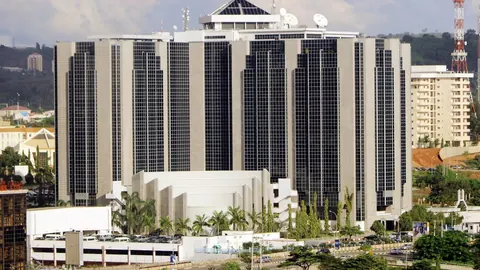
- Commons file: Central bank nigeria.jpg · Wikimedia Commons · 2007
Confidence: high. This is our own assessment of whether the event occurred as described, separate from the grade, which describes what kind of thing the claim rests on.
Not obtained: where the underlying document is named above but not linked, we did not hold a copy at the time of publication. We purchase nothing and request nothing in our own name.
Corrections
None on this report. If you find an error, it will be published here, at the same length, with the date it was found, and the original wording will remain visible above it.
Dr VeroInvestigations editor, Vero Record
Reads the Nigerian public record that others leave unread: budgets, audit reports, court files and registers. Every claim on this page carries the grade of the document behind it, and the report says what that document does not establish.
All 124 reportsHow we grade evidenceAdd Vero Record as a preferred source on Google