Audit says UNILAG gave a N226.76m power contract to the fourth-ranked bidder, not the N124.08m lowest; UNILAG says the lowest bidder asked for more
The Auditor-General's 2024 report says the University of Lagos passed over a N124,075,425.00 bid that its own evaluation committee had recommended, and gave the rehabilitation of its electrical supply system to the fourth-ranked of four bidders for N226,755,017.50. The university says the lowest bidder asked for more money after winning, which made the award void. The project carries an "ongoing" line in the 2024, 2025 and 2026 Appropriation Acts, N707,971,959 in all. An audit query is not a finding of wrongdoing, and the university's printed replies contest this and most of the other findings cited here, including N29.6 billion of 2024 spending for which the auditors say records were withheld.
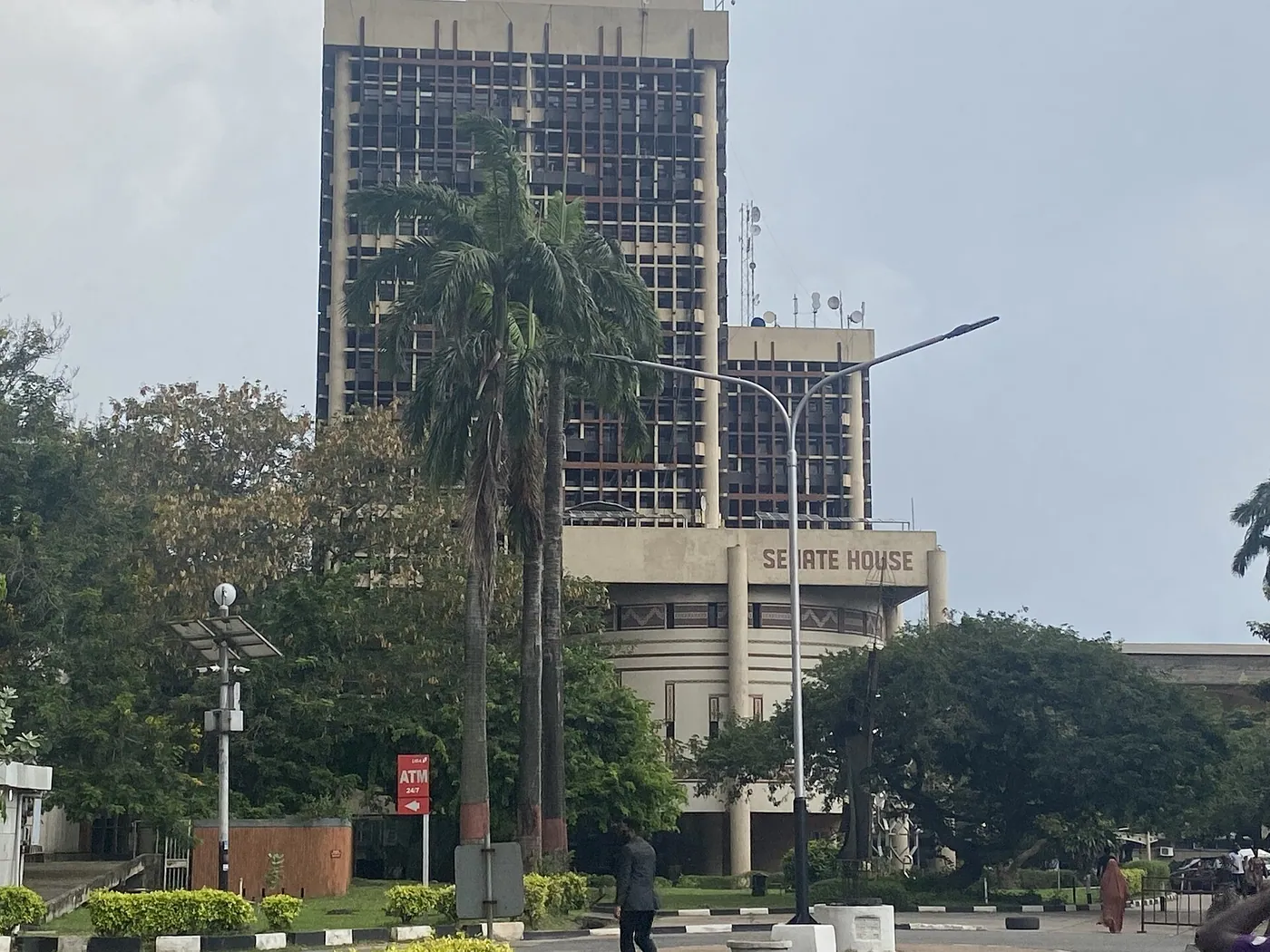
In September 2024 the University of Lagos's Bid Evaluation Committee recommended a bid of N124,075,425.00, the lowest of four, for the rehabilitation of the university's electrical supply and distribution system. According to the Auditor-General for the Federation, the contract went instead to the company ranked fourth, at N226,755,017.50. That is N102,679,592.50 more than the lowest bid, or 82.8 per cent above it. The finding is Issue 5 of the 25 queries raised at the university in Volume I of the Auditor-General's 2024 annual report on non-compliance, and the university disputes it. The 2026 Appropriation Act gives a project of the same name and code at the university, marked "ongoing", N188,576,689.
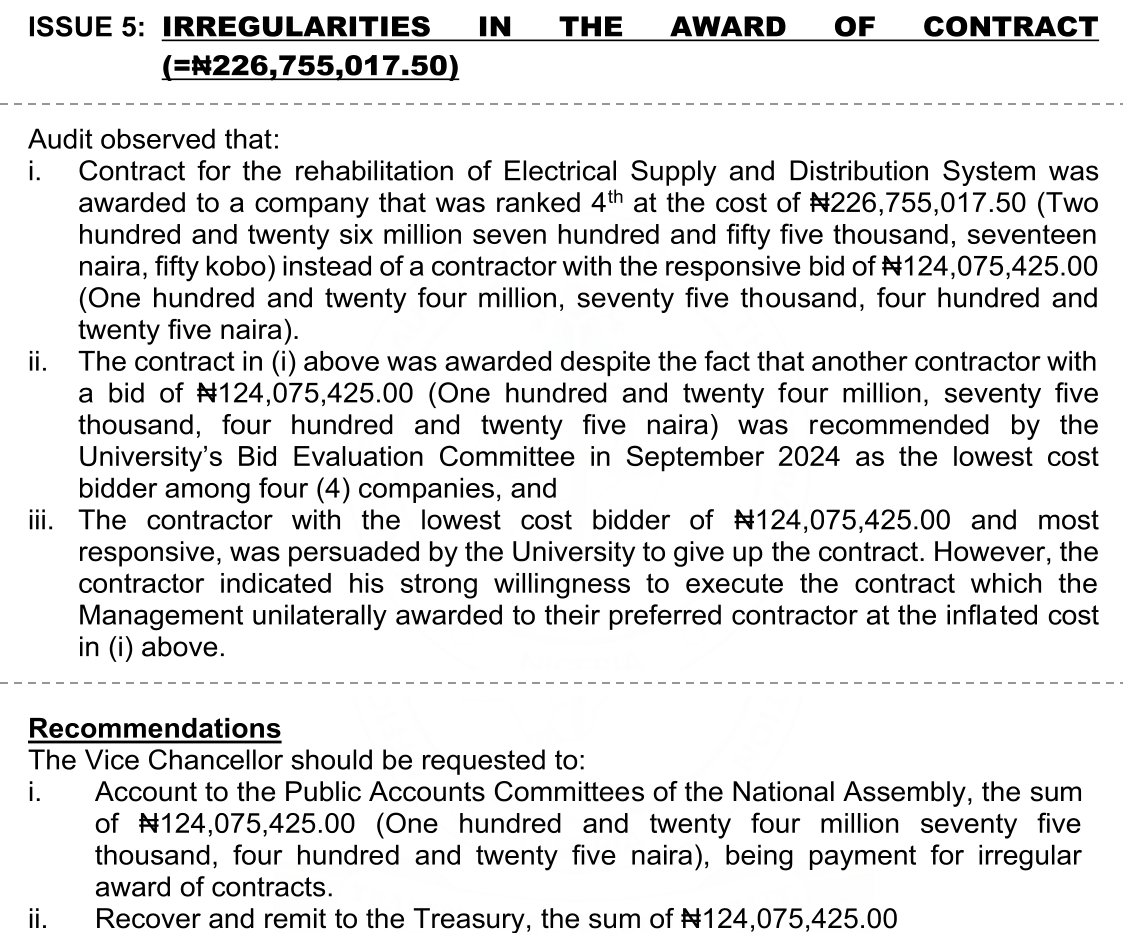
The report, whose transmittal letter to the Clerk to the National Assembly is dated 17 July 2026, covers the university's accounts for 1 January to 31 December 2024 on pages 250 to 290. On page 256 the auditors wrote that the lowest bidder "was persuaded by the University to give up the contract", that the contractor "indicated his strong willingness to execute the contract", and that management "unilaterally awarded to their preferred contractor at the inflated cost". The query describes an award and does not name the companies. Its findings do not say how much had been paid by the time of the audit; the recommendation that follows calls N124,075,425.00 a sum "being payment for irregular award of contracts", without saying when or to whom it was paid.
The university's reply, printed under the query, gives a different sequence. It says the contract, which it calls Lot 1, was first awarded in September 2024 to the lowest bidder, after that company "convinced the Technical Evaluation Committee of its readiness to execute the project at the quoted amount". By a letter dated 8 October 2024, the reply says, the company asked for an upward review of the contract sum, and the university treated this as a counter-offer that made the award void. The next-ranked bidder was written to on 23 October 2024, 15 days later; the reply says it acknowledged the letter but did not answer a request to confirm its willingness and capacity to do the work. The university then turned to "the next responsive bidder", which confirmed its readiness. Citing section 33(2) of the Public Procurement Act 2007, which it says allows a procuring entity to pass over the lowest bidder on valid grounds, the university said the process "was undertaken in the best interest of the University".
The two accounts disagree on the central fact: whether the lowest bidder stepped aside under persuasion while still willing to do the work, as the auditors say, or asked in writing for more money, as the university says. Vero Record has not seen the letters of 8 and 23 October 2024 or the university's appendix 4, which the reply says holds the relevant documents and which the report does not print. The reply also does not give the rank of the company that won; the audit says it was fourth of four. The Auditor-General deemed the reply unsatisfactory and recommended that the Vice-Chancellor account to the Public Accounts Committees of the National Assembly for N124,075,425.00 and recover and remit that sum to the Treasury, describing it as "being payment for irregular award of contracts". That figure is the lowest bid. It is neither the N226,755,017.50 in the query's heading nor the N102,679,592.50 difference between the two bids, and the report does not explain the choice.
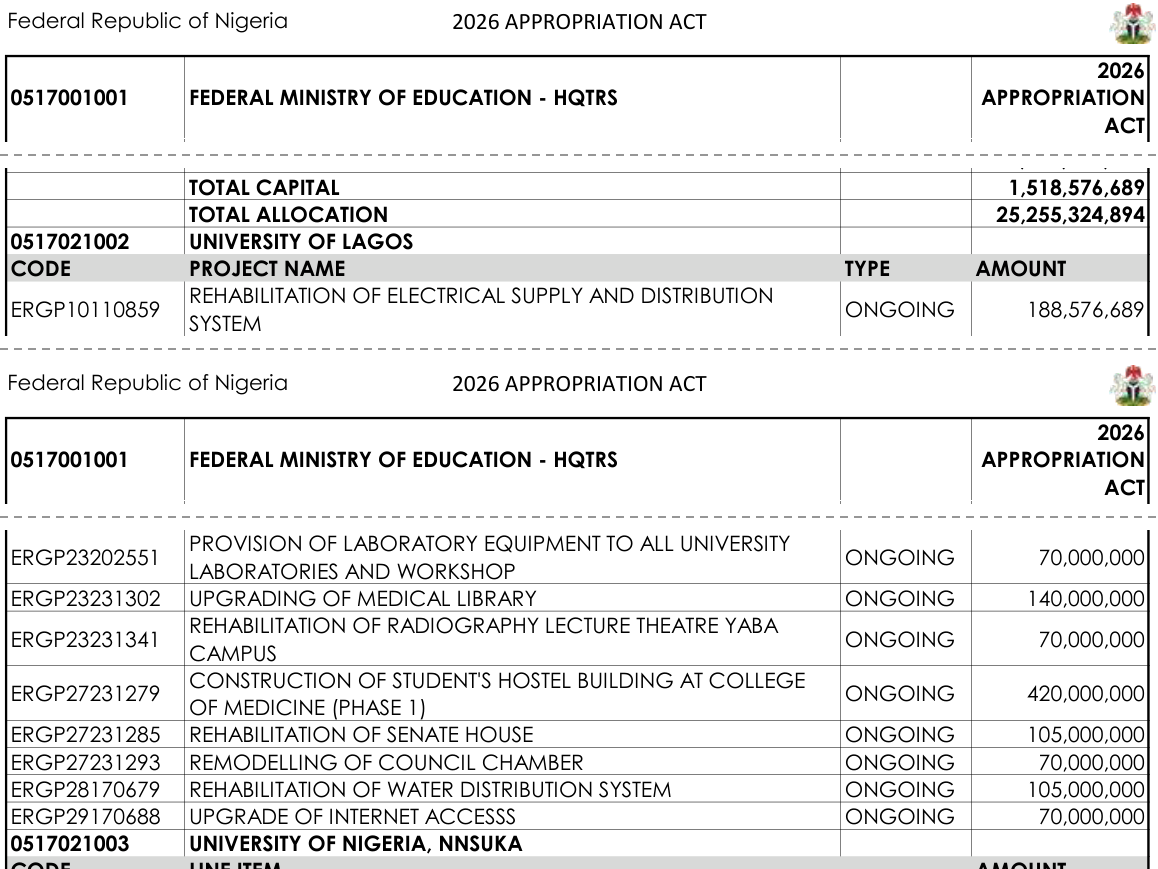
The project has a line under the same code, ERGP10110859, in each of the last three Appropriation Acts, and each time it is marked "ongoing". The 2024 Act, for the year of the award, gives "Rehabilitation of electrical supply and distribution system" N250,000,000 (page 1420). The award of N226,755,017.50 is N23,244,982.50 below that, or 90.7 per cent of the line. The 2025 Act gives the project N269,395,270 (page 1587) and the 2026 Act N188,576,689 (page 1974). Over the three years that is N707,971,959. The Budget Office said on 7 January 2026 that the 2024 and 2025 Acts had been repealed and re-enacted; the figures here are from the Acts as first published, and the re-enacted versions were not checked.
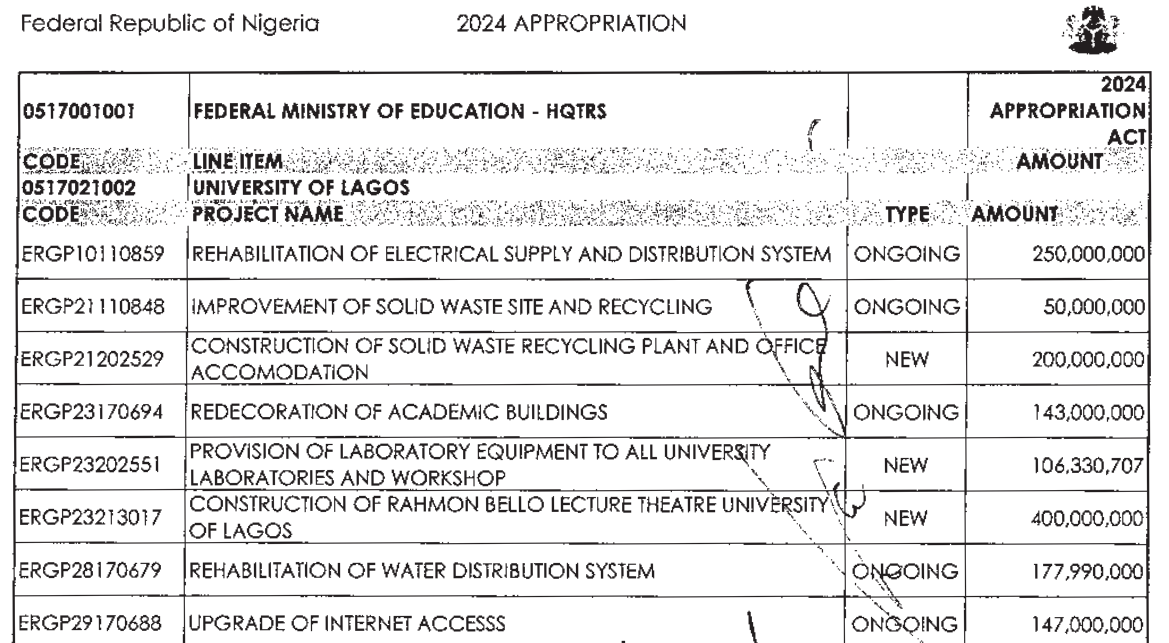
The university's water project follows the same pattern, and it too is queried. Issue 3, on pages 252 to 254, says N175,058,616.88 "was paid to a company, being the cost of contract for the rehabilitation of Water Distribution System"; that the four companies shortlisted were, according to Corporate Affairs Commission records, "owned by the same Directors"; and that "only one contractor, acting for and answering for four (4) names, was provided for the contract award". The university replied that the contract was advertised in national newspapers, that it carried out due diligence on the lowest evaluated responsive bidder, and that it has since told its procurement unit to examine corporate ownership and to blacklist companies that bid under common ownership on the same contract. "Rehabilitation of water distribution system", code ERGP28170679, has N177,990,000 in the 2024 Act, N150,000,000 in 2025 and N105,000,000 in 2026 (page 1975), N432,990,000 in all. The payment the auditors cite is N2,931,383.12 less than the 2024 line.
The two lines are among the 12 projects that make up the university's 2026 capital allocation of N1,518,576,689, and together they take N293,576,689 of it, or 19.3 per cent. The Act gives the university N25,255,324,894 in all, of which N23,226,091,060 is for personnel and N510,657,145 for overheads. It does not say whether any of the money for the electrical system is meant for the contract the auditors queried. Nor do the Acts show what was actually released. In its reply to a revenue query on page 274, the university says: "Up till now, 2024 capital projects have remained unfunded while nothing was released in 2025. The University has had to use its Internally Generated Revenue to take care of all its repair works to the extent of its funds." If that is right, the 2024 and 2025 lines for the two projects were not funded as voted. The documents do not say what the payments the auditors examined were drawn from, and Vero Record did not obtain release figures for the university.
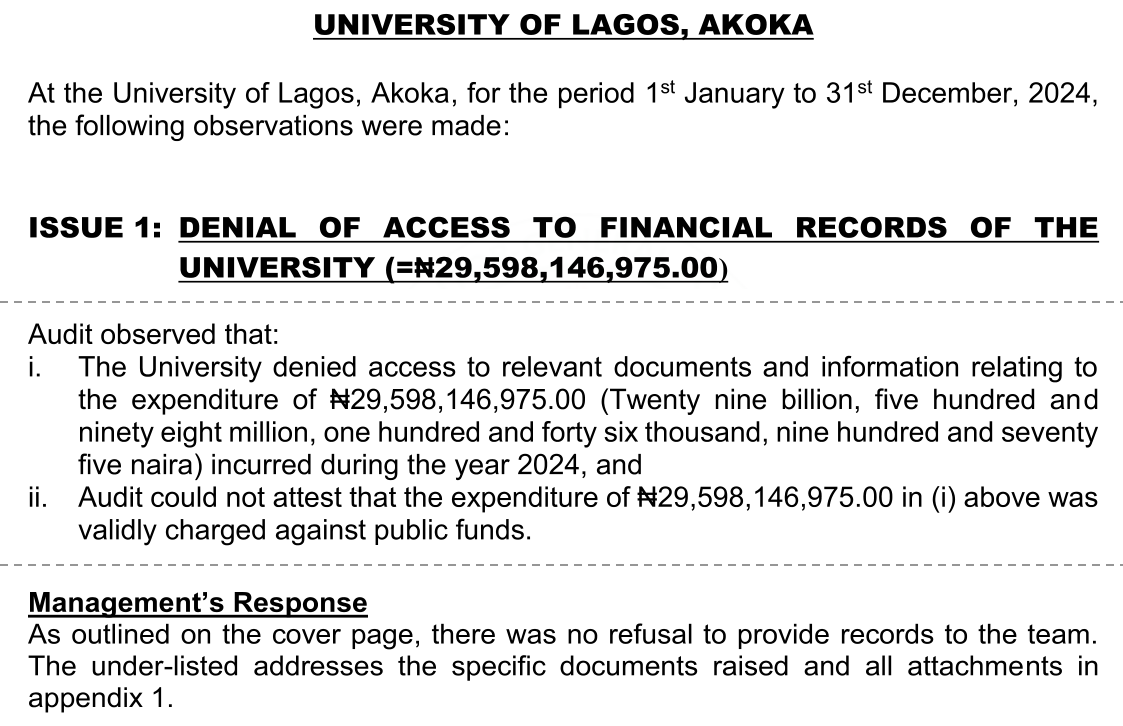
The largest sum in the university's section is in Issue 1, on page 250. The auditors wrote that the university "denied access to relevant documents and information relating to the expenditure of N29,598,146,975.00" incurred in 2024, and that they could not attest that the spending "was validly charged against public funds". The university's reply begins: "As outlined on the cover page, there was no refusal to provide records to the team." It says the documents raised are dealt with in an appendix, which the report does not print. The sum is 1.53 times the N19,356,457,009 that the 2024 Act gave the university for salaries, overheads and projects (pages 1419 and 1420). The report does not say how it was made up or which sources of money it covers. In its summary of cross-cutting issues (page xiii), the report lists the university with the highest amount under this heading among six bodies: N29.6 billion of N83,335,828,272.24, or 35.5 per cent.
The auditors also say the university reported N13,558,867,127.00 of internally generated revenue for 2024, made up of N11,960,706,649.00 of "Auxiliary Funds" and N1,598,160,678.00 "reported as IGR" (pages 272 to 276). Issue 14 asks it to remit N398,301,002.00 from the hire of university property, rent on quarters, the sale of unserviceable items and an insurance claim, which the auditors class as wholly federal revenue. Issue 15 says there was no evidence that 25 per cent of the remaining N13,160,556,125.00, which is N3,290,139,031.25, was paid into the Consolidated Revenue Fund. The report's summary (page x) puts the university first on that heading among nine bodies, with 40.7 per cent of N8,089,249,067.74. The university replied that fees collected from students to cover student costs cannot be treated as internally generated revenue, that this had been accepted in annual reconciliations with the Office of the Accountant-General of the Federation and the Fiscal Responsibility Commission, and that it had remitted more than N600 million to the Federal Government between 2015 and 2024.
The other queries include N727,441,614.90 of stores and repair work that the auditors say was bought "in a fragmented manner, with contract sums kept within the approval thresholds of the Vice-Chancellor", often on the same day; N1,309,471,672.01 of contracts they say went to related companies, which the university denies; and N444,612,904.90 paid on a N1,935,135,087.35 library contract awarded on 6 October 2016. The university says the library is fully sponsored by TETFund and that it stopped the work after part of a first-floor slab collapsed during casting on 14 February 2019. The auditors also query N726,973,770.79 of off-payroll allowances for 2023 and 2024 and N397,501,351.78 paid to staff as the "Unilag factor", in both cases, the auditors say, with no evidence of approval from the National Salaries, Incomes and Wages Commission; the university says its Governing Council approved both under the University of Lagos Act 1967 and that they were paid from internally generated revenue, not from school fees in the first case. For N7,828,737,226.27 of contracts awarded in 2024, the auditors saw no evidence that the procurement records had been sent to the Bureau of Public Procurement through the Nigeria Open Contracting Portal; the university said it was taking steps to update the records there.
An audit query is not a finding of wrongdoing, and nothing in the documents read for this report establishes a crime by anyone. The report's recommendations, which in every case cited here ask the Vice-Chancellor to account to the Public Accounts Committees and to recover and remit the sum to the Treasury, are its standard form; it is for the committees to decide whether an explanation is accepted. The Auditor-General deemed every reply cited here unsatisfactory. In its replies the university rejected most of the findings cited here or said the documents had been supplied; on the contracts portal it said it was taking steps to update its records. The 2026 Act, meanwhile, keeps both queried projects on the university's list, with N188,576,689 for the electrical system and N105,000,000 for the water network.
What this rests on
Office of the Auditor-General for the Federation, Annual Report on Non-compliance/Internal Control Weaknesses in MDAs for the year ended 31 December 2024, Volume I: transmittal letter dated 17 July 2026 (p.ii); summary of cross-cutting issues (pp.x and xiii); University of Lagos, Akoka, Issues 1 to 25, pp.250 to 290 (PDF pp.286 to 326), period 1 January to 31 December 2024. Every passage quoted, and the observations of Issues 1, 3, 4, 5, 15 and 24, were checked on the rendered page images; the other issue headings and figures come from OCR of the same pages, and every amount used was checked against the query's own recommendation. 2024 Appropriation Act, University of Lagos (0517021002), pp.1419 and 1420 (scanned pages, read as images). 2025 Appropriation Act as passed, pp.1585 to 1587. 2026 Appropriation Act, pp.1974 and 1975. Page extracts of all four are saved with this report. Arithmetic re-done: N226,755,017.50 - N124,075,425.00 = N102,679,592.50; N102,679,592.50 / N124,075,425.00 = 82.8%. Electrical line ERGP10110859: N250,000,000 (2024) + N269,395,270 (2025) + N188,576,689 (2026) = N707,971,959; N250,000,000 - N226,755,017.50 = N23,244,982.50; N226,755,017.50 / N250,000,000 = 90.7%. Water line ERGP28170679: N177,990,000 + N150,000,000 + N105,000,000 = N432,990,000; N177,990,000 - N175,058,616.88 = N2,931,383.12. 2026: N188,576,689 + N105,000,000 = N293,576,689, / N1,518,576,689 = 19.3%; the 12 project lines (188,576,689 + 49,000,000 + 56,000,000 + 175,000,000 + 70,000,000 + 140,000,000 + 70,000,000 + 420,000,000 + 105,000,000 + 70,000,000 + 105,000,000 + 70,000,000) add to N1,518,576,689, the capital total; N23,226,091,060 + N510,657,145 + N1,518,576,689 = N25,255,324,894, the printed total. 2025: N21,884,777,359 + N510,657,145 + N2,169,395,270 = N24,564,829,774; the non-zero project lines add to N2,169,395,270. 2024: N17,605,648,287 + N276,488,015 + N1,474,320,707 = N19,356,457,009; the 8 project lines (250,000,000 + 50,000,000 + 200,000,000 + 143,000,000 + 106,330,707 + 400,000,000 + 177,990,000 + 147,000,000) add to N1,474,320,707. N29,598,146,975 / N19,356,457,009 = 1.53; N29,598,146,975 / N83,335,828,272.24 = 35.5%; N3,290,139,031.25 / N8,089,249,067.74 = 40.7%. Issue 14 table: N240,309,904 + N106,388,323 + N1,341,200 + N50,261,575 = N398,301,002. Issue 17: N319,158,617.16 + N407,815,153.63 = N726,973,770.79. 8 October to 23 October 2024 = 15 days. Where the audit text does not agree with itself: in Issue 5 the heading and finding give N226,755,017.50 but the recommendation asks the university to account for N124,075,425.00, the lowest bid, without explanation. In Issue 15, N11,960,706,649.00 + N1,598,160,678.00 = N13,558,867,327.00, but the report prints the total as N13,558,867,127.00, N200 less; and N13,558,867,127.00 - N398,301,002.00 = N13,160,566,125.00, but the report prints the net as N13,160,556,125.00, N10,000 less. The query sum of N3,290,139,031.25 is exactly 25% of the printed net; on the corrected figures it would be N3,290,141,581.25, N2,550 more. The same issue writes N11,960,706,649.00 in figures and "six hundred and forty eight naira" in words. On the library, the audit says the contract has been abandoned since 2018; the university dates the slab collapse to 14 February 2019.
What this does not establish
Whether the lowest bidder for the electrical contract withdrew under persuasion, as the audit says, or by asking for a higher price, as the university says; the letters of 8 and 23 October 2024 and the university's appendices are not printed in the report and were not seen. How much has been paid on the N226,755,017.50 award, and whether the work was done. The rank of the winning company in the university's own evaluation. Whether the four companies shortlisted for the water contract share directors; Vero Record did not search Corporate Affairs Commission records. How much of the 2024, 2025 and 2026 appropriations for the two projects was released, and from what money the payments the auditors examined were made. How the N29,598,146,975.00 in Issue 1 was made up, and which records were said to be withheld. Whether the Public Accounts Committees have considered these queries or accepted any explanation. Whether the 2024 and 2025 lines changed when those Acts were repealed and re-enacted. Neither the university nor the companies were contacted for this report; their positions are given as printed in the audit report. Nothing in the documents establishes wrongdoing by any person or company.
What we did ourselves
Read the University of Lagos section of the Auditor-General's 2024 report, all 25 queries and the university's printed replies, and checked the key passages on the page images. Traced the two queried capital projects by name and project code through the 2024, 2025 and 2026 Appropriation Acts, reading the scanned 2024 pages as images, and re-added each year's project list against the university's printed capital and total allocations. Set the award, the lowest bid and the recommended recovery against one another and against the budget lines, and recomputed the revenue figures in Issues 14 and 15, finding small arithmetic slips in the report's own totals.
Sources for this report
(A) Office of the Auditor-General for the Federation, 2024 Annual Report on Non-compliance, Volume I, University of Lagos, Akoka, pp.250 to 290; 2024 Appropriation Act, pp.1419 to 1420; 2025 Appropriation Act as passed, pp.1585 to 1587; 2026 Appropriation Act, pp.1974 to 1975.
- Auditor-General for the Federation's Annual Report on Non-compliance/Internal Control Weaknesses in MDAs for the year ended 31 December 2024, Vol. I · Office of the Auditor-General for the Federation · 17 July 2026 (transmittal letter)
- 2024 Appropriation Act · National Assembly / Budget Office of the Federation · 2024
- 2025 Appropriation Act as Passed · National Assembly / Budget Office of the Federation · 2025
- 2026 Appropriation Act (copy published by PLAC) · National Assembly of the Federal Republic of Nigeria · April 2026
- President Tinubu assents to 2026 Appropriation Bill and 2025 budget extension · State House, Abuja · 17 April 2026
- On the repeal and re-enactment of the 2024 and 2025 Appropriation Acts and budget transparency · Budget Office of the Federation (published by State House, Abuja) · 7 January 2026
- File:Unilag Senate house.jpg · Wikimedia Commons (Abiolakintrunde, CC BY-SA 4.0) · 21 December 2021
Confidence: high. This is our own assessment of whether the event occurred as described, separate from the grade, which describes what kind of thing the claim rests on.
Not obtained: where the underlying document is named above but not linked, we did not hold a copy at the time of publication. We purchase nothing and request nothing in our own name.
Corrections
None on this report. If you find an error, it will be published here, at the same length, with the date it was found, and the original wording will remain visible above it.
Dr VeroInvestigations editor, Vero Record
Reads the Nigerian public record that others leave unread: budgets, audit reports, court files and registers. Every claim on this page carries the grade of the document behind it, and the report says what that document does not establish.
All 172 reportsHow we grade evidenceAdd Vero Record as a preferred source on Google