The 2026 budget gives the National Teachers Institute N16.21bn for projects. N3.5bn of it is for health centres and medical equipment; N911.31m is for training teachers alone
The signed 2026 Appropriation Act lists 59 capital projects under the National Teachers Institute, the federal body that trains serving teachers. They add to N16,206,579,150. Five of them, worth N911,309,000, are training for teachers alone. Three, worth N3.5 billion, are for health centres and medical equipment in the South South, and the largest single item is a N2.8 billion solar power station.
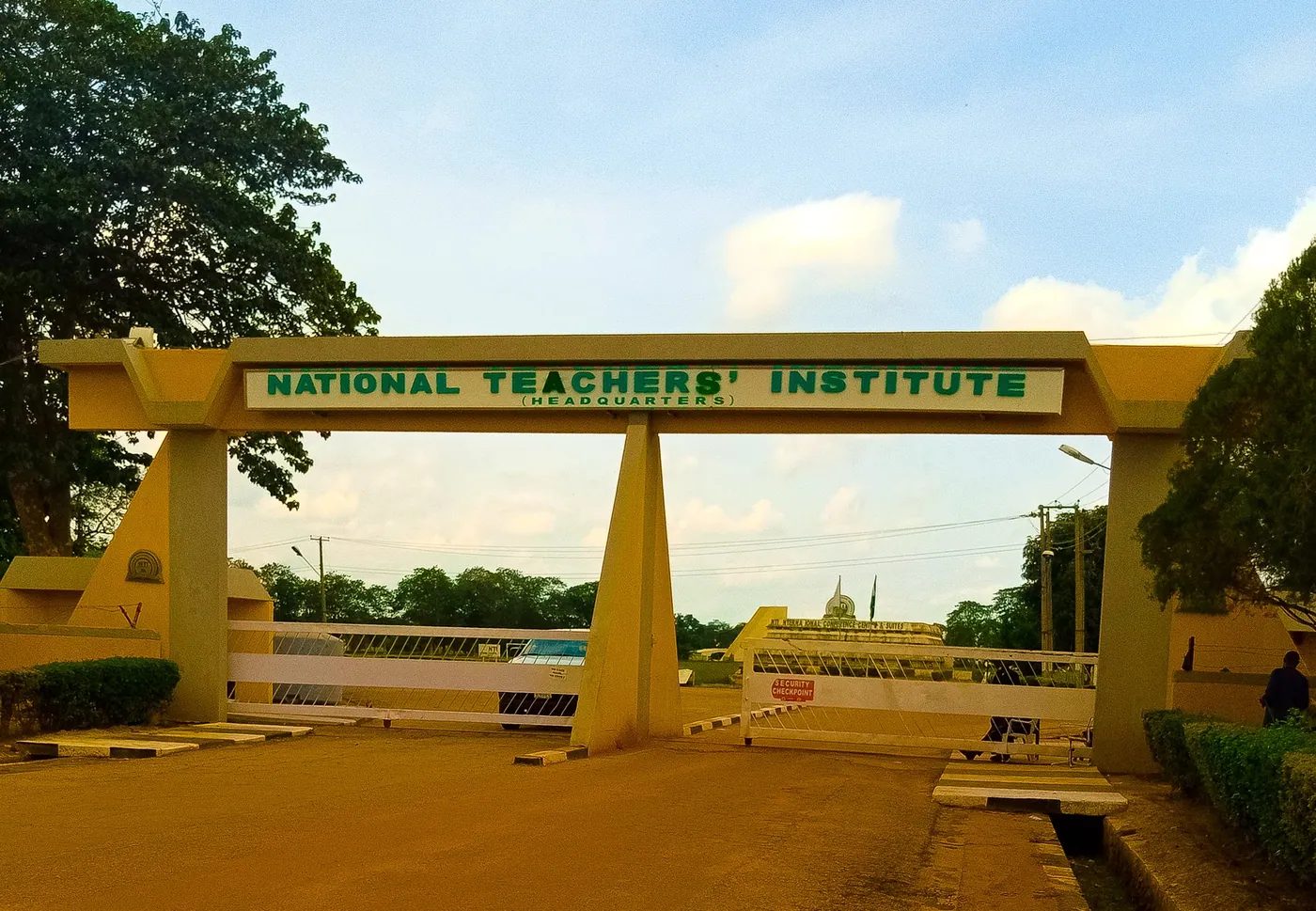
On World Teachers' Day, the federal budget's own schedule shows what Nigeria's two federal teacher bodies are funded to do in 2026. The 2026 Appropriation Act, signed in April, gives the Federal Ministry of Education and its agencies N2,398,761,320,016: N1,679,387,148,903 for personnel, N127,792,767,273 for overhead and N591,581,403,840 for capital, which add to the printed total. Within that, the summary table on page 1817 gives the Teachers Registration Council of Nigeria N2,628,540,382 and the National Teachers Institute (NTI) N19,439,836,280.
The Teachers Registration Council, which licenses teachers, receives N2,128,540,382 for personnel, N200,000,000 for overhead and N300,000,000 for capital. That is 0.11 per cent of the education vote. The NTI, the Kaduna-based institute that runs distance training and retraining for serving teachers, receives N2,896,053,110 for personnel, N337,204,020 for overhead and N16,206,579,150 for capital, 0.81 per cent of the education vote. Most of the NTI's money is therefore capital, and the Act lists what that capital is for.
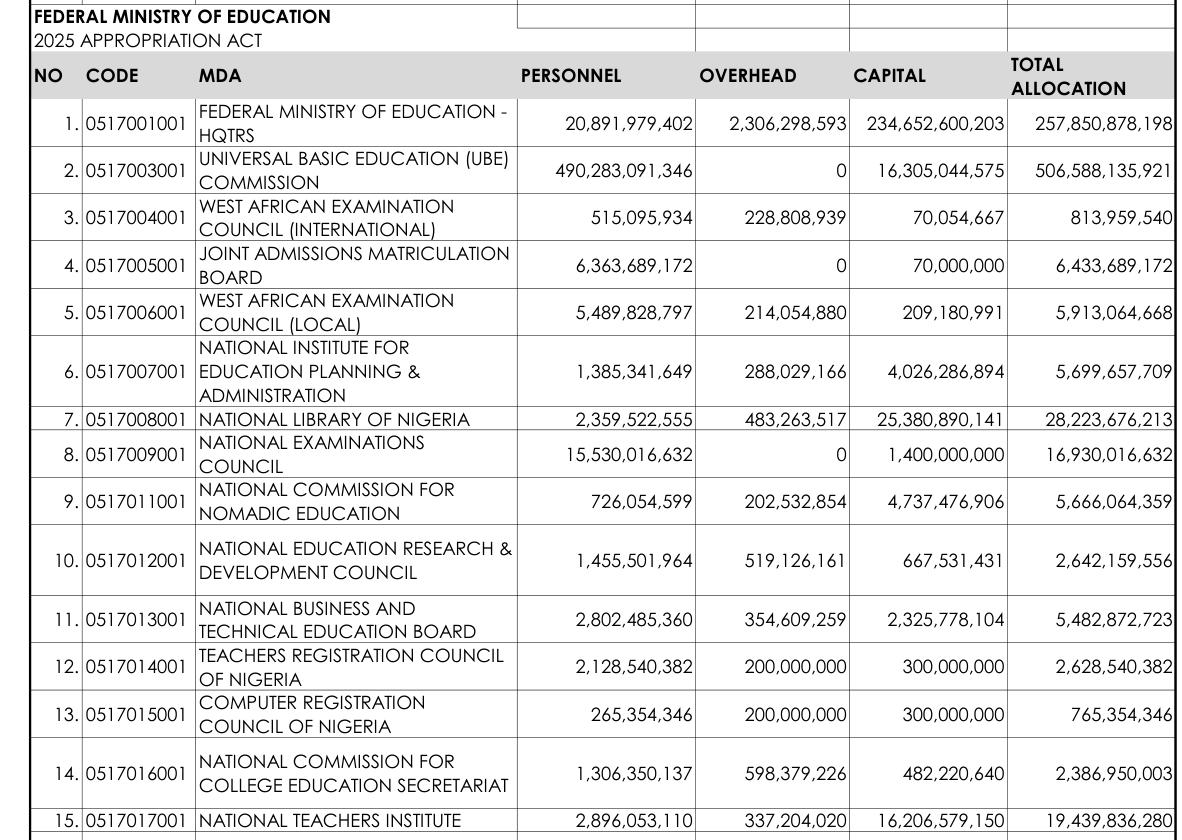
Pages 1870 to 1872 list 59 capital projects under code 0517017001, National Teachers Institute. Re-added one by one, they come to N16,206,579,150, exactly the capital figure in the summary table. Every project is marked "ongoing".
Some of the list is the institute's own work. There is N280,000,000 for retraining workshops for public primary school teachers on teaching techniques nationwide, N158,809,000 for training public school teachers on climate change education in the six geopolitical zones, N280,000,000 for a digital literacy teachers' training centre at the NTI headquarters in Kaduna, N175,000,000 for training teachers in academic leadership and digital literacy, and N17,500,000 for training teachers in the Takai/Sumaila federal constituency of Kano State. Those five items, whose descriptions name teachers alone, add to N280,000,000 + N158,809,000 + N280,000,000 + N175,000,000 + N17,500,000 = N911,309,000, or 5.62 per cent of the NTI's capital.
Two further items cover teachers together with others: N200,000,000 for training and empowerment of teachers and health workers in the Suleja/Tafa/Gurara federal constituency of Niger State, and N42,000,000 for training and empowerment of teachers and youth entrepreneurship in an Adamawa senatorial district. With these, items that name teachers come to N1,153,309,000, or 7.12 per cent. One more item mentions teachers: N100,000,000 for the "supply of grains for teachers and other constituents" in the Ekiti North 1 (Ikole/Oye) federal constituency.
The largest single item is not about teaching. It is N2,800,000,000 for the "construction and installation of 1 mega-watt photovoltic station on 5 hectares of land to powered sellected local government area in South South geo-political zone", as the Act spells it. That one line is 17.28 per cent of the institute's capital, and three times the five teacher-only training items together.

Three items are for health. The Act gives N1,400,000,000 for "construction of a unit of administrative building in various health centres in South South geo-political zone with wings A, B, C, D @500M per wing", N1,400,000,000 for the supply of maternal and neonatal care, surgical instruments, sterilisation and resuscitation equipment in the South South, and N700,000,000 for basic health equipment across primary health centres of the South South region. Together that is N1,400,000,000 + N1,400,000,000 + N700,000,000 = N3,500,000,000, or 21.60 per cent of the capital of an institute whose statutory work is teacher education. The health and solar items together come to N6,300,000,000, 38.87 per cent.


Other items are livelihood programmes. They include N1,400,000,000 for the empowerment of youths and women in agro-processing "across the federation @ N100,000,000 each", N315,000,000 for a workshop on multiplying plantain and banana suckers in the South South, N200,000,000 for fairly used vehicles for youths for e-hailing in Suleja/Tafa/Gurara, N200,000,000 for sewing machines, grinding machines and freezers for women and youth in the same constituency, N175,000,000 for interlocked access roads there, N100,000,000 for boreholes, N40,000,000 for motorcycles for "selected individuals" in a Bauchi constituency, and N140,000,000 for training on cyber security, artificial intelligence and cryptocurrency in Owan federal constituency, Edo State. Several other items are school buildings, furniture, bursaries and National Open University facilities, all of them education spending, though most are named for single constituencies.
The Universal Basic Education Commission line in the same ministry schedule follows a similar pattern on its smaller capital side. The Act gives the commission N506,588,135,921, of which N490,283,091,346, or 96.78 per cent, is a single salary line and N16,305,044,575 is capital. Pages 1843 to 1849 list 127 capital projects under the commission which re-add to N16,305,044,575. Fifty-four of them mention classrooms; the largest is N2,800,000,000 for one block of six classrooms in each senatorial district. Two mention teachers, both for teachers' residences.
The record also supports the bodies in part. The NTI's list does contain real teacher-training work, and much of the commission's list is classrooms, furniture and instructional materials for basic schools, which is what the commission exists to fund. Nothing in the Act shows who proposed any line, and project lists of this kind, placed under an agency's code, are commonly added during the National Assembly's work on the bill; the Act itself does not say so for any of these items.
What the documents on disk do not show is the commission's statutory transfer. The Compulsory, Free Universal Basic Education Act 2004 provides, in section 11, for a federal block grant of not less than 2 per cent of the Consolidated Revenue Fund, which is paid to the commission as a statutory transfer, separate from the ministry vote above. The 2,604-page schedule of the Act that this report used, and the 2,635-page "Act details" file published by the Budget Office, list ministries, departments and agencies only; neither contains the statutory transfers table or the Consolidated Revenue Fund total, so whether the 2026 transfer meets the 2 per cent rule cannot be checked from them.
What this rests on
The 2026 Appropriation Act schedule (2,604 pages, file 2026-Appropriation-Act.pdf, created 10 April 2026, from placng.org), read for this report: Federal Ministry of Education summary on page 1817; Universal Basic Education (UBE) Commission detail and project list on pages 1843 to 1849; National Teachers Institute project list on pages 1870 to 1872 (printed page numbers match PDF page numbers). A second copy, the Budget Office's "2026 Appropriation Act details" PDF (2,635 pages), was downloaded on 5 October 2026 and checked for a statutory transfers table; it has none. Arithmetic re-done: ministry N1,679,387,148,903 + N127,792,767,273 + N591,581,403,840 = N2,398,761,320,016; TRCN N2,128,540,382 + N200,000,000 + N300,000,000 = N2,628,540,382 (0.11 per cent of the education vote); NTI N2,896,053,110 + N337,204,020 + N16,206,579,150 = N19,439,836,280 (0.81 per cent); the 59 NTI projects re-added = N16,206,579,150; teacher-only items 280,000,000 + 158,809,000 + 280,000,000 + 175,000,000 + 17,500,000 = 911,309,000 (5.62 per cent); plus mixed items 200,000,000 + 42,000,000 = 1,153,309,000 (7.12 per cent); health 1,400,000,000 + 1,400,000,000 + 700,000,000 = 3,500,000,000 (21.60 per cent); solar 2,800,000,000 (17.28 per cent); health plus solar 6,300,000,000 (38.87 per cent); UBEC N490,283,091,346 + N0 + N16,305,044,575 = N506,588,135,921, salary share 96.78 per cent; the 127 UBEC projects re-added = N16,305,044,575.
What this does not establish
Who proposed any of the NTI or UBEC project lines, and whether the NTI is expected to execute the health, solar and livelihood items itself; the Act gives only the line, the code and the amount. Whether any of the money has been released or spent in 2026. What the N490,283,091,346 salary line under the UBE Commission pays for. The size of the UBEC statutory transfer for 2026, the Consolidated Revenue Fund total and education's share of aggregate spending, because the schedules on disk do not contain the Act's statutory transfers and summary tables; whether the 2 per cent rule is met is therefore not tested here. The text of section 11 of the UBE Act is cited from published reproductions; the Act itself was not downloaded for this report. UBEC's own records of matching grants left unaccessed by states were not obtained. Nothing in the documents suggests wrongdoing by anyone, and none is alleged. The NTI, UBEC, TRCN and the Federal Ministry of Education were not asked for comment.
What we did ourselves
Extracted and re-added all 59 NTI capital project lines and all 127 UBEC capital project lines from the signed Act, matched each total to the ministry summary table, and sorted the NTI lines by what their descriptions say they fund. Checked a second, longer copy of the Act from the Budget Office for the statutory transfers table needed to test the 2 per cent rule.
Sources for this report
(A) 2026 Appropriation Act, Federal Ministry of Education summary (p. 1817), Universal Basic Education (UBE) Commission (code 0517003001, pp. 1843 to 1849) and National Teachers Institute (code 0517017001, pp. 1870 to 1872).
- 2026 Appropriation Act · National Assembly / Federal Government of Nigeria · 2026-04
- 2026 Appropriation Act details · Budget Office of the Federation · 2026-04
- Compulsory, Free Universal Basic Education Act 2004, section 11 · Federal Republic of Nigeria (reproduced by PLAC) · 2004
Confidence: high. This is our own assessment of whether the event occurred as described, separate from the grade, which describes what kind of thing the claim rests on.
Not obtained: where the underlying document is named above but not linked, we did not hold a copy at the time of publication. We purchase nothing and request nothing in our own name.
Corrections
None on this report. If you find an error, it will be published here, at the same length, with the date it was found, and the original wording will remain visible above it.

Dr VeroInvestigations editor, Vero Record
Reads the Nigerian public record that others leave unread: budgets, audit reports, court files and registers. Every claim on this page carries the grade of the document behind it, and the report says what that document does not establish.
All 93 reportsHow we grade evidenceAdd Vero Record as a preferred source on Google