Six months after signing an N892bn Oyo budget, Makinde's government moved to lift it to N1.10tn
Governor Seyi Makinde signed Oyo State's 2026 budget of N892.09bn into law on 23 December 2025. By 1 July 2026 the Oyo State House of Assembly had approved an N330bn realignment-and-supplementary package - N120bn from reallocated existing lines plus N210bn in new spending - pushing the 2026 budget to roughly N1.102tn, a rise of about 37% inside the fiscal year.
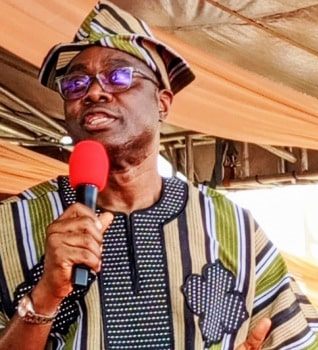
INEC’s own final list of candidates for the 2027 presidential election - not a newspaper’s reprint of it, but the signed commission document, which we downloaded from inecnigeria.org and read - carries this candidacy on page 2 of three. The entry is printed surname first, as "MAKINDE OLUSEYI ABIODUN", against APM, age 58, with MUSA LAWAL DAURA (73) as running mate. The qualifications filed with the commission are given as Bishop Philips Academy Ibadan; University of Lagos, Akoka. The list is signed on every page by Rose Oriaran-Anthony, Secretary of the Commission. It names eighteen presidential candidates, two more than most published summaries of the field.
Makinde governs Oyo State, and Oyo publishes its finances in detail, so his fiscal record can be read rather than characterised. We downloaded the state’s own documents from its budget portal. The Citizens’ Budget for 2026 puts the year’s budget at N891,985,074,480.79, of which N502,846,477,812.85 is capital and N389,138,596,667.94 recurrent - a capital share of 56.37 per cent, with N210,025,443,802.16, or 23.55 per cent of the whole, allocated to infrastructure.
The more revealing document is the one that reports back. The Budget Performance Report for the fourth quarter of 2025, produced by the Accountant-General and the Ministry of Budget and Economic Planning, records that the year was assessed not against the approved budget but against a final budget swollen by "a supplementary provision of N299,887,400,000.00" - roughly N300bn added to a N684bn plan during the year.
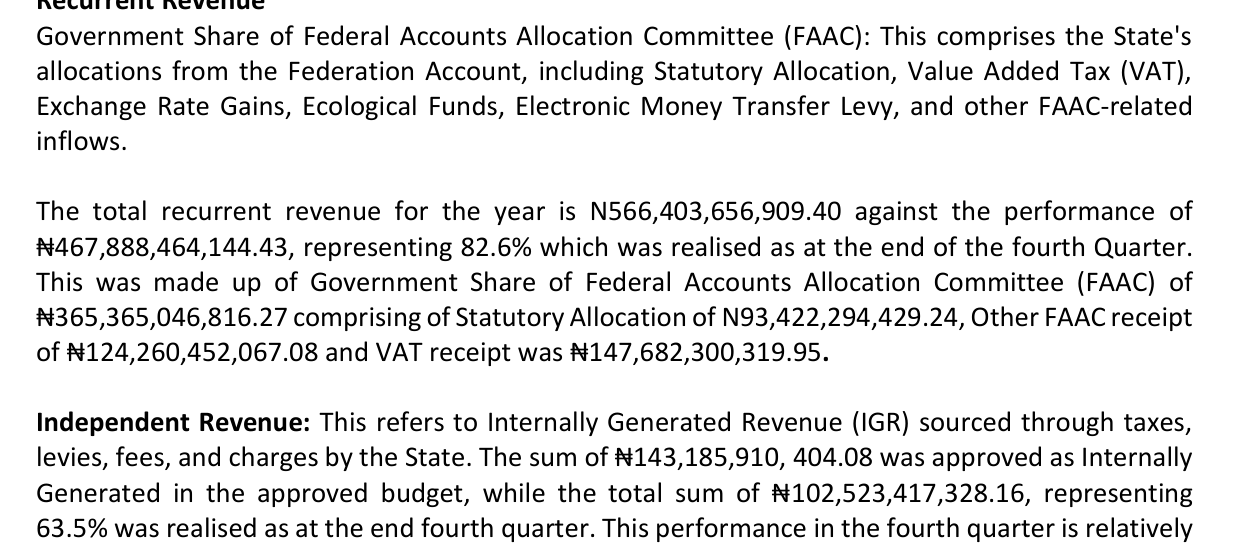
Against that, the internally generated revenue line did not deliver. The report states it plainly: "The sum of N143,185,910,404.08 was approved as Internally Generated in the approved budget, while the total sum of N102,523,417,328.16, representing 63.5% was realised as at the end fourth quarter." That is a shortfall of about N40.7bn on the state’s own target, and it sits beside recurrent revenue that came in at 82.6 per cent. A state that raises under two-thirds of the local revenue it budgeted is a state leaning harder on the federation account than it planned to, and the same report shows N365,365,046,816.27 arriving from FAAC.
We are reporting the state’s own accounting of itself, and that cuts both ways: these are the numbers Oyo chose to publish, and publishing a 63.5 per cent IGR outturn is not the behaviour of a government hiding it. What the figures do not support is any claim, from any direction, about Makinde’s fiscal record that has not been checked against them.
The enacted document is the starting point: the N891.99bn 2026 Oyo State Appropriation Bill that Governor Makinde presented on 24 November 2025 — N389.34bn recurrent, N502.65bn capital — signed into law at N892.09bn on 23 December 2025 and tagged the Budget of Economic Expansion. That is the base figure against which everything after it should be measured.
The second document is the mid-year change. On or about 1 July 2026 the Oyo State House of Assembly approved, on an executive communication from Makinde read in plenary, a N330bn package: N120bn from realignment of allocations already in the December budget, plus N210bn as a fresh supplementary budget. Together they lifted the 2026 budget to roughly N1.102tn.
The size of the swing is something a reader can check by subtraction. N892.09bn to about N1,102bn is roughly N210bn of genuinely new money and a total increase near 37 per cent — inside six months of the budget being signed. The realignment tranche of N120bn only reshuffles what was already appropriated in December; it is the N210bn supplementary that is new spending, and separating the two is the difference between a headline and an accurate one.
The supplementary funds are attached to named capital projects: the Circular Road, the Ido-Eruwa Road, the Airport-Ajia-New Ife Expressway, the Saki-Igboho Road, an airport upgrade, a Government House construction, together with debt servicing, gratuities and preparations for local-government elections. Named projects are easier to check later than a lump sum, which is a point in the budget's favour.
A large in-year supplementary is not by itself irregular — states pass them, and rising costs are real. What makes this one worth documenting is the scale and the timing: a 37 per cent rise so soon after assent invites the question of how firm the original December figure ever was, and whether a budget presented as complete was in practice a first instalment.
Vero reconciled the November proposal, the December assent figure and the July supplementary against one another and did the arithmetic itself. That establishes the scale and composition of the increase. It does not establish how much of the money was released, contracted or spent, nor that any project was completed — allocated is not released, and released is not paid — and the report claims none of those things.
What this rests on
Oyo State’s own budget portal documents, downloaded and read: the Citizens’ Budget 2026 and the Accountant-General’s fourth-quarter 2025 performance report. Figures were read from the documents themselves and checked against the page. The candidacy, the printed name, the age, the running mate and the filed qualifications rest on INEC’s own signed final list, read on the page. The signed 2026 Oyo Appropriation figure and the Assembly's July 2026 supplementary/realignment resolution. Verify via the Oyo State House of Assembly votes-and-proceedings for that sitting.
What this does not establish
It does not establish that the 2026 budget will be executed as approved, nor what the money bought. It does not establish his governorship vote totals: no INEC document for the 2019 or 2023 Oyo governorship result is published, and the 515,621 figure on the state’s own profile page sits beside two mutually inconsistent dates for that election. Oyo publishes no Auditor-General report, so these are the executive’s own accounts of itself, not an independent audit. The 2026 Appropriation Law we hold is an unsearchable scan and nothing is quoted from it. It does not establish that the funds were released, contracted or spent, nor that any project was completed; it does not allege irregularity. The exact Assembly sitting date and the signed supplementary Act reference were not retrieved. We use the party label 'APM' as supplied and did not independently verify Makinde's 2027 party.
What we did ourselves
We set the governor’s own 2026 budget against his own Accountant-General’s report on the year before, and pulled out the number that comparison produces: a 63.5 per cent internally generated revenue outturn, roughly N40.7bn short of target, in a year whose budget had already been enlarged by N300bn.
Sources for this report
(A) Oyo State Citizens’ Budget 2026: total budget N891,985,074,480.79; capital N502,846,477,812.85 (56.37%); recurrent N389,138,596,667.94; infrastructure N210,025,443,802.16 (23.55%). Oyo State Budget Performance Report for 2025 Fourth Quarter (Accountant-General / Ministry of Budget and Economic Planning): supplementary provision N299,887,400,000.00; IGR approved N143,185,910,404.08 against N102,523,417,328.16 realised, 63.5%; recurrent revenue performance 82.6%; FAAC N365,365,046,816.27. INEC, "Presidential and National Assembly Elections for Jan, 2027 - Presidential: Final List of Candidates", signed by Rose Oriaran-Anthony, Secretary, INEC; published at inecnigeria.org and downloaded by Vero on 26 September 2026, page 2: "MAKINDE OLUSEYI ABIODUN", APM, age 58. Oyo State 2026 Appropriation Law (signed 23 Dec 2025, N892.09bn) and the Oyo State House of Assembly approval (~1 July 2026) of a N330bn realignment/supplementary raising the total to ~N1.102tn.
Check it yourself:
- inecnigeria.org/documents/press/2027%20PRESIDENTIAL%20FINAL%20LI…
- inecnigeria.org/parties
- www.channelstv.com/2025/12/23/makinde-signs-oyo-2026-budget-into…
- nairametrics.com/2025/12/23/gov-makinde-signs-n892-billion-oyo-2…
- insideoyo.com/oyo-assembly-approves-makindes-n330bn-budget-reali…
- budget.oyostate.gov.ng/wp-content/uploads/2026/02/CITIZENS-BUDGE…
- budget.oyostate.gov.ng/wp-content/uploads/2026/01/OYO-STATE-BUDG…
- oyostate.gov.ng/meet-gov-seyi-makinde
Not obtained: where a document is named above but not linked, we did not hold a copy at publication. We purchase nothing and request nothing in our own name.
Corrections
None on this report. If you find an error, it will be published here, at the same length, with the date it was found, and the original wording will remain visible above it.