SERAP's N126.46bn INEC suit quotes the audit as finding "no evidence that the items were procured". Its page 224 says procurement records were missing
SERAP has asked the Federal High Court to compel INEC to account for N126.46 billion flagged in the Auditor-General's 2023 report. Vero Record read the INEC pages. All seven sums are there and add to N126,466,265,038.60, and the audit rejected every INEC reply. But the line SERAP quotes most, "no evidence that the items were procured", is not in them: the audit says records of due process were not produced and the goods were not checked by internal audit. INEC's own election report says it bought sensitive materials under sections 40 and 42 of the Procurement Act; the audit says it relied on section 15(2), the defence and security clause.
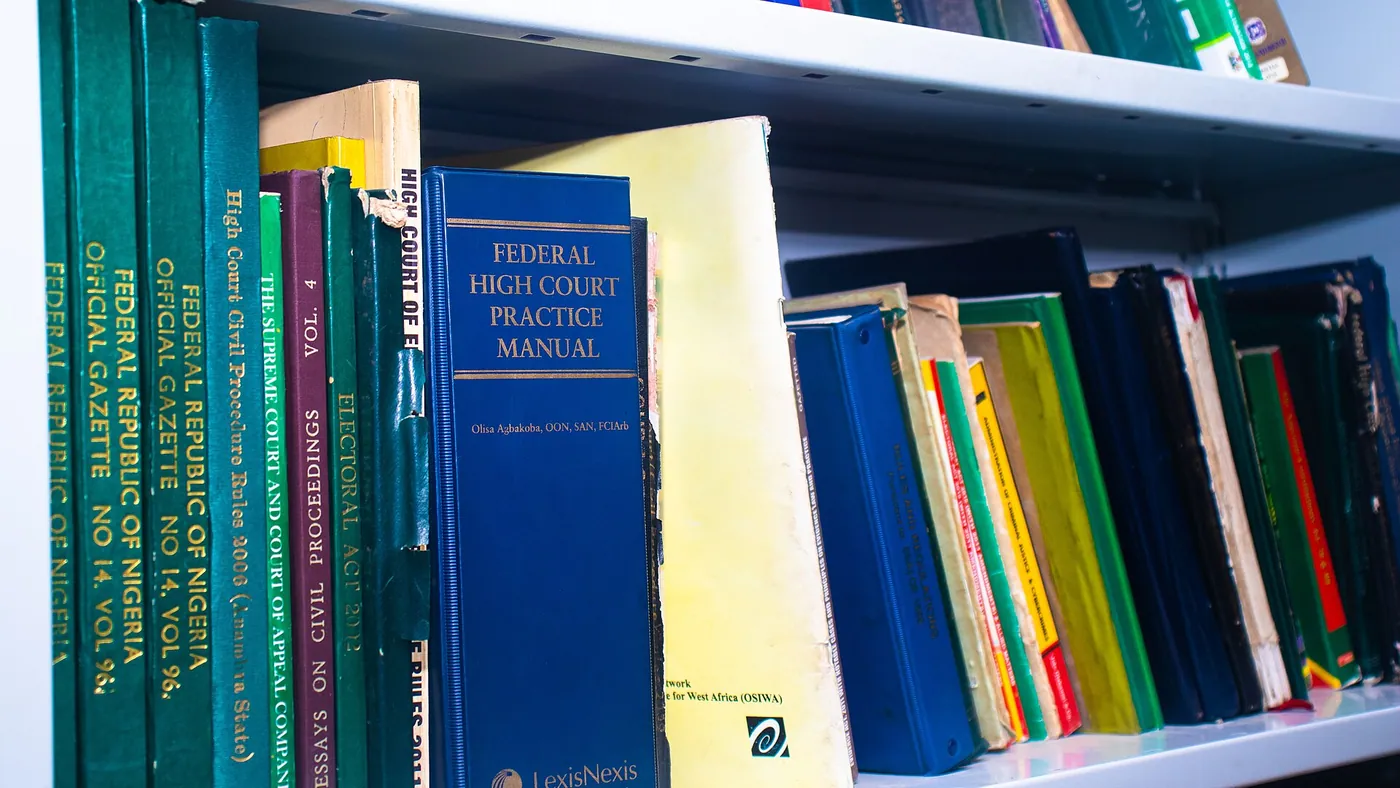
The Socio-Economic Rights and Accountability Project (SERAP) has asked the Federal High Court in Abuja to order the Independent National Electoral Commission (INEC) to account for "over N126.46 billion" in electoral funds. The suit, FHC/ABJ/CS/2507/2026, rests on the Auditor-General for the Federation's 2023 Annual Report on Non-compliance, Volume I, which the Auditor-General's office posted on 7 August 2026. Vero Record read the eleven pages on INEC in that report (printed pages 223 to 233) and set them against SERAP's release of 18 October, INEC's own Report of the 2023 General Election and the Public Procurement Act 2007. The seven sums SERAP lists are all in the audit, and they add up. The sentence SERAP quotes most, that the Auditor-General found "no evidence that the items were procured", is not there.
The audit section opens: "At the Independent National Electoral Commission (INEC), Abuja, for the 1st January to 31st December, 2022, the following observations were made". It then raises seven issues: N112,155,597,845.00 for electoral equipment and materials; N1,058,925,000.00 for vehicles; N3,136,806,050.00 for contracts executed before award; N9,245,965,502.60 for split contracts; N129,375,000.00 of reimbursable expenses paid to audit firms; N504,492,641.00 for accreditation devices; and N235,103,000.00 paid to contractors the audit calls ineligible. Together they come to N126,466,265,038.60, the figure SERAP rounds to N126.46 billion. The first issue alone is 88.7 per cent of it. For every one of the seven, the report prints INEC's reply, calls it "unsatisfactory", and asks the Commission's chairman to account to the Public Accounts Committees of the National Assembly and to "Recover and remit" the sum to the Treasury. On those points SERAP's account matches the record.
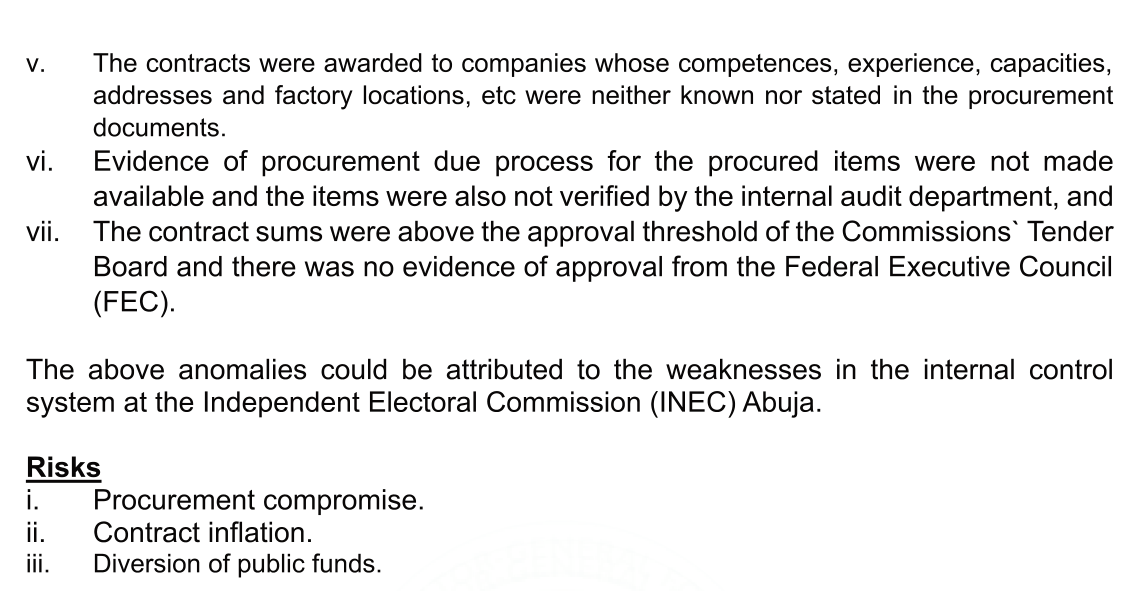
On the N112.16 billion, the audit observed that INEC "procured Ballot Boxes, Electoral Devices, Items and materials" by "the Direct Procurement Method without the required procurement due process such as competitive bidding or obtaining a 'No Objection' from the BPP", the Bureau of Public Procurement. It said INEC "sought the approval of Mr. President under section 15(2) of the Procurement Act, 2007, relating to National defence or National Security when there is no nexus between the electoral items procured and defence items", and that ballot boxes and card readers "though sensitive electoral items, cannot be classified as security items under section 15(2)". The contract sums were above the threshold of INEC's tenders board, and there was "no evidence of approval from the Federal Executive Council (FEC)".
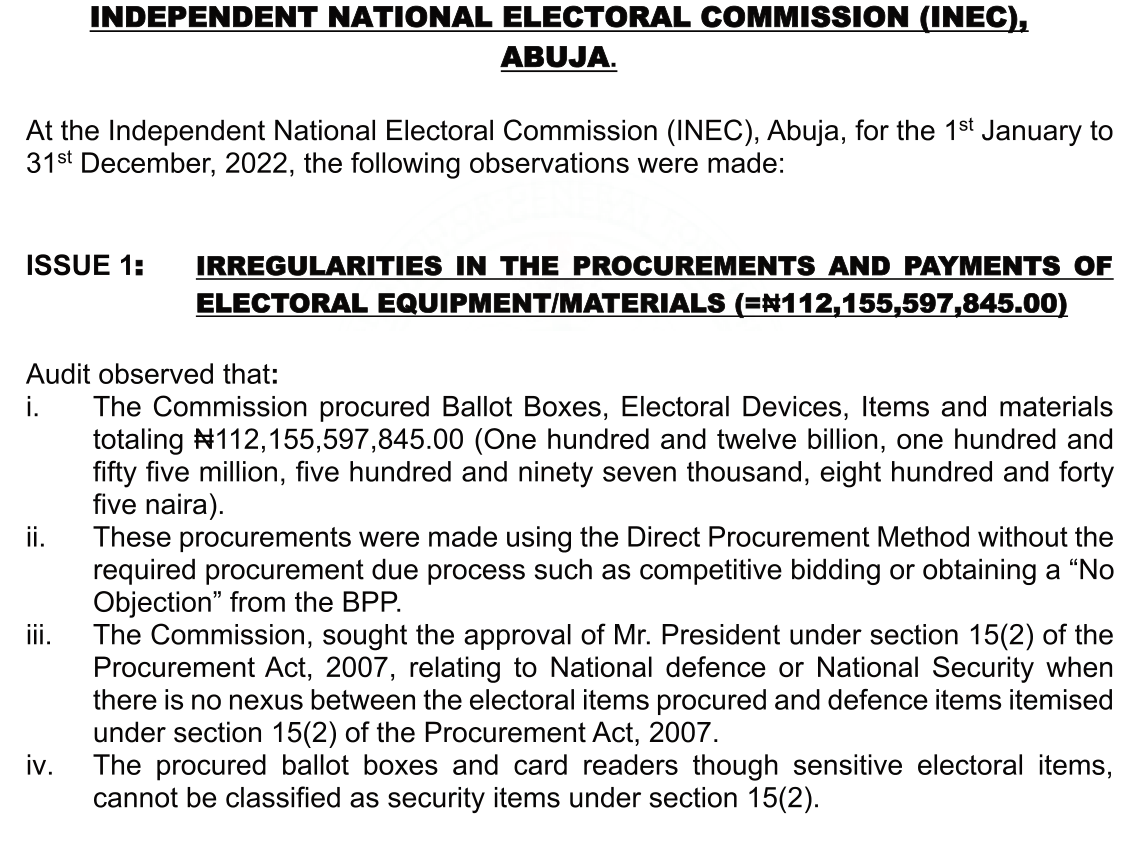
SERAP's suit, as quoted in its release, says: "The Auditor-General found 'no evidence that the items were procured.'" Those words do not appear on the INEC pages. The nearest passage, item vi on page 224, reads: "Evidence of procurement due process for the procured items were not made available and the items were also not verified by the internal audit department". The audit's first observation begins "The Commission procured". Read as printed, the finding is that the paperwork for the procurement was not produced and that INEC's internal auditors had not checked the goods. It does not say whether the goods were delivered. The same applies to SERAP's phrases "may have been diverted", "may have been lost" and "may have been inflated", which it presents as the Auditor-General's words. They are not in the section either. Under each issue the audit lists "Risks", such as "Contract inflation" and "Diversion of public funds". For the N112.16 billion it also recommends the sanctions in the Financial Regulations for "payment for job not done and irregular payment".
INEC's answer to the first issue is printed in the same report: "Due to the nature of procurement, the Commission sought and obtained approval President before embarking on the project." It said ballot boxes are "classified by the Commission as sensitive material" with "hidden security features embedded in the boxes", that the companies were chosen on "verifiable records of their performances in similar contracts" and recommended by a technical committee that visited their facilities, that the items were delivered to designated locations, and that "All required due process records for the procurement are contained in the project file." The Auditor-General did not accept the reply but did not say which records were missing from that file.
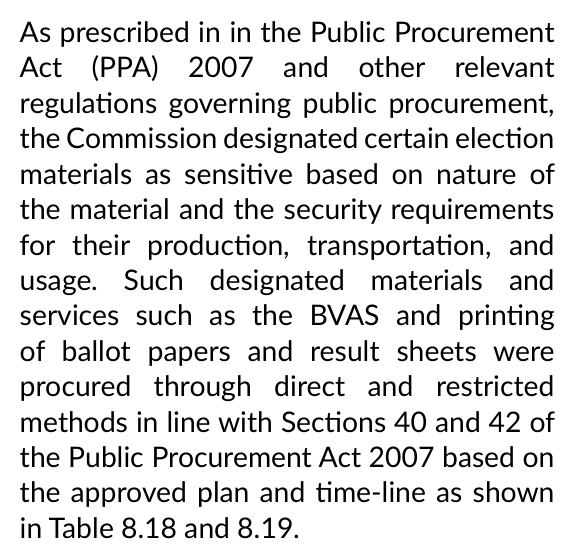
The Act the audit cites says, in section 15(2): "The provisions of this Act shall not apply to the procurement of special goods, works and services involving national defence or national security unless the President's express approval has been first sought and obtained." INEC's own account of the same kind of procurement cites different sections. Its Report of the 2023 General Election, published in February 2024, says on page 125 that sensitive items "such as the BVAS and printing of ballot papers and result sheets were procured through direct and restricted methods in line with Sections 40 and 42 of the Public Procurement Act 2007". Section 40 opens: "Subject to the approval by the Bureau, a procuring entity may for reasons of economy and efficiency engage in procurement by means of restricted tendering". Section 42, headed "Direct procurement", allows a single supplier in listed cases, among them where "the procuring entity applies this Act for procurement that concerns national security". INEC's report therefore places these purchases inside the Act, while the audit records INEC relying on the clause for defence and security purchases. A circular of 29 January 2018 from the Secretary to the Government of the Federation, addressed among others to the INEC chairman, told agencies to meet "the conditions for the adoption of Restricted Tendering and Emergency Procurement as stipulated in Sections 40 to 43" before asking the Bureau for a "No Objection".
The two INEC documents agree on one step. The timetables printed in INEC's report, Table 8.18 for the BVAS and Table 8.19 for sensitive materials, each include "Request to Mr President for Approval to Procure" before the award letters. Neither table has a step that names the Bureau of Public Procurement. The BVAS timetable does include an "Invitation to submit Technical & Financial Bids" and an "Evaluation of Bids", and the sensitive materials plan describes short-listing printers "through Selective Tendering Method" and a "Request for Quotation (RFQ) from Qualified Companies". The audit does not list the contracts inside its N112.16 billion, so the documents do not show whether they are the same purchases the report describes.
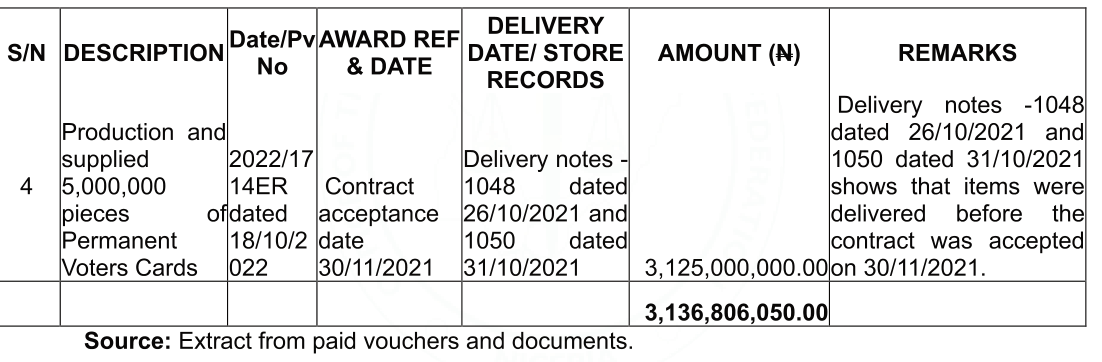
SERAP's release describes the third issue as N3,136,806,050.00 paid "to four contractors for ballot guides, sensitive materials and result sheets before the contracts were awarded, with no evidence of payment". The audit's table on pages 226 and 227 lists four contracts, and N3,125,000,000.00 of the total, 99.6 per cent, was for "Production and supplied 5,000,000 pieces of Permanent Voters Cards". The delivery notes for the cards are dated 26 and 31 October 2021; the contract was accepted on 30 November 2021, 35 days after the first delivery note; the payment voucher, 2022/1714ER, is dated 18 October 2022. The other three contracts, braille ballot guides for the Ekiti governorship election and result sheets and appointment letters for an Ekiti East constituency election, total N11,806,050.00. The table is headed "Source: Extract from paid vouchers and documents". What the audit says was missing is evidence of "advertisement, biding, bid evaluation and other procurement records", not evidence of payment. INEC's reply does not dispute the order of events: it says that "due to exigency, and late supply of materials", contractors were "always directed" to go ahead with printing "pending the award of contract letters".
On the vehicles, the audit says a contract for "Toyota Prado TXL 2021 Model" worth N1,058,925,000.00 was awarded by direct procurement with a three-week completion period, and that evidence of "advertisement, competitive bidding, bid evaluation, No Objection from BPP, etc. were not provided". INEC replied that the Bureau granted a "Certificate of 'No Objection'" for "the supply and delivery of 43nos Operational/Logistics Vehicles" by letter of 28 April 2022, reference BPP/RPT/22/Vol.I.012, and that the President's approval followed. SERAP's release states the audit's finding but not INEC's reply. The audit does not say whether its staff saw that letter or whether it covers this contract.
The four smaller issues are set out much as SERAP describes them. The N9,245,965,502.60 went to "twenty two (22) contractors" for "the same type of goods and services", awarded on the same day; INEC replied that the EC.50 series envelopes "were not the same" items. The N129,375,000.00 is the reimbursable part of a N388,125,000.00 contract with nineteen accounting firms to audit INEC's accounts for 2018, 2019 and 2020; INEC said there is "documentary evidence of utilization". The law on those audits has since tightened: section 5 of the Electoral Act 2022 required INEC's accounts to be audited "as soon as possible" after each year, and section 5 of the Electoral Act 2026 says "not later than six months". The N504,492,641.00 accreditation software, awarded on 13 July 2022, was valid only from February to May 2023, and the contractor's advance payment guarantee expired on 9 November 2022, 84 days before the licence key arrived on 1 February 2023; INEC said the software "was used for 2023 general election". Of the N235,103,000.00, N226,503,000.00 was for sleeping mats from a company registered on 13 August 2021 that, the audit says, had a "zero-year tax assessment" at the time of the award; INEC replied: "Observation is noted."
The audit covers 2022, when Mahmood Yakubu chaired INEC. SERAP's letter of 12 September 2026, sent 36 days after the report was posted, was addressed to the present chairman, Joash Amupitan, and gave the Commission seven days to respond. Its release of 18 October says the suit was filed the previous week and that no hearing date has been fixed. Vero Record did not find a public statement from INEC on the suit in the reports it checked.
The documents do not establish that any money was stolen, that any goods were not delivered, or that any official or contractor did anything unlawful. An Auditor-General's query is a finding for the Public Accounts Committees to consider; it is not a judgment, and no court has ruled on any of these payments. The audit names no contractors, and Vero Record has not seen INEC's project files, the President's approvals, the Bureau's letter of 28 April 2022 or the court papers in SERAP's suit, which it knows only from SERAP's release.
What this rests on
Office of the Auditor-General for the Federation, Annual Report on Non-compliance (Internal Control Weaknesses) for the year ended 31 December 2023, Volume I, INEC section, printed pp.223 to 233 (PDF pp.253 to 263), scanned PDF downloaded from oaugf.ng on 19 October 2026 (server Last-Modified 7 August 2026), read from the page images. INEC, Report of the 2023 General Election (February 2024), section 8.8, p.125, and Tables 8.18 and 8.19, pp.126 and 127 (PDF pp.164 to 166); the file is identical (SHA-1) to the Wayback Machine capture of INEC's own URL on 27 March 2024. Public Procurement Act 2007 (Official Gazette No. 65, Vol. 94), ss.15(2), 40(1) and 42(1)(f), gazette pp.A216 and A231 to A233, downloaded from the Bureau of Public Procurement's website. OSGF circular SGF50/S.52/III/694 of 29 January 2018. Electoral Act 2022 s.5 (p.A360) and Electoral Act 2026 s.5 (p.A10). SERAP release of 18 October 2026. Arithmetic re-done: 112,155,597,845.00 + 1,058,925,000.00 + 3,136,806,050.00 + 9,245,965,502.60 + 129,375,000.00 + 504,492,641.00 + 235,103,000.00 = 126,466,265,038.60 (SERAP: "over N126.46 billion"); 112,155,597,845.00 / 126,466,265,038.60 = 88.7%. Issue 3: 4,992,000.00 + 3,017,250.00 + 3,796,800.00 + 3,125,000,000.00 = 3,136,806,050.00, matching the table total; 3,125,000,000.00 / 3,136,806,050.00 = 99.6%; the three small contracts 4,992,000 + 3,017,250 + 3,796,800 = 11,806,050. Issue 5: 388,125,000.00 - 129,375,000.00 = 258,750,000.00 of audit fees; 129,375,000 / 388,125,000 = one third. Issue 7: 226,503,000.00 + 8,600,000.00 = 235,103,000.00. Days: 26 October 2021 to 30 November 2021 = 35 days (5 + 30); 9 November 2022 to 1 February 2023 = 84 days (21 + 31 + 31 + 1); 7 August 2026 to 12 September 2026 = 36 days (24 + 12).
What this does not establish
Whether the goods behind the N112.16 billion were delivered; the audit says only that procurement records were not produced and that internal audit had not verified the items. Which contracts make up the N112.16 billion, and whether they are the BVAS and sensitive-material purchases INEC's report describes. Whether the President's approval was sought under section 15(2), section 42 or both, and whether the Bureau of Public Procurement issued a No Objection for any of the Issue 1 contracts. Whether the Bureau's letter of 28 April 2022 covers the Toyota Prado contract. Whether SERAP's court papers quote the audit in the same words as its release; the suit itself was not obtained. The phrases SERAP attributes to the Auditor-General were checked against the INEC section of Volume I only, not against the whole report. INEC's response to the suit, if any. Nothing in the documents read establishes a crime by anyone, and no court has ruled on the payments.
What we did ourselves
Downloaded the 388-page scanned Volume I of the Auditor-General's 2023 report, located the INEC section from the contents page and read all seven issues from the page images, including INEC's printed responses and the auditor's evaluations. Re-added the seven sums against SERAP's N126.46 billion and the Issue 3 table against its printed total. Checked each phrase SERAP's release attributes to the Auditor-General against the printed text. Set the audit's account of the legal basis for the N112.16 billion against INEC's own 2023 election report and its procurement timetables, against the text of sections 15(2), 40 and 42 of the Public Procurement Act 2007 downloaded from the Bureau of Public Procurement, and against a 2018 circular from the Secretary to the Government of the Federation. Compared section 5 of the Electoral Acts of 2022 and 2026 on the timing of INEC's own audits.
Sources for this report
(A) Auditor-General for the Federation, 2023 Annual Report on Non-compliance, Volume I, INEC section, pp.223 to 233; INEC, Report of the 2023 General Election (2024), pp.125 to 127; Public Procurement Act 2007, ss.15(2), 40 and 42.
- SERAP sues INEC over failure to account for 'missing' N126bn electoral funds · SERAP · 18 October 2026
- Auditor-General for the Federation's Annual Report on Non-compliance (Internal Control Weaknesses) 2023, Vol. I · Office of the Auditor-General for the Federation · 7 August 2026
- Report of the 2023 General Election · Independent National Electoral Commission · February 2024
- Public Procurement Act 2007 · Bureau of Public Procurement (Official Gazette No. 65, Vol. 94) · 19 June 2007
- Adherence to the conditions for the adoption of restricted tendering (circular SGF50/S.52/III/694) · Office of the Secretary to the Government of the Federation · 29 January 2018
- Electoral Act 2026 · Federal Republic of Nigeria · 2026
- SERAP sues INEC over N126bn electoral funds · The Punch · 19 October 2026
- SERAP gives INEC 7 days to account for N126bn over alleged diversion, procurement violations · Sahara Reporters · 13 September 2026
Confidence: high. This is our own assessment of whether the event occurred as described, separate from the grade, which describes what kind of thing the claim rests on.
Not obtained: where the underlying document is named above but not linked, we did not hold a copy at the time of publication. We purchase nothing and request nothing in our own name.
Corrections
None on this report. If you find an error, it will be published here, at the same length, with the date it was found, and the original wording will remain visible above it.
Dr VeroInvestigations editor, Vero Record
Reads the Nigerian public record that others leave unread: budgets, audit reports, court files and registers. Every claim on this page carries the grade of the document behind it, and the report says what that document does not establish.
All 126 reportsHow we grade evidenceAdd Vero Record as a preferred source on Google