Q1 2026 debt service of N4.63tn exceeded the N3.83tn of federal revenue left once a N1.25tn line set at exactly a quarter of its budget is taken out
The Budget Office of the Federation's implementation report for January to March 2026 puts federal revenue at N5,075.43 billion and debt service at N4,627.83 billion, or 91.2 per cent. N1,245.22 billion of that revenue is the line for government-owned enterprises, and it equals exactly a quarter of the line's annual budget, as do the matching spending lines. Without it, debt service was 120.8 per cent of revenue. The Debt Management Office's own ledger matches the domestic debt service to the kobo. The report's N3.90 trillion of bond borrowing does not match the DMO's auction results.
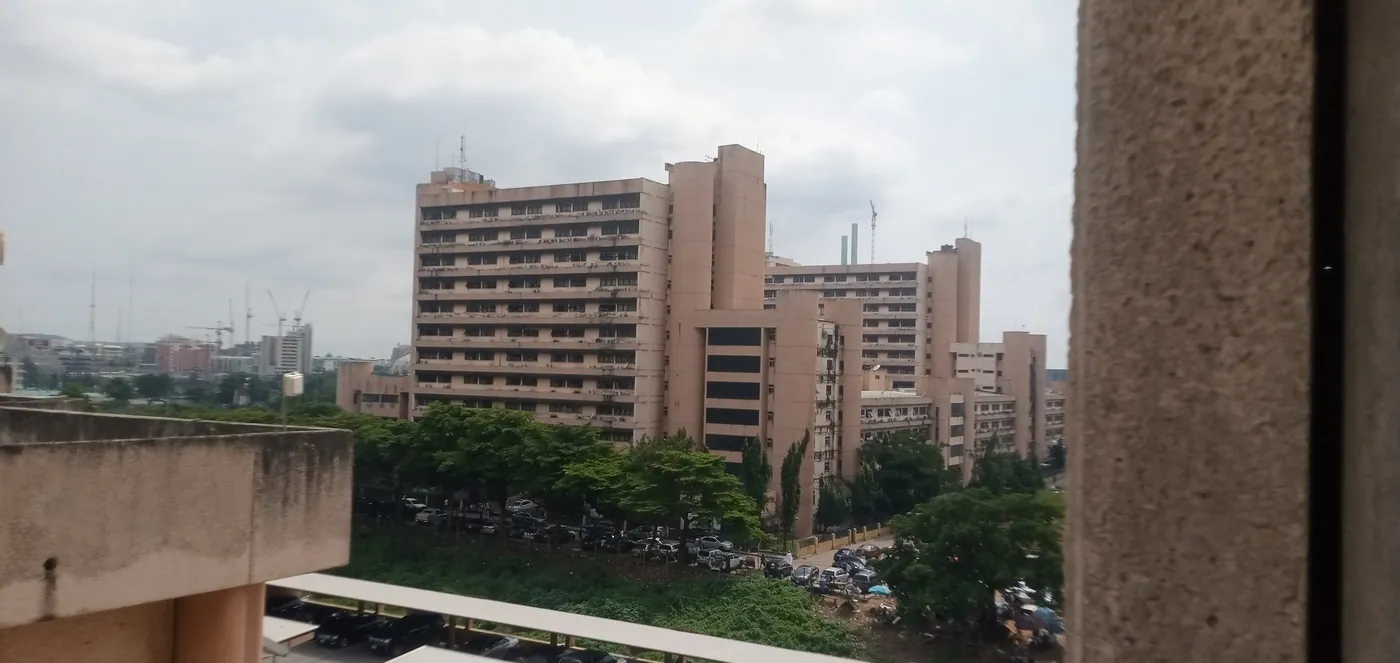
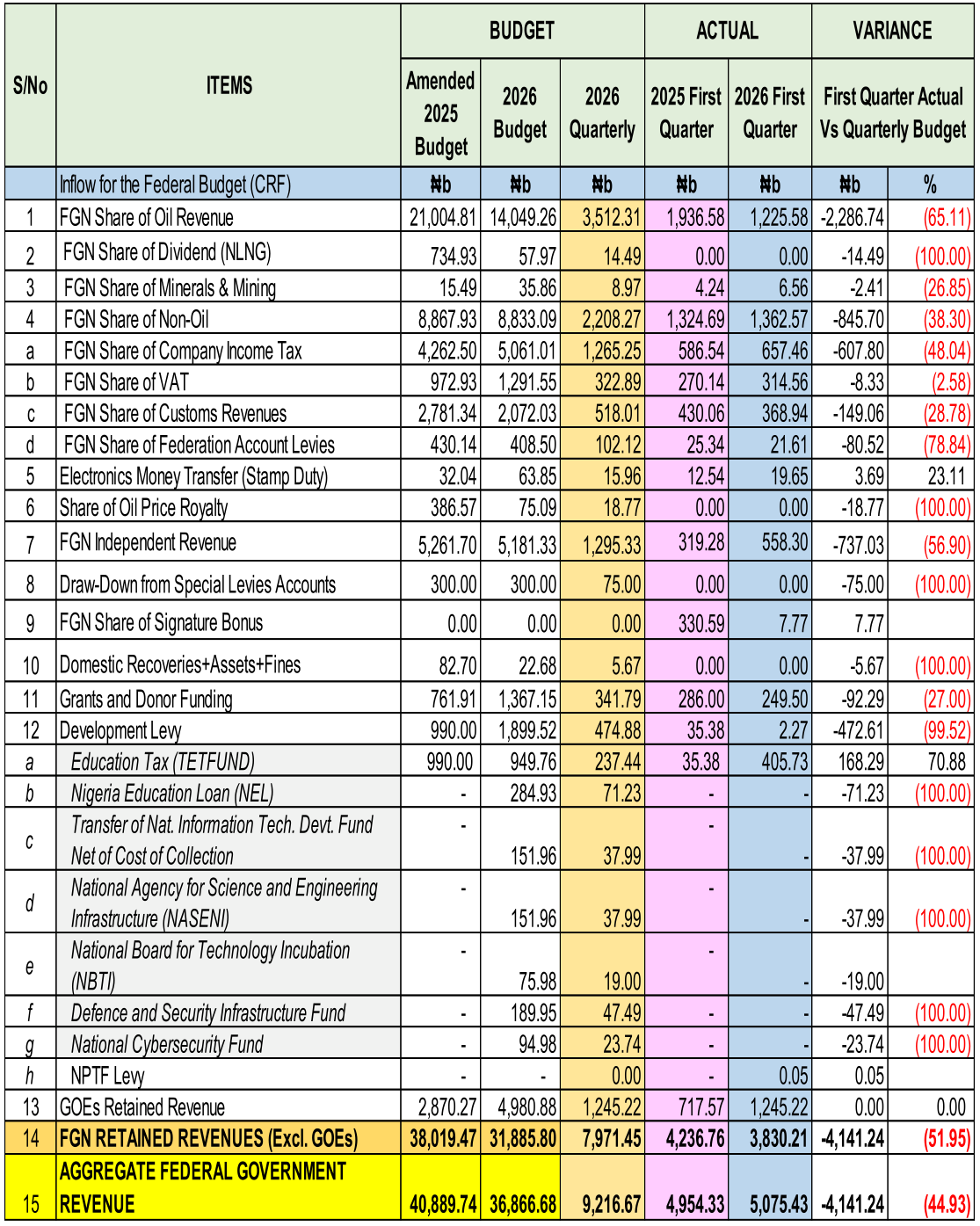
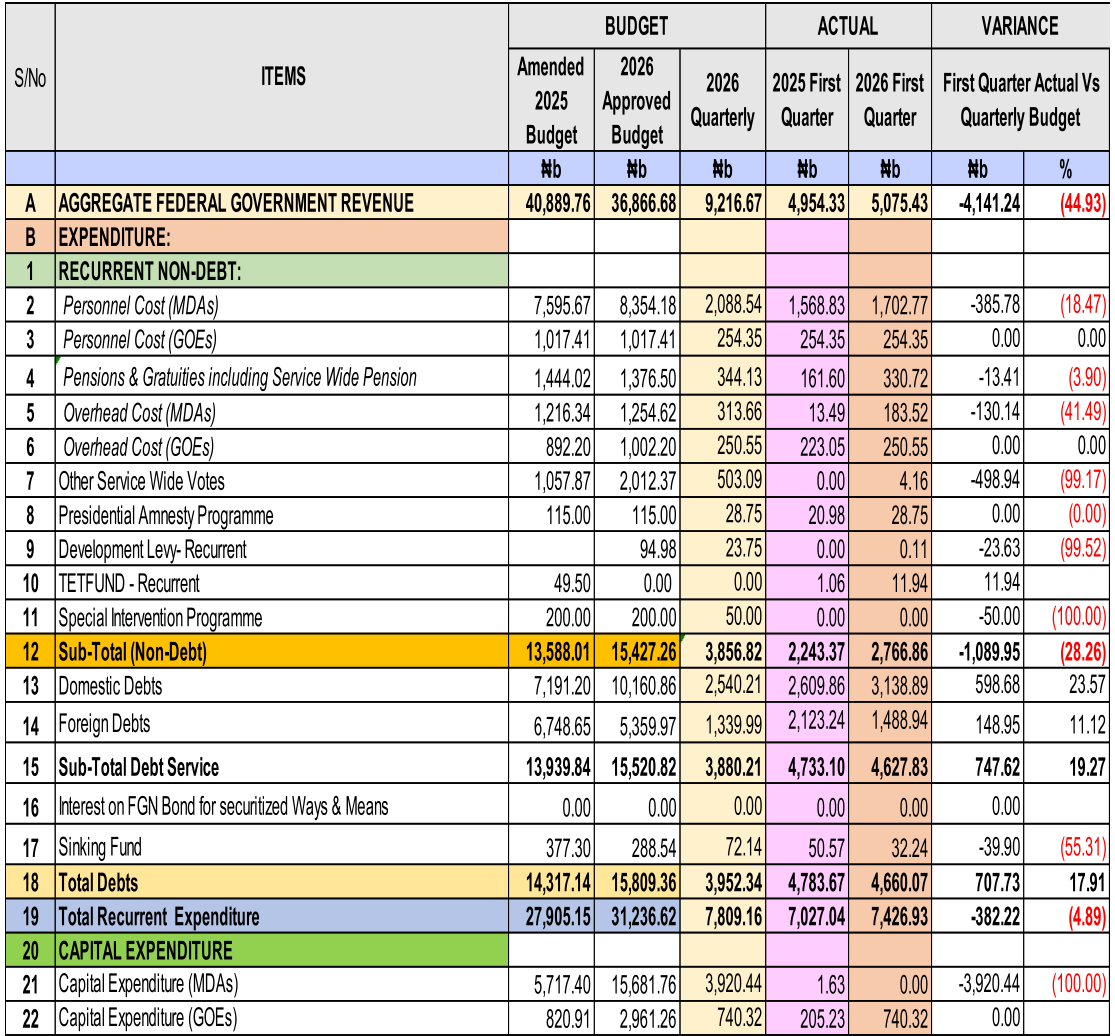
The Budget Office of the Federation has posted its 2026 First Quarter Budget Implementation Report, the only report in the 2026 folder of its website on 4 November; the file's own data dates it 2 November 2026. Table 3.9 on page 32, compiled with the Office of the Accountant-General of the Federation, puts aggregate federal government revenue for January to March at N5,075.43 billion and debt service at N4,627.83 billion, made up of N3,138.89 billion on domestic debt and N1,488.94 billion on foreign debt. Debt service therefore took 91.2 per cent of revenue, or 91.8 per cent once the N32.24 billion sinking fund is added. Of the revenue, N1,245.22 billion is a single line in Table 3.8, "GOEs Retained Revenue", the money kept by government-owned enterprises. That figure is exactly one quarter of the line's N4,980.88 billion annual budget, and the variance column beside it reads 0.00. The table's own subtotal without it, "FGN Retained Revenues (Excl. GOEs)", is N3,830.21 billion. Debt service was N797.62 billion more than that sum, or 120.8 per cent of it.
The same N1,245.22 billion appears on the spending side of Table 3.9, split three ways, and each part is also a quarter of its annual budget: personnel cost of GOEs N254.35 billion (budget N1,017.41 billion), overhead N250.55 billion (N1,002.20 billion) and capital N740.32 billion (N2,961.26 billion). The three add to N1,245.22 billion, and each has a variance of 0.00. Page 27 says "a total of N1.25 trillion was realised as GOEs Retained Revenue in the first quarter of 2026 which was (100.0 percent) of the quarterly projection." The report does not say whether the enterprises reported these sums or whether the budget figures were entered in their place. Because the same amount is counted once as revenue and once as spending, the line does not change the quarter's deficit of N4,686.82 billion.
The practice is recent. In the Budget Office's fourth-quarter report for 2024, which it marks provisional, the GOE revenue line differs from quarter to quarter: N152.01 billion, N162.45 billion, N172.88 billion and N612.96 billion, or N1,100.30 billion for the year against a budget of N2,861.08 billion, 38.5 per cent of it. In its third-quarter report for 2025, the line reads N717.57 billion, N717.57 billion and N717.56 billion, each a quarter of the N2,870.27 billion amended budget, and the three GOE spending lines sit within N0.01 billion of a quarter of their budgets in every quarter (N254.35 billion, N223.05 billion and N205.23 billion). The N1,245.22 billion credited for the first three months of 2026 is N144.92 billion more than the Budget Office recorded from the enterprises for the whole of 2024.
This affects how the report describes revenue. Page 26 says the N5.08 trillion received in the quarter was "N0.13 trillion (2.63 percent) higher than the N4.95 trillion generated in the first quarter of 2025". On the table's unrounded figures, N5,075.43 billion against N4,954.33 billion, the rise is N121.10 billion, or 2.44 per cent. The GOE line alone rose by N527.65 billion, from N717.57 billion to N1,245.22 billion, because its 2026 budget is N2,110.61 billion, or 73.5 per cent, larger than the 2025 one. Everything else, as the table totals it, fell by N406.55 billion, from N4,236.76 billion to N3,830.21 billion, a fall of 9.60 per cent. The largest falls are in the FGN share of oil revenue, down N711.00 billion to N1,225.58 billion, and signature bonus, down N322.82 billion to N7.77 billion. Several non-oil lines grew: the FGN share of company income tax rose from N586.54 billion to N657.46 billion, its share of VAT from N270.14 billion to N314.56 billion, and independent revenue from N319.28 billion to N558.30 billion.
The same effect runs through the debt ratio. For the first quarter of 2025 the table shows debt service of N4,733.10 billion: 95.5 per cent of aggregate revenue and 111.7 per cent of revenue excluding GOEs. A year later the aggregate ratio is lower, at 91.2 per cent, while the ratio excluding GOEs is higher, at 120.8 per cent. The report's preface says "The debt service-to-revenue ratio remains at an elevated level" but prints no ratio. First quarters carry heavy debt payments, so one quarter says little about the year: in the Budget Office's third-quarter report for 2025, debt service as a share of revenue excluding GOEs falls from 111.7 per cent in the first quarter to 83.8 per cent in the second (N4,407.33 billion against N5,257.42 billion) and 48.4 per cent in the third (N3,384.31 billion against N6,985.93 billion).
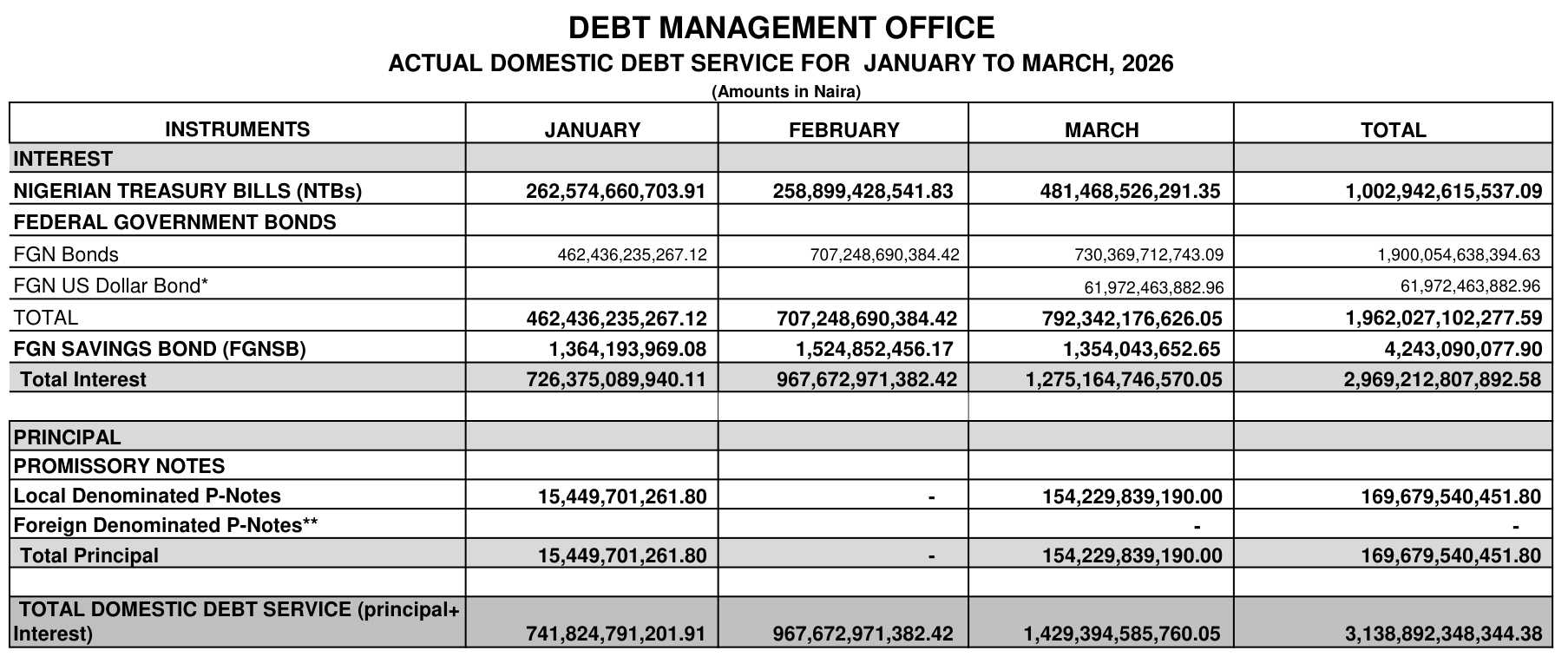
The debt figures themselves hold up against a second record. The Debt Management Office's table of actual domestic debt service for January to March 2026 totals N3,138,892,348,344.38, which rounds to the Budget Office's N3,138.89 billion. The DMO breaks it into N2,969.21 billion of interest, of which N1,002.94 billion was on Treasury bills, N1,962.03 billion on FGN bonds including the dollar bond and N4.24 billion on savings bonds, and N169.68 billion of promissory notes repaid. By month it was N741.82 billion in January, N967.67 billion in February and N1,429.39 billion in March. Domestic debt service alone equals 82.0 per cent of the report's revenue excluding GOEs. The report's debt stock also matches the DMO's tables for 31 March 2026: total public debt of N159.35 trillion (US$114.95 billion), N87.40 trillion domestic and N71.95 trillion external, and N82.88 trillion of FGN domestic debt.
The two offices part company on how the deficit was paid for. Page 33 of the report says the N4.69 trillion deficit "was financed through domestic borrowing (FGN Bond) of N3.90 trillion", and the table on page 34 gives N3,903.02 billion. The DMO's result sheets for its January and February bond auctions, the two that settled inside the quarter, show N2,068.96 billion allotted plus N130.72 billion of non-competitive allotment, N2,199.68 billion in all. The March auction added N485.50 billion but settled on 1 April. Even counting it, the three auctions come to N2,685.18 billion, N1,217.84 billion short of the Budget Office figure. The DMO's stock tables point the same way: FGN naira bonds outstanding fell by N134.26 billion between 31 December 2025 and 31 March 2026, while Treasury bills rose by N2,714.90 billion, more than the whole N2,388.76 billion increase in FGN domestic debt. Page 13 of the report nonetheless says: "The increase in domestic debt relative to the second quarter of 2024 was due to the new issuance of FGN bonds during the period."
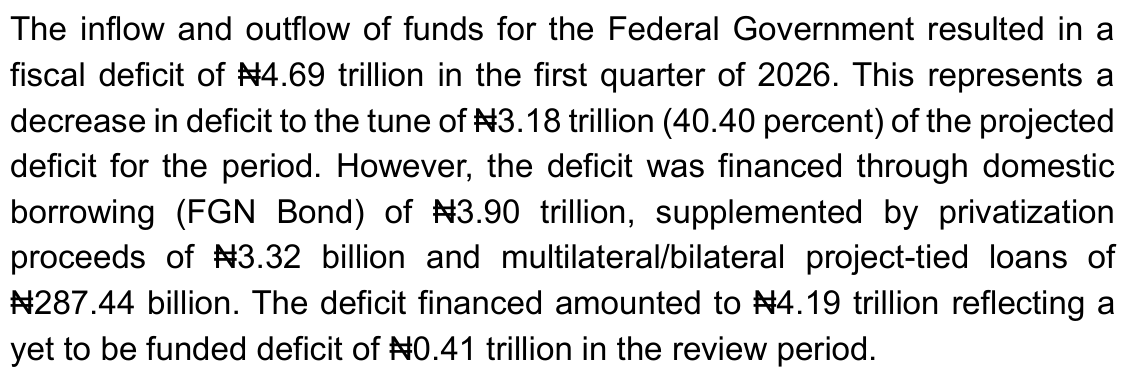
The report also disagrees with itself in places. Its financing paragraph says the N4.19 trillion raised left "a yet to be funded deficit of N0.41 trillion"; N4,686.83 billion less N4,193.78 billion is N493.05 billion. The executive summary gives external debt service as N1.34 trillion, which is the budgeted amount; the table and page 31 give N1,488.94 billion, and the summary's N3.14 trillion and N1.34 trillion add to N4.48 trillion, not its N4.63 trillion total. In Table 3.8 the Development Levy row shows N2.27 billion while the Education Tax row beneath it shows N405.73 billion. Read with N2.27 billion, the rows add to N3,432.20 billion, N398.01 billion short of the printed N3,830.21 billion; read with the N405.73 billion and N0.05 billion sub-lines, they add to N3,835.71 billion, N5.50 billion over. On either reading, debt service is larger than revenue excluding GOEs. The domestic debt breakdown on page 13 is labelled as at 31 December 2025 but gives the DMO's figures for 31 March 2026. The PDF's document properties, which are not printed in the report, give its subject as "Structural editing and copy editing only; technical reconciliation remains outstanding."
On several points the record supports the Budget Office. Its debt service and debt stock figures match the DMO's to the last published digit. It shows the GOE line's zero variance openly, and that line leaves the deficit unchanged. Non-oil taxes grew, as the report says, and it names oil as the weak point: crude production averaged 1.55 million barrels a day against a benchmark of 1.84 million, and Table 3.4 puts gross oil and gas revenue at N2,966.26 billion against a prorated N9,327.11 billion. It also states plainly that the 2026 capital budget of ministries, departments and agencies had zero implementation by 31 March, because spending of 2025 capital releases was extended to 31 December 2026. Nothing in these documents suggests that any money is missing; the gaps described here are between published figures.
The documents do not establish whether the government-owned enterprises earned and spent N1,245.22 billion in the quarter, or why budget figures appear in the actual columns from 2025 onward. They do not say what the N3,903.02 billion of domestic borrowing consists of; it may include Treasury bills or proceeds counted on a different basis from the DMO's, but that is inference. The N1,488.94 billion of foreign debt service could not be checked against the DMO, whose website returned errors on 4 November, and the Federation Account figures in Table 3.4 were not re-added against the Accountant-General's monthly reports. The DMO's 31 December 2025 table is marked provisional. The Budget Office was not asked for comment before publication; the figures above are its own and the DMO's, set against each other.
What this rests on
Budget Office of the Federation, 2026 First Quarter Budget Implementation Report (52 pages, file '2026 Q1 Budget Implementation Report.pdf', created 2 November 2026), downloaded from budgetoffice.gov.ng on 4 November 2026 and read for this report: Table 3.8 (p.28), Table 3.9 (p.32), deficit financing text and table (pp.33 to 34), Table 3.4 (p.22), debt stock section (pp.12 to 14), revenue text (pp.26 to 27), debt service text (pp.30 to 31), preface (p.v) and executive summary (pp.xiv to xvi); document properties read with pymupdf. Earlier Budget Office reports reused from Vero Record's 3 October check: 2024 Fourth Quarter BIR, provisional (Table 3.8, p.28; Table 3.9, p.33) and 2025 Third Quarter BIR (Table 3.8, p.23; Table 3.9, p.28); page extracts saved. Debt Management Office tables downloaded by Vero Record in August to October 2026 and re-read: Actual Domestic Debt Service for January to March 2026; FGN Domestic Debt Stock by Instruments as at 31 March 2026 and 31 December 2025 (provisional); Nigeria's Total Public Debt Portfolio as at 31 March 2026; FGN bond auction results for January, February and March 2026. Arithmetic re-done: N3,138.89bn + N1,488.94bn = N4,627.83bn; + N32.24bn sinking fund = N4,660.07bn; N4,627.83bn / N5,075.43bn = 91.18 per cent; N4,660.07bn / N5,075.43bn = 91.82 per cent; N5,075.43bn - N1,245.22bn = N3,830.21bn; N4,627.83bn - N3,830.21bn = N797.62bn; N4,627.83bn / N3,830.21bn = 120.82 per cent; GOE lines N4,980.88bn / 4 = N1,245.22bn, N1,017.41bn / 4 = N254.35bn, N1,002.20bn / 4 = N250.55bn, N2,961.26bn / 4 = N740.32bn, and N254.35bn + N250.55bn + N740.32bn = N1,245.22bn; 2025: N2,870.27bn / 4 = N717.57bn, N892.20bn / 4 = N223.05bn, N820.91bn / 4 = N205.23bn; 2024: N152.01bn + N162.45bn + N172.88bn + N612.96bn = N1,100.30bn, 38.5 per cent of N2,861.08bn; N1,245.22bn - N1,100.30bn = N144.92bn. Revenue: N5,075.43bn - N4,954.33bn = N121.10bn (2.44 per cent; the report's 2.63 per cent is N0.13tn / N4.95tn on rounded figures); N1,245.22bn - N717.57bn = N527.65bn; N4,980.88bn - N2,870.27bn = N2,110.61bn (73.5 per cent); N3,830.21bn - N4,236.76bn = -N406.55bn (-9.60 per cent); N527.65bn - N406.55bn = N121.10bn. Ratios: Q1 2025 N4,733.10bn / N4,954.33bn = 95.5 per cent and / N4,236.76bn = 111.7 per cent; Q2 2025 N4,407.33bn / N5,257.42bn = 83.8 per cent; Q3 2025 N3,384.31bn / N6,985.93bn = 48.4 per cent. DMO: interest N1,002,942,615,537.09 + N1,962,027,102,277.59 + N4,243,090,077.90 = N2,969,212,807,892.58; + principal N169,679,540,451.80 = N3,138,892,348,344.38; months N741,824,791,201.91 + N967,672,971,382.42 + N1,429,394,585,760.05 = N3,138,892,348,344.38; N3,138.89bn / N3,830.21bn = 82.0 per cent. Financing: N3,903.02bn + N3.32bn + N287.44bn = N4,193.78bn; N4,686.83bn - N4,193.78bn = N493.05bn. Auctions: January N398.19bn + N576.33bn + N570.16bn = N1,544.68bn, non-competitive N17.50bn + N113.22bn = N130.72bn; February N188.14bn + N208.63bn + N127.51bn = N524.28bn; N1,544.68bn + N524.28bn = N2,068.96bn, + N130.72bn = N2,199.68bn; March N88.797bn + N63.997bn + N332.706bn = N485.50bn; all three N2,685.18bn; N3,903.02bn - N2,685.18bn = N1,217.84bn. DMO stock: naira bonds N39,463,776,313,592.00 - N39,598,033,695,592.00 = -N134,257,382,000.00; Treasury bills N16,566,899,525,000 - N13,852,000,953,000 = N2,714,898,572,000; total N82,877,621,730,226.60 - N80,488,865,114,501.70 = N2,388,756,615,724.90. Table 3.8 rows (Q1 2026): N1,225.58bn + N6.56bn + N1,362.57bn + N19.65bn + N558.30bn + N7.77bn + N249.50bn = N3,429.93bn; + N2.27bn = N3,432.20bn (N398.01bn below N3,830.21bn); + N405.73bn + N0.05bn = N3,835.71bn (N5.50bn above). Executive summary N3.14tn + N1.34tn = N4.48tn against N4.63tn.
What this does not establish
Whether the government-owned enterprises actually earned and spent N1,245.22 billion in January to March 2026, whether they reported any figures for the quarter, and why the Budget Office's actual columns have shown exactly a quarter of the GOE budget lines since 2025. What the N3,903.02 billion of 'domestic borrowing (FGN Bond)' is made of, and why it exceeds every DMO bond figure for the quarter; Treasury bills or a different timing basis could explain part of it, which is inference. Which reading of the Development Levy row in Table 3.8 is correct. The N1,488.94 billion of foreign debt service was not checked against a DMO record, because the DMO website returned errors on 4 November 2026. The Federation Account figures in Table 3.4 were not re-added against the Accountant-General's monthly FAAC reports. The DMO's 31 December 2025 table is marked provisional. Whether the document-properties note about outstanding technical reconciliation describes the published version. A first-quarter ratio does not show the full-year outcome. Nothing in the documents suggests wrongdoing by anyone, and none is alleged. The Budget Office and the DMO were not asked for comment.
What we did ourselves
Downloaded the Budget Office's new first-quarter 2026 report and re-added its revenue, expenditure and financing tables. Found that the GOE revenue and spending lines equal exactly a quarter of their annual budgets, compared them with the Budget Office's 2024 and 2025 reports to date the practice, and recomputed the debt service ratio and the year-on-year revenue change with and without that line. Set the report's domestic debt service and debt stock against the DMO's tables, where they match, and its N3,903.02 billion of bond borrowing against the DMO's three auction result sheets and its bond and Treasury bill stock for 31 December 2025 and 31 March 2026, where they do not. Checked the report's own arithmetic on the unfunded deficit, the executive summary and Table 3.8.
Sources for this report
(A) Budget Office of the Federation, 2026 First Quarter Budget Implementation Report, Tables 3.4, 3.8 and 3.9 and the deficit financing section (pp.22, 28, 32 to 34); Debt Management Office, Actual Domestic Debt Service for January to March 2026, FGN domestic debt stock by instrument at 31 December 2025 and 31 March 2026, total public debt at 31 March 2026, and FGN bond auction results for January to March 2026.
- 2026 First Quarter Budget Implementation Report (52 pages) · Budget Office of the Federation, Ministry of Budget and Economic Planning · 2 November 2026
- 2026 Budget Implementation Reports (listing page) · Budget Office of the Federation · accessed 4 November 2026
- 2025 Third Quarter Budget Implementation Report · Budget Office of the Federation · January to September 2025
- 2024 Fourth Quarter Budget Implementation Report (provisional) · Budget Office of the Federation · Fiscal year 2024
- Actual Domestic Debt Service for January to March 2026 · Debt Management Office · 2026
- FGN Domestic Debt Stock Outstanding by Instruments as at March 31st, 2026 · Debt Management Office · 2026
- FGN Domestic Debt Stock Outstanding by Instruments as at December 31st, 2025 (provisional) · Debt Management Office · 2026
- Nigeria's Total Public Debt Portfolio as at March 31, 2026 · Debt Management Office · 2026
- January 2026 FGN Bond Auction Result · Debt Management Office · 26 January 2026
- February 2026 FGN Bond Auction Result · Debt Management Office · 23 February 2026
- March 2026 FGN Bond Auction Result · Debt Management Office · 30 March 2026
- Nigeria spends N3.14 trillion servicing domestic debt in Q1 2026, up 20.3% year-on-year · Nairametrics · 8 August 2026
- Tinubu govt spent more servicing domestic debt in Q1 2026 than Q1 2025: DMO · Gazette Nigeria · August 2026
Confidence: high. This is our own assessment of whether the event occurred as described, separate from the grade, which describes what kind of thing the claim rests on.
Not obtained: where the underlying document is named above but not linked, we did not hold a copy at the time of publication. We purchase nothing and request nothing in our own name.
Corrections
None on this report. If you find an error, it will be published here, at the same length, with the date it was found, and the original wording will remain visible above it.
Dr VeroInvestigations editor, Vero Record
Reads the Nigerian public record that others leave unread: budgets, audit reports, court files and registers. Every claim on this page carries the grade of the document behind it, and the report says what that document does not establish.
All 169 reportsHow we grade evidenceAdd Vero Record as a preferred source on Google