
NNPC's audited-results release calls 1.77 million barrels a day its 2025 average. Its own December report called that figure the year's peak
On 29 September NNPC Limited said Nigeria's crude oil and condensate production "averaged 1.77 million barrels per day" in 2025. In February its own Monthly Report Summary for December 2025 labelled 1.77 the "2025 Peak Production" and gave twelve monthly averages, none higher than 1.69. The regulator's 2025 table works out to 1.64 million barrels a day. The same press release also gives an annual total that works out to 1.55.

On Tuesday, 29 September 2026, NNPC Limited announced its audited results for the year ended 31 December 2025. The press release is signed by Andy Odeh, the company's Chief Corporate Communications Officer. It reports profit after tax of N7.2 trillion, revenue of N34.5 trillion and a declared dividend of N5.8 trillion. Under "Operational Highlights" it says: "Crude oil and condensate production averaged 1.77 million barrels per day, its highest level in five years." Vero Record read the release on NNPC's website. On 30 September, Voice of Nigeria, the federal government's international broadcaster, repeated the claim: the company's production "averaged 1.77 million barrels per day in 2025". ThisDay reported that the Group Chief Executive Officer, Bashir Bayo Ojulari, gave the same 1.77 million barrels a day as the year's average.
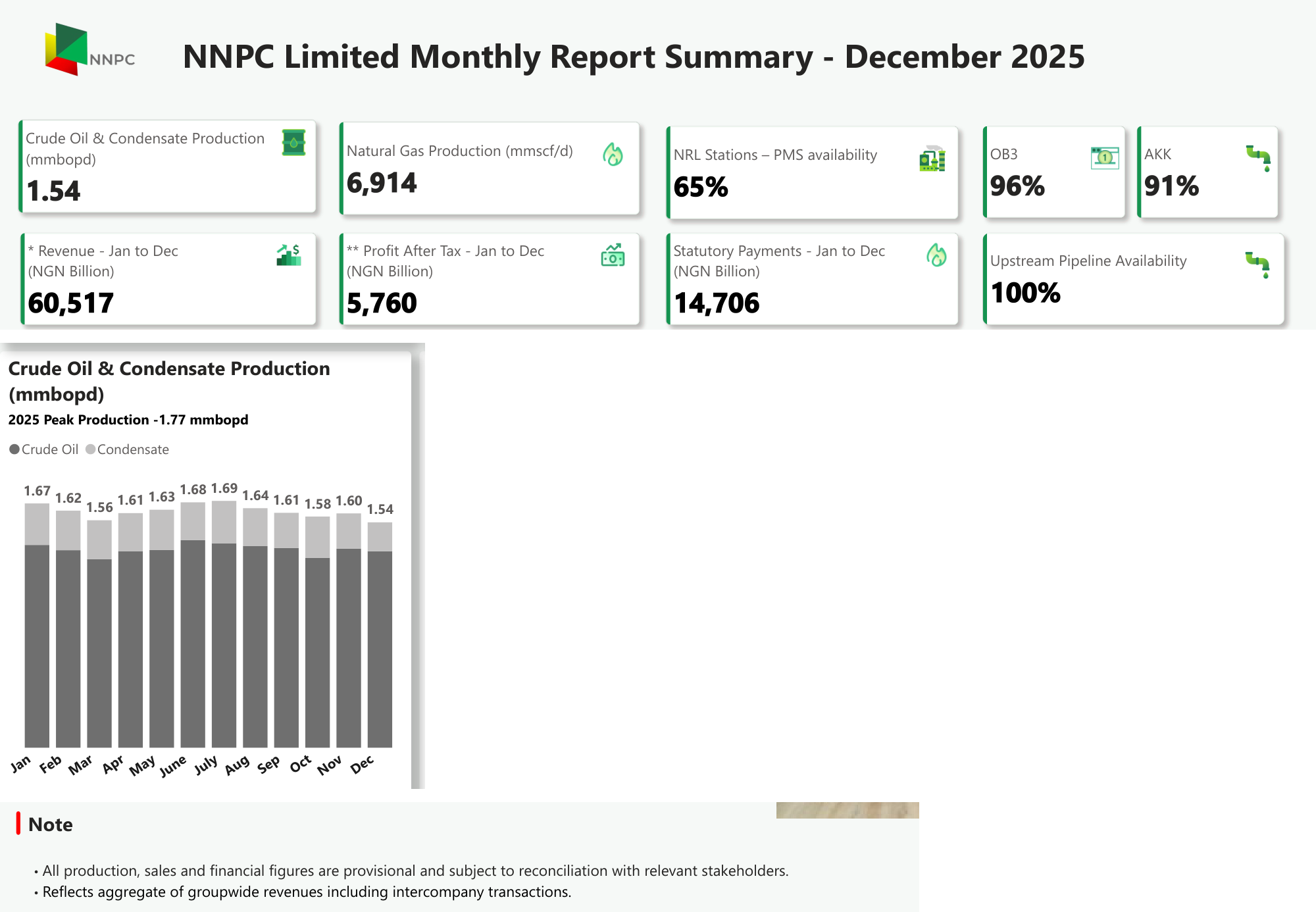
NNPC had already put the same number on the record seven and a half months earlier, and described it differently. On 12 February 2026 the company published its Monthly Report Summary for December 2025, a one-page document that Vero Record downloaded from NNPC's website. Its chart headed "Crude Oil & Condensate Production (mmbopd)" carries the subtitle "2025 Peak Production -1.77 mmbopd". Beneath it the chart gives a production average for each month of 2025: 1.67 in January, 1.62 in February, 1.56 in March, 1.61 in April, 1.63 in May, 1.68 in June, 1.69 in July, 1.64 in August, 1.61 in September, 1.58 in October, 1.60 in November and 1.54 in December, all in million barrels per day.
None of those twelve monthly figures reaches 1.77. The highest is 1.69, in July, and the lowest is 1.54, in December. The following is Vero Record's own arithmetic, and we label it as such. The simple average of the twelve figures is 1.62 million barrels a day. If each month is weighted by its number of days, the chart implies about 590.97 million barrels for the year, which is also about 1.62 million barrels a day. A full year at 1.77 million barrels a day would need 646.05 million barrels. Because the monthly figures are rounded to two decimals, the day-weighted total is approximate. The rounding cannot account for a gap of about 0.15 million barrels a day.
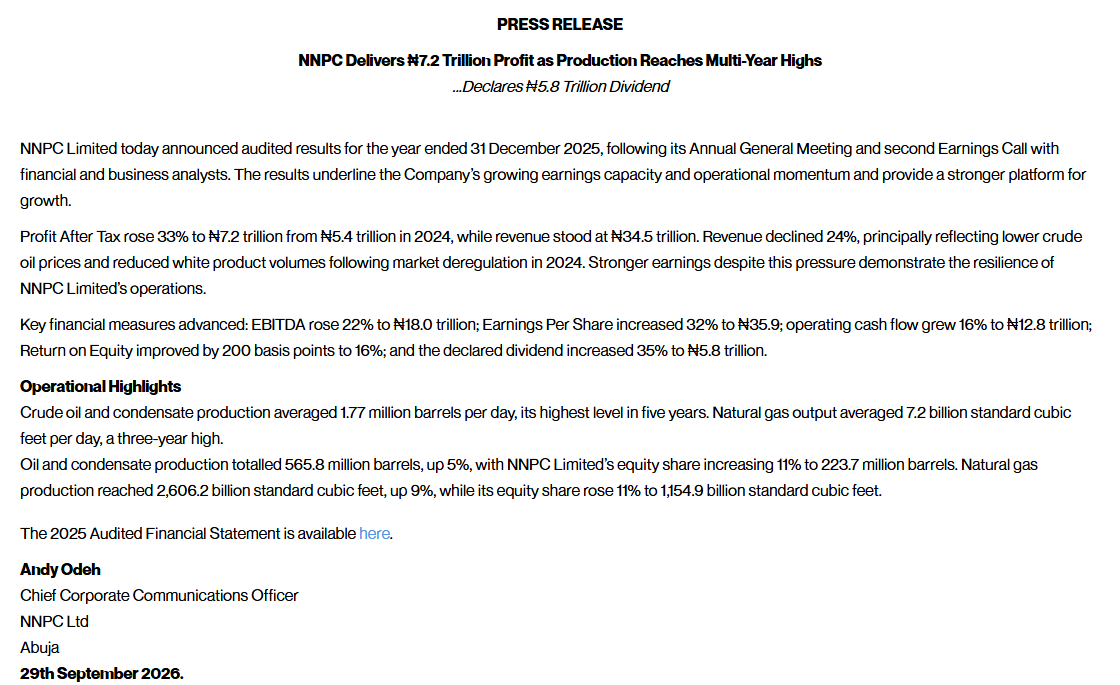
The September release contains a second production figure that does not fit the first. It says: "Oil and condensate production totalled 565.8 million barrels, up 5%, with NNPC Limited's equity share increasing 11% to 223.7 million barrels." On our arithmetic, 565.8 million barrels over the 365 days of 2025 is about 1.55 million barrels a day. Read side by side, the release gives an average of 1.77 million barrels a day and an annual total that works out to 1.55. Over a year, that is a difference of about 80.25 million barrels. The release does not say whether the 565.8 million figure covers all of Nigeria's production or only the fields in which NNPC holds an interest. It does not explain how the two figures relate.
The upstream regulator publishes its own record. Every month the Nigerian Upstream Petroleum Regulatory Commission (NUPRC) publishes a table of crude oil and condensate production by terminal and stream. Its table headed "Crude Oil and Condensate Production - 2025", with December filled in, was uploaded to the commission's website in January 2026 and captured by the Internet Archive on 6 February 2026. The original address now returns a "not found" error, so Vero Record retrieved and read the archived copy of the PDF. Its "Daily Average of Liquid" row gives national totals of 1,737,480 barrels a day in January, 1,671,953 in February, 1,603,776 in March, 1,683,307 in April, 1,657,435 in May, 1,697,045 in June, 1,712,282 in July, 1,631,613 in August, 1,581,181 in September, 1,597,199 in October, 1,599,054 in November and 1,544,345 in December.
In the regulator's table, too, no month averages 1.77 million barrels a day. The highest is January, at 1,737,480. On our arithmetic, the table's twelve monthly "Total Liquid (Barrels)" figures add up to 599,640,345 barrels of crude oil and condensate for 2025. Over 365 days that is about 1,642,850 barrels a day. NUPRC's remarks on December say that the "Lowest and Peak Combined crude oil and Condensate were 1.52 million bopd and 1.82 million bopd respectively" in that month. So national output went above 1.77 million barrels on at least one day. Over the year as a whole it averaged about 1.64 million on the regulator's figures.
NNPC's monthly chart and NUPRC's table are close to each other. For December both give 1.54 million barrels a day. In nine months NNPC's figure is below the regulator's, by up to about 0.07 million barrels a day, in January and April. In August, September and November it is slightly above, by up to about 0.03 million. NNPC's chart does not say whether it measures national output or its own portfolio, but its figures track the national series closely. Neither record supports an annual average of 1.77.
The regulator's previous annual table shows the same trend. NUPRC's "Crude Oil and Condensate Production - 2024" table, also retrieved from an archived copy and read, gives monthly totals that add up, on our arithmetic, to 566,794,493 barrels over 2024's 366 days, or about 1.55 million barrels a day. On the regulator's figures, total production in 2025 was therefore about 5.8 per cent higher than in 2024. Per day, because 2024 had one day more, the increase was about 6.1 per cent. That fits NNPC's statement that output rose. It does not fit the 1.77 average. Vero Record did not check the claim that 2025 was the highest year "in five years" against NUPRC's tables for 2021 to 2023.
This is not the first time an NNPC production figure has been read two ways. In November 2024, according to Nairametrics, NNPC's then spokesman Olufemi Soneye issued a statement about reports that NNPC's figure of 1.8 million barrels a day did not match NUPRC's 1.54 million. He said NNPC's figure represented peak production for October 2024, while NUPRC's was the average for September 2024. That is a press account, and we grade it B. In August 2026, as reported by ThisDay, NNPC said in a statement issued by Mr Odeh that average crude oil production, "including condensate", was 1.60 million barrels a day in April 2025. That is close to the 1.61 on its own December chart for that month. It is far from 1.77.
The September release's gas figures show a smaller version of the same mismatch. The release says natural gas output "averaged 7.2 billion standard cubic feet per day" and that production "reached 2,606.2 billion standard cubic feet". On our arithmetic, 2,606.2 billion over 365 days is about 7.14 billion a day. The December monthly chart's twelve gas figures, weighted by days, average about 7,069 million standard cubic feet a day, or 7.07 billion. Rounding may explain part of this difference. It cannot explain the oil gap.
The December summary and the audited results also differ on money. NNPC's own footnotes give the main reasons. The December summary reported provisional profit after tax of N5,760 billion and revenue of N60,517 billion for January to December 2025. It notes that "All production, sales and financial figures are provisional and subject to reconciliation with relevant stakeholders" and that the revenue line "Reflects aggregate of groupwide revenues including intercompany transactions." The audited figures in September are N7.2 trillion profit and N34.5 trillion revenue. Nairametrics reported that the audited accounts include N7.10 trillion of sundry income, part of it from writing back a previously recognised provision. Differences between provisional and audited accounts are normal, and this article draws no conclusion from them. The provisional caveat covers production too. Even so, the December document called 1.77 a peak. We found no later NNPC document that revises any of its 2025 monthly figures up to that level.
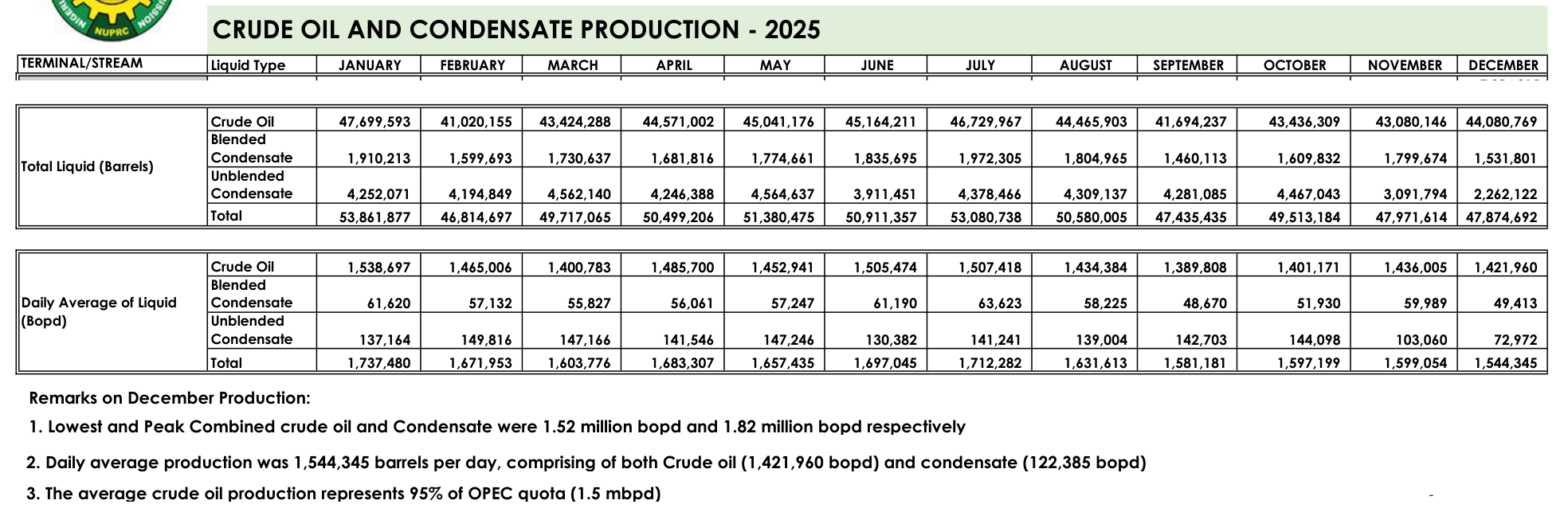
The production figure matters beyond NNPC's own results. NNPC Limited is owned on behalf of the Federation. According to the release, the results were announced after its annual general meeting and an earnings call with analysts. The release's outlook says NNPC is "targeting crude oil production of 2 million barrels per day by 2027 and 3 million barrels per day by 2030". It does not say whether the target includes condensate. If it does, the regulator's 2025 average of about 1.64 million barrels a day leaves a gap of roughly 360,000 barrels a day to the 2027 target, where a 1.77 average would make the gap look like 230,000. If the target is for crude oil alone, the regulator's 2025 table gives crude oil without condensate of 530,407,756 barrels on our sum, about 1.45 million barrels a day, and the gap is roughly 547,000. NUPRC's December remarks compare crude oil production alone with Nigeria's OPEC quota of 1.5 million barrels a day, and put that month's average at 95 per cent of it.
There are plausible explanations, and the records do not choose between them. The 1.77 figure may have been carried from the December chart, where it is a peak, into the release's sentence about the average. NNPC may have measured it on a different basis from the monthly chart, for example at the wellhead rather than at the export terminals, or over a different set of assets. Or it may come from a calculation the release does not show. The release links to NNPC's 2025 audited financial statement. Vero Record has not reviewed that document for this article, so we cannot say how its operating review states the figure. The documents establish that NNPC has published two different descriptions of the same number. They do not establish why.
Vero Record has not yet put these questions to NNPC. If NNPC responds, the article will be updated. The questions are: whether 1.77 million barrels a day is an annual average, a peak or a figure on another basis; whether it covers national production or NNPC's portfolio; how it relates to the 565.8 million barrel annual total in the same release; and whether NNPC has revised the twelve monthly averages it published in February. NUPRC has not commented on NNPC's figure. Its own published tables are quoted here as they stand.
What this rests on
NNPC press release of 29 September 2026 (read in full on nnpcgroup.com); NNPC Monthly Report Summary for December 2025, published 12 February 2026 (downloaded and read); NUPRC tables "Crude Oil and Condensate Production - 2025" and "- 2024" (archived copies of the regulator's PDFs, downloaded and read); press reports from Voice of Nigeria, ThisDay and Nairametrics for how the claim was repeated and for earlier NNPC statements (grade B); Vero Record's own sums and divisions of the published monthly figures, labelled in the text (grade C).
What this does not establish
Why the release calls 1.77 million barrels a day an average when NNPC's December summary calls it the peak; whether the 1.77 or the 565.8 million barrel figure measures national output or NNPC's portfolio, or uses wellhead rather than terminal volumes; whether NNPC's 2 million barrel 2027 target includes condensate; how NNPC's 2025 audited financial statement itself states production (not reviewed for this article); whether 2025 was the highest year in five (2021 to 2023 not checked); whether NNPC has revised its provisional monthly figures. No response from NNPC has been sought or received.
What we did ourselves
Set NNPC's 29 September claim against its own February chart, which uses the same 1.77 figure as the peak, and against the twelve monthly averages on that chart. Divided the release's own 565.8 million barrel total by 365 to show it implies 1.55 million bpd. Found that NUPRC's 2025 production table no longer loads at its original address and retrieved the archived copy. Added the regulator's twelve monthly totals for 2025 and 2024 and compared them month by month with NNPC's series. Ran the same check on the gas figures.
Sources for this report
(A) NNPC Limited press release "NNPC Delivers N7.2 Trillion Profit as Production Reaches Multi-Year Highs", 29 September 2026 (1.77 million bpd "averaged"; 565.8 million barrels total); NNPC Limited Monthly Report Summary December 2025 ("2025 Peak Production -1.77 mmbopd"; monthly averages 1.54 to 1.69); NUPRC "Crude Oil and Condensate Production - 2025" (national total 599,640,345 barrels on our sum; no month above 1,737,480 bpd).
- PRESS RELEASE: NNPC Delivers N7.2 Trillion Profit as Production Reaches Multi-Year Highs · NNPC Limited (Andy Odeh) · 2026-09-29
- NNPC Limited Monthly Report Summary December 2025 · NNPC Limited · 2026-02-12
- NNPC Limited Monthly Report Summary December 2025 (landing page) · NNPC Limited · 2026-02-12
- Crude Oil and Condensate Production - 2025 (archived copy) · Nigerian Upstream Petroleum Regulatory Commission · 2026-01
- Crude Oil and Condensate Production - 2024 (archived copy) · Nigerian Upstream Petroleum Regulatory Commission · 2025-01
- NNPC Ltd Records N7.2trn Profit, Declares N5.8trn Dividend · Voice of Nigeria · 2026-09-30
- Audited Results: NNPC Profit Rises 33% to N7.2trn, Dividends Climb to N5.8trn · ThisDay · 2026-10-01
- NNPC's sundry income hits N7.1 trillion, equivalent to 99% of annual profit · Nairametrics · 2026-09-30
- NNPC Rejects Underperformance Claims, Says Oil Output Up 6% Under Ojulari · ThisDay · 2026-08-09
- Crude oil production: No disparity between NNPC's, NUPRC's figures - NNPC official · Nairametrics · 2024-11-26
- Nigeria's oil output drops 6.3% to 1.627m bpd · Vanguard · 2026-02-18
Confidence: high. This is our own assessment of whether the event occurred as described, separate from the grade, which describes what kind of thing the claim rests on.
Not obtained: where the underlying document is named above but not linked, we did not hold a copy at the time of publication. We purchase nothing and request nothing in our own name.
Corrections
None on this report. If you find an error, it will be published here, at the same length, with the date it was found, and the original wording will remain visible above it.