Nigeria's US health memorandum sets $2.08bn against $2.98bn from Abuja and creates no legal obligations; the specimen pact signed with it is in force
Nigeria's US$5.1 billion health deal with the United States rests on at least two signed documents. The memorandum carrying US$2,078,224,000 from Washington and US$2,975,634,499 in new Nigerian spending says it creates no legal obligations. The specimen sharing agreement signed with it on 19 December 2025 has been in force since 18 January 2026 and commits Nigeria to start sharing outbreak specimens within five days of a US request. Set against the four objections Ghana's President John Mahama gave for rejecting his country's offer, the Nigerian text matches one (co-financing), reads differently from his description on two (pathogens and medicine inspection) and cannot answer the fourth, on medical records, because its data sharing annex is not in the copy.
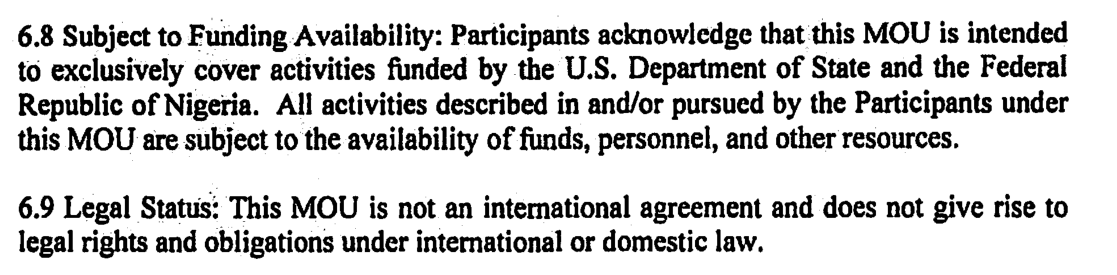
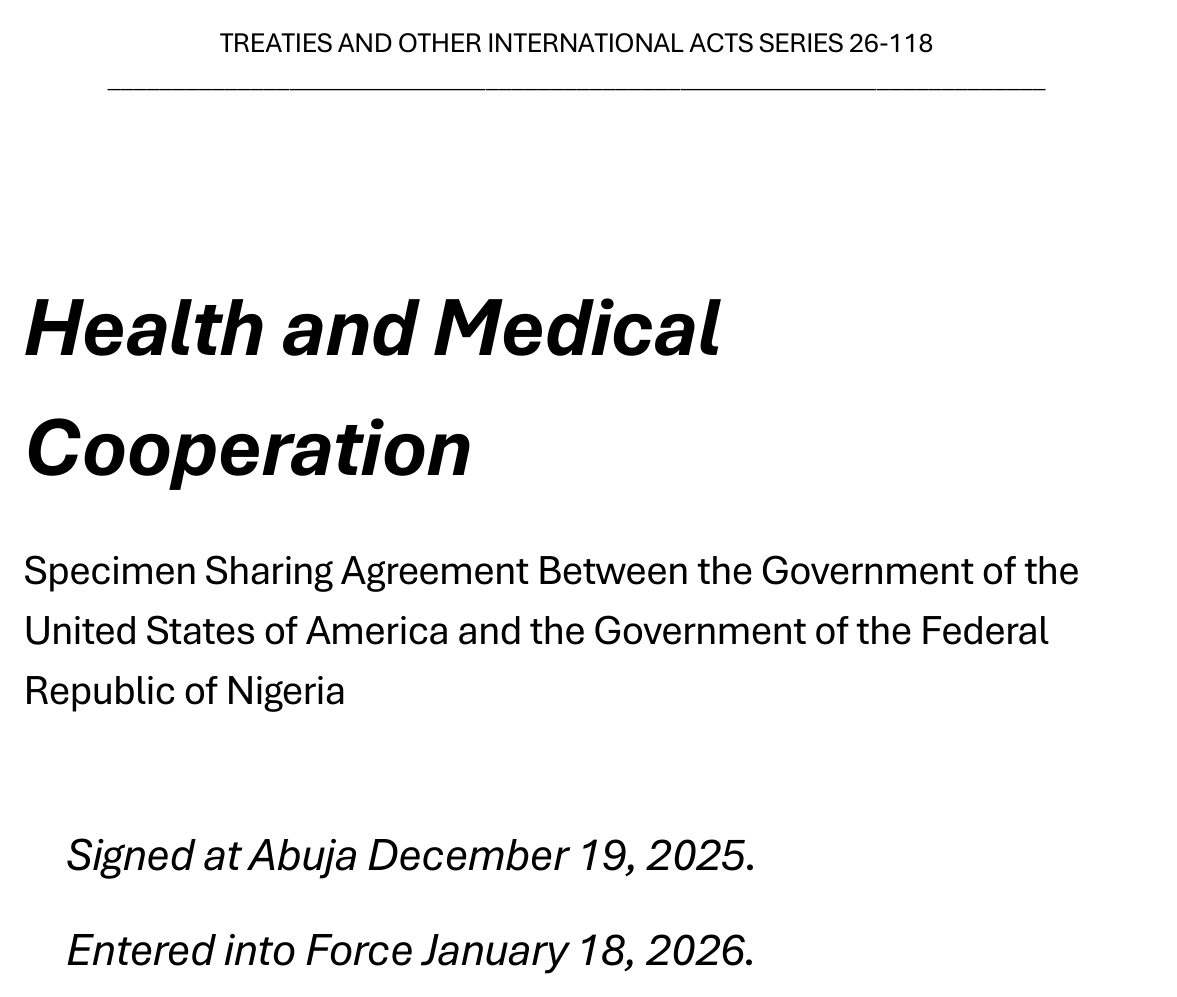
Among the documents signed in Abuja on 19 December 2025 by the United States Ambassador, Richard M. Mills Jr., and the Coordinating Minister of Health and Social Welfare, Muhammad Ali Pate, are two that Vero Record has read in full. The first is the five-year health Memorandum of Understanding that carries the money, US$2,078,224,000 planned from Washington and US$2,975,634,499 in new Nigerian health spending. Section 6.9 of that memorandum says it "is not an international agreement and does not give rise to legal rights and obligations under international or domestic law." The second is a four-page Specimen Sharing Agreement. The US State Department prints it in its Treaties and Other International Acts Series as number 26-118, "Entered into Force January 18, 2026", and under it Nigeria agreed to begin sharing specimens and related data within five days of a US request.
The deal has drawn fresh questions since Ghana's President, John Dramani Mahama, told the Council on Foreign Relations in New York on 25 September 2026 that his cabinet had thrown out a similar US offer. On 30 September the former Vice-President Atiku Abubakar asked the Federal Government to publish the full Nigerian text, including its data-sharing and specimen-sharing agreements, ThisDay reported, and Daily Trust carried a review of the agreement on 12 October. Vero Record read the 41-page signed memorandum, the specimen agreement as published by the State Department, the US Mission's fact sheet, the Federal Government's own release of 19 December 2025 and the Council on Foreign Relations transcript, and set each of Mr Mahama's objections against the Nigerian wording.
The money is set out in Appendix 1 of the memorandum, on page 32. The United States column runs US$500,719,200 in 2026, US$455,590,740 in 2027, US$402,010,740 in 2028, US$358,357,140 in 2029 and US$236,852,740 in 2030, a total of US$1,953,530,560. A note adds a 6 per cent management and operations allocation of US$124,693,440, which brings the US figure to US$2,078,224,000. Both governments' public figures fit the document: the US Mission's "nearly $2.1 billion" includes the management allocation, and the Federal Government's "nearly US$2 billion" leaves it out. The Nigerian column rises from US$344,827,586 in 2026 to US$845,426,207 in 2030. The page prints its total as US$2,975,634,499; the five yearly figures add to US$2,975,634,483, US$16 less. Together the two sides come to US$5,053,858,499, the "$5.1 billion" of the headlines.
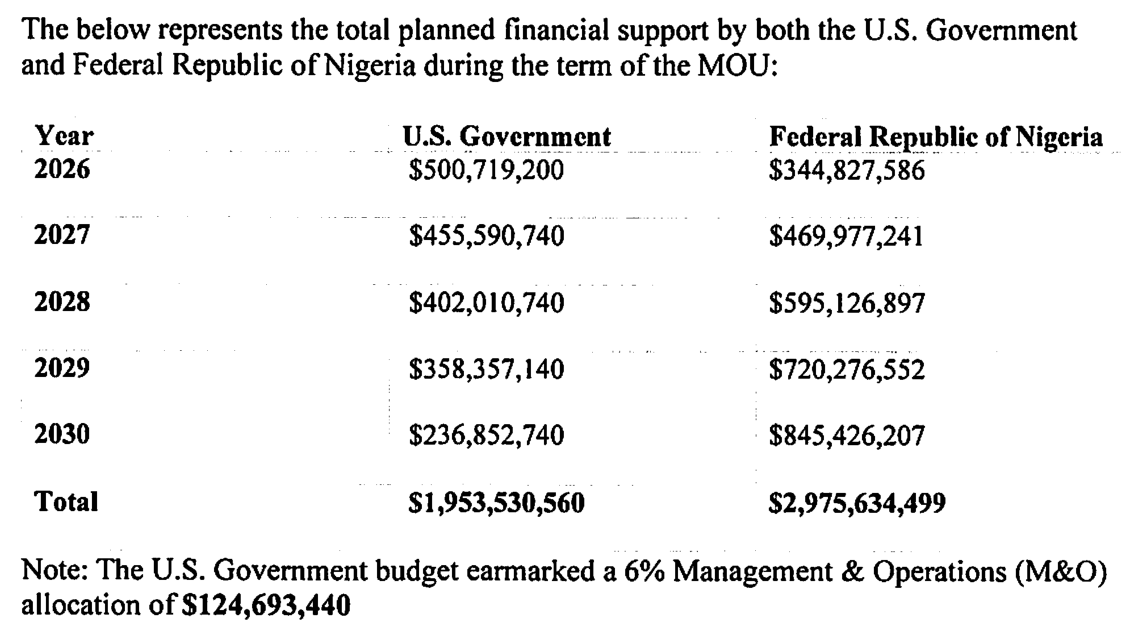
The Nigerian figures are not a lump sum handed over. Section 5.1.1 defines them as increases in domestic government health spending above the 2025 baseline, counts only money "raised directly by the Federal Republic of Nigeria, including loans", and excludes donor grants. If Nigeria falls short, the United States "may prorate its funding": the memorandum's own example is that an increase of US$720,276,552 instead of US$845,426,207 in 2030 would let US support fall from US$236 million to US$136 million. The same section gives Nigeria a reciprocal right: if the United States does not meet its commitment, Nigeria "may revise the terms of its co-investment accordingly." Activities run from 1 April 2026 to 31 December 2030. Section 2.6.2 earmarks 10 per cent, "approximately $208M", for faith-based providers, which matches 10 per cent of US$2,078,224,000, or US$207,822,400.
The specimen agreement is a separate instrument. The State Department's cover page records it as signed at Abuja on 19 December 2025 and in force from 18 January 2026, which is 30 days later, as Article 5(a) provides. It runs for five years, renewable for five more. Article 1 limits its purpose to "specimens, samples, sequencing data, and any other associated data related to novel and emerging infectious diseases with epidemic or pandemic potential", for "legitimate public health purposes, including responding to outbreaks and the development of diagnostics and medical countermeasures."
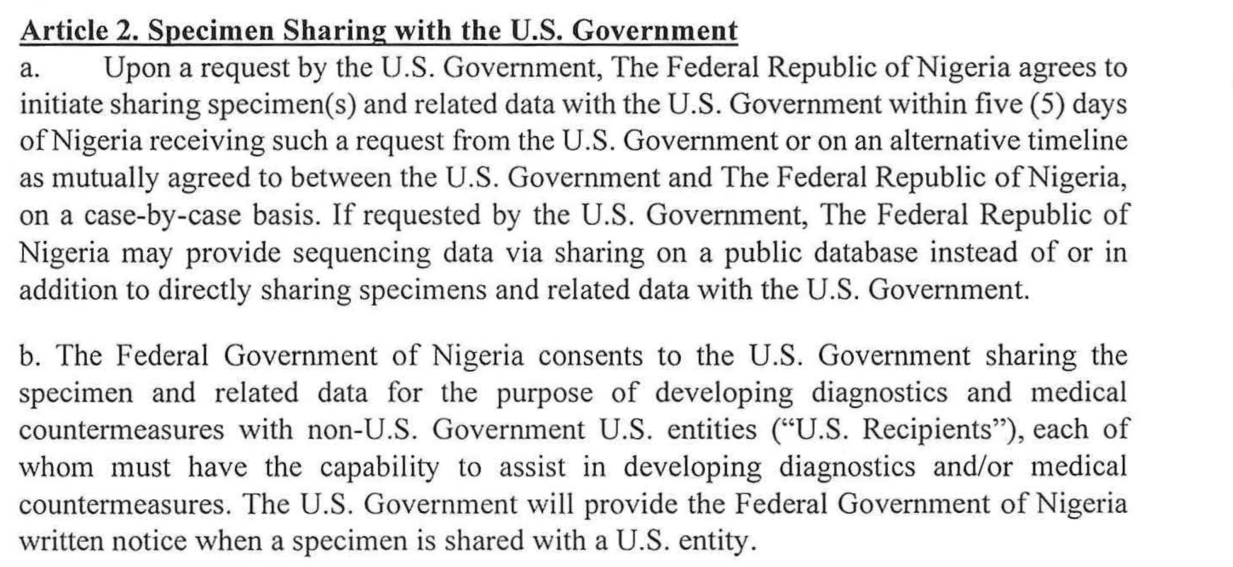
Article 2(a) commits Nigeria, "upon a request by the U.S. Government", to initiate sharing "within five (5) days" or on another timeline "as mutually agreed" case by case. Article 2(b) records Nigeria's consent to the US Government passing the specimens and data to "non-U.S. Government U.S. entities" able to develop diagnostics or countermeasures, with written notice to Nigeria each time. Article 5(b) says that if Nigeria ends the agreement, termination "shall NOT affect the use by the U.S. Government of any specimens and related data previously shared." In return, Article 3 promises priority access to any countermeasure developed primarily from Nigerian specimens, "subject to the availability of funds and applicable law", donation of such products by "reallocating U.S. foreign assistance in the MOU", acknowledgement in publications, and the sharing of relevant findings.
The two documents are tied together. Section 4.7 of the memorandum, repeated in Article 4(b) of the specimen agreement, says that while US funding continues, failure to fulfil the specimen and data sharing commitments "could result in changes in the planned assistance contemplated under this MOU and/or discontinuation of this MOU". The specimen agreement adds that the United States "shall enter into good faith consultations" with Nigeria before acting. Section 4.2 commits Nigeria to give "regulated data access, on-site access, or other information" to audit progress figures in up to 5 per cent of health facilities, clinics, labs or programmes, "in line with the Data Sharing Agreement", and Section 4.5 provides similar access to confirm that no US money is used for "the performance of abortion as a method of family planning", under the Helms Amendment.
Mr Mahama's account, in the Council's transcript, was this: "we flagged several things in the compact. One, it says that we shall give the United States our pathogen profile. It means that diseases that are endemic in Ghana... And it also says we should give our medical records. I mean, who takes another country's medical records?" He went on: "it says we would have to put up a certain amount of money as part of the program into health care, and then it also says that any medications or any medical products that shall be brought into our country our food and drugs administration has absolutely no right to inspect. I mean, it was humiliating." Cabinet rejected it, he said, and the health minister told the US Ambassador that Ghana did not need it: "We'll manage ourselves, you know, and for a pittance, a hundred and something million dollars." Reuters, citing an unnamed source, had reported on 28 April 2026 that the offer was US$109 million over five years; a State Department spokesperson said then: "We continue to look for ways to strengthen the bilateral partnership between our two countries." Vero Record has not seen the Ghanaian draft.
On pathogens, the Nigerian text is narrower on its face than the "pathogen profile" Mr Mahama described. It covers diseases "with epidemic or pandemic potential", and Section 2.1.2 of the memorandum speaks of specimens of "detected pathogens with epidemic potential as approved by the data and specimen governance committee on a case-by-case basis". It does not, in the pages read, ask for a list of the diseases endemic in Nigeria. The surveillance section that houses this commitment is mostly Nigerian money: US$4,171,000 a year from the United States, US$20,855,000 over five years, against US$238,050,759 of new Nigerian funding over the same years.
On medical records, no clause in the 41 pages read hands patient records to the United States. The memorandum commits Nigeria to roll out its own electronic health records in 20 per cent of facilities in 2026, rising to 100 per cent in 2030, and refers to a separate data sharing arrangement "for the purpose of exchanging data on the long-term performance of this MOU and for accountability to the United States Congress", to be kept "in compliance with relevant laws regarding storage of personally identifiable information". That arrangement is Appendix 5, and its page in the copy read says only "See attachment". What data it covers cannot be established from the record available.
On medicines, the memorandum says on pages 9 and 14 that, "as guided by the Mutual Recognition Framework of the NAFDAC-FDA", Nigeria "intends to depend on its Regulatory Directive on Reliance" to "accelerate the evaluation of relevant applications". Nothing in the pages read bars NAFDAC from inspecting products; Section 2.7 separately commits Nigeria to a general tax exemption on US assistance. On money, Mr Mahama's third objection does match the Nigerian text: Nigeria agreed to co-finance, and on a larger scale than the US share. The Federal Government's release presents this as the point of the deal, saying Nigeria "has committed to allocating at least six percent of executed annual Federal and State budgets to health".
Both governments explain the arrangement in their own terms. Prof. Pate, in the ministry's release, called it a partnership that "underscores our determination to build a health system that can prevent, detect, and respond to health threats". That release describes cooperation on "biosafety procedures for pathogen sample collection" and does not mention the specimen agreement signed the same day. The US Mission's fact sheet says the memorandum supports "resilient, self-reliant, and durable health systems", calls Nigeria's share "the largest co-investment any country has made to date" under the America First Global Health Strategy, and says it "was negotiated in connection with reforms undertaken by the Government of Nigeria to prioritize the protection of Christian populations from extremist violence."
The memorandum copy read is a scanned, signed text with every page marked "NOT FOR PUBLIC RELEASE", hosted by the US group Public Citizen, whose April 2026 court complaint says the State Department briefly published some of these memoranda in March 2026 and then removed them. Its figures agree with both governments' releases, and Section 6.4 says "either Participant may make this MOU itself public." The documents do not show what Ghana was actually offered, whether its draft used the same clauses, how many specimen requests the United States has made since January, or what the Data Sharing Agreement contains.
What this rests on
Memorandum of Understanding between the Government of the United States of America and the Government of the Federal Republic of Nigeria on health cooperation, 19 December 2025 (signed scan, 41 pp.): Appendix 1 p.32; US yearly breakdown p.33; Sections 2.1.2-2.1.3 pp.8-9; 2.3.2 p.14; 2.5.2-2.5.3 pp.18-19; 2.6.2 p.24; 2.7 p.25; 4.2-4.7 pp.26-27; 5.1-5.1.1 pp.28-29; 6.1, 6.4 p.30; 6.9 p.31; Appendix 5 p.41. Specimen Sharing Agreement, TIAS 26-118 (State Department PDF): cover p.1; Articles 1-2 p.3 (agreement p.1); Articles 3-4 p.4; Article 5 p.5. Sums: US 500,719,200 + 455,590,740 + 402,010,740 + 358,357,140 + 236,852,740 = 1,953,530,560 (matches printed total). 1,953,530,560 + 124,693,440 (M&O) = 2,078,224,000; 124,693,440 / 2,078,224,000 = 6.0 per cent exactly. Each US year re-added from p.33 categories: 2026: 4,171,000 + 70,312,145 + 4,447,069 + 133,188,061 + 23,600,000 + 60,000,000 + 205,000,925 = 500,719,200; 2027: 4,171,000 + 57,688,940 + 2,335,302 + 88,948,866 + 12,000,000 + 49,000,000 + 241,446,632 = 455,590,740; 2028: 4,171,000 + 31,611,794 + 1,223,535 + 85,038,295 + 11,800,000 + 42,000,000 + 226,166,116 = 402,010,740; 2029: 4,171,000 + 21,992,148 + 1,611,768 + 84,562,080 + 5,900,000 + 23,000,000 + 217,120,144 = 358,357,140; 2030: 4,171,000 + 19,633,990 + 1,500,000 + 50,405,150 + 5,700,000 + 22,000,000 + 133,442,600 = 236,852,740. All match. Nigeria 344,827,586 + 469,977,241 + 595,126,897 + 720,276,552 + 845,426,207 = 2,975,634,483; printed total 2,975,634,499; difference 16. Steps between years are 125,149,655 or 125,149,656 each year. Combined: 2,078,224,000 + 2,975,634,499 = 5,053,858,499 (about 5.1 billion); without M&O 1,953,530,560 + 2,975,634,499 = 4,929,165,059. Faith-based: 10 per cent of 2,078,224,000 = 207,822,400 (MOU: approximately $208M; fact sheet: approximately $200 million). Surveillance (Section 2.1.3): US 4,171,000 x 5 = 20,855,000; Nigeria 27,586,207 + 37,598,179 + 47,610,152 + 57,622,124 + 67,634,097 = 238,050,759. Proration example (p.29): 236,852,740 planned for 2030; at 720,276,552 increase, 236 to 136 million (a 100 million fall). Days: 19 December 2025 to 18 January 2026 = 12 days left in December + 18 in January = 30 days, as Article 5(a) requires. 2026 commodity appendix p.37: 49,820,490 + 14,638,788 + 5,852,867 = 70,312,145; 62,838,947.46 + 67,054,949 + 3,294,165 = 133,188,061.46 (printed 133,188,061). Ghana: Mahama's words from the CFR transcript of 25 September 2026; US$109 million is Reuters' figure from an unnamed source, not a document; ratio 2,078,224,000 / 109,000,000 = 19.1 not used in the text because the Ghana figure is unverified.
What this does not establish
What Ghana was offered and in what words: Vero Record has not seen the Ghanaian draft, so whether its clauses on pathogens, records and the Food and Drugs Authority differ from Nigeria's cannot be established; the US$109 million figure rests on an unnamed Reuters source and Mr Mahama's "a hundred and something million". The content of the Data Sharing Agreement (Appendix 5), which is not in the copy read, and therefore whether any patient-level data is covered. The text of NAFDAC's Regulatory Directive on Reliance and the NAFDAC-FDA Mutual Recognition Framework, which the memorandum cites but which were not read. Whether the United States has made any specimen requests since 18 January 2026, or shared any Nigerian specimens with US entities. Whether Nigeria has met its 2026 co-investment of US$344,827,586 or the United States its 2026 figure of US$500,719,200; no implementation or disbursement record was read. Whether the memorandum copy hosted by Public Citizen is the final version on file in Abuja; its figures agree with both governments' releases. Why the Nigerian total is printed US$16 above the sum of its five years.
What we did ourselves
Downloaded the signed memorandum and the State Department's treaty-series copy of the specimen agreement and read both in full. Re-added the US and Nigerian columns of Appendix 1 and every US year from its categories on page 33, found the Nigerian total printed US$16 above its parts, and reconciled the US Mission's "nearly $2.1 billion" with the Federal Government's "nearly US$2 billion" through the 6 per cent management allocation. Counted the 30 days from signature to entry into force. Took Mr Mahama's words from the Council on Foreign Relations transcript rather than from reports, and set each of his four objections against the clause in the Nigerian text that deals with the same subject.
Sources for this report
(A) Memorandum of Understanding between the Government of the United States of America and the Government of the Federal Republic of Nigeria on Health Cooperation, signed at Abuja 19 December 2025 (41 pp.); Specimen Sharing Agreement between the two governments, signed 19 December 2025, in force 18 January 2026, Treaties and Other International Acts Series 26-118 (US Department of State); US Mission Nigeria fact sheet of 21 December 2025; Federal Government press release of 19 December 2025; Council on Foreign Relations transcript, A Conversation With President John Dramani Mahama of Ghana, 25 September 2026.
- Memorandum of Understanding between the Government of the United States of America and the Government of the Federal Republic of Nigeria on Health Cooperation (signed scan) · US Department of State and Federal Republic of Nigeria (copy hosted by Public Citizen) · 19 December 2025
- Health and Medical Cooperation: Specimen Sharing Agreement, TIAS 26-118 · US Department of State · 19 December 2025 (in force 18 January 2026)
- Strengthening U.S.-Nigerian Health Cooperation under the America First Global Health Strategy · US Mission Nigeria · 21 December 2025
- Nigeria And United States Sign Landmark Agreement To Strengthen Health Security, Expand Primary Care, And Drive Self-Reliance · Federal Ministry of Health and Social Welfare (published by the Federal Ministry of Information and National Orientation) · 19 December 2025
- A Conversation With President John Dramani Mahama of Ghana (transcript) · Council on Foreign Relations · 25 September 2026
- Public Citizen v. U.S. Department of State, complaint, Case 1:26-cv-01137 · Public Citizen · 2 April 2026
- Nigeria-U.S. Health Deal Under Scrutiny · Daily Trust · 12 October 2026
- Atiku to Tinubu: Publish Details of Nigeria's $5bn Health Deal with US · ThisDay · 30 September 2026
- Ghana rejects proposed US health aid deal, citing data concerns, source says · Reuters via Graphic Online · 28 April 2026
- It was humiliating: who takes another country's medical records? Mahama on Ghana's rejection of US health compact · MyJoyOnline · 28 September 2026
Confidence: high. This is our own assessment of whether the event occurred as described, separate from the grade, which describes what kind of thing the claim rests on.
Not obtained: where the underlying document is named above but not linked, we did not hold a copy at the time of publication. We purchase nothing and request nothing in our own name.
Corrections
None on this report. If you find an error, it will be published here, at the same length, with the date it was found, and the original wording will remain visible above it.
Dr VeroInvestigations editor, Vero Record
Reads the Nigerian public record that others leave unread: budgets, audit reports, court files and registers. Every claim on this page carries the grade of the document behind it, and the report says what that document does not establish.
All 112 reportsHow we grade evidenceAdd Vero Record as a preferred source on Google