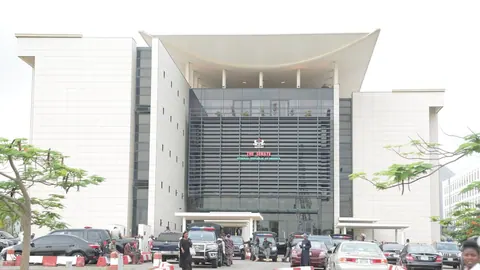
Wike asked INEC to sanction Amaechi. Electoral Act section 96 sets N5m or 12 months for a candidate, but only a court can impose it
On 9 October Nyesom Wike called on INEC to sanction Rotimi Amaechi, the ADC vice-presidential candidate, over remarks about voters at a Benin City town hall. Vero Record read the Electoral Act 2026 against INEC's final list of candidates, the 2022 Act and the parties' Code of Conduct. Abusive campaign language is an offence for a candidate, with a maximum fine of N5,000,000 or 12 months in prison, five times the 2022 fine. The penalty applies only on conviction in court, with INEC as prosecutor. The Act gives INEC no power to fine or disqualify a candidate by its own decision.
On Friday, 9 October 2026, the Minister of the Federal Capital Territory, Nyesom Wike, called on the Independent National Electoral Commission (INEC) to sanction Rotimi Amaechi, the vice-presidential candidate of the African Democratic Congress (ADC), over remarks Mr Amaechi made at an ADC town hall in Benin City the day before. Vero Record read the Electoral Act 2026 to see what INEC can actually do. The Act makes abusive campaign language an offence for a candidate, punishable by a maximum fine of N5,000,000 or 12 months' imprisonment, five times the fine set in the 2022 Act. But that penalty applies only "on conviction" in a Magistrate Court or a High Court. The Act gives INEC no power to impose it by its own decision. INEC's role under the Act is to prosecute.
The remark at the centre of the dispute was reported by Vanguard on 8 October. The paper said Mr Amaechi, speaking at the ADC town hall in Edo State that Thursday, described the removal of the petrol subsidy as "reckless" and said: "It is only a madman that can vote for Tinubu." Vero Record did not hear the remarks and relies on the press account for the wording.
Mr Wike's call was reported by the News Agency of Nigeria (NAN) on 9 October. NAN said he spoke to reporters in Abuja after a meeting with FCT area council chairmen and heads of security agencies, and described Mr Amaechi's utterances as "irresponsible and inciting". It quoted him as saying: "Up till now, I have not heard that INEC has been able to call the attention of Amaechi." He added: "Many Nigerians have called on INEC to sanction political parties, candidates or some politicians who, in their campaigns, incite the public or raise matters that are not issue-based."
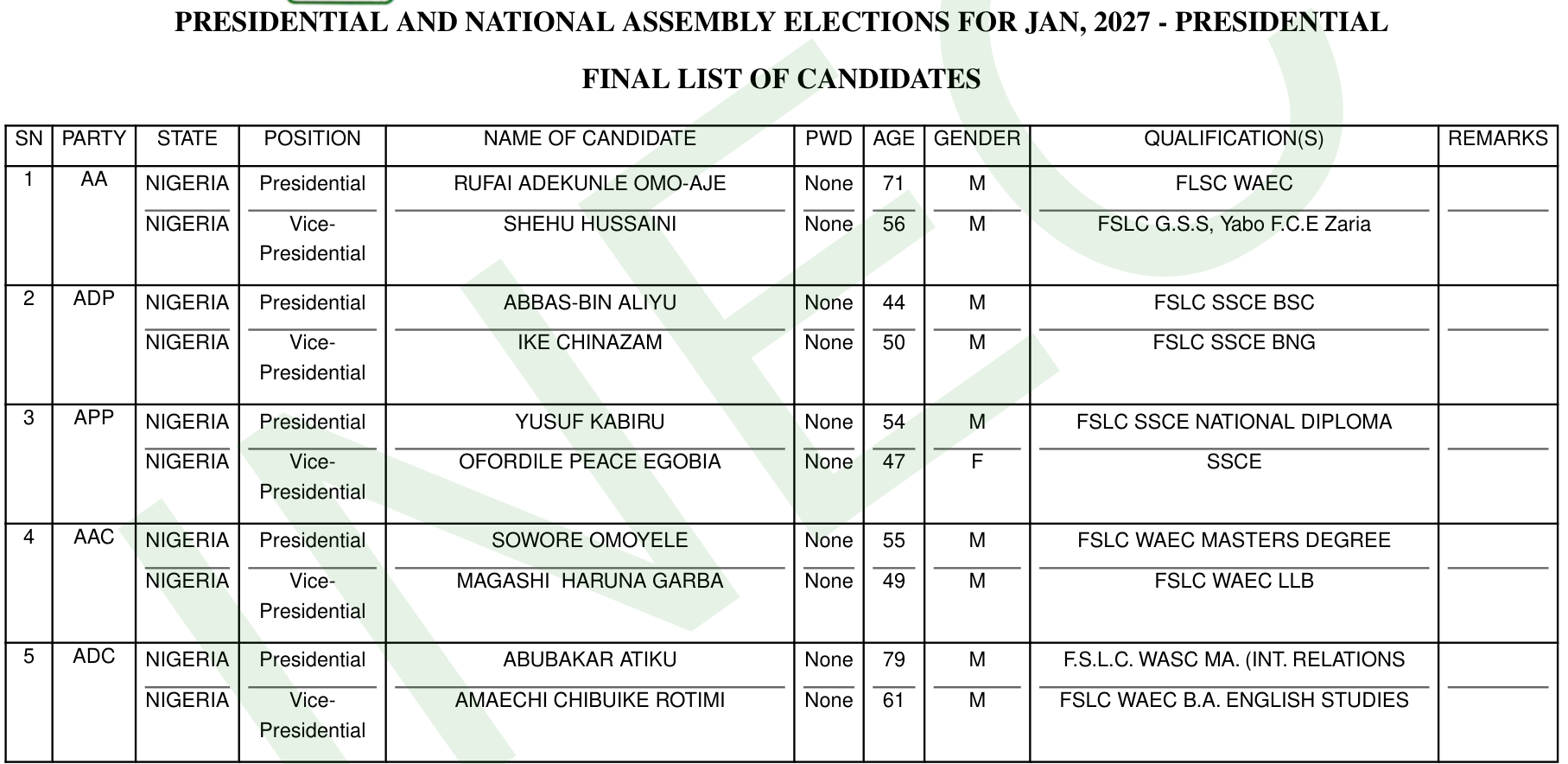
The first question is whether the Act's campaign rules reach Mr Amaechi at all. They do. INEC's final list of candidates for the January 2027 presidential election, signed by Rose Oriaran-Anthony as Secretary, INEC, shows the ADC at row 5, with Abubakar Atiku as presidential candidate and "AMAECHI CHIBUIKE ROTIMI", aged 61, as vice-presidential candidate. The Act, on page 70, defines a candidate as "a person who has secured the nomination of a political party to contest an election for any elective office". The remarks also fell inside the campaign period. Under section 98(1), public campaigning opens 150 days before polling day, which for the 16 January 2027 polls on INEC's calendar was 19 August 2026. The town hall on 8 October took place 50 days after that date.
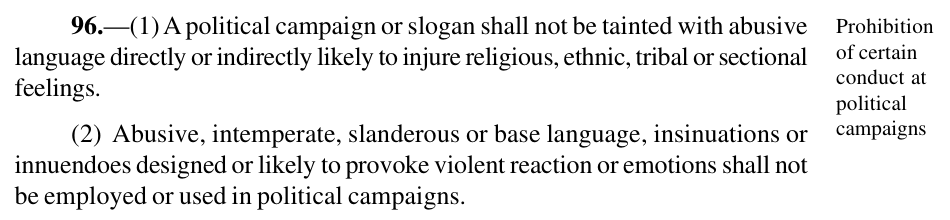
The provision in play is section 96, headed "Prohibition of certain conduct at political campaigns", on page 43. Subsection (1) says a campaign or slogan "shall not be tainted with abusive language directly or indirectly likely to injure religious, ethnic, tribal or sectional feelings". Subsection (2) says: "Abusive, intemperate, slanderous or base language, insinuations or innuendoes designed or likely to provoke violent reaction or emotions shall not be employed or used in political campaigns." The Act does not define "abusive", "intemperate" or "base". Whether a particular remark meets either test is a matter for a court. No court has considered Mr Amaechi's words, and nothing in this report suggests what a court would find.
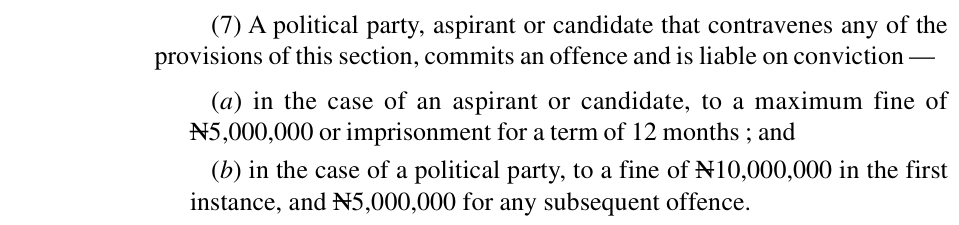
The penalty is in section 96(7), on page 44. A party, aspirant or candidate that contravenes any part of the section "commits an offence and is liable on conviction": an aspirant or candidate "to a maximum fine of N5,000,000 or imprisonment for a term of 12 months", and a party to a fine of N10,000,000 for a first offence and N5,000,000 for any later one. The 2022 Act it replaced carried the same rule in section 92, in nearly identical words, with lower fines: section 92(7), on page A393 of that Act, set N1,000,000 or 12 months for a candidate, and N2,000,000 then N1,000,000 for a party. Each fine was multiplied by five in 2026. The prison term did not change.
Who enforces it is set out in section 148, on page 68. An offence under the Act "shall be triable in a Magistrate Court or a High Court of a State in which the offence is committed, or the Federal Capital Territory, Abuja", and "A prosecution under this Act shall be undertaken by legal officers of the Commission or any legal practitioner appointed by it." On the record, then, Mr Wike addressed his call to the body the Act names as prosecutor. What the Act does not do is let INEC fine or punish anyone without a court.

INEC does hold some powers of its own, but they run to parties rather than to candidates personally. Section 83(2), on page 37, lets the Commission "seek information or clarification from any registered political party in connection with any activity of the political party which may be contrary to the provisions of the Constitution or any other law", an enquiry section 83(3) lets it direct to the party's chairman or secretary. A party that fails to answer or to carry out a lawful directive "is liable to a fine not more than N1,000,000" under section 83(4). Section 99(1) requires candidates and parties to campaign under rules set by INEC, and the Constitution's Third Schedule, paragraph 15(f), gives INEC power to "monitor political campaigns and provide rules and regulations which shall govern the political parties". A search of the 2026 Act for "sanction" and "disqualif" finds no clause letting INEC itself fine, suspend or disqualify a candidate over campaign speech: the word "sanction" appears only in clauses on disobeying court orders and on office holders pending appeal.
The Code of Conduct for Political Parties does not change that picture. The version on INEC's website asks every party to "avoid defamatory, derogatory and insulting attacks on rival parties or individual personalities", and describes itself as rules "to which the Parties ideally will voluntarily agree; and which may subsequent to that agreement be incorporated in law". The fuller 2013 Code, dated 16 July 2013 and once hosted by INEC, bars "inflammatory language" in campaigns. Its enforcement route runs through the Inter-Party Advisory Council (IPAC): a complaint goes first to the offending party, then to IPAC, which "is empowered to recommend to INEC appropriate sanctions on erring political party". That is a recommendation about a party, not a penalty on a candidate.
Earlier campaigns offer a comparison, though not a precedent. INEC's own Report of the 2019 General Election, on pages 92 and 93, says the campaign environment "was muddied, characterised by violent clashes, disruptions and mudslinging between the candidates and supporters of contending political parties", and notes the use of social media "to propagate fake news and hate speech". The report's section on campaigns does not mention any prosecution for campaign language. Vero Record did not find, in the documents read for this report, a recorded conviction under the abusive-language clause of either the 2022 or the 2026 Act. That does not establish that none exists.
The same Act also speaks to part of Mr Wike's own statement. NAN quoted him as saying of Mr Amaechi: "If he continues along this line, it will be difficult for him to campaign in Rivers. We will make it difficult for him." Section 95(4), on page 43, which carries no penalty of its own, provides that a party, aspirant or candidate "shall not be prevented from holding rallies, processions or meetings at any time for their constitutional political purposes". Mr Wike did not say what he meant, and the documents do not establish that any step has been or will be taken.
Vero Record did not put questions to Mr Amaechi, the ADC, Mr Wike or INEC for this report. In the reports checked before publication, no reply from Mr Amaechi or the ADC to Mr Wike's call, and no INEC statement on it, had appeared. What the documents establish is narrow: the law treats abusive campaign language as a matter for the criminal courts, with INEC as prosecutor and a maximum of N5,000,000 or 12 months for a candidate. They do not give INEC a power to punish a candidate by its own decision, and they do not establish that Mr Amaechi broke the law.
What this rests on
Electoral Act 2026: s.96(1) and (2), p.43 (abusive language rule); s.96(7), p.44 (candidate: maximum N5,000,000 or 12 months; party: N10,000,000 first, N5,000,000 later); s.148, p.68 (trial in a Magistrate or High Court; prosecution by INEC's legal officers or a practitioner it appoints); s.83(2) to (4), pp.37 to 38 (INEC may query a party; party liable to a fine not more than N1,000,000); s.95(4), p.43; s.98(1), p.44; s.99(1), p.45; definition of candidate, p.70. Electoral Act 2022 s.92(7), p.A393: N1,000,000 or 12 months; party N2,000,000 then N1,000,000. Ratios: 5,000,000 / 1,000,000 = 5; 10,000,000 / 2,000,000 = 5; 5,000,000 / 1,000,000 = 5. Prison term 12 months in both. INEC final list, presidential, p.1, row 5: ADC, Abubakar Atiku (Presidential), Amaechi Chibuike Rotimi (Vice-Presidential, 61). Campaign window: 19 August 2026 is 150 days before 16 January 2027 (12 + 30 + 31 + 30 + 31 + 16 = 150); 19 August to 8 October = 12 days to 31 August + 30 in September + 8 in October = 50 days. 8 October 2026 was a Thursday, 9 October a Friday. Constitution, Third Schedule Part I, para 15(f) (Ministry of Justice copy, p.143). Code of Conduct (INEC preamble version) paras 6 and 22; 2013 Code, Campaign Issues para 7 and Commitments paras 3 and 4. INEC Report of the 2019 General Election pp.92 to 93. Quotations of Mr Amaechi from Vanguard (8 October 2026); of Mr Wike from NAN (9 October 2026).
What this does not establish
Vero Record did not hear Mr Amaechi's or Mr Wike's remarks; their wording rests on Vanguard and NAN. The documents do not establish that Mr Amaechi's words meet the test in section 96(1) or (2); only a court can decide that, and none has. Whether any prosecutor other than INEC could bring a charge under the Act, for example under the Attorney-General's constitutional powers, was not tested. Any campaign rules or regulations INEC has made under section 99(1) for 2027 were not retrieved. Whether a Code of Conduct later than the 2013 version is in force, and whether the ADC signed one, was not established; the 2013 Code was read from a Wayback Machine copy of INEC's file of 15 August 2026, because INEC's link now returns an error. The absence of any recorded conviction under the abusive-language clause rests only on the documents read for this report. Mr Amaechi, the ADC, Mr Wike and INEC were not contacted for this report.
What we did ourselves
Read section 96 of the Electoral Act 2026 and its penalty clause against section 92 of the 2022 Act and computed the change in each fine; checked Mr Amaechi's status against INEC's final list and the Act's definition of candidate; counted the days from the opening of the campaign window to the town hall; searched the Act's text for any INEC power to sanction a candidate; set the Act against the Constitution's grant of powers to INEC, the parties' Code of Conduct and INEC's 2019 election report; applied the same Act to both men's reported statements.
Sources for this report
(A) Electoral Act 2026, sections 83, 95, 96, 98, 99, 148 and interpretation (INEC copy); INEC, Presidential and National Assembly Elections for Jan, 2027: Presidential Final List of Candidates; Electoral Act 2022, section 92; Constitution of the Federal Republic of Nigeria 1999, Third Schedule, Part I, para 15; Code of Conduct for Political Parties (INEC preamble version and 2013 Code); INEC Report of the 2019 General Election, pp.92 to 93.
- Electoral Act 2026 · National Assembly (INEC copy) · 2026
- Presidential and National Assembly Elections for Jan, 2027: Presidential Final List of Candidates · INEC · 2026
- Full Election Calendar and Timetable · INEC · 2026-10-04
- Electoral Act 2022 · National Assembly (INEC copy) · 2022
- Constitution of the Federal Republic of Nigeria 1999, Third Schedule, Part I, para 15 · Federal Ministry of Justice
- Code of Conduct for Political Parties: Preamble · INEC (Wayback Machine copy, 15 August 2026)
- Political Parties Code of Conduct 2013 · Registered political parties, hosted by INEC (Wayback Machine copy, 15 August 2026) · 2013-07-16
- Report of the 2019 General Election · INEC · 2019
- Only a madman will vote for Tinubu in 2027, Amaechi · Vanguard · 2026-10-08
- 2027: Wike urges INEC to sanction Amaechi over inciting, inflammatory remarks · News Agency of Nigeria · 2026-10-09
- File:Ring Road Benin City.jpg · Wikimedia Commons (Omorodion1, CC BY-SA 4.0) · 2021-09-29
Confidence: high. This is our own assessment of whether the event occurred as described, separate from the grade, which describes what kind of thing the claim rests on.
Not obtained: where the underlying document is named above but not linked, we did not hold a copy at the time of publication. We purchase nothing and request nothing in our own name.
Corrections
None on this report. If you find an error, it will be published here, at the same length, with the date it was found, and the original wording will remain visible above it.

Dr VeroInvestigations editor, Vero Record
Reads the Nigerian public record that others leave unread: budgets, audit reports, court files and registers. Every claim on this page carries the grade of the document behind it, and the report says what that document does not establish.
All 105 reportsHow we grade evidenceAdd Vero Record as a preferred source on Google