Kingibe says tax will take 25% of everything Nigerians earn. The Nigeria Tax Act, in force since 1 January, charges 25% only above N50m
Senator Ireti Kingibe, the ADC candidate for the FCT, told voters tax will rise to "25 per cent of everything you earn" under a law passed but not implemented. The Nigeria Tax Act's own schedule taxes the first N800,000 at nothing, charges 25 per cent only above N50 million, exempts minimum wage earners and took effect on 1 January.

Senator Ireti Kingibe told voters in a video reported on Sunday that tax "will soon be increased to 25 per cent of everything you earn", that the National Assembly had already passed it, and that "they are scared to implement it". The law she was describing is the Nigeria Tax Act, 2025. Vero Record read the certified copy released by the National Assembly. It charges 25 per cent only on the part of a person's taxable income above N50 million a year, it exempts minimum wage earners, and it has been in force since 1 January.
Kingibe represents the Federal Capital Territory in the Senate and is seeking re-election on 16 January on the ticket of the African Democratic Congress; INEC's final list of Senate candidates names her as the ADC candidate for the territory. In the video, reported by Sunday Punch on 25 October, she spoke in Pidgin English and urged her constituents not to vote for the All Progressives Congress. "And what I am telling you, it has been passed. We have passed it in the National Assembly, but they are scared to implement it," she said, in the newspaper's English rendering.
The rates are in the Act's Fourth Schedule, which section 58 applies to individuals. After reliefs and exemptions, taxable income is charged in six bands: the first N800,000 at 0 per cent, the next N2,200,000 at 15 per cent, the next N9,000,000 at 18 per cent, the next N13,000,000 at 21 per cent, the next N25,000,000 at 23 per cent, and income "Above N50,000,000 at 25%". The first five bands add up to exactly N50 million.
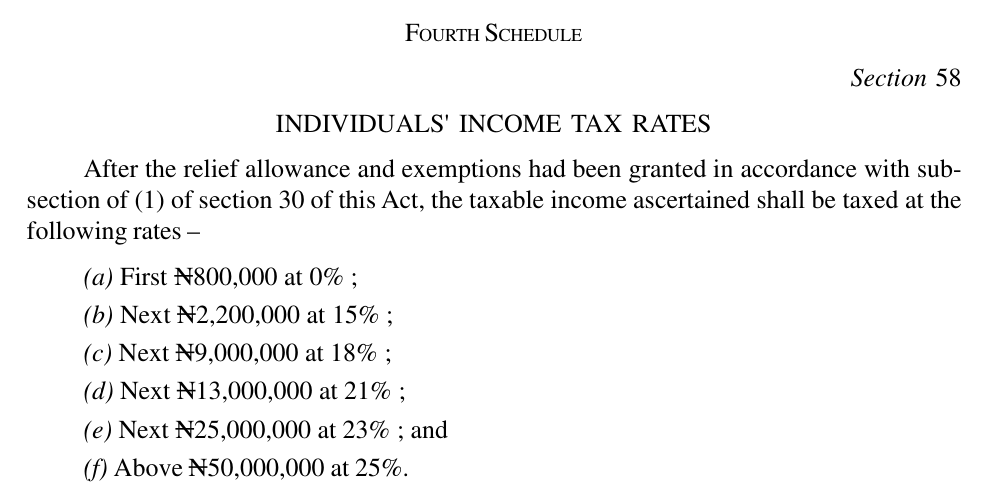
Because each rate applies only to the slice of income inside its band, no one's bill reaches 25 per cent of what they earn. On the schedule's own figures, a person with N3 million of taxable income a year owes N330,000, or 11 per cent. At N12 million the bill is N1,950,000, or 16.25 per cent. At N50 million it is N10,430,000, or 20.86 per cent, and at N100 million it is N22,930,000, or 22.93 per cent. Even at N1 billion it is N247,930,000, or 24.79 per cent. The share comes closer to 25 per cent as income rises, but never reaches it.
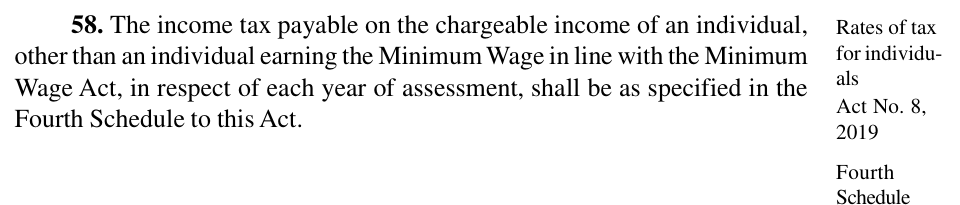
Section 58 also takes one group out of the schedule altogether. It applies the rates to the chargeable income of "an individual, other than an individual earning the Minimum Wage in line with the Minimum Wage Act". On the Act's wording, a worker on the minimum wage is outside the rate schedule altogether. The Presidential Fiscal Policy and Tax Reforms Committee says the same in a notice on its website listing reliefs that apply "From 1 January 2026", and adds that annual gross income up to N1,200,000, "translating to about N800,000 taxable income", is exempt.
The second part of the claim, that the law has been passed but is being held back, is also contradicted by the document. The Act prints its commencement date directly under its long title: "[1st January, 2026]". By 27 October it had been in force for 300 days. The State House announced on 26 June 2025 that President Bola Tinubu had signed it into law with three other tax bills.
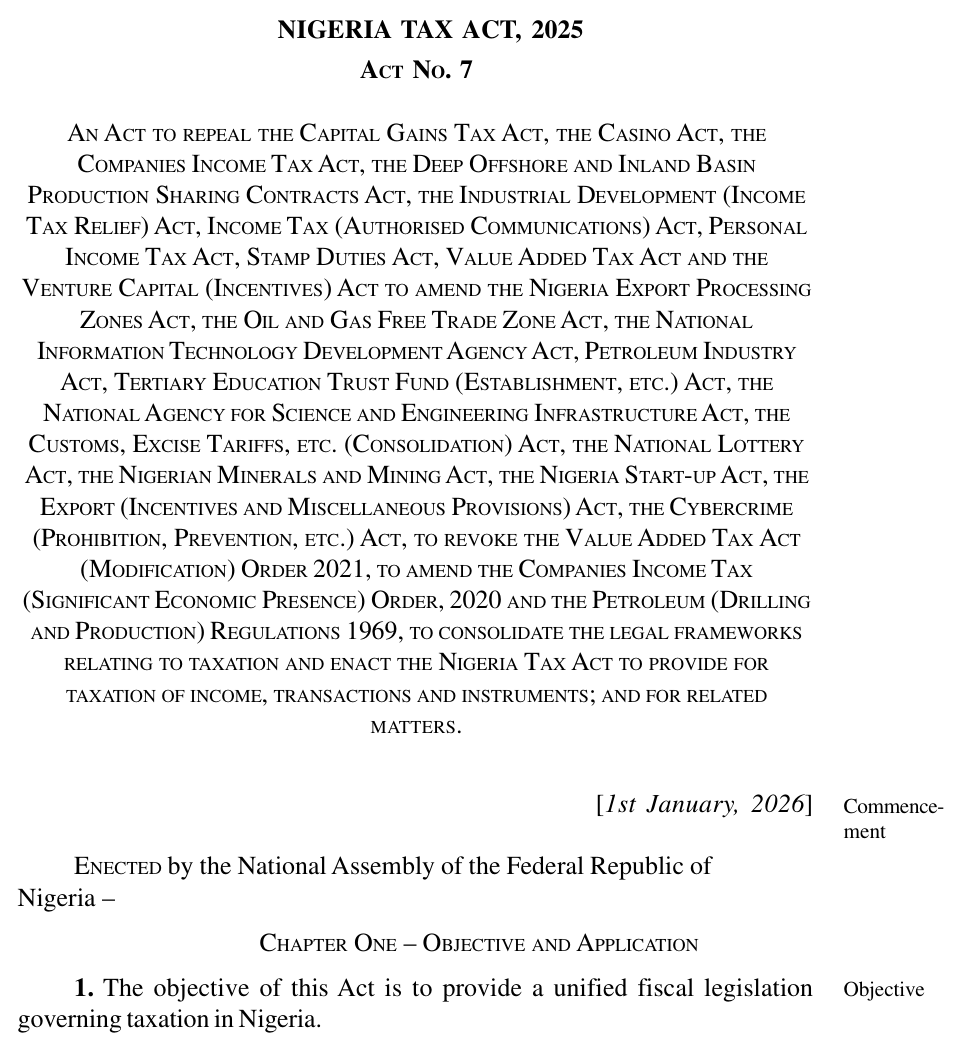
The record supports the senator on two points. The National Assembly did pass the law: the schedule at the end of the Act records the Nigeria Tax Bill as passed by the Senate and by the House of Representatives on 28 May 2025, the Clerk to the National Assembly certified it on 11 June 2025, and the President's assent is dated 26 June 2025. And 25 per cent is a real rate in the Act. It is the top band. What the Act does not do is apply that rate to everything a person earns.
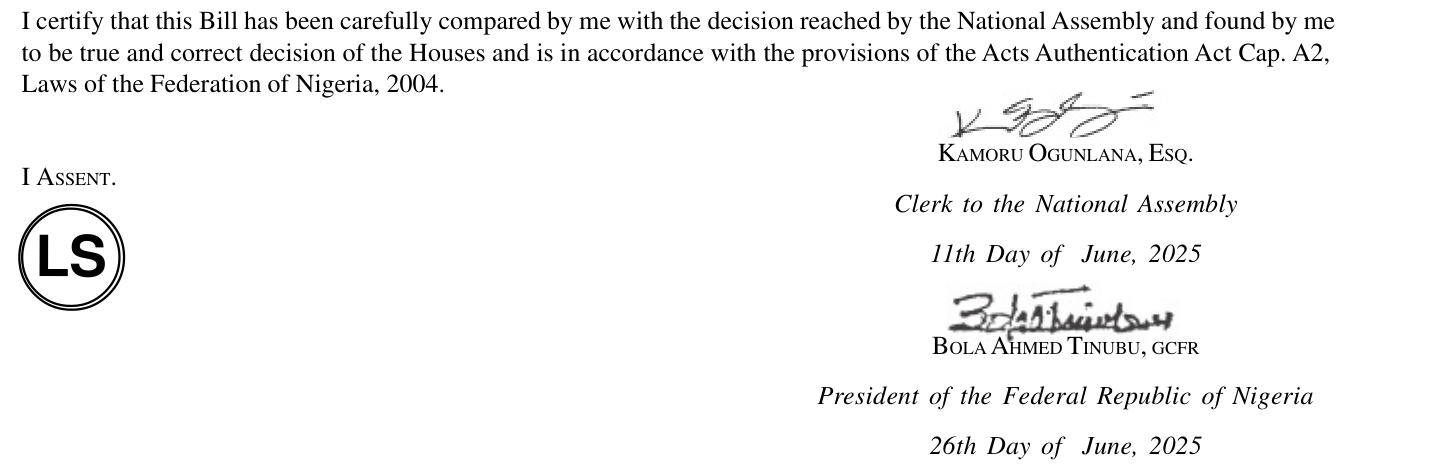
The Senate has already answered her. Its spokesman, Senator Yemi Adaramodu, chairman of the Committee on Media and Public Affairs, told Sunday Punch that "anybody bringing anything back from the tax reform or law is just becoming a revisionist" and that "It became law over a year ago." The documents support him on the date: the assent of 26 June 2025 came 486 days before his comments were published on 25 October. Sunday Punch and FactCheckAfrica, which both reported the video on 25 October, also pointed to the Fourth Schedule.
The figures above are for taxable income. Section 30 of the Act lets an individual deduct, among other things, pension, health insurance and National Housing Fund contributions and a rent relief of 20 per cent of annual rent paid, up to N500,000, before the bands are applied. How much of a person's gross pay is taxable depends on those deductions, so the percentages here describe the tax on a given taxable income, not anyone's whole payslip.
The claim reached voters 83 days before the 16 January polls, and Kingibe tied it to hardship: "How do you expect people to manage?" she asked in the same video, as rendered by Sunday Punch. Income tax on pay reaches most salaried workers directly, and the Act's bands decide how much of each payslip goes to it.
In January, after a lawmaker alleged that the gazetted tax laws differed from those the Assembly had passed, the National Assembly released certified true copies. Vero Record used the certified copy of the Nigeria Tax Act released then; we did not compare it line by line with the gazette. The documents do not establish what Kingibe had in mind; she may have been referring to the top rate. Nothing here suggests any wrongdoing by anyone.
We invite a response from Senator Ireti Kingibe on which provision of the Nigeria Tax Act charges 25 per cent of everything a person earns, and on what basis she says the law has not been implemented. We will publish any reply in full.
What this rests on
Grade A, downloaded and read in full where cited (copies in src): (1) Nigeria Tax Act, 2025 (Act No. 7), Final Approved Copy for Print released by the National Assembly in January 2026 (215-page PDF, gazette pagination A385 to A598): long title p. A395 (PDF p. 11) with commencement "[1st January, 2026]"; section 58, p. A429 (PDF p. 45), rates apply to "an individual, other than an individual earning the Minimum Wage in line with the Minimum Wage Act"; section 30(2)(a), p. A416 (PDF p. 32), eligible deductions incl. rent relief 20% of annual rent up to N500,000; Fourth Schedule, p. A540 (PDF p. 156), bands N800,000 at 0%, N2,200,000 at 15%, N9,000,000 at 18%, N13,000,000 at 21%, N25,000,000 at 23%, above N50,000,000 at 25%; schedule to the Bill, p. A597 (PDF p. 213), passed by Senate and House 28th May, 2025; certification and assent, pp. A596 and A598 (PDF pp. 212, 214), Clerk Kamoru Ogunlana 11 June 2025, President Bola Ahmed Tinubu 26 June 2025. (2) Presidential Fiscal Policy and Tax Reforms Committee, "Fifty (50) tax exemptions and reliefs...effective from 1 January 2026" (fiscalreforms.ng): minimum wage earners exempt; gross income up to N1,200,000 (about N800,000 taxable) exempt. (3) State House release, 26 June 2025: Tinubu signed the four tax bills. (4) INEC Final List of Candidates, Senate, p. 48: entry 6, FCT, Ireti Heebah Kingibe, ADC, 72. Arithmetic: bands 800,000 + 2,200,000 + 9,000,000 + 13,000,000 + 25,000,000 = 50,000,000. Tax on N3,000,000 = 0 + 2,200,000 x 15% = 330,000 (11.00%). On N12,000,000 = 330,000 + 9,000,000 x 18% (1,620,000) = 1,950,000 (16.25%). On N50,000,000 = 1,950,000 + 13,000,000 x 21% (2,730,000) + 25,000,000 x 23% (5,750,000) = 10,430,000 (20.86%). On N100,000,000 = 10,430,000 + 50,000,000 x 25% (12,500,000) = 22,930,000 (22.93%). On N1,000,000,000 = 10,430,000 + 950,000,000 x 25% (237,500,000) = 247,930,000 (24.79%). Days: 1 January to 27 October 2026 inclusive = 31+28+31+30+31+30+31+31+30+27 = 300; 26 June 2025 to 25 October 2026 = 486 days; 25 October 2026 (publication of the video reports) to 16 January 2027 = 6 + 30 + 31 + 16 = 83 days. Grade B: Kingibe's words, as reported and rendered in English by Sunday Punch (25 October 2026) and in Pidgin by FactCheckAfrica (25 October 2026); Adaramodu's comments as reported by Sunday Punch.
What this does not establish
When and where Kingibe recorded the video, and her exact words beyond the two published renderings; we did not obtain the video. What she meant by 25 per cent: she may have meant the top rate. Whether the certified copy and the gazetted copy are identical in every line; we used the National Assembly's certified copy and checked only the cited provisions. How the minimum wage exclusion is applied in practice by tax authorities and employers. Any person's actual tax bill, which depends on deductions under section 30 and on income outside the Fourth Schedule. Nothing here suggests wrongdoing by anyone.
What we did ourselves
Vero Record set Senator Kingibe's reported words against the National Assembly's certified copy of the Nigeria Tax Act, read the rate schedule, the minimum wage exclusion, the commencement date and the passage and assent records, and worked out the tax on five levels of taxable income from the Act's own bands.
Sources for this report
(A) Nigeria Tax Act, 2025, National Assembly certified copy: long title with commencement [1st January, 2026], section 58, section 30, Fourth Schedule, schedule of passage (28 May 2025) and assent (26 June 2025); Presidential Fiscal Policy and Tax Reforms Committee notice on reliefs from 1 January 2026; State House release of 26 June 2025; INEC final Senate list, p. 48
- Nigeria Tax Act, 2025 (Final Approved Copy for Print, certified copy released by the National Assembly) · National Assembly (copy hosted by Premium Times) · 2025-06-26
- Fifty (50) tax exemptions and reliefs that will benefit the masses under the new tax reform laws effective from 1 January 2026 · Presidential Fiscal Policy and Tax Reforms Committee · 2025-11-03
- President Tinubu: New tax laws the way forward for Nigeria's prosperity · State House · 2025-06-26
- Final List of Candidates, Presidential and National Assembly Elections for Jan, 2027 - Senatorial District · INEC · 2026-09-12
- Tax: Senate dismisses Kingibe's claim · Sunday Punch · 2026-10-25
- FACT-CHECK: No, Nigeria Has not Passed a Tax Law Requiring all Citizens to Pay 25% of their Earnings · FactCheckAfrica · 2026-10-25
- Download: Certified True Copies of Nigeria's New Tax Laws · allAfrica (Premium Times) · 2026-01-05
- File:Garki Market.jpg · Wikimedia Commons · 2019-11-07
Confidence: high. This is our own assessment of whether the event occurred as described, separate from the grade, which describes what kind of thing the claim rests on.
Not obtained: where the underlying document is named above but not linked, we did not hold a copy at the time of publication. We purchase nothing and request nothing in our own name.
Corrections
None on this report. If you find an error, it will be published here, at the same length, with the date it was found, and the original wording will remain visible above it.

Dr VeroInvestigations editor, Vero Record
Reads the Nigerian public record that others leave unread: budgets, audit reports, court files and registers. Every claim on this page carries the grade of the document behind it, and the report says what that document does not establish.
All 145 reportsHow we grade evidenceAdd Vero Record as a preferred source on Google