NLC's wage ultimatum lapses on 23 October; the Minimum Wage Act's own deadline for talks falls 98 days later, on 29 January 2027
The Nigeria Labour Congress wants renegotiation of the N70,000 minimum wage to begin within two weeks of 9 October. The 2024 amendment makes the wage expire after three years, and section 8 of the 2019 Act requires the tripartite committee to meet no later than six months before expiry: 29 January 2027, counted from commencement on 29 July 2024. The law lets talks start now and makes them compulsory by January, but sets no October date.
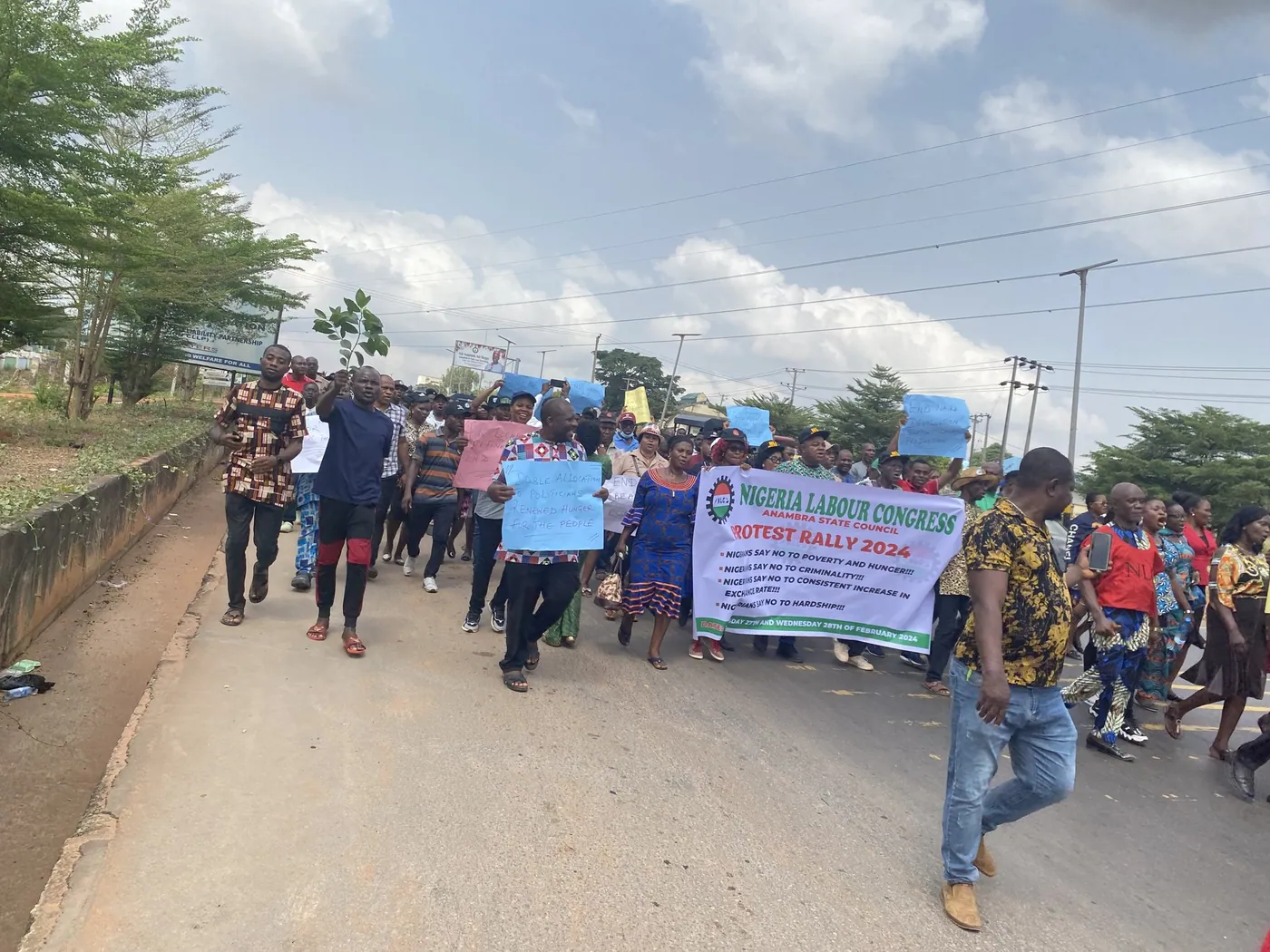
The Nigeria Labour Congress has given the federal government until Friday 23 October to "commence the process of renegotiating a new national minimum wage". The law that governs that renegotiation sets a later date. Under the National Minimum Wage Act 2019, as amended in July 2024, the N70,000 wage "expires after three years", and the tripartite committee that negotiates its successor must meet "not later than six months to the expiration of the existing national minimum wage". Counted from the amendment's commencement on 29 July 2024, that latest date is 29 January 2027, 98 days after the NLC's ultimatum lapses. The Act allows talks to start now. It does not require them to start yet.
The ultimatum comes from the communiqué of a joint meeting of the NLC's National Executive Council and Central Working Committee, held at Labour House, Abuja, on 7 October 2026 and posted on nlcng.org on 8 October over the name of the Congress president, Joe Ajaero. It "issues a two-week ultimatum to the federal government, beginning from Friday, the 9th day of October, 2026" within which the government is expected, "among other things", to reduce the petrol price "to what it was at the signing of the current national minimum wage in 2024"; to "Commence the process of renegotiating a new national minimum wage"; to implement the Terms of Settlement reached with the Joint Health Sector Unions and Assembly of Healthcare Professionals (JOHESU) "on the 5th day of February, 2026"; and to "Implement the demands of the Joint Public Sector Negotiating Council (JPSNC)". Fourteen days from Friday 9 October is Friday 23 October, ten days from today, the date given in press reports of the ultimatum.
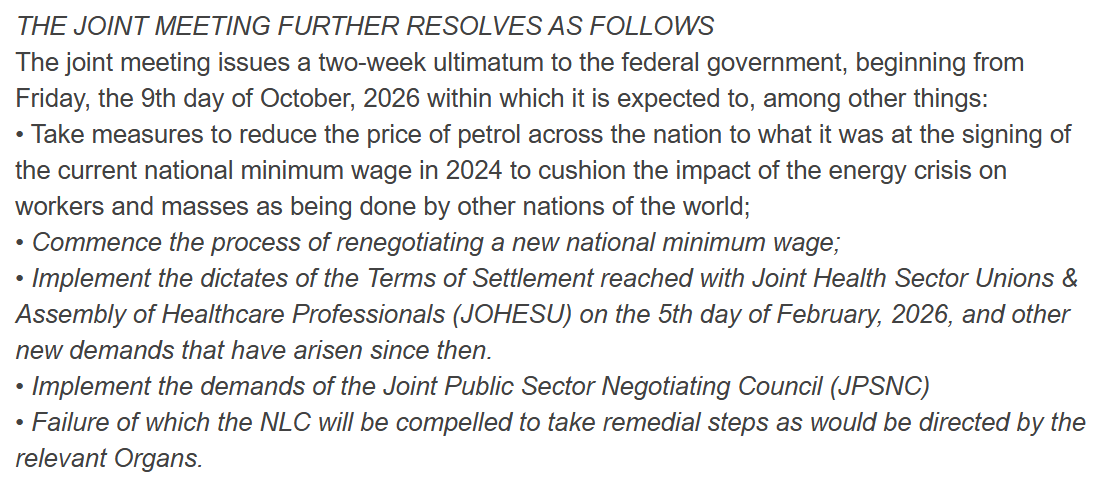
Elsewhere in the same document the NLC says the minimum wage "has been rendered worthless by the relentless depreciation of the naira", demands that renegotiation begin "before the end of this month", and asks the government to "grant tax relief to workers as agreed and immediately provide Wage Awards to workers". The communiqué does not announce a strike, a strike date or a ballot. Its last item says that on failure "the NLC will be compelled to take remedial steps as would be directed by the relevant Organs".
The government's reply so far is spoken, not written. Mohammed Idris, the Minister of Information and National Orientation, told a media engagement on Monday 12 October that President Bola Tinubu would keep meeting labour, as reported by The Nation and OsunDefender. "The President is going to keep to his promise. We will always bring them together and find solutions in the collective interest of our country," he said. Recalling the 2024 talks, he quoted the President: "As we keep going, why do we even have to wait for five years before we review this?" The Information Ministry's own website carried no release on the labour dispute between 8 and 12 October; its 11 October release from the minister's office covered an APC rally in Lafia. We found no statement on the ultimatum on the State House website in the same period.
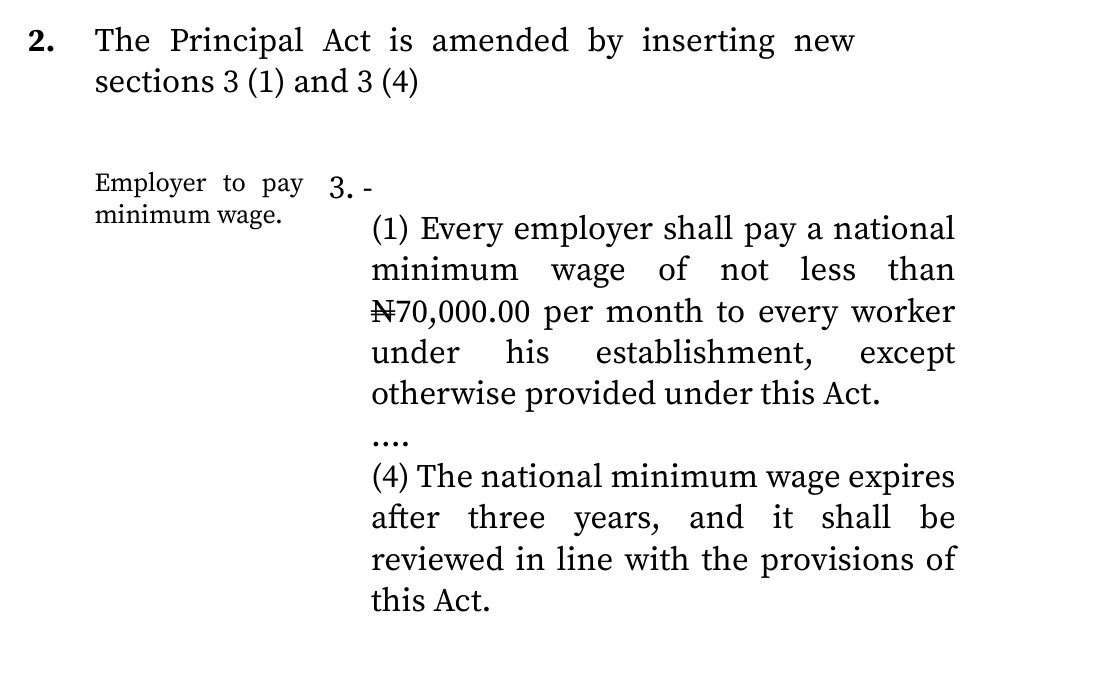
The minister's account of 2024 matches the record. The 2019 Act, in section 3(4), said the national minimum wage "expires after five years, and it shall be reviewed in line with the provisions of this Act". The National Minimum Wage (Amendment) Bill 2024, as transmitted to the National Assembly in July 2024, inserts a new section 3(1), under which every employer "shall pay a national minimum wage of not less than N70,000.00 per month", and a new section 3(4): "The national minimum wage expires after three years, and it shall be reviewed in line with the provisions of this Act." Its explanatory memorandum states the purpose as reducing "the time for periodic review of the national minimum wage from five years to three years". The Act's published listing gives its commencement as Monday 29 July 2024, and the President said in his broadcast of 4 August 2024: "I signed the National Minimum Wage into law last week."
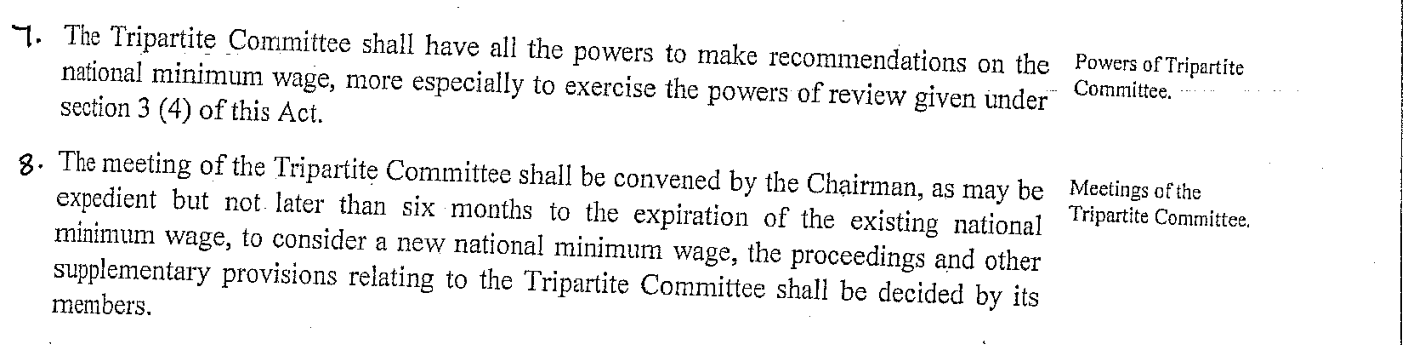
The Bill changes only those two subsections. The machinery for the next review is still the 2019 text. Section 5 establishes a Tripartite Committee on National Minimum Wage of government, organised labour and the private sector "on equal representation", with its secretariat at the National Salaries, Incomes and Wages Commission. Section 6 says the committee "shall be appointed by the President" and lists a representative each of the NLC and the TUC among its members. Section 7 gives it "the powers of review given under section 3 (4)". Section 8 sets the timing: the committee "shall be convened by the Chairman, as may be expedient but not later than six months to the expiration of the existing national minimum wage, to consider a new national minimum wage".
The count is simple, with one assumption stated. If the three years run from the commencement date, the N70,000 wage expires on 29 July 2027. Six months before that is 29 January 2027. From today, 13 October 2026, that is 108 days: 18 days left in October, 30 in November, 31 in December and 29 in January. From the NLC's deadline of 23 October it is 98 days. The current wage has been in force for 806 days, two years and two and a half months, of its three years. The Act does not itself say from which date the three years run; 29 July 2024, the commencement date in the Act's listing, is also the date widely reported for the President's signature, so either reading gives the same result.
On the substance, the law is on labour's side. Section 3(4) says the wage "shall be reviewed"; a review is mandatory, not a favour. The words "as may be expedient" in section 8 let the committee meet at any time before the deadline, so nothing in the Act stops the government from starting in October 2026. The President also committed himself to the three-year cycle in his own words. The State House release of 18 July 2024 quotes him telling the NLC and TUC leaders: "Let us look at the tenure of review. Let us agree on that, and affirm three years. Two years is too short. We affirm three years. We will review."
On the timing, the law is on the government's side. Section 8 sets a latest date, not an earliest one, and that date is 29 January 2027. The NLC's 23 October deadline and its call for talks "before the end of this month" have no basis in the Act; they are the Congress's own dates. The Act has no provision for reopening the N70,000 figure before it expires, and it does not cover the petrol price, the JOHESU settlement or the JPSNC's demands, which are separate matters. The first step the NLC asks for is one only the government can take: under section 6 the President appoints the committee, and under section 8 its chairman convenes it.
The 2026 Appropriation Act carries a line for minimum wage adjustments. Under the Service Wide Vote (code 0238005002), page 938 carries N845,284,513,819 for "MINIMUM WAGE RELATED ADJUSTMENTS" and N150,000,000,000 for "PAYMENT FOR PROMOTION AND SALARY ARREARS", together N995,284,513,819, and N67,722,681,600 for "PENSION INCREASE DUE TO 2024 CONSEQUENTIAL ADJUSTMENT". A search of the text of all 2,604 pages of the Act found no line called "wage award" or "peculiar allowance", the two items that press reports of a public-service negotiating council letter of 31 July 2026 described as its main claims. That does not show the items are unfunded: they could sit inside agencies' personnel lines under other names, and the Act does not say what the N845.28 billion adjustment line covers.

Several of the NLC's demands cannot be tested against a document. The communiqué gives no figure for the petrol price it wants restored. It does not list the JPSNC's demands. The JOHESU Terms of Settlement of 5 February 2026 were not available to us, and the communiqué does not say what tax relief was "agreed" or when. The TUC, the other labour centre named in the Act, has not issued a written position that we could read: its website address, tucnigeria.org.ng, did not return a TUC page when we tried it on 13 October. Press reports quote the TUC president, Festus Osifo, as saying talks should start around February 2027, which would sit close to the statutory date.
The minister has said the President will meet labour; neither side has published a date. If the government convenes the tripartite committee before 29 January 2027, it will have met the Act's timetable whatever happens to the ultimatum. If it does not, it will have missed the date the Act sets.
What this rests on
Primary documents downloaded and read for this report on 13 October 2026: (1) the NLC communiqué of the joint NEC/CWC meeting of 7 October 2026, from nlcng.org (WordPress post 6412, published 8 October 2026 16:44), saved as HTML, JSON and a full-page screenshot; (2) the National Minimum Wage Act 2019, 14-page scanned copy (policyvault.africa file NGA1043.pdf), read at pages 3 to 6: section 3(1) N30,000.00, section 3(4) "expires after five years", sections 5 to 8 (Tripartite Committee); (3) the National Minimum Wage (Amendment) Bill 2024 as transmitted in July 2024, 3 pages (PLAC copy), page 3: new section 3(1) N70,000.00 and new section 3(4) "expires after three years"; (4) the Law Nigeria listing of the National Minimum Wage (Amendment) Act 2024, giving commencement Monday 29 July 2024 and the same arrangement of sections as the Bill; (5) State House releases of 18 July 2024 ("affirm three years ... We will review") and 4 August 2024 (broadcast, paragraph 26: "I signed the National Minimum Wage into law last week"); (6) the 2026 Appropriation Act, 2,604 pages, Service Wide Vote 0238005002, page 938; full-text search of every page for "wage award", "peculiar allowance" and "minimum wage". Minister Idris's words come from the OsunDefender report of 12 October 2026 (The Nation carried the same story); the Information Ministry's website was checked for posts dated 8 to 12 October 2026. Arithmetic: 9 October 2026 (a Friday) plus 14 days = 23 October 2026 (a Friday); 13 October to 23 October = 10 days. Commencement 29 July 2024 plus three years = 29 July 2027; minus six months = 29 January 2027. 13 October 2026 to 29 January 2027 = 18 + 30 + 31 + 29 = 108 days; 23 October 2026 to 29 January 2027 = 108 - 10 = 98 days. 29 July 2024 to 13 October 2026 = 806 days. Budget: N845,284,513,819 + N150,000,000,000 = N995,284,513,819; adding N67,722,681,600 gives N1,063,007,195,419 (not used in the text).
What this does not establish
We read the 2024 amendment as the Bill transmitted in July 2024 and the Act's published listing, not a Federal Government Gazette copy of the signed Act; law firm summaries and the listing match the Bill's two clauses, but we did not see the gazetted text. The Act does not state from which date the three years in section 3(4) run; our dates assume the commencement date of 29 July 2024. We found no 2025 or 2026 amendment to the Act, but did not search the Gazette exhaustively. Whether the government has appointed or is preparing a new tripartite committee; whether a meeting with labour has been scheduled. What the petrol price was at the signing of the 2024 Act on the NLC's measure, and how far it has moved since; the content of the JOHESU Terms of Settlement of 5 February 2026; the JPSNC's demands; what tax relief was agreed and when. What the N845,284,513,819 "minimum wage related adjustments" line pays for, and whether wage award arrears or a peculiar allowance are funded elsewhere in the 2026 budget under other names. Whether the NLC counts its two weeks to 22 or 23 October; the communiqué gives only a start date. Whether any strike will be called; the communiqué announces none, so the notice requirements of the Trade Disputes Act were not tested. The TUC's written position. Nothing here suggests unlawful conduct by either side.
What we did ourselves
Read the NLC communiqué in full from the Congress's own website and separated its dated demands from its general ones. Set the demand to begin renegotiation against the statutory timetable in the 2019 Act and the 2024 amendment, read from the texts themselves, and counted the days to the ultimatum and to the latest lawful date for convening the tripartite committee. Checked the minister's account of the 2024 review-period change against the Bill and the State House record. Searched the full text of the 2026 Appropriation Act for wage award, peculiar allowance and minimum wage lines.
Sources for this report
(A) Nigeria Labour Congress, Communiqué of the joint NEC and CWC meeting held in Abuja on 7 October 2026 (nlcng.org, 8 October 2026); National Minimum Wage Act 2019, sections 3(4), 5, 6, 7 and 8; National Minimum Wage (Amendment) Bill 2024, clause 2 (new sections 3(1) and 3(4)); 2026 Appropriation Act, Service Wide Vote 0238005002, page 938; State House releases of 18 July 2024 and 4 August 2024.
- Communiqué of the joint meeting of the National Executive Council (NEC) and Central Working Committee (CWC) of the Nigeria Labour Congress held in Abuja on the 7th day of October, 2026 · Nigeria Labour Congress · 2026-10-08
- National Minimum Wage Act, 2019 (scanned copy, 14 pages) · National Assembly of Nigeria (copy hosted by Policy Vault Africa) · 2019-04-18
- National Minimum Wage (Amendment) Bill, 2024 · National Assembly of Nigeria (copy hosted by PLAC) · 2024-07-23
- National Minimum Wage (Amendment) Act, 2024 (listing with commencement date) · Law Nigeria · 2024-07-29
- Labour leaders praise President Tinubu over approval of N70,000 minimum wage and promise review after three years · State House, Abuja · 2024-07-18
- President Tinubu's broadcast on the nationwide protest · State House, Abuja · 2024-08-04
- 2026 Appropriation Act · National Assembly of Nigeria (copy hosted by PLAC) · 2026
- Tinubu To Meet Labour Over Workers' Demands, Strike Threat: Information Minister · OsunDefender · 2026-10-12
- Information Minister hails APC mobilisation in North Central, calls for peaceful, issue-based campaigns ahead of 2027 · Federal Ministry of Information and National Orientation · 2026-10-11
Confidence: high. This is our own assessment of whether the event occurred as described, separate from the grade, which describes what kind of thing the claim rests on.
Not obtained: where the underlying document is named above but not linked, we did not hold a copy at the time of publication. We purchase nothing and request nothing in our own name.
Corrections
None on this report. If you find an error, it will be published here, at the same length, with the date it was found, and the original wording will remain visible above it.

Dr VeroInvestigations editor, Vero Record
Reads the Nigerian public record that others leave unread: budgets, audit reports, court files and registers. Every claim on this page carries the grade of the document behind it, and the report says what that document does not establish.
All 115 reportsHow we grade evidenceAdd Vero Record as a preferred source on Google