
The Appropriation Act Nigeria signed authorises N16.73 trillion more than the budget details the Budget Office published
Vero opened both files. The Budget Office's published 2026 Appropriation Bill details total N51,592,233,171,028. The Act the President signed authorises N68,323,309,818,667. The two documents reconcile head for head, to the naira, which is what makes the N16,731,076,647,639 gap measurable. It also contains 8,076 project lines carrying a code prefix the Bill uses not once.
Nigeria publishes its budget twice: once as the Bill details the Budget Office puts out when the President presents it, and once as the Act the National Assembly passes and the President signs. Almost nobody reads them side by side, because one runs to 2,790 pages and the other to 2,635. We read both.
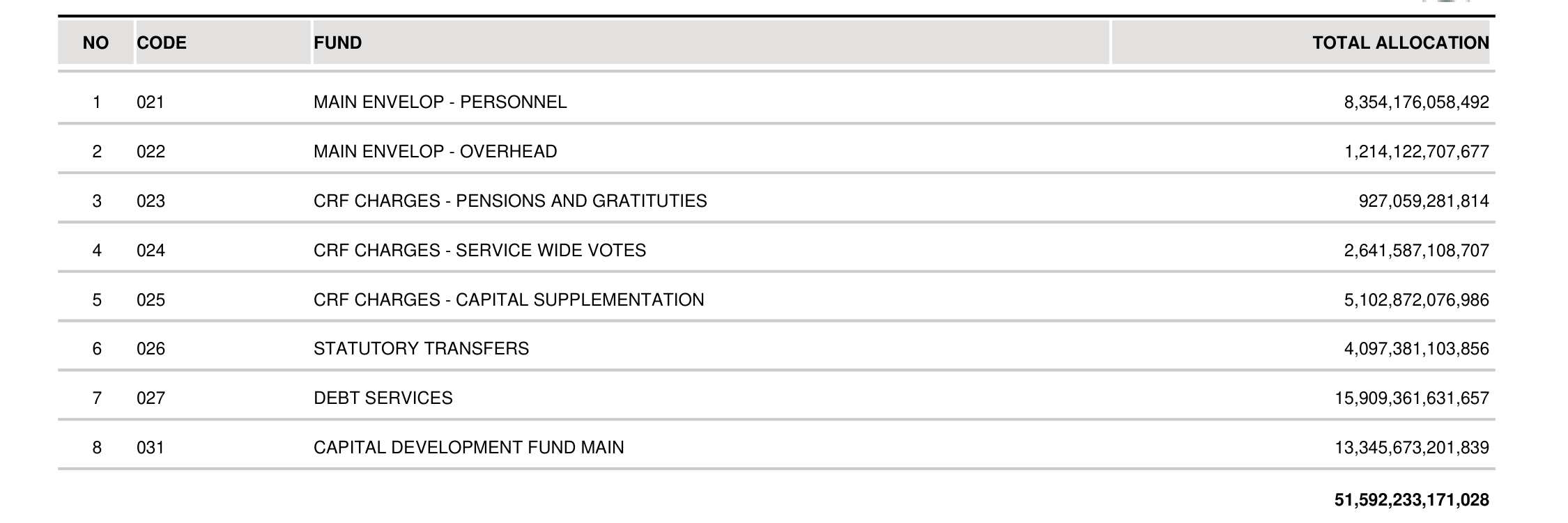
The Bill details carry their own arithmetic. On printed page 2, under SUMMARY BY MDAs, the grand total row reads 51,592,233,171,028. Page 3 breaks the same sum into eight funds, from MAIN ENVELOP - PERSONNEL at 8,354,176,058,492 to CAPITAL DEVELOPMENT FUND MAIN at 13,345,673,201,839, and those eight add back to the same figure exactly.
The signed Act states its own total in section 1, in figures and again in words: N68,323,309,818,667, of which N4,799,628,911,806 is for Statutory Transfers, N15,809,361,631,657 for Debt Service, N15,427,257,802,407 for Recurrent (Non-Debt) Expenditure and N32,287,061,472,797 for capital.
The eight funds of the Bill map onto the four heads of the Act without residue, and the mapping is not our construction: the Bill's own capital column total, 18,448,545,278,825, is precisely funds 025 plus 031. Set the two side by side and the difference is N16,731,076,647,639, a rise of 32.4 per cent. Statutory Transfers gained N702bn. Debt Service fell by exactly N100bn. Recurrent rose by N2.29tn. Capital rose by N13.84tn.
Something else separates the two files. Every capital project carries an ERGP code. The Bill details contain 28,009 of them. The Act contains 36,751. Of those, 8,767 appear in no line of the Bill, and 8,076 of that group share a single prefix, ERGP2027, which the Bill does not use once. Those 8,076 lines are worth N9,669,925,681,731 and their median value is N210,000,000.
Where they land is uneven. The Federal Ministry of Agriculture and Food Security takes 3,423 of them, worth N1.98tn. Labour and Employment takes 1,403, worth N474bn. Science, Technology and Innovation takes 1,189, worth N1.03tn. Eighty-three of them sit under the Ministry of Budget and Economic Planning and are worth N4.63tn between them.
It would be easy, and wrong, to call this N16.73 trillion of legislative insertions. The documents do not support that sentence. Nothing in either PDF says who changed what. The largest single component of the new block is not constituency-shaped at all: it is Renewed Hope infrastructure, MOFI counterpart funding for light rail schemes in Kaduna, Ogun, Enugu and Maiduguri, and arrears provisions, which read as executive material added during passage rather than as anything a legislator inserted.
Nor do the new project lines explain the whole gap. They account for N9.67tn against a total rise of N16.73tn. The remaining N7tn is not traceable inside these two documents, and we could not find it. That is the honest shape of the finding: a measurable difference of N16.73tn between what the Budget Office published and what the President signed, roughly three-fifths of it attributable to project lines that appear from nowhere, and the rest unexplained by anything in either file.
One check matters before anyone repeats these numbers. We could not establish from the file itself that the Budget Office's published Bill details are the version laid before the National Assembly on presentation day. It is what the Budget Office published as the Bill details, and it is what we compared.
What this rests on
Both documents opened and read by Vero. The totals were read off the printed pages; the code counts come from extracting every ERGP token in the project-code column of each file and comparing the sets. The head-by-head reconciliation uses the documents' own subtotals, not any allocation of ours.
What this does not establish
It does not establish who made any change, and specifically does not establish that the National Assembly inserted the difference: nothing in either PDF attributes an edit, and the largest new block reads as executive material. It does not establish that any of the spending is improper. It does not explain roughly N7tn of the gap, which is not traceable inside these two files. And we could not confirm from the file that the published Bill details are the version laid before the Assembly.
What we did ourselves
We reconciled the Budget Office's eight published funds against the Act's four statutory heads, which no published account of this budget appears to have done, and separately counted the project codes in both files to establish that 8,076 lines carry a prefix the Bill never uses.
Sources for this report
(A) 2026 Appropriation Bill (Details), Budget Office of the Federation, 2,790 pages: SUMMARY BY MDAs grand total 51,592,233,171,028 (printed p.2) and SUMMARY BY FUNDS (printed p.3). 2026 Appropriation Act as assented, 2,635 pages: section 1 and long title, printed p.iii, total 68,323,309,818,667 with its four component heads. Project-code counts taken from a full extraction of the ERGP code column in both files.
Confidence: high. This is our own assessment of whether the event occurred as described, separate from the grade, which describes what kind of thing the claim rests on.
Not obtained: where the underlying document is named above but not linked, we did not hold a copy at the time of publication. We purchase nothing and request nothing in our own name.
Corrections
None on this report. If you find an error, it will be published here, at the same length, with the date it was found, and the original wording will remain visible above it.