
INEC says all 22 parties filed their registers on time. The Supreme Court says the register penalty falls on parties, not on candidates personally
On 24 September the Supreme Court restored the Electoral Act's rules on party membership registers. Vero Record read all 36 pages of the lead judgment. It names no 2027 candidate, and it holds that the penalty in section 77(7) falls on a party that misses the register deadline, not on an individual personally. INEC's own May release says all 22 parties met that deadline. The commission has said it will take a position once it has a certified copy. Press reports say INEC's final governorship lists are due on 10 October.
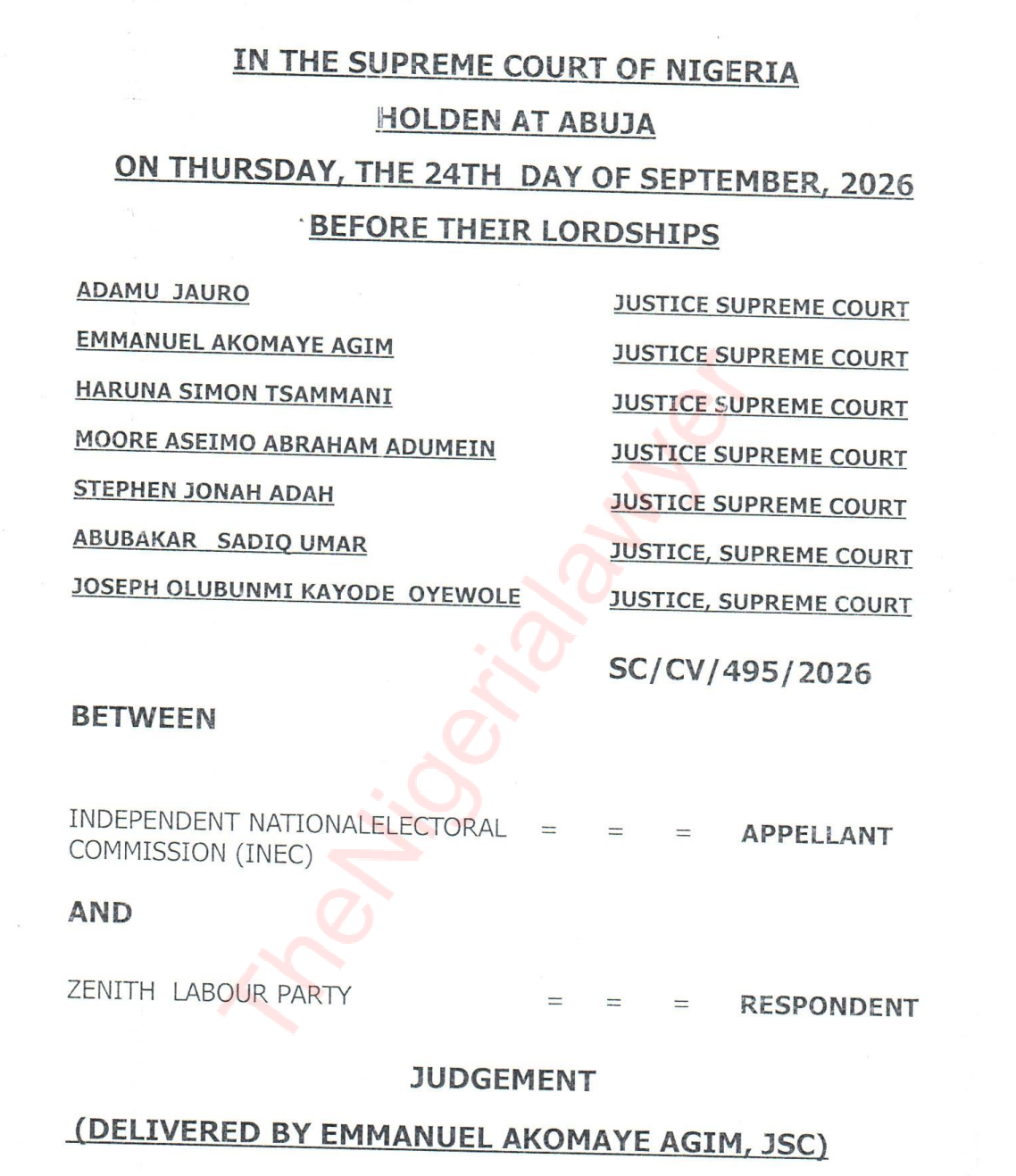
On Thursday, 24 September 2026, a seven-member panel of the Supreme Court allowed the Independent National Electoral Commission's appeal against the Zenith Labour Party, appeal SC/CV/495/2026. The lead judgment was delivered by Justice Emmanuel Akomaye Agim. It set aside the Court of Appeal decision of 16 July 2026 in appeal CA/ABJ/CV/750/2026. That decision had declared sections 77(5), 77(6), 77(7) and 84(2) of the Electoral Act 2026 unconstitutional, along with Activity Serial Number Two of INEC's revised timetable for the 2027 general election. The Supreme Court restored the Federal High Court judgment of 5 May 2026, which had dismissed the party's suit, FHC/ABJ/CS/509/2026, and it ordered the Zenith Labour Party to pay N2,000,000 in costs to INEC. The first page lists the panel as Justices Adamu Jauro, Emmanuel Akomaye Agim, Haruna Simon Tsammani, Moore Aseimo Abraham Adumein, Stephen Jonah Adah, Abubakar Sadiq Umar and Joseph Olubunmi Kayode Oyewole.
Vero Record downloaded and read the 36-page copy that the legal news site TheNigeriaLawyer published on 1 October. It is a scanned typescript with the site's watermark on every page. It is not a certified true copy from the court registry. It holds Justice Agim's lead judgment and the list of appearances, and no concurring opinions. The caption, panel, dates and costs order match press reports of the delivery, including the News Agency of Nigeria report that ThisDay carried on 26 September. TheNigeriaLawyer's report of the hearing on 16 September gave the same appeal number, SC/CV/495/2026; some later reports print it as SC/CR/495/2026. Legit.ng, citing BusinessDay, and Naija News described the decision as unanimous. We have not seen the other justices' opinions, so we cannot confirm that. We treat the copy as the text of the lead judgment on that basis. A certified copy may differ in small ways.
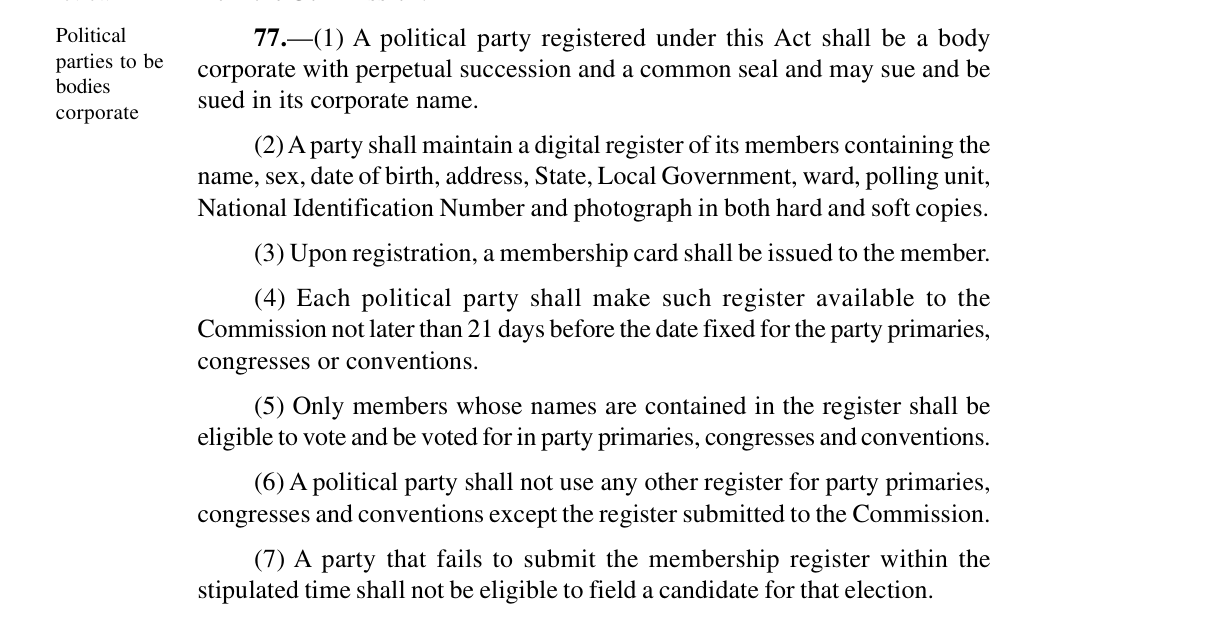
The provisions in dispute are in section 77 of the Electoral Act 2026, published in the Official Gazette, No. 40, Vol. 113, of 2 March 2026, which Vero Record downloaded from the National Assembly's website. Section 77(4) requires every party to make its digital register of members available to INEC "not later than 21 days before the date fixed for the party primaries, congresses or conventions". Section 77(5) says "Only members whose names are contained in the register shall be eligible to vote and be voted for in party primaries, congresses and conventions." Section 77(6) bars a party from using any other register. Section 77(7) reads: "A party that fails to submit the membership register within the stipulated time shall not be eligible to field a candidate for that election." Section 84(2) says nomination "shall be by direct primaries or consensus". That leaves out indirect primaries, which use delegates.
The Supreme Court judgment quotes the Court of Appeal's reasoning at length. That quoted text is the only part of the July decision Vero Record has read. The appeal court said section 77(5) to (7) "clearly places disqualification for failure to submit the Register within stipulated time". It added that the provision "placed disqualification on an individual whom the Constitution had already cleared, merely because the individual joined another party after the deadline to submit Register, even if the new party is willing to sponsor him." It described INEC's role at primaries as that of an observer, and said: "The Respondent should not use this mandate to cherry pick who to disqualify." For 70 days, from 16 July to 24 September, that was the most recent appellate ruling on the provisions.
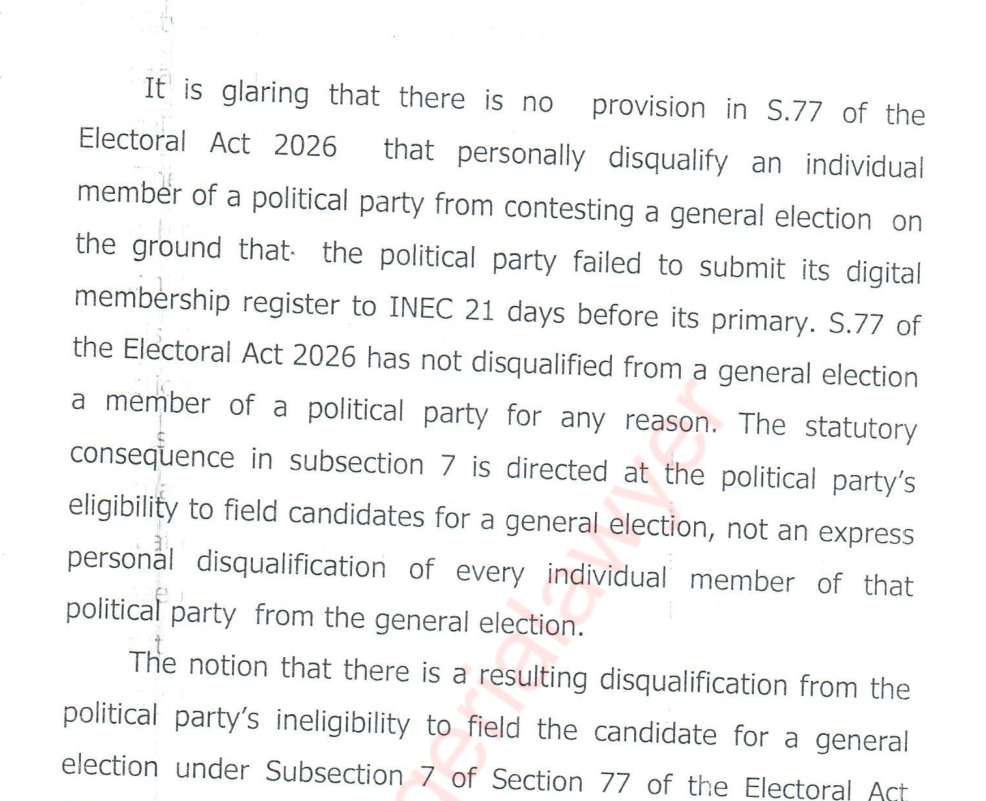
The Supreme Court rejected that reading. On page 23 Justice Agim wrote: "It is glaring that there is no provision in S.77 of the Electoral Act 2026 that personally disqualify an individual member of a political party from contesting a general election on the ground that the political party failed to submit its digital membership register to INEC 21 days before its primary." He continued: "The statutory consequence in subsection 7 is directed at the political party's eligibility to field candidates for a general election, not an express personal disqualification of every individual member of that political party from the general election." On page 24: "So section 77(7) does not in any way disqualify the individual member of a political party personally from being a candidate in an election." The same page accepts that the practical effect of a party's default is that its members cannot be fielded as its candidates. The court treats that as exclusion through the party, not as a personal disqualification. On page 25 it set aside the Court of Appeal's ruling on the ground that section 77(5) to (7) "has not disqualified any member of a political party from contesting any general election". The court held that the provisions serve internal party democracy under section 228 of the Constitution. It also observed that the earlier 2022 rule, which required registers 30 days before primaries, had carried no sanction, and that parties had not strictly complied with it.
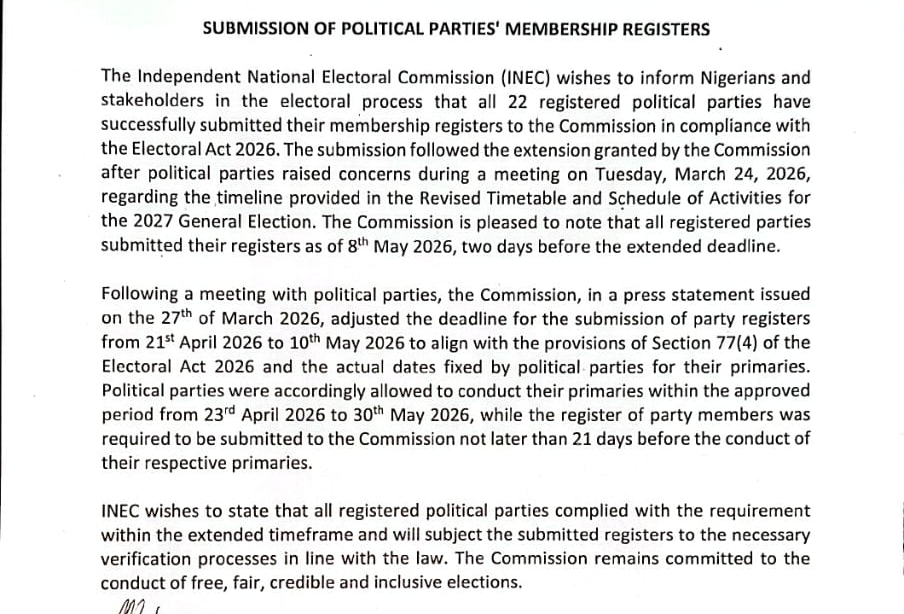
INEC's own paperwork narrows the question further. On 15 May 2026 the commission issued a release signed by Mohammed Kudu Haruna, National Commissioner and Chairman of its Information and Voter Education Committee, and Vero Record has read it. It says "all 22 registered political parties have successfully submitted their membership registers" and that they did so "as of 8th May 2026, two days before the extended deadline". It adds: "all registered political parties complied with the requirement within the extended timeframe." Our own reading, graded C: the Supreme Court says the section 77(7) bar falls on a party that missed the deadline, and INEC has said in writing that no party missed it. On INEC's own published record, then, no party falls under section 77(7) for primaries held within the window that closed on 30 May. That rests on the commission's statement alone, because INEC has not published the date each register arrived. The same release said INEC would "subject the submitted registers to the necessary verification processes". We have found no published result of that check.
The provision in the restored text that does concern individuals is section 77(5): only people named in the register filed with INEC may "be voted for" at a primary. The judgment's discussion of personal disqualification is framed around section 77(7) and the general election. It does not say how section 77(5) applies at the primary stage to someone who joined a party after that party's register was filed, and it does not discuss any individual defection. Apart from the titles of earlier cases it cites, it names no politician, no state and no party other than the Zenith Labour Party. Vero Record read all 36 pages and found no 2027 candidate or aspirant named anywhere in the text.
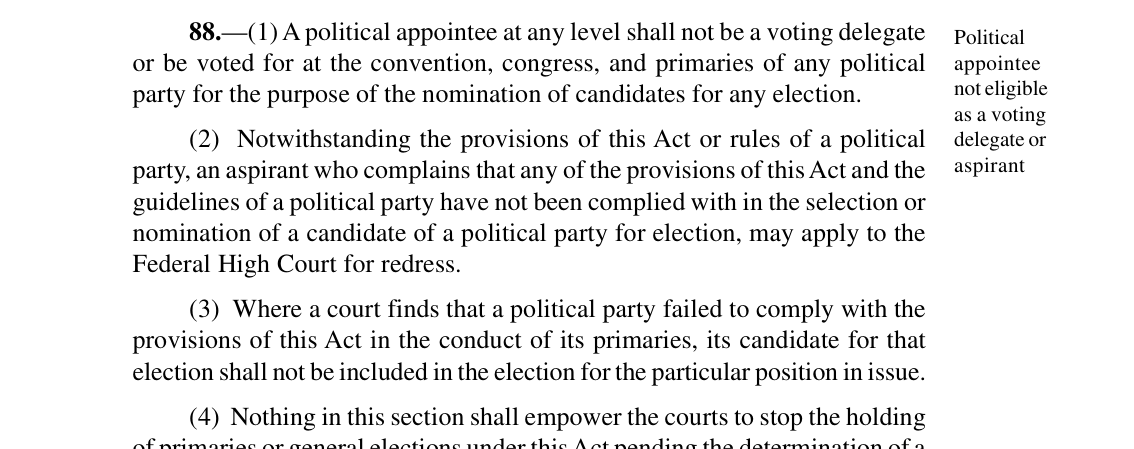
The Act also says who acts when a party breaks the rules on primaries, and both relevant clauses begin with a court. Section 88(2) allows "an aspirant who complains that any of the provisions of this Act and the guidelines of a political party have not been complied with" to apply to the Federal High Court. Section 88(3) says: "Where a court finds that a political party failed to comply with the provisions of this Act in the conduct of its primaries, its candidate for that election shall not be included in the election for the particular position in issue." Section 29(5) and (6) let an aspirant from the same primary sue over false information in a candidate's affidavit, and they leave the disqualification order to the court. We searched the gazetted text for the words "reject" and "disqualify". The only provision that orders a candidate disqualified is section 29(6), and the order there is the court's. Some provisions state a consequence without saying who applies it: section 77(7) itself, section 82(6), which says a party's failure to give INEC notice of a primary renders it invalid, and section 29(1), which requires candidates to have emerged from "valid primaries". We found no section that expressly gives INEC a power to remove a candidate whose name a party has submitted. That is our reading, graded C. INEC's lawyers may point to powers we have not identified.
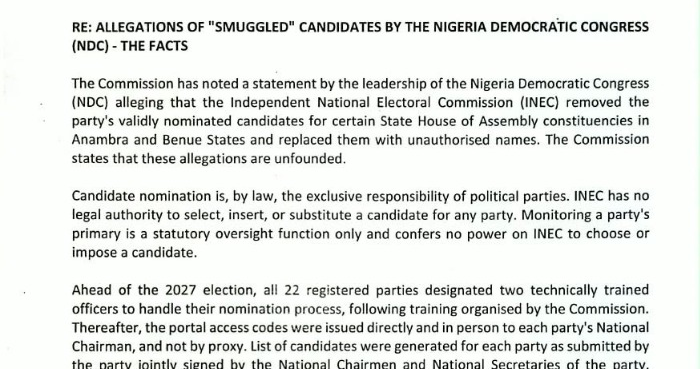
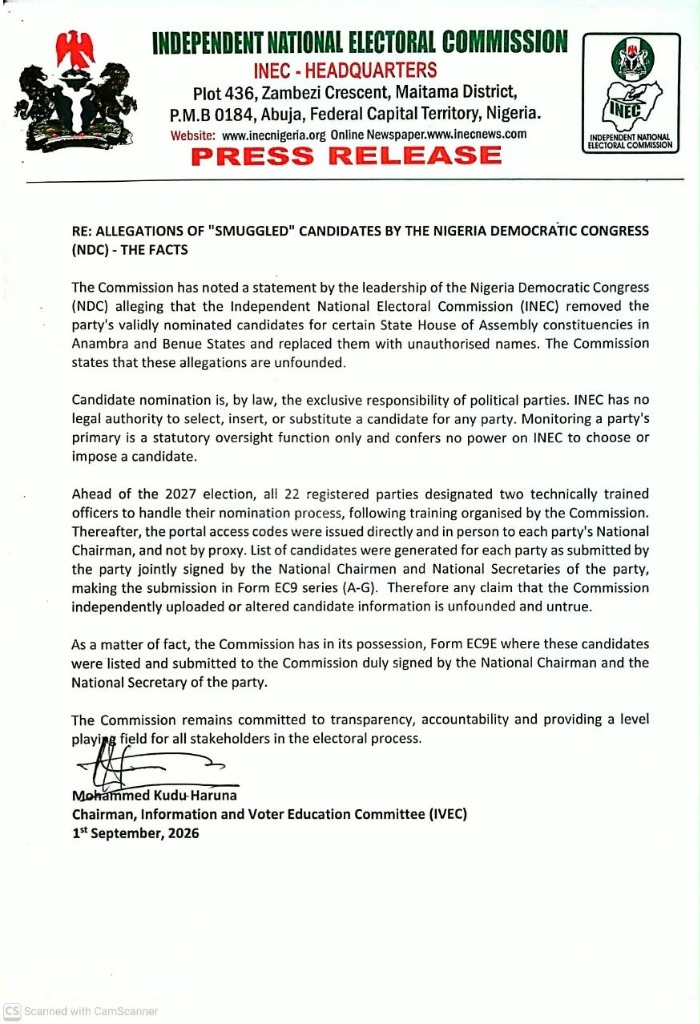
INEC has put its own view of its role in writing. On 1 September 2026, answering the Nigeria Democratic Congress's complaint about State House of Assembly lists in Anambra and Benue, it issued a release signed by Haruna. It reads: "Candidate nomination is, by law, the exclusive responsibility of political parties. INEC has no legal authority to select, insert, or substitute a candidate for any party. Monitoring a party's primary is a statutory oversight function only and confers no power on INEC to choose or impose a candidate." The release says each party designated its own officers to handle nominations on INEC's portal, with access codes issued to the party's national chairman, and that the lists were submitted on the Form EC9 series signed by the national chairman and national secretary.
Since the judgment, the commission has spoken through officials quoted in the press, not through a release. Daily Trust reported on 30 September, citing a source in the commission, that INEC was "considering moving against candidates who violated certain provisions of the 2026 Electoral Act". It quoted Haruna as saying it takes about a week to obtain a certified true copy, and that the commissioners would take a position after the legal department had reviewed the judgment. Tribune reported on 28 September that Haruna said the commission had not yet met on the ruling. Leadership, the same day, quoted Deputy Director Wilfred Ifogah: "The Commission has to meet after receiving the Certified True Copy (CTC) of the judgment." The 1 September release and the reported plan to move against candidates have not been reconciled in any document INEC has published. When Vero Record checked inecnigeria.org on 2 October, none of the press releases the site carried concerned the judgment.
Press reports have named candidates whose positions could be questioned. Daily Trust wrote of fears that candidates "who emerged late or after presenting themselves for elections on other platforms" may be affected, and named former Inspector-General of Police Mohammed Adamu, Isa Ali Pantami, Kingsley Chinda, Shehu Buba and Mohammed Nami. The camps of Adamu, Pantami and Chinda have rejected that; we found no published response from Buba or Nami. Leadership reported that Adamu's spokesman, Otaru Douglas, insisted no court had invalidated the Social Democratic Party's membership register or ordered INEC to delist Adamu. The SDP's publicity secretary, Araba Rufus Ayenigba, told Tribune that Adamu, the party's Nasarawa governorship candidate, joined the SDP on 24 May 2026, the day he resigned from the APC, and that his name was on a register forwarded to INEC more than three months before the substitution primary of 5 September. Set beside INEC's statement that all registers were in by 8 May, that account implies the SDP sent INEC a register, or an addition to one, after that date. That is our reading, graded C; INEC has not said whether it received one. Oby Ndukwe, an ally of Chinda, the APC's Rivers governorship candidate, told Leadership that "there is no suit challenging O.K. Chinda's election or eligibility". The Pantamiyya Movement told Leadership the judgment did not affect Pantami's Gombe bid. The Nigeria Democratic Congress said the judgment would not affect Peter Obi. The PDP and the APC told Tribune they would not comment until they had the certified copy. Vero Record has not checked any of these candidates' membership dates against a party register, because INEC has not published the registers.
Lawyers quoted in the press disagree. Monday Ubani, SAN, writing on TheNigeriaLawyer on 30 September, argued that "INEC does not possess an unfettered independent power to disqualify a candidate after the candidate's name has been forwarded to it", citing sections 29 and 88 and the Supreme Court's 2011 decision in Dingyadi v INEC. Salman Jawondo, SAN, was quoted by Legit.ng as saying the judgment "does not affect any nomination at all" and that "INEC needs a fresh court pronouncement to delist them." Ahmed Raji, SAN, told Tribune that the court had declared what the law already was, so retroactivity did not arise. On 28 September the activist lawyer Deji Adeyanju called on INEC to remove from its portal the names of all candidates affected by the judgment, according to Naija News. He did not say which candidates those were.
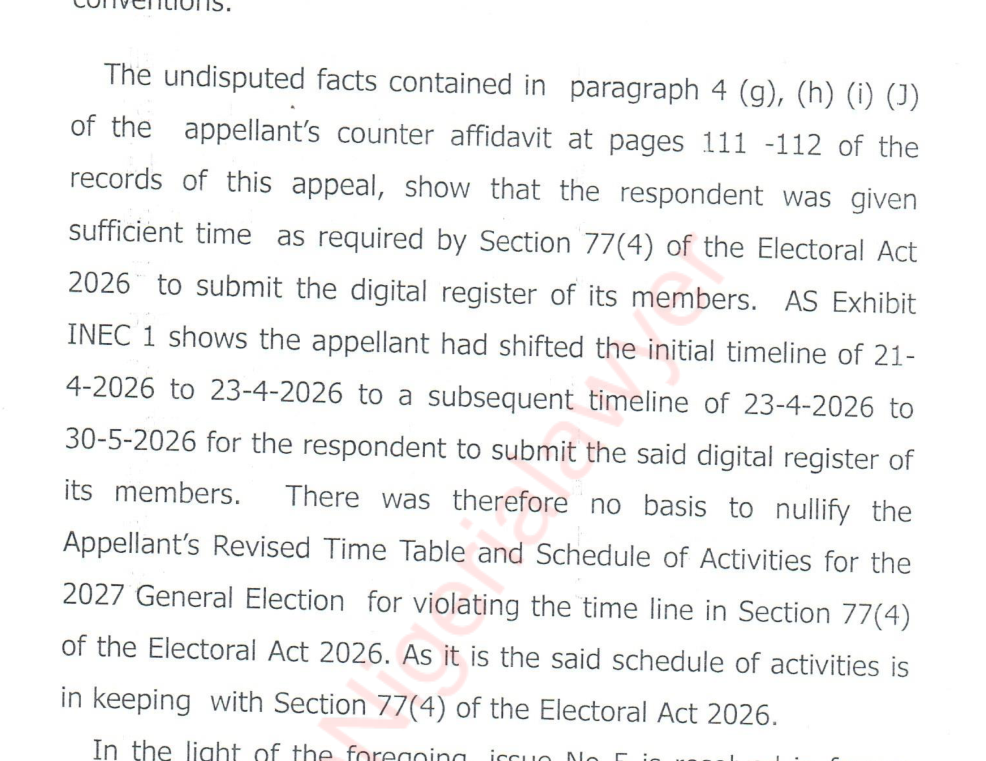
The judgment and INEC's own releases also describe the register dates differently. On page 34, Justice Agim relies on an exhibit he calls Exhibit INEC 1. He writes that it shows INEC "had shifted the initial timeline of 21-4-2026 to 23-4-2026 to a subsequent timeline of 23-4-2026 to 30-5-2026 for the respondent to submit the said digital register of its members." INEC's signed release of 27 March 2026 gives different dates. It says the register window was "originally fixed for 1st April 2026 to 21st April 2026". It says 23 April to 30 May was the period for holding primaries, and that the final deadline for registers was moved to 10 May 2026. The 15 May release repeats the 23 April to 30 May primary window and the move of the deadline from 21 April to 10 May. Vero Record has not seen Exhibit INEC 1. These records appear inconsistent, and we cannot yet say why. The difference does not change the court's conclusion that the timetable complied with section 77(4). It does matter to anyone who relies on the judgment for the register dates.
The dates around the appeal, set side by side, are our own arithmetic. INEC filed its notice of appeal on 28 July 2026, 12 days after the Court of Appeal ruled, according to page 2 of the judgment. TheNigeriaLawyer reported on 16 September that the Supreme Court had heard the appeal and reserved judgment. Judgment came eight days later. INEC published its final list of presidential candidates on 12 September, according to Channels Television, 58 days into the 70-day period in which the Court of Appeal's ruling stood. Daily Trust reports that INEC's timetable schedules the final governorship and State House of Assembly lists for 10 October, 16 days after the judgment. Vero Record has not seen that date in an INEC document.
A number of points remain open. We do not know what the certified copy and any concurring opinions say, or whether INEC's commissioners will claim a power to act without a court order. We do not know whether INEC's verification of the 22 registers found any defects, or when each party filed its register in relation to the date of each primary. Nor do we know how section 77(5) applies to candidates who joined a party after its register was filed. That question could reach a court through section 88(2), but only if an aspirant brings it. Vero Record has not sent questions to INEC or to the candidates named in press reports for this article. Their positions are quoted from their own releases and from the outlets named above. We will add any response we receive.
What this rests on
The 36-page lead judgment in INEC v Zenith Labour Party, SC/CV/495/2026, downloaded from TheNigeriaLawyer and read in full (all pages; scanned, watermarked, not a certified true copy); the Electoral Act 2026 as gazetted (Official Gazette No. 40, 2 March 2026), downloaded from nass.gov.ng, sections 29, 77, 82, 84, 85, 87 and 88 read; INEC's signed releases of 27 March, 15 May and 1 September 2026, read; press reports (Daily Trust, Leadership, Tribune, Legit.ng, ThisDay/NAN, TheNigeriaLawyer, Naija News, Channels) for INEC officials' post-judgment remarks, candidates' responses, lawyers' views and the 10 October and 12 September dates; Vero Record's own day counts and readings, labelled C.
What this does not establish
Whether the certified true copy matches the copy read, and what any concurring opinions say; whether the decision was unanimous (press only); what INEC's commissioners will decide, and whether they will claim a power to remove a nominated candidate without a court order; the result of INEC's verification of the 22 registers and the filing date of each party's register in relation to each primary; whether INEC received any register or addition after 8 May, including from the SDP; how section 77(5) applies to people who joined a party after its register was filed; the contents of Exhibit INEC 1 and why the judgment's register dates differ from INEC's releases; the 10 October deadline in an INEC document; any individual candidate's membership date as shown in a party register.
What we did ourselves
Read the full 36-page judgment and checked it for named candidates (no 2027 candidate or aspirant is named; politicians appear only in the titles of cited cases). Set its holding that section 77(7) falls on parties beside INEC's 15 May written statement that all 22 parties filed on time. Searched the gazetted Act for disqualification and rejection clauses and found that the only disqualification order (s.29(6)) and the primaries sanction (s.88(3)) both rest with a court, while ss.77(7), 82(6) and 29(1) state consequences without naming who applies them. Placed INEC's 1 September statement that it has no power to select or substitute candidates beside press reports that it may move against candidates. Set the SDP's own account of Adamu's 24 May membership beside INEC's 8 May filing statement. Found that the judgment's account of the register window (page 34) does not match INEC's 27 March and 15 May releases. Counted the 70 days in which the Court of Appeal ruling stood, and placed the 12 September presidential list and the reported 10 October governorship deadline against that period.
Sources for this report
(A) Supreme Court of Nigeria, INEC v Zenith Labour Party, SC/CV/495/2026, lead judgment of Emmanuel Akomaye Agim JSC delivered 24 September 2026 (36 pages); Electoral Act 2026, Official Gazette No. 40, Vol. 113, 2 March 2026, sections 29, 77, 82, 84 and 88; INEC press releases signed by Mohammed Kudu Haruna dated 27 March, 15 May and 1 September 2026.
- Supreme Court of Nigeria, INEC v Zenith Labour Party, SC/CV/495/2026, judgment delivered by Emmanuel Akomaye Agim JSC (36 pages) · Supreme Court of Nigeria (copy published by TheNigeriaLawyer) · 2026-09-24
- [DOWNLOAD JUDGMENT] Failure To Submit Membership Register Does Not Disqualify Individual Candidate · TheNigeriaLawyer · 2026-10-01
- Electoral Act, 2026 (Act No. 1), Official Gazette No. 40, Vol. 113 · National Assembly / Federal Government Press · 2026-03-02
- INEC press release: Re: Revised Timetable and Schedule of Activities for 2027 General Election · INEC (Mohammed Kudu Haruna) · 2026-03-27
- INEC press release: Submission of Political Parties' Membership Registers · INEC (Mohammed Kudu Haruna) · 2026-05-15
- INEC press release: Re: Allegations of 'smuggled' candidates by the Nigeria Democratic Congress (NDC) - the facts · INEC (Mohammed Kudu Haruna) · 2026-09-01
- INEC website, inecnigeria.org (press releases carried on the site) · INEC · 2026-10-02
- Supreme Court judgement: INEC to move against erring candidates next week · Daily Trust (Andrew Agbese, Musa Luka Musa) · 2026-09-30
- Electoral Act: INEC Reviews S'Court Verdict As Chinda, Pantami, Ex-IGP Insist On Candidacy · Leadership (Ademu Idakwo and others) · 2026-09-28
- Political parties, legal experts differ on Supreme Court ruling on Electoral Act · Nigerian Tribune · 2026-09-28
- 2027 Election: Fresh Court Battles Brew Over Party Primaries · Legit.ng · 2026-09-27
- Supreme Court Upholds INEC's Appeal on Electoral Act · ThisDay / News Agency of Nigeria · 2026-09-26
- Supreme Court Reserves Judgment In INEC Appeal Seeking Restoration Of Electoral Act Provisions · TheNigeriaLawyer · 2026-09-16
- 'Supreme Court Restored The Law, It Did Not Disqualify Any Individual Candidate' - Ubani, SAN · TheNigeriaLawyer · 2026-09-30
- Adeyanju Demands Immediate Action From INEC Over Supreme Court Judgment · Naija News · 2026-09-28
- INEC Publishes Final List Of Presidential Candidates For 2027 Election · Channels Television · 2026-09-12
- Wikimedia Commons: File:Area shot of polling units.jpg · Wikimedia Commons · 2023-02-25

Confidence: high. This is our own assessment of whether the event occurred as described, separate from the grade, which describes what kind of thing the claim rests on.
Not obtained: where the underlying document is named above but not linked, we did not hold a copy at the time of publication. We purchase nothing and request nothing in our own name.
Corrections
None on this report. If you find an error, it will be published here, at the same length, with the date it was found, and the original wording will remain visible above it.