Katsina's foreign debt doubled to $200.62m in 2025; its audited accounts file $87.59m of the rise under state loan schemes listed as owed to the state
Katsina State's audited accounts for 2025 and the Debt Management Office agree on the total: the state's foreign debt rose from $100,461,044.55 to $200,620,219.72 in one year. The borrowing note gives $87,585,874.07 of that rise the names of the state's own farmer and small-business loan schemes, names the same accounts list among money owed to the state. The Auditor-General's debt schedule names four donor-financed projects instead, without naming the lenders, and the loan money the accounts record as received in 2025 is about half the new debt.
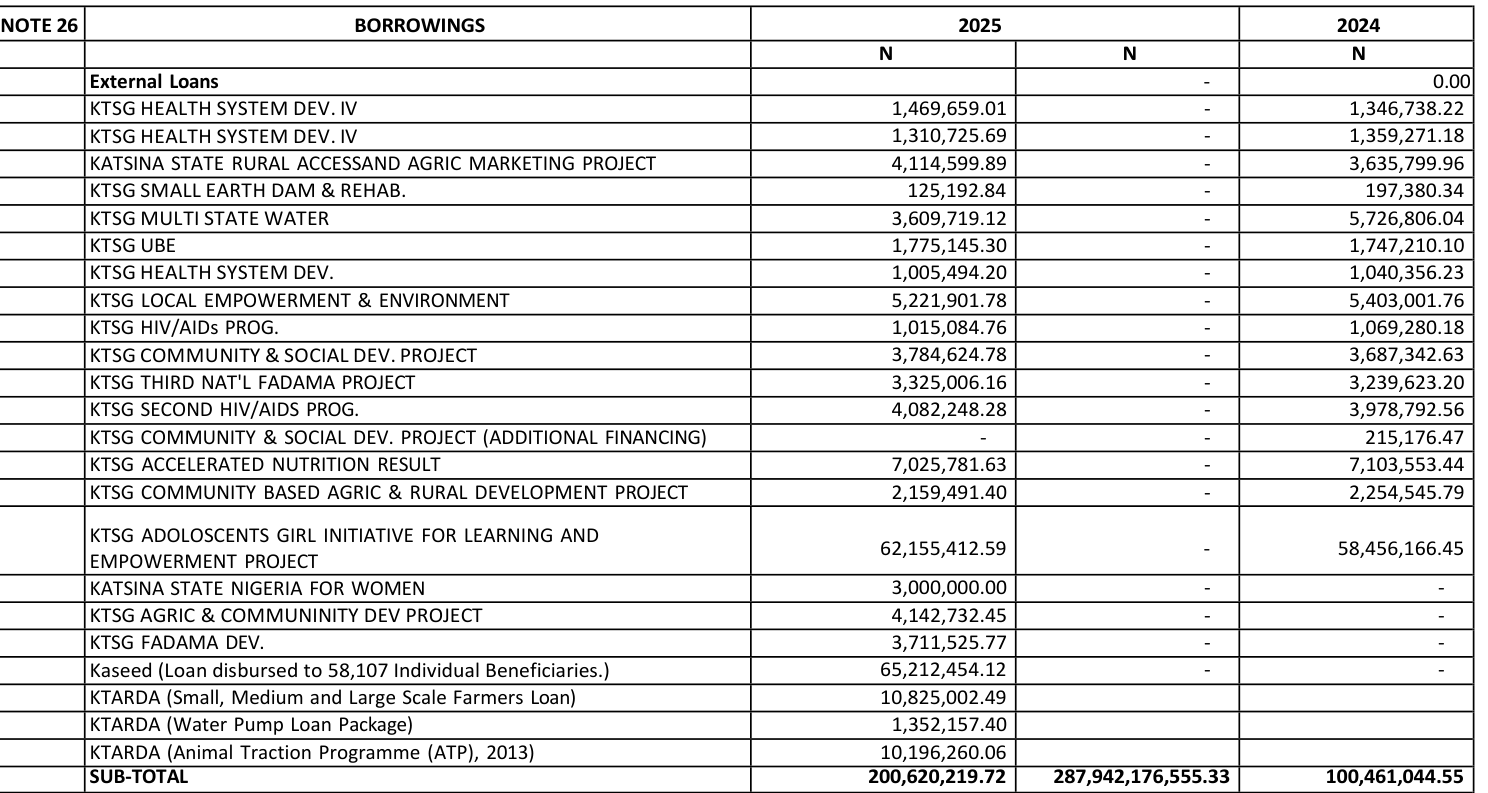
Katsina State's financial statements for 2025, prepared by the Office of the Accountant General and certified by the state Auditor-General, put the state's external loans at $200,620,219.72 on 31 December 2025. A year earlier the same note gave $100,461,044.55. The rise is $100,159,175.17, or 99.70 per cent. Four lines added at the bottom of Note 26, on page 56, account for $87,585,874.07 of it, or 87.45 per cent. They read: "Kaseed (Loan disbursed to 58,107 Individual Beneficiaries.)" $65,212,454.12; "KTARDA (Small, Medium and Large Scale Farmers Loan)" $10,825,002.49; "KTARDA (Water Pump Loan Package)" $1,352,157.40; and "KTARDA (Animal Traction Programme (ATP), 2013)" $10,196,260.06. None of the four has a figure for 2024. The note heads these columns "N", but the amounts are dollars: the Debt Management Office gives the same $200,620,219.72, and the note's second column carries the naira equivalent, N287,942,176,555.33.
The same four names appear 26 pages earlier, on the other side of the balance sheet. Note 21 on page 30 lists receivables, money owed to the state, and includes Kaseed's loans to 58,107 beneficiaries at N2,238,626,170.75 (N2,248,626,170.75 in 2024) and the three KTARDA schemes at N115,221,700.00, N117,492,900.00 and N93,440,000.00, unchanged from 2024. KTARDA is the state's agricultural and rural development authority; Kaseed, by the accounts' own description, is a scheme that disbursed loans to 58,107 individuals. In Note 21 the four lines are naira loans the state made. In Note 26 the same labels sit against dollar amounts the state owes, and the dollar amounts bear no fixed ratio to the naira ones.

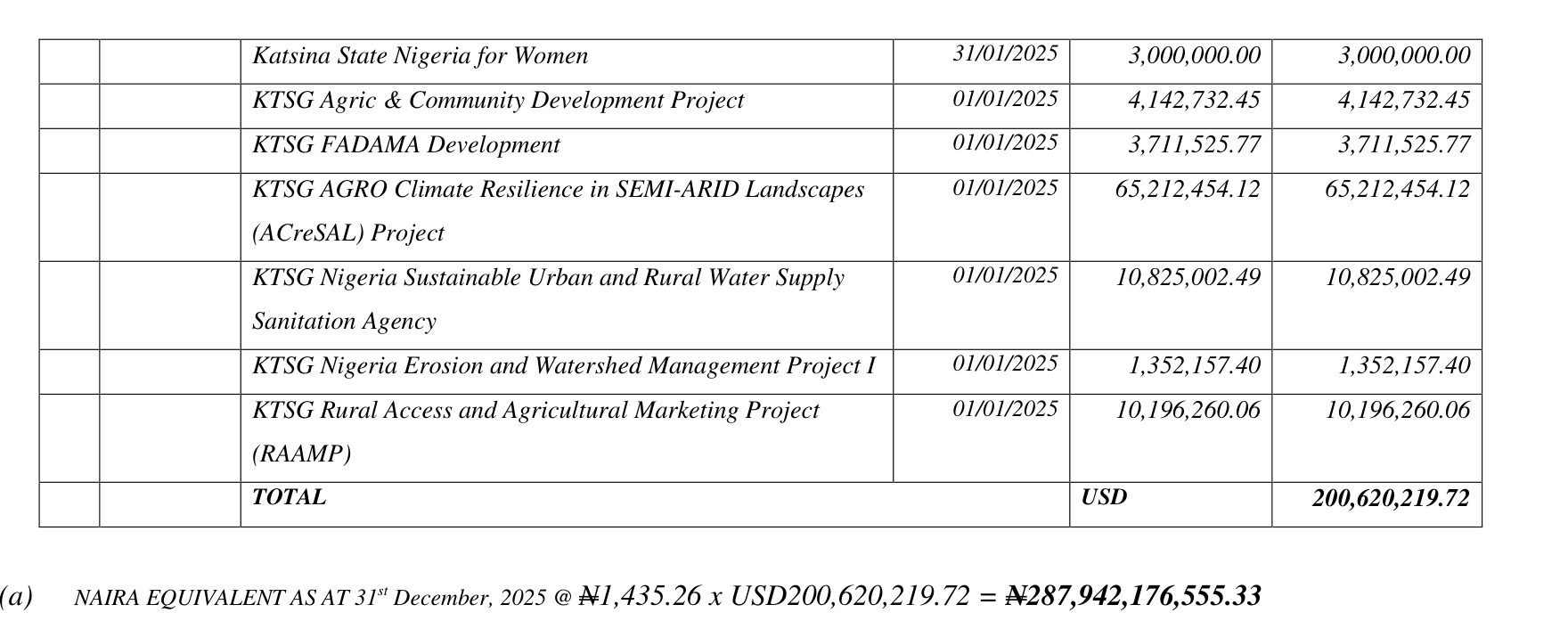
The Auditor-General's own report on the 2025 accounts, published by the state in June 2026 alongside the statements, gives the four dollar amounts different names. His external debt portfolio as at 31 December 2025, on pages 138 and 139, lists $65,212,454.12 as the Agro-Climatic Resilience in Semi-Arid Landscapes (ACReSAL) Project, $10,825,002.49 as the Nigeria Sustainable Urban and Rural Water Supply Sanitation programme, $1,352,157.40 as the Nigeria Erosion and Watershed Management Project and $10,196,260.06 as the Rural Access and Agricultural Marketing Project (RAAMP). Each is dated 01/01/2025, each shows a loan amount equal to the debt outstanding, and the creditor column is blank for all four. The schedule totals $200,620,219.72 and converts it at N1,435.26 to the dollar into N287,942,176,555.33, the figure carried to the balance sheet. The same report reprints the Accountant-General's Note 26 with the Kaseed and KTARDA labels unchanged, on page 334.
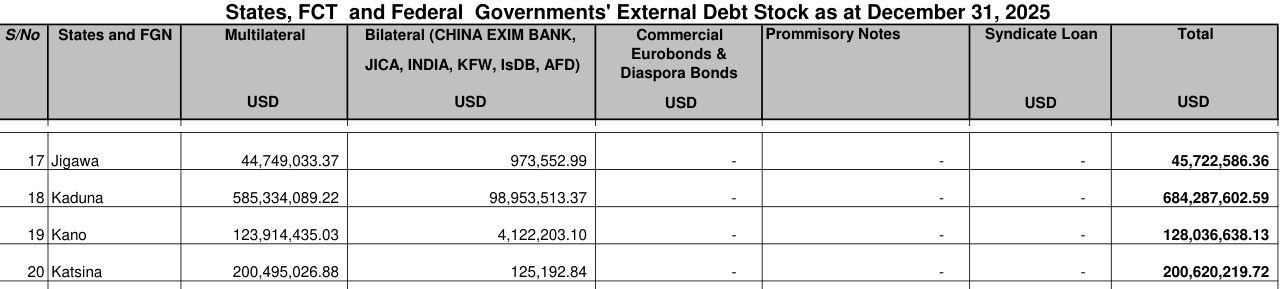
The federal record supports the total. The Debt Management Office's table of states' external debt at 31 December 2025 gives Katsina $200,620,219.72, split into $200,495,026.88 multilateral and $125,192.84 bilateral. Its table for 31 December 2024 gives $100,461,044.55. Both match the state's accounts to the cent. The office's table for 30 June 2026 puts Katsina at $240,768,640.33, a further $40,148,420.61 in six months. The DMO tables give totals by type of lender, not by loan, so they confirm the size of the debt and not the names attached to it.
The accounts record far less loan money arriving in 2025 than the debt they add. Note 7 on page 21 lists "Actual Receipt 2025" by project, with separate columns for loans and grants. The loan column totals N68,993,628,852.27, of which N24,018,983,432.57 is for ACReSAL, N23,058,813,011.30 for RAAMP and N9,163,522,341.78 for the water and sanitation programme. The Auditor-General's movement table for Note 26, on page 311, records N141,287,184,270.55 of external loans "received 2025", N72,293,555,418.28 more than Note 7's loan receipts. That table does reconcile with itself: N154,237,841,697.62 at the start of the year, plus N141,287,184,270.55 received, less N6,575,518,800.09 paid and N1,007,330,612.74 of adjustment, gives N287,942,176,555.34, within one kobo of the balance sheet.
ACReSAL shows the size of the gap. At the accounts' own rate, its $65,212,454.12 is N93,596,826,900.27. The Auditor-General's revenue notes record N22,768,372,862.60 of ACReSAL receipts in 2024 and the accounts N24,018,983,432.57 in 2025, together N46,787,356,295.17, about half. No ACReSAL line appears in the state's end-2024 debt list, whose total the DMO matches, although money for the project was received in 2024. One possible reading is that the 2025 lines bring onto the books loans drawn over several years, or drawn on the state's behalf; the documents do not say so, and they do not give a drawdown schedule for any of the four.
The statements also count the loan money as income. The Consolidated Statement of Financial Performance on page 6 includes "Capital Reciepts" of N68,993,628,852.27, the loan column of Note 7, in Total Revenue of N528,692,670,581.02, and reports a surplus for the year of N152,982,393,649.24. Without the loan receipts, the surplus would be N83,988,764,796.97. The debt itself is not hidden: it appears in full as a liability on the balance sheet, which shows total borrowings of N302,406,353,115.38, against N229,485,590,687.94 a year earlier.
On domestic debt, the record is largely consistent and the state's account is supported. Domestic borrowings fell from N75,247,748,990.32 to N14,464,176,560.05, a fall of N60,783,572,430.27. The Auditor-General's notes explain most of it: four federal facilities, the salary bailout (N7,982,860,163.94), budget support (N11,706,425,969.00), the excess crude infrastructure loan (N7,446,291,253.90) and the bridging facility (N18,043,082,742.84), together N45,178,660,129.68, "have been liquidated by the Federal Government of Nigeria" with "no more deductions from FAAC", and the state's Sukuk bond fell by N10,751,990,000.00 to N11,432,725,208.00. The DMO's figure for Katsina's domestic debt at 31 December 2025, N14,109,376,761.49, is N354,799,798.56 below the accounts. Its figure for the end of 2024, N25,679,586,232.65, is N49,568,162,757.67 below the N75,247,748,990.32 the accounts give for that date, a difference neither document explains.
The Auditor-General, Dr Anas Tukur A., signed an unqualified opinion that the statements "show a true and fair view of the Financial Position of the Government of Katsina State". The statement of responsibility is signed by the Accountant General, Malam Nura Tela. The statements and the audit report were posted on the state government's website in June 2026, under Governor Dikko Umaru Radda, whose administration took office in May 2023.
More foreign borrowing is planned. The 2026 approved budget summary, reprinted in the Auditor-General's report on page 259, expects N125,328,174,156.35 of loans in 2026, of which N122,128,174,156.35, or 97.45 per cent, is international, in a budget of N897.87 billion. For a state whose foreign debt doubled in 2025 and rose again by June 2026, the borrowing note is where a reader would expect to find which lender is owed what. In the 2025 accounts, the four largest new entries in that note carry the names of the state's own lending schemes.
None of this shows that money is missing or misused. The DMO's figures confirm that Katsina owes what its accounts say it owes in total, and the Auditor-General's schedule supplies project names that fit known donor-supported programmes. What the documents do not settle is who lent the $87,585,874.07, on what terms, when it was drawn, and why the Accountant-General's note, the version certified as true and fair, labels it with the names of the state's receivables.
What this rests on
Three primary records, all downloaded on 29 October 2026 and read for this report: (1) Katsina State Office of the Accountant General, Financial Statements for the Year Ended 31st December, 2025 (103 pages, katsinastate.gov.ng, PDF created 23 June 2026), Note 26 Borrowings (p.56), Note 21 Receivables (p.30), Note 7 Capital Receipts (p.21), Consolidated Statement of Financial Performance (p.6), Statement of Financial Position (p.7), audit certificate (p.4); (2) Report of the Auditor General on the Accounts of the Government of Katsina State of Nigeria for the Year Ended 31st Dec 2025 (384 pages, katsinastate.gov.ng), Debt Profile (pp.135 to 137), External Debt Portfolio (pp.138 to 139), Notes to Debt Profile (p.141), revenue notes XXVIII (pp.43 to 44), reprinted 2026 budget summary (p.259), Note 26 movement table (p.311) and reprinted Note 26 (p.334); (3) Debt Management Office tables: States, FCT and Federal Governments' External Debt Stock as at December 31, 2025, the same at December 31, 2024 and at June 30, 2026, and States and FCT Domestic Debt Stock as at December 31, 2025 and Q4 2024. Arithmetic re-done: $200,620,219.72 - $100,461,044.55 = $100,159,175.17 (99.70 per cent); four lines $65,212,454.12 + $10,825,002.49 + $1,352,157.40 + $10,196,260.06 = $87,585,874.07, which is 87.45 per cent of the rise; $87,585,874.07 x 1,435.26 = N125,708,501,617.71; $200,620,219.72 x 1,435.26 = N287,942,176,555.33 (printed); 2024 rate implied N154,237,841,697.62 / $100,461,044.55 = N1,535.30; Note 7 loan column 11,309,714,223.40 + 0 + 9,163,522,341.78 + 23,058,813,011.30 + 326,196,961.22 + 266,398,882.00 + 24,018,983,432.57 + 850,000,000.00 = N68,993,628,852.27 (printed); N141,287,184,270.55 - N68,993,628,852.27 = N72,293,555,418.28; movement N154,237,841,697.62 + N141,287,184,270.55 - N6,575,518,800.09 - N1,007,330,612.74 = N287,942,176,555.34 against N287,942,176,555.33 printed; ACReSAL $65,212,454.12 x 1,435.26 = N93,596,826,900.27 and N22,768,372,862.60 + N24,018,983,432.57 = N46,787,356,295.17; surplus N152,982,393,649.24 - N68,993,628,852.27 = N83,988,764,796.97; total borrowings N287,942,176,555.33 + N14,464,176,560.05 = N302,406,353,115.38 and N154,237,841,697.62 + N75,247,748,990.32 = N229,485,590,687.94; domestic N75,247,748,990.32 - N14,464,176,560.05 = N60,783,572,430.27; federal facilities N7,982,860,163.94 + N11,706,425,969.00 + N7,446,291,253.90 + N18,043,082,742.84 = N45,178,660,129.68; Sukuk N22,184,715,208.00 - N11,432,725,208.00 = N10,751,990,000.00; 2025 domestic N11,432,725,208.00 + N1,437,018,471.62 + N1,594,432,880.43 = N14,464,176,560.05; DMO gaps N14,464,176,560.05 - N14,109,376,761.49 = N354,799,798.56 and N75,247,748,990.32 - N25,679,586,232.65 = N49,568,162,757.67; DMO June 2026 $240,768,640.33 - $200,620,219.72 = $40,148,420.61; 2026 budget N122,128,174,156.35 / N125,328,174,156.35 = 97.45 per cent.
What this does not establish
Who lent the $87,585,874.07 recorded under the Kaseed and KTARDA labels, on what terms, and when it was drawn: the Auditor-General's schedule names projects but leaves the creditor column blank, and the DMO tables give totals by lender type only. Whether the labels in Note 26 are a clerical carry-over from the receivables note or something else. Why external loans received in 2025 are N141,287,184,270.55 in the debt movement table and N68,993,628,852.27 in Note 7, and whether the 2025 lines include loans drawn in earlier years or on the state's behalf by federal agencies. Why the DMO's end-2024 domestic figure for Katsina is N49,568,162,757.67 below the accounts. Nothing in the documents suggests that any money is missing or misused, and none is alleged. The Katsina State Government, its Accountant General and its Auditor-General were not asked for comment before publication; the figures above are their own and the DMO's, set against each other.
What we did ourselves
Downloaded the Accountant-General's 2025 financial statements and the Auditor-General's 384-page report from the Katsina State Government website and the DMO's state debt tables for end-2024, end-2025 and mid-2026. Set the borrowings note against the receivables note in the same statements, which showed four new dollar debt lines carrying the names of naira receivables. Matched the four amounts to the Auditor-General's external debt portfolio, which names four donor-financed projects. Checked the external and domestic totals against the DMO tables for both year-ends. Set the debt added in 2025 against the loan receipts recorded in Note 7 and the Auditor-General's movement table, and re-added every total.
Sources for this report
(A) Katsina State Government, Office of the Accountant General, Financial Statements for the Year Ended 31st December, 2025, Notes 7, 21 and 26; Report of the Auditor General on the Accounts of the Government of Katsina State of Nigeria for the Year Ended 31st Dec 2025, External Debt Portfolio (pp.138 to 139), Notes to Debt Profile (p.141) and Note 26 movement table (p.311); Debt Management Office, States, FCT and Federal Governments' External Debt Stock as at December 31, 2025 and December 31, 2024.
- Katsina State Government, Financial Statements for the Year Ended 31st December, 2025 (Office of the Accountant General, 103 pages) · Katsina State Office of the Accountant General · June 2026
- Report of the Auditor General on the Accounts of the Government of Katsina State of Nigeria for the Year Ended 31st Dec 2025 (384 pages) · Office of the Auditor General for the State, Katsina · June 2026
- States, FCT and Federal Governments' External Debt Stock as at December 31, 2025 · Debt Management Office · 2026
- FGN, 36 States and FCT External Debt Stock as at December 31, 2024 · Debt Management Office · 2025
- States, FCT and Federal Governments' External Debt Stock as at June 30, 2026 · Debt Management Office · 2026
- States and FCT Domestic Debt Stock as at December 31, 2025 · Debt Management Office · 2026
- 36 States and FCT Q4 2024 Domestic Debt · Debt Management Office · 2025
Confidence: high. This is our own assessment of whether the event occurred as described, separate from the grade, which describes what kind of thing the claim rests on.
Not obtained: where the underlying document is named above but not linked, we did not hold a copy at the time of publication. We purchase nothing and request nothing in our own name.
Corrections
None on this report. If you find an error, it will be published here, at the same length, with the date it was found, and the original wording will remain visible above it.

Dr VeroInvestigations editor, Vero Record
Reads the Nigerian public record that others leave unread: budgets, audit reports, court files and registers. Every claim on this page carries the grade of the document behind it, and the report says what that document does not establish.
All 151 reportsHow we grade evidenceAdd Vero Record as a preferred source on Google