
Bauchi's audit report counts N110.02 billion of foreign loans in one table and drops them from the next, turning a rise in capital receipts into a 30 per cent fall
The Bauchi State Auditor-General's report on the 2025 accounts, signed in May 2026 and posted on the state website at the end of July, gives the state's 2025 capital receipts as N177.14 billion, N152.87 billion and N67.12 billion in different tables. The smallest figure leaves out N110.02 billion of external loans, and the report uses it to describe a 30.45 per cent fall from 2024. The same report puts Bauchi's loan stock at N441.69 billion and its total debt stock at N494.34 billion, and certifies the accounts as true and fair.
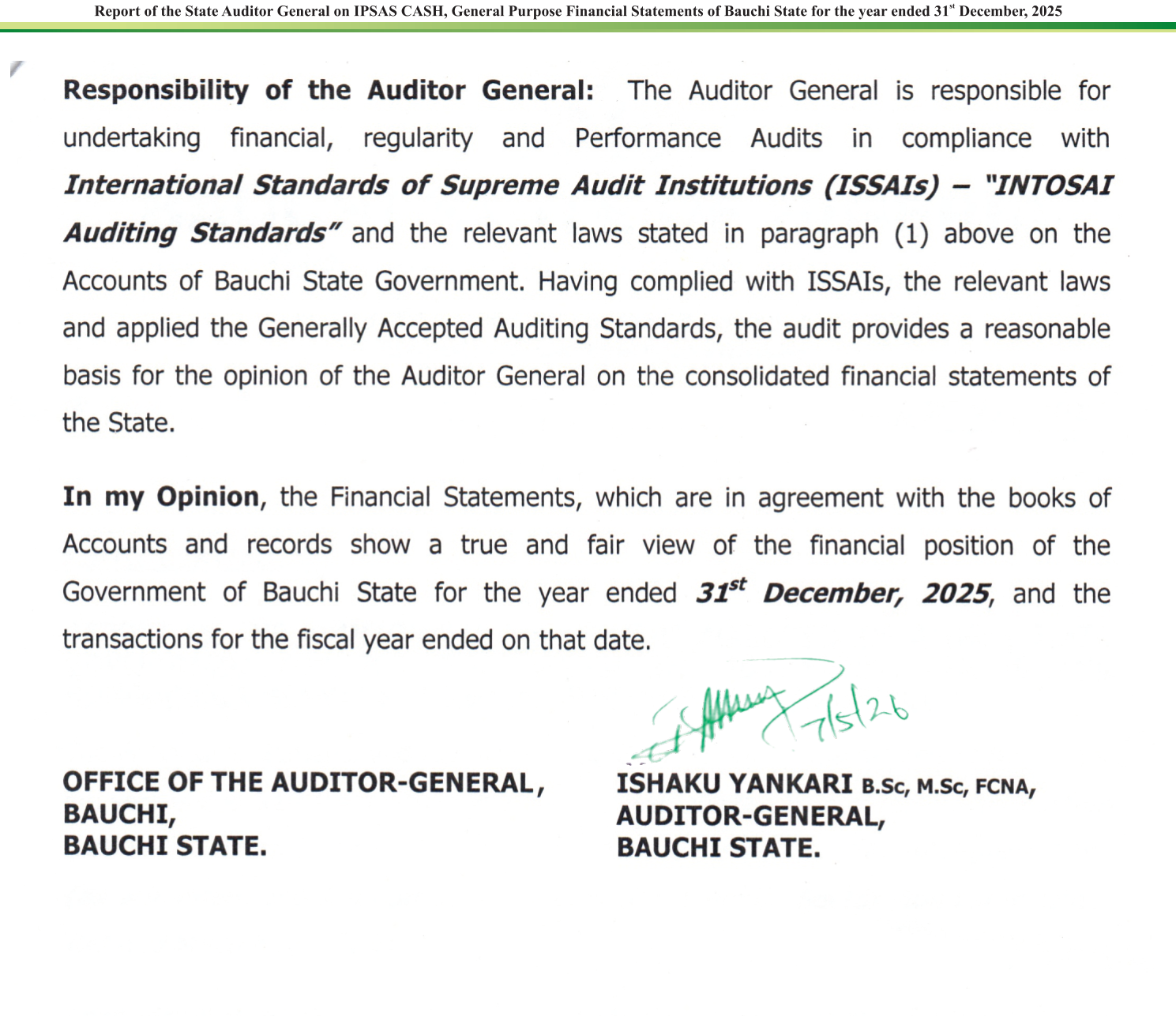
Bauchi State's Auditor-General, Ishaku Yankari, has certified the state's 2025 accounts as showing "a true and fair view of the financial position of the Government of Bauchi State for the year ended 31st December, 2025." His opinion, with the handwritten date 7/5/26 (7 May 2026) beside his signature, opens a 156-page report titled "Report of the State Auditor General on the Accounts of Bauchi State Government FY 2025". The state website's sitemap shows the report's download page was last modified on 30 July 2026, and the Accountant-General's audited financial statements for 2025 were posted on 31 July 2026. Vero Record downloaded the report from bauchistate.gov.ng and read it in full. Every figure below comes from it unless we say otherwise.
The report gives three different figures for one number: the capital money Bauchi received in 2025, meaning grants, domestic borrowing and foreign borrowing. Table 4 on page 21, "Budget Performance of Capital Receipts", lists N24,270,012,596.04 in aids and grants, N42,847,361,068.92 under "Other Capital Receipts" and N110,018,391,045.96 in "International/External Loans/ Borrowing Receipts". The total is N177,135,764,710.92, against a final budget of N210,745,353,172.00, or 84.05 per cent. We re-added the three lines and they come to that total.
The five-year highlights table on page 5 has a row called "Other Capital Receipts" and puts it at N152,865,752,114.88 for 2025. That is exactly the N42,847,361,068.92 of domestic receipts plus the N110,018,391,045.96 of external loans. Grants appear on a separate line in that table. On that basis, the 2024 figure in the same row is N96,501,131,517.67.
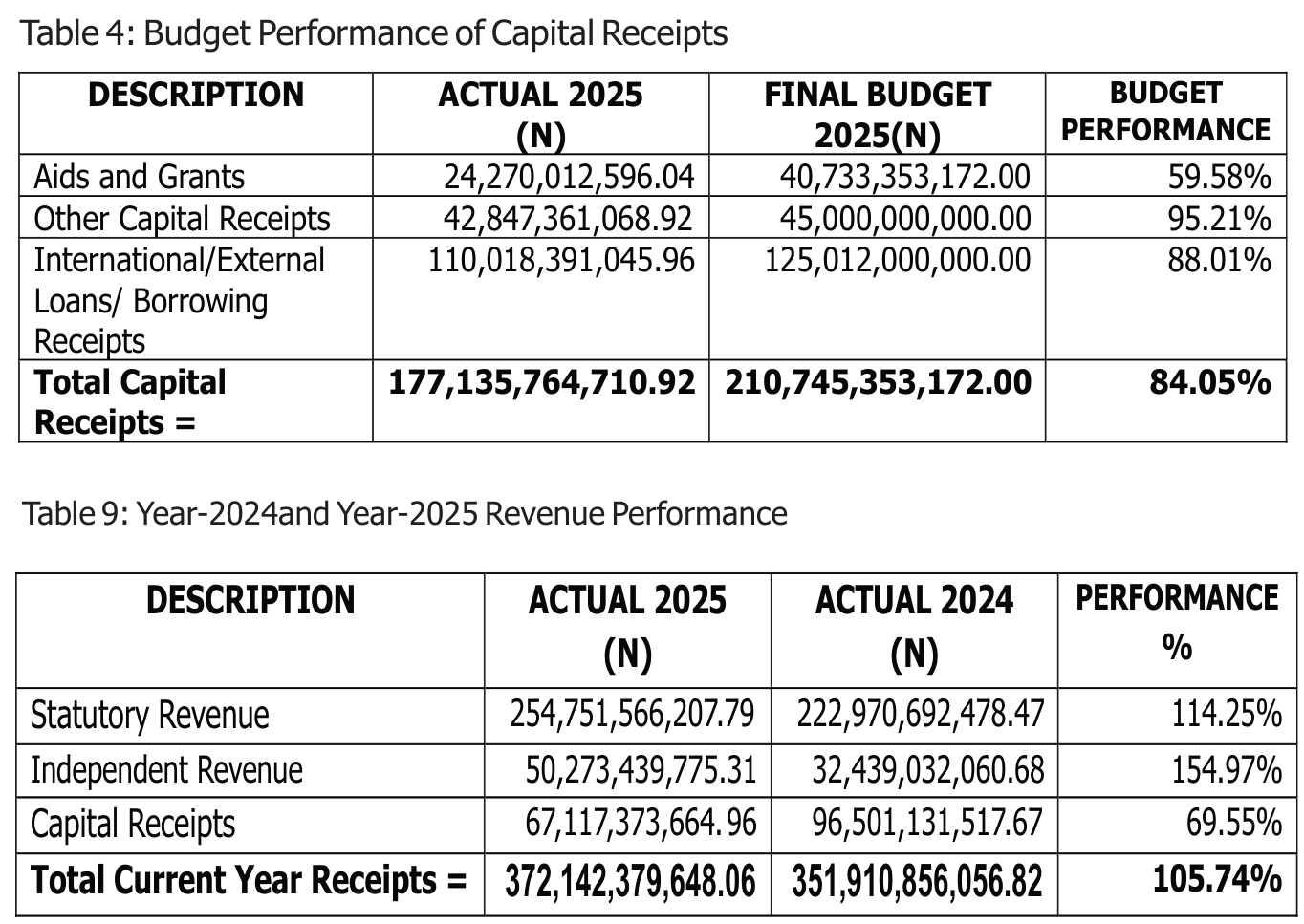
Table 9 on page 36, "Year-2024 and Year-2025 Revenue Performance", gives a third figure. It shows 2025 capital receipts of N67,117,373,664.96 against N96,501,131,517.67 for 2024, and calls the result 69.55 per cent. N67,117,373,664.96 is what remains of the Table 4 total once the N110,018,391,045.96 of external loans is taken out. The 2024 comparator is the same N96,501,131,517.67 that the five-year table shows under the heading that includes loans.
The report builds its year-on-year account on that third figure. "Capital Receipts saw a substantial 30.45% decrease, from N96,501,131,517.67 in 2024 to N67,117,373,664.96 in 2025," it says on page 35, a fall of N29,383,757,852.66. As possible causes it lists "Lower realization of External/Internal Loans", "Poor performance on Other Capital Revenue sources" and "Reduction in Grants or Aids", and it concludes that 2025 "reflects a notable contraction compared to 2024, indicating reduce capital financing capacity".
Vero Record's own arithmetic, which is analysis and not a figure printed in the report, gives a different result. Measured the way the five-year table measures it, Bauchi's borrowing receipts rose from N96,501,131,517.67 in 2024 to N152,865,752,114.88 in 2025, an increase of N56,364,620,597.21, or about 58 per cent. Add the N24,270,012,596.04 of grants and 2025 capital receipts reach the N177,135,764,710.92 in Table 4. We found no 2025 figure in the report, on any basis, that is lower than the 2024 one except the figure that leaves out the foreign loans.
The report's descriptions of the foreign loans also conflict. Page 20 says external borrowing reached 88.01 per cent of the N125,012,000,000.00 budgeted and then, in the same paragraph, refers to "the absence of international loans" and to "a strategic choice to avoid external debt". Page 22 says external loans made up 62.10 per cent of capital receipts, and then discusses that 62 per cent as if it were a performance rate against budget: "loan inflows were partially realized but did not fully meet expectations". The first figure is about performance against budget and the second is a share of the total. The report treats them as one measure.
There are smaller slips as well. On page 9 the report gives actual revenue as "N482,160,770.02". The table on the next page gives N482,160,770,694.02, which is N254,751,566,207.79 of statutory revenue, N50,273,439,775.31 of independent revenue and N177,135,764,710.92 of capital receipts added together. Table 9's "Total Current Year Receipts" of N372,142,379,648.06 is that same total less the external loans. On page 41 the report gives the state's "Trust and Other Public Funds" as N52,652,239,780.43. That is the same amount, to the kobo, as the domestic arrears total in the paragraph before it, but the report gives a different 2024 base for each (N44,257,369,008.69 for trust funds and N44,638,799,403.09 for arrears).
On debt, page 41 puts Bauchi's external and internal loans at N441,686,610,070.77 at 31 December 2025, up from N386,127,310,422.89 a year earlier. It breaks the 2025 figure into N316,569,334,822.92 of external loans, N61,299,783,647.30 of bonds, treasury bonds and a bridging facility, and N63,817,491,600.55 of internal loans from other funds. Those three lines add up to the stated total. Our subtraction gives an increase of N55,559,299,647.88. The report prints N55,559,299,648.77, which is 89 kobo more.
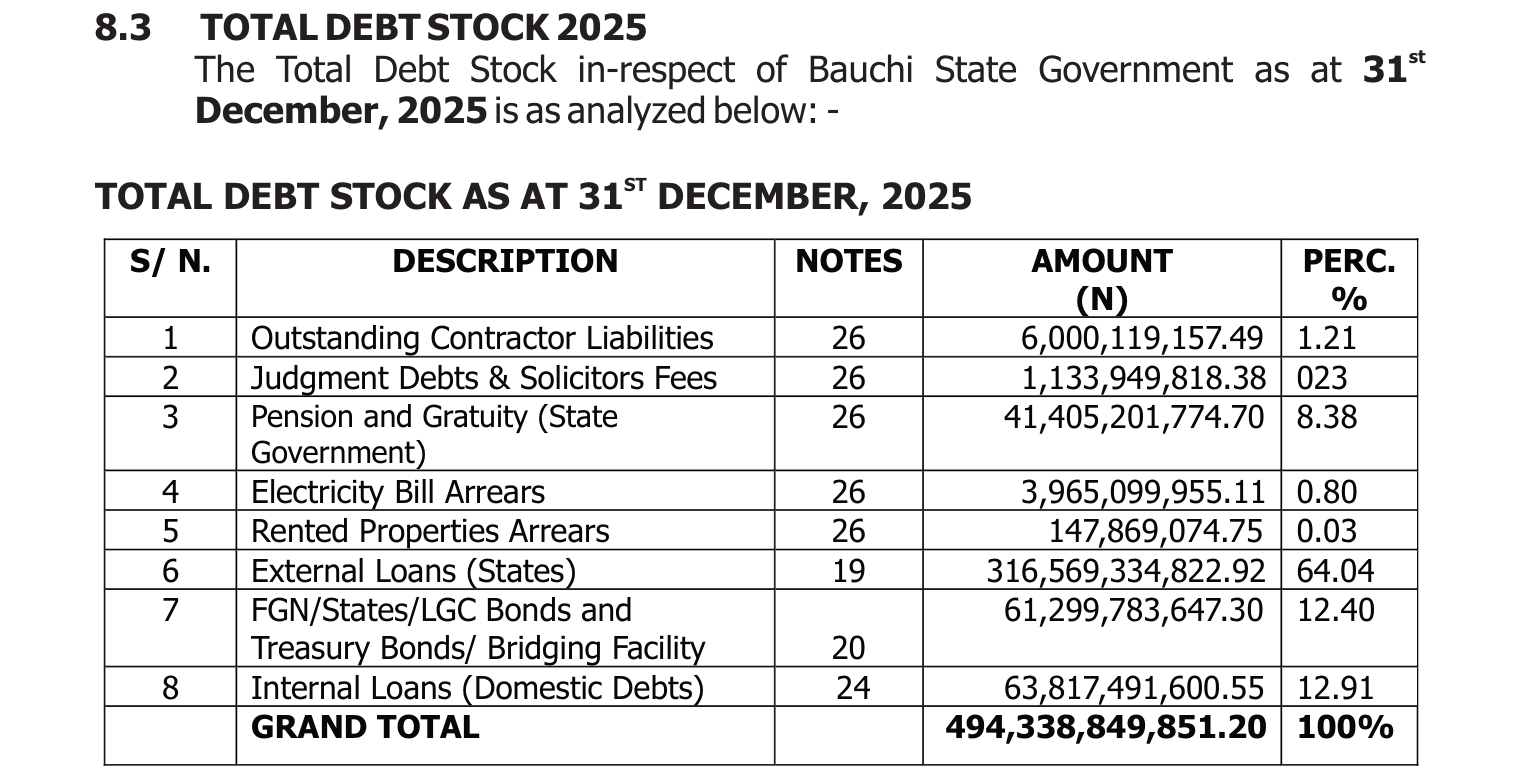
The "Total Debt Stock" table on page 48 adds the domestic arrears to those loans. The arrears are N41,405,201,774.70 of state pension and gratuity, N6,000,119,157.49 owed to contractors, N3,965,099,955.11 of electricity bills, N1,133,949,818.38 of judgment debts and solicitors' fees and N147,869,074.75 of rent. With them the grand total is N494,338,849,851.20, and our re-addition matches it. External loans are 64.04 per cent of that total. The report says it converted foreign debt at N1,436.25 to the dollar, the DMO rate at 31 December 2025. At that rate the external loans come to about $220.4 million, which is our conversion.
Read side by side, the report's own figures raise a question it does not answer. It records N152,865,752,114.88 of new borrowing received in 2025, but loan stock rose by only N55,559,299,647.88. The report puts public debt charges for the year at N59,593,610,619.30 and does not split that amount into interest and principal repaid. The year-end exchange rate also affects the naira value of foreign loans. Without the notes to the accounts, Vero Record cannot say how much of the difference repayments or currency movements explain. We are not suggesting that any money is missing. We are saying the published report does not reconcile the two figures.
The report also records how the audit was done. It says the Accountant-General's statements arrived on 30 March 2026 under letter OAG/TD/S/363/V.II, and that the audit ran late because of queries, which the Accountant-General "finally responded" to in a letter "dated 30 March, 2026", the same day the statements arrived. In his general observations the Auditor-General asks again for monthly cash-flow statements and internal audit reports to be copied to his office. He notes N271,179,120.86 of unretired imprest and N641,962,314.76 of outstanding advances, and says no effort had been made to retire the imprest "despite my recommendation in my 2024 Report".
Other parts of the report are internally consistent. Statutory allocation and VAT come to N254,751,566,207.79. Independent revenue reached N50,273,439,775.31, or 99.00 per cent of budget, although revenue lines budgeted at N5,809,343,830.00 collected nothing. Capital spending was N191,198,000,096.14, which is 61.58 per cent of the N310,446,570,051.56 budgeted, and N151,391,741,287.15 of it went to the economic sector. Social services received N31,531,135,400.43 of an N87,831,702,930.60 budget, or 35.89 per cent.
Bauchi's accounts are prepared on the IPSAS cash basis. Under that standard, borrowing shows up as cash received and debt shows up only in the notes, so the capital receipts line is the main place a reader can see in a single figure how much the state borrowed. The Auditor-General's year-on-year table leaves the state's single largest capital inflow out of that line.
The Accountant-General's audited financial statements for 2025, posted separately on 31 July 2026, are a 74-page scanned document with no text layer. Vero Record has not checked the notes on loans (Notes 19, 20 and 24) against the Auditor-General's report, and this article does not rely on them. We have not had a response from the Office of the Auditor-General or the Office of the Accountant-General of Bauchi State on which capital receipts figure is correct, on the "absence of international loans" passage, or on how the N152.87 billion of 2025 borrowing reconciles with the N55.56 billion rise in loan stock.
What this rests on
Entirely on the Auditor-General's own report, read in full: Table 4 (p.21), five-year highlights (p.5), Table 9 and text (pp.35-36), capital receipts text (pp.20, 22), liabilities (p.41), debt stock table (p.48), audit opinion (p.xxii). All totals re-added with decimal arithmetic. The 58 per cent rise and the dollar conversion are Vero Record's arithmetic (grade C, labelled as such).
What this does not establish
Why the year-on-year table excludes external loans; whether the 2024 comparator of N96.50bn includes loans (the five-year table implies it does, but the 2024 breakdown is not in this report); how N152.87bn of 2025 borrowing reconciles with a N55.56bn rise in loan stock (repayments, exchange-rate movements, or other); the content of the scanned FY2025 audited financial statements notes 19, 20 and 24. There has been no response from the Bauchi Auditor-General or Accountant-General. Nothing here suggests that any money is missing or that anyone committed wrongdoing.
What we did ourselves
The finding comes from Vero Record reading the full report and reconciling its tables. We found no press coverage of the three capital receipts figures.
Sources for this report
(A) Report of the State Auditor General on the Accounts of Bauchi State Government FY 2025 (156 pages; opinion signed with handwritten date 7/5/26; download page last modified 30 July 2026), bauchistate.gov.ng download_id=3859
- Report of the State Auditor General on the Accounts of Bauchi State Government FY 2025 (PDF) · Office of the Auditor-General, Bauchi State · 2026-05-07
- Download page: Report of the State Auditor General on the Accounts of Bauchi State Government FY 2025 · Bauchi State Government · 2026-07-30
- Bauchi State website sitemap (sdm_downloads) · Bauchi State Government · 2026-10-01
- Auditor General Publications (listing page) · Bauchi State Government · 2026-10-01
- Bauchi State Audited Financial Statements FY 2025 (scanned PDF, 74 pages) · Office of the Accountant-General, Bauchi State · 2026-07-31
- File:Top view of bauchi state capital Nigeria.jpg · Wikimedia Commons

Confidence: high. This is our own assessment of whether the event occurred as described, separate from the grade, which describes what kind of thing the claim rests on.
Not obtained: where the underlying document is named above but not linked, we did not hold a copy at the time of publication. We purchase nothing and request nothing in our own name.
Corrections
None on this report. If you find an error, it will be published here, at the same length, with the date it was found, and the original wording will remain visible above it.