
CBN's rate reset rests on inflation figures that match NBS's own files. The communique does not mention that food inflation rose in June and July
We checked every price figure in Monetary Policy Communique No. 164 against the National Bureau of Statistics' August, July, June and May 2026 CPI reports and spreadsheets. The numbers are copied correctly. The fuller NBS series shows a slower, more uneven decline than the communique describes, and the 3.5-point cut changes the corridor more at the top than at the bottom.
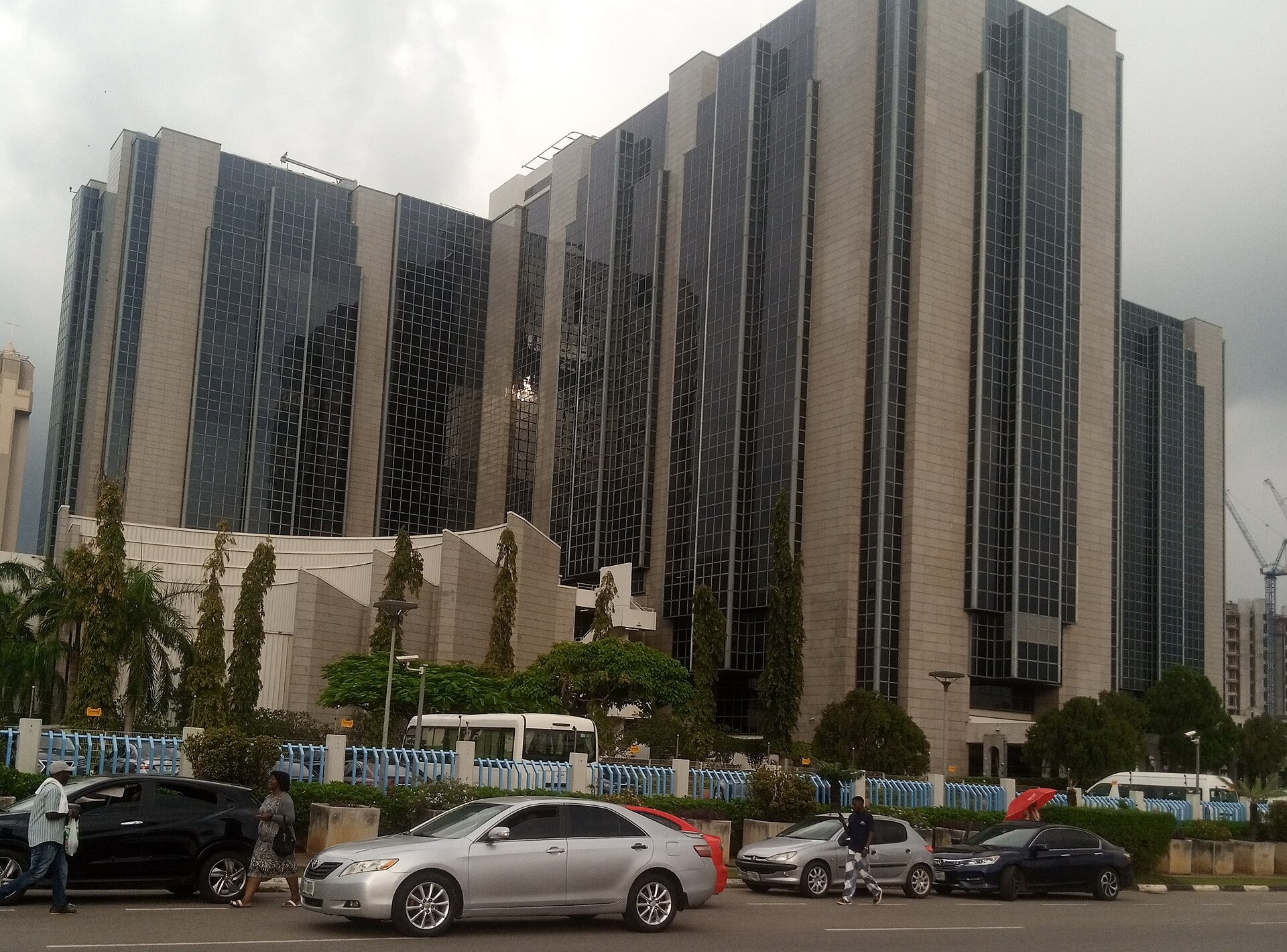
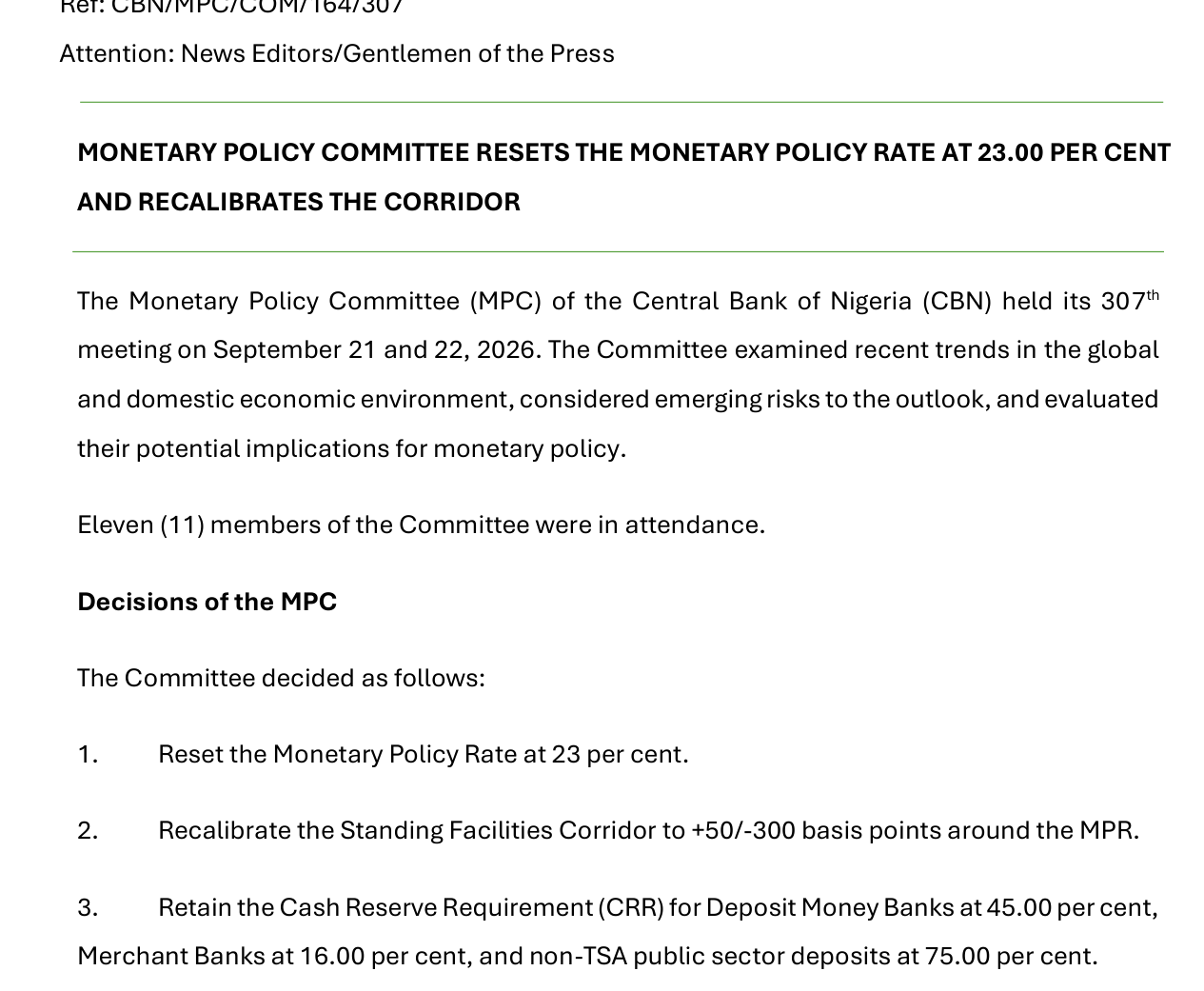
The Central Bank of Nigeria's Monetary Policy Committee ended its 307th meeting on 22 September 2026 by resetting the Monetary Policy Rate (MPR) at 23 per cent, down from the 26.5 per cent it had held since February. The decision is set out in Monetary Policy Communique No. 164, reference CBN/MPC/COM/164/307, a five-page document signed by Governor Olayemi Cardoso and posted on the CBN website. It records that eleven members attended, that the Standing Facilities Corridor was recalibrated to +50/-300 basis points around the MPR, and that the Cash Reserve Requirement was left at 45.00 per cent for deposit money banks, 16.00 per cent for merchant banks and 75.00 per cent for non-TSA public sector deposits.
The communique is careful about how the cut should be read. It calls the move an 'operational reset' and says the Committee 'emphasized that the recalibration of the corridor does not constitute a change in the current monetary policy stance.' The reason given is that 'the observed divergence between the MPR and the prevailing market rates had weakened the effectiveness of monetary policy transmission.' The document does not state what those market rates were, how wide the divergence had become, or over what period; it refers only to the adoption of NOFR as a 'transaction-based operational benchmark.'
The Committee also leaned on inflation. The communique says headline inflation 'slowed to 15.39 per cent in August 2026 from 15.43 per cent in the preceding month', that food inflation fell to 19.57 per cent from 20.31 per cent, that core inflation fell to 13.29 per cent from 14.97 per cent, that the 12-month moving average fell to 16.30 per cent from 16.89 per cent, 'marking twenty (20) consecutive months of moderation', and that month-on-month headline inflation slowed to 0.71 per cent from 1.57 per cent. It describes 'three consecutive months of decline in headline inflation.'
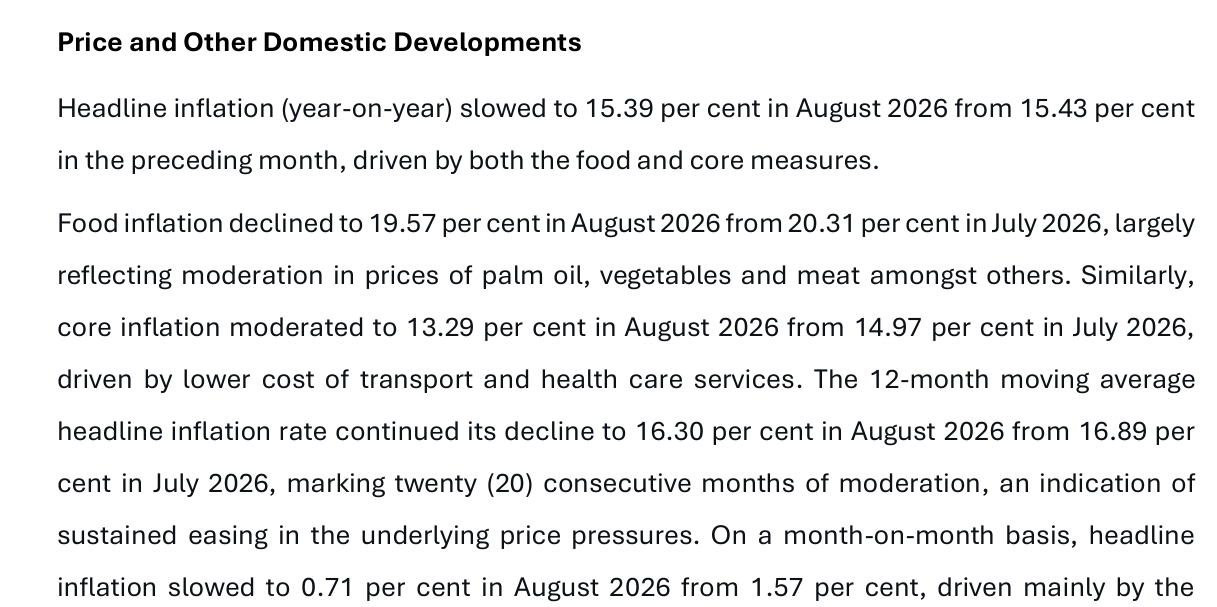
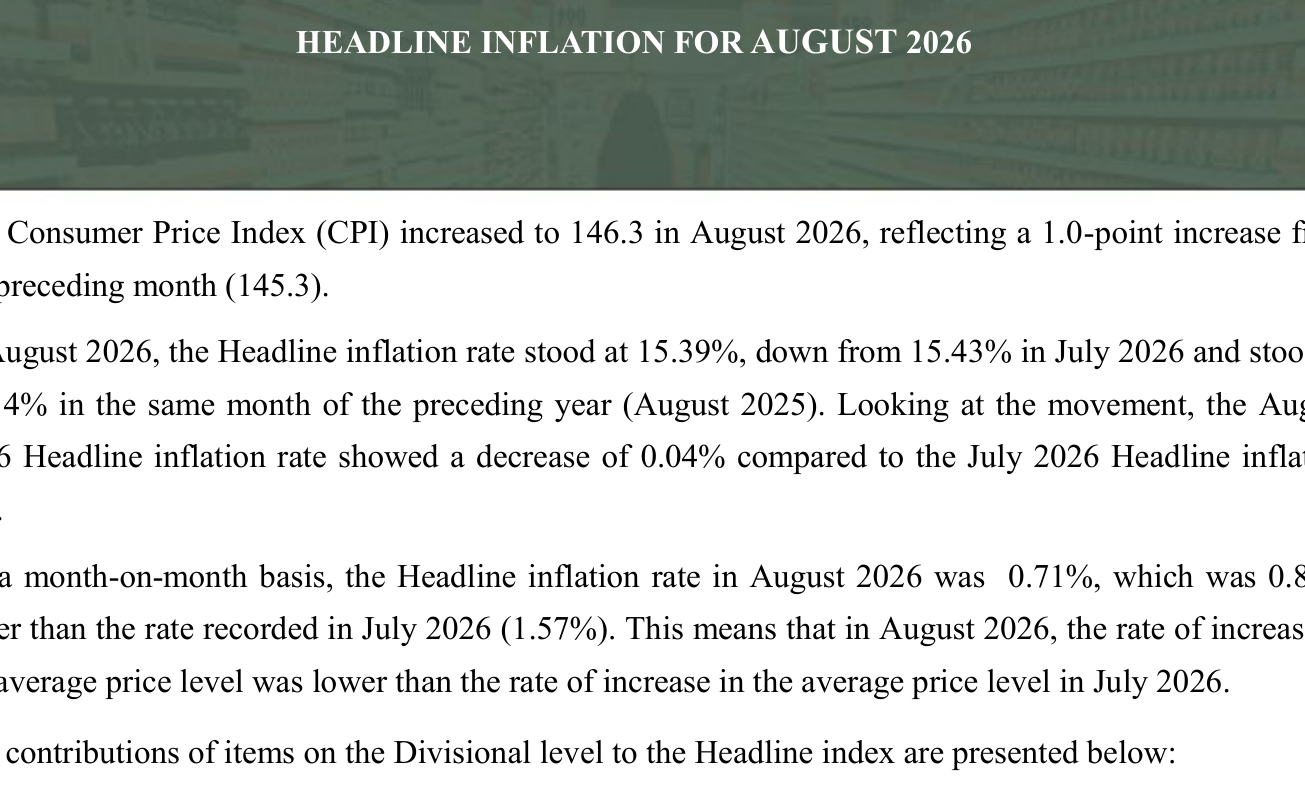
To test those figures we downloaded the National Bureau of Statistics' CPI releases for May, June, July and August 2026 from the NBS microdata portal, where each month is published as a zip file containing a PDF report and an Excel workbook (the NBS e-library pages we checked did not list any CPI report after 2024). We read the reports and compared the communique line by line against both the text and the index table in the August workbook, which rebases prices to 2024 = 100.
Every price figure in the communique matches the NBS record. The August 2026 CPI report gives headline inflation of 15.39 per cent, down from 15.43 per cent in July; a month-on-month rate of 0.71 per cent against 1.57 per cent in July; food inflation of 19.57 per cent; core inflation, which NBS defines as all items less farm produce and energy, of 13.29 per cent; and a twelve-month average rate of 16.30 per cent. The July report gives 20.31 per cent for food and 14.97 per cent for core. We also checked whether NBS had quietly revised earlier months between releases: the June, July and August workbooks carry identical index values for March to July 2026, so the communique is comparing like with like.
The claim of 20 consecutive months of moderation in the 12-month average also holds. In the August workbook's Table 1, the 12-month average change peaks at 33.24 per cent in December 2024 and falls in every month from January 2025 to August 2026, which is 20 months by our count. The 'three consecutive months' of headline decline also hold on the NBS figures: 15.93 per cent in May, 15.91 per cent in June, 15.43 per cent in July and 15.39 per cent in August.
What the NBS series adds is the size and shape of that decline. The three monthly falls were 0.02, 0.48 and 0.04 percentage points, a combined 0.54 points (our arithmetic, Grade C). The month before the run began, headline inflation had risen, from 15.69 per cent in April to 15.93 per cent in May, and the headline rate in August 2026 was slightly higher than the 15.10 per cent NBS recorded for January 2026 and the 15.06 per cent for February, when the MPC last cut the rate. On the NBS numbers, headline inflation has sat in a band between about 15.1 and 15.9 per cent for the whole of 2026.
Food is where the communique's summary is narrowest. It reports only the August fall, from 20.31 to 19.57 per cent. The NBS reports show that food inflation was 16.96 per cent in May, rose to 17.52 per cent in June and then to 20.31 per cent in July, before easing in August. On a month-on-month basis, food prices rose 2.98 per cent in May, 3.75 per cent in June and 5.56 per cent in July, according to NBS, before slowing to 1.02 per cent in August. So the August food figure the Committee cites is still almost 2.6 points above where food inflation stood in May (our arithmetic, Grade C). The communique does not mention the June and July increases.
The core figure deserves a note. The communique's 13.29 per cent is NBS's 'all items less farm produce and energy' measure, taken from the August report. The August workbook also carries a second, older series, 'All items less farm produce', which still includes energy; it shows 12.64 per cent for August and 14.08 per cent for July. Both series fell. The workbook's Table 1 also shows that the less-farm-produce index was lower in August (142.06) than in June (142.25), so prices on that measure dropped slightly for two months running. The communique puts the core decline down to 'lower cost of transport and health care services'; the NBS report gives month-on-month core inflation of -0.06 per cent in August.
The NBS report also shows a split the communique does not discuss. Urban month-on-month inflation fell to 0.28 per cent in August from 1.90 per cent in July. Rural month-on-month inflation rose, to 1.79 per cent from 0.78 per cent. On a year-on-year basis urban inflation was 15.88 per cent and rural inflation 14.23 per cent.
The other figures in the communique that we checked against published sources also agree. The Q2 2026 GDP growth rate of 4.43 per cent, up from 3.89 per cent in Q1, with the oil sector at 7.31 per cent and the non-oil sector at 4.31 per cent, matches the NBS release as reported by several outlets on 31 August and 1 September (Grade B; we did not download the NBS GDP report for this piece). The communique says the current account surplus 'increased by 67.92 per cent to US$7.54 billion in Q2 2026, from US$4.49 billion.' Using the rounded figures printed in the document we get 67.93 per cent, a difference that unrounded underlying values would account for (our arithmetic, Grade C). We did not independently verify the US$55.25 billion gross reserves figure for 18 September or the balance of payments figures.
Leaving aside whether the cut changes the 'stance', the corridor arithmetic shows how much it moves (our calculation from the decisions in this communique and the previous one, Grade C). With the MPR at 26.5 per cent and a corridor of +50/-450 basis points, the standing lending rate stood at 27.0 per cent and the standing deposit rate at 22.0 per cent. With the MPR at 23 per cent and a corridor of +50/-300, they are now 23.5 per cent and 20.0 per cent. The ceiling at which banks borrow from the CBN fell by 3.5 percentage points. The floor at which the CBN pays on deposits fell by only 2 points. That fits the communique's account of bringing the MPR closer to market rates that were already trading below it, but it also means the rate banks pay when they borrow overnight from the CBN is lower.
Measured against August headline inflation of 15.39 per cent, the MPR sat 11.11 points above inflation before the meeting and sits 7.61 points above it now (our arithmetic, Grade C). This is a simple ex-post comparison, not the forward-looking real rate a central bank would use, and the communique itself gives no inflation forecast figure. It projects that inflation will 'moderate further in the short-to-medium term' and names 'election-related spendings' and Middle East tensions as upside risks.
Two record-keeping points came up during the work. The communique is filed on the CBN website under the name 'MPC_Comminique No 164 Sept 2026 MPR Corridor Recalibration.pdf', with communique misspelt, and the CBN's Monetary Policy Decisions page, which summarises each meeting, lists the 304th meeting of February 2026 twice, once above and once below the 305th meeting of May. Neither affects the substance of the decision. The CBN site blocks ordinary automated downloads, and we retrieved the PDF through a standard browser session.
In short, the Committee's statement of the inflation data is accurate to the second decimal place and consistent with NBS's own spreadsheets. What it leaves out is context the same NBS files contain: a headline rate that has barely moved all year, food inflation that climbed by more than three points in June and July before dipping in August, and rural prices speeding up in the month the Committee cites as evidence of easing. The next MPC meeting is scheduled for 23 and 24 November 2026, by which time NBS will have published its September and October CPI reports.
What this rests on
A line-by-line comparison of the communique's inflation figures against the NBS PDF reports and the Table 1 index series in the August 2026 CPI workbook, plus our own corridor and real-rate arithmetic from the decisions printed in the 306th and 307th communiques and decisions page.
What this does not establish
The size of the MPR-to-market-rate divergence the Committee cites (no NOFR or interbank figures are given in the communique and we did not pull them); the US$55.25 billion reserves figure and balance of payments figures; GDP figures rest on press reports of the NBS release (Grade B). No individual members' votes or personal statements were available to us.
What we did ourselves
Downloaded and read the communique PDF and four NBS monthly CPI packages; checked for revisions across three workbooks; recomputed the 12-month-average streak, the headline declines, the food path, the corridor bounds, the ex-post real rate and the current account percentage.
Sources for this report
(A) CBN Monetary Policy Communique No. 164 (CBN/MPC/COM/164/307), 22 September 2026, 5 pages; NBS CPI reports and Excel workbooks for May, June, July and August 2026 (microdata.nigerianstat.gov.ng catalog 154)
- Monetary Policy Communique No. 164 (307th MPC meeting) · Central Bank of Nigeria · 2026-09-22
- Monetary Policy Decisions · Central Bank of Nigeria · 2026-09
- CPI August 2026 report and workbook (CPI_AUGUST_2026_final.zip) · National Bureau of Statistics · 2026-09-15
- CPI July 2026 report and workbook · National Bureau of Statistics · 2026-08
- CPI June 2026 report and workbook · National Bureau of Statistics · 2026-07
- CPI May 2026 report and workbook · National Bureau of Statistics · 2026-06
- NBS microdata catalog 154: Consumer Price Index related materials · National Bureau of Statistics
- Nigeria's GDP Growth Accelerates to 4.43% in Q2 2026 · Voice of Nigeria
- Nigeria's Economy Records 4.43% Growth in Second Quarter of 2026 · BusinessPost
- CBN 'resets' baseline interest rate to 23% · News Agency of Nigeria
- Nigeria's Inflation Eases to 15.39% in August · PRNigeria
- Commons file: CBN Building Abuja.jpg · Wikimedia Commons (Umabruka, CC BY-SA 4.0)

Confidence: high. This is our own assessment of whether the event occurred as described, separate from the grade, which describes what kind of thing the claim rests on.
Not obtained: where the underlying document is named above but not linked, we did not hold a copy at the time of publication. We purchase nothing and request nothing in our own name.
Corrections
None on this report. If you find an error, it will be published here, at the same length, with the date it was found, and the original wording will remain visible above it.