Power training institute did not remit N2.77bn of tender fees, Auditor-General says; 2026 Act gives it N3.64bn for transformers and streetlights
The Auditor-General's 2024 report raised 11 queries on the National Power Training Institute for 2022 and 2023, led by N2,771,731,464.25 of bid-document and tender-fee proceeds it says were not remitted to the Treasury, and records "No response" to every one. Seven of the rest concern constituency projects, among them transformers and streetlights. The 2026 Appropriation Act gives the institute N19.50bn for capital: N13.93bn is a vocational training loan, and N5.02bn sits in 54 lines naming a community or constituency, N3.64bn of it for transformers and streetlights. An audit query is not a finding of wrongdoing.
The federal institute that trains workers for Nigeria's electricity industry did not remit N2,771,731,464.25 of bid-document and tender-fee proceeds to the Consolidated Revenue Fund, according to the Auditor-General for the Federation's 2024 report on non-compliance. That is one of 11 queries the auditors raised on the National Power Training Institute of Nigeria (NAPTIN) for 2022 and 2023, and the report records the same answer to every one of them: "No response." Seven of the other ten concern works and services the institute paid for as constituency projects, among them transformers and solar streetlights. Vero Record set the audit against NAPTIN's lines in the 2026 Appropriation Act. Of its N19.50 billion capital budget, N13.93 billion is a loan for vocational training. Of the rest, N5.02 billion sits in 54 lines that each name a community, local government area, federal constituency or senatorial district, and N3.64 billion of that is for transformers and streetlights.
The NAPTIN section runs from page 502 to page 513 of Volume II of the report and covers 1 January 2022 to 31 December 2023. The first query is that the institute did not give the auditors "critical documents and records required for audit examination": correspondence files with its supervising ministry, the Ministry of Power, its trial balance, general ledger, remittance inflows and outflows statement, and its 2023 financial proposal. The auditors wrote that the gap "limited audit verification and undermined accountability and transparency."
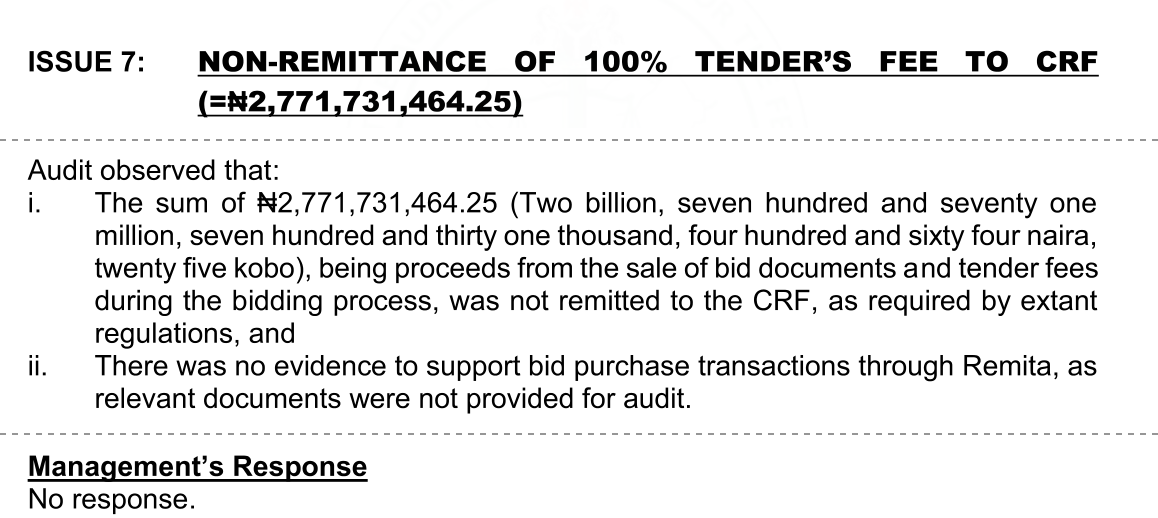
The tender-fee query, Issue 7 on page 508, cites a Treasury circular of 20 December 2021 which says that "All statutory revenue lines like tender fees, contractor's registration fees etc., should be remitted 100%." The auditors observed that N2,771,731,464.25, "being proceeds from the sale of bid documents and tender fees during the bidding process, was not remitted to the CRF, as required by extant regulations", and that there was "no evidence to support bid purchase transactions through Remita, as relevant documents were not provided for audit." They asked the Director-General to account for the sum to the Public Accounts Committees of the National Assembly and to recover and remit it. Under "Management's Response", page 509 reads: "No response." The report does not say how many bid documents were sold, at what price, or for which contracts. For scale only, N2.77 billion is 6.5 times the N423,904,359 the 2026 Act gives NAPTIN for a full year of overheads.
Six other queries concern constituency projects. Issue 2 (page 503) says contracts totalling N758,299,219.96 "awarded for various works and services under constituency projects" included N24,399,592.33 as a 5 per cent administrative charge in the bills of quantities, with no evidence that it "was requested for, approved, or utilized". Issue 3 (page 504) says contracts totalling N1,506,763,925.25 carried N10,678,497.06 as provision for certification by the Nigerian Electrical Management Services Agency, with no supporting documents provided. Issue 4 (page 505) says N17,340,224.95 of contingency in contracts totalling N1,121,537,553.09 was paid at the first interim certificate, shortly after the contracts were awarded. Issues 5 and 6 (pages 506 and 507) find withholding tax under-deducted and value added tax under-remitted on 21 constituency contracts totalling N136,861,244.31, and Issue 11 (page 513) says N29,650,030.00 of duty tour allowances, sitting allowances and honoraria was charged to the constituency project account.
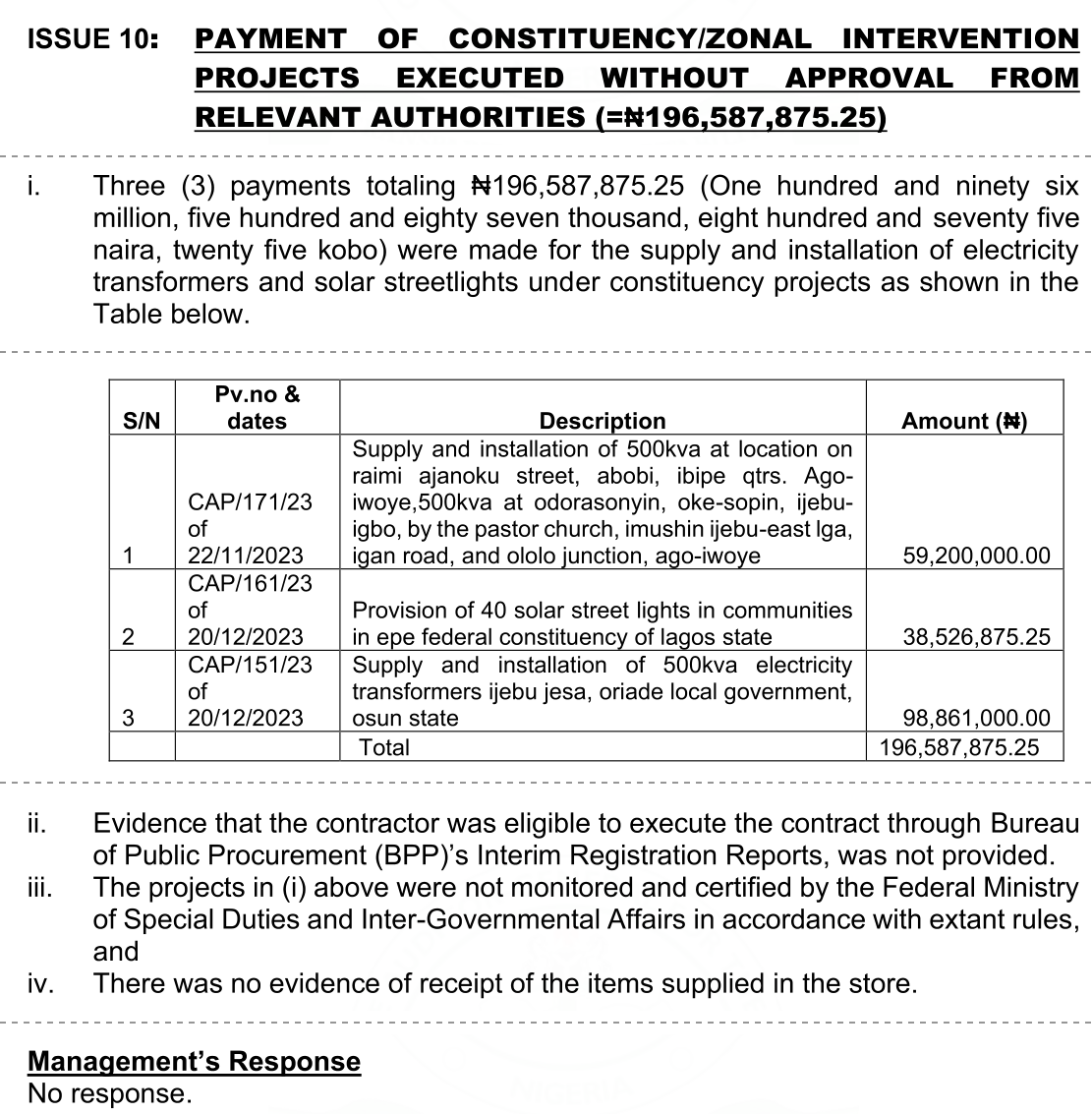
The most specific is Issue 10, on pages 511 and 512. It lists three payments "for the supply and installation of electricity transformers and solar streetlights under constituency projects": N59,200,000.00 for 500kVA transformers at locations in Ago-Iwoye and Ijebu-Igbo, Ogun State (voucher dated 22 November 2023); N38,526,875.25 for 40 solar streetlights in communities in Epe federal constituency, Lagos State; and N98,861,000.00 for 500kVA transformers at Ijebu-Jesa, Oriade local government, Osun State (both dated 20 December 2023). The three add to N196,587,875.25, the total the table prints. The auditors found that evidence of the contractor's eligibility through the Bureau of Public Procurement was not provided, that the projects "were not monitored and certified by the Federal Ministry of Special Duties and Inter-Governmental Affairs in accordance with extant rules", and that there was "no evidence of receipt of the items supplied in the store." The response recorded is "No response."
Two queries are not about constituency work. Issue 8 (page 509) says 11 payments totalling N547,214,158.13 were made for store items with no evidence of delivery or of store receipt vouchers to show the items were taken on charge. Issue 9 (page 510) says N22,445,500.00 was transferred on 25 December 2022 from the institute's capital account to a Remita account for NAPTIN's part in a programme for youths and women in Nasarawa State, with no evidence of approval for the transfer or that the training was carried out.
An audit query is not a finding of wrongdoing. Each NAPTIN query ends with the same evaluation: "Since the Management failed to respond to the issue raised, the findings remain valid until the Management implements the recommendations." That records that the auditors did not receive an answer. It does not establish that money was lost or misused: the documents they asked for may exist, and the report does not say whether the institute answered later. The recommendations go to the Public Accounts Committees of the National Assembly, which decide what follows. Nothing in the documents read for this report shows that any official committed an offence, and none is suggested.
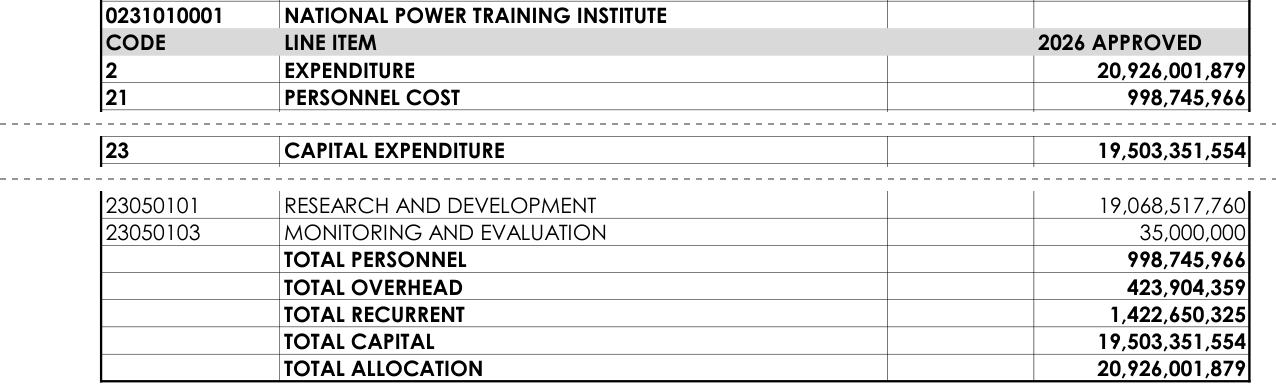
The 2026 Appropriation Act lists NAPTIN under the Federal Ministry of Power with a total allocation of N20,926,001,879: N998,745,966 for personnel, N423,904,359 for overheads and N19,503,351,554 for capital (pages 1446 and 1447). Personnel and overheads add to the printed recurrent total of N1,422,650,325, and recurrent and capital add to the total allocation. In the Act's economic classification, N19,068,517,760 of the capital is booked under "Research and Development".
The project list on pages 1448 to 1451 breaks the N19,503,351,554 into 73 lines, all marked "ongoing", which add exactly to the capital total. The largest by far, N13,927,773,000 or 71.4 per cent, is a "multilateral/bilateral tied loan" for "enhancing vocational training delivery for the power sector in Nigeria". That leaves N5,575,578,554 in 72 lines. Eighteen of them, worth N553,833,794, are for the institute's own offices, equipment and training centres: computers, printers, the headquarters building, a regional training centre at Gembu in Taraba State, N56,000,000 for "capacity building of NAPTIN instructors", N14,000,000 for learning aids and testing equipment and N49,000,000 for workshops and seminars. The other 54 lines, worth N5,021,744,760 or 90.1 per cent of the capital outside the loan, each name a community, local government area, federal constituency or senatorial district.
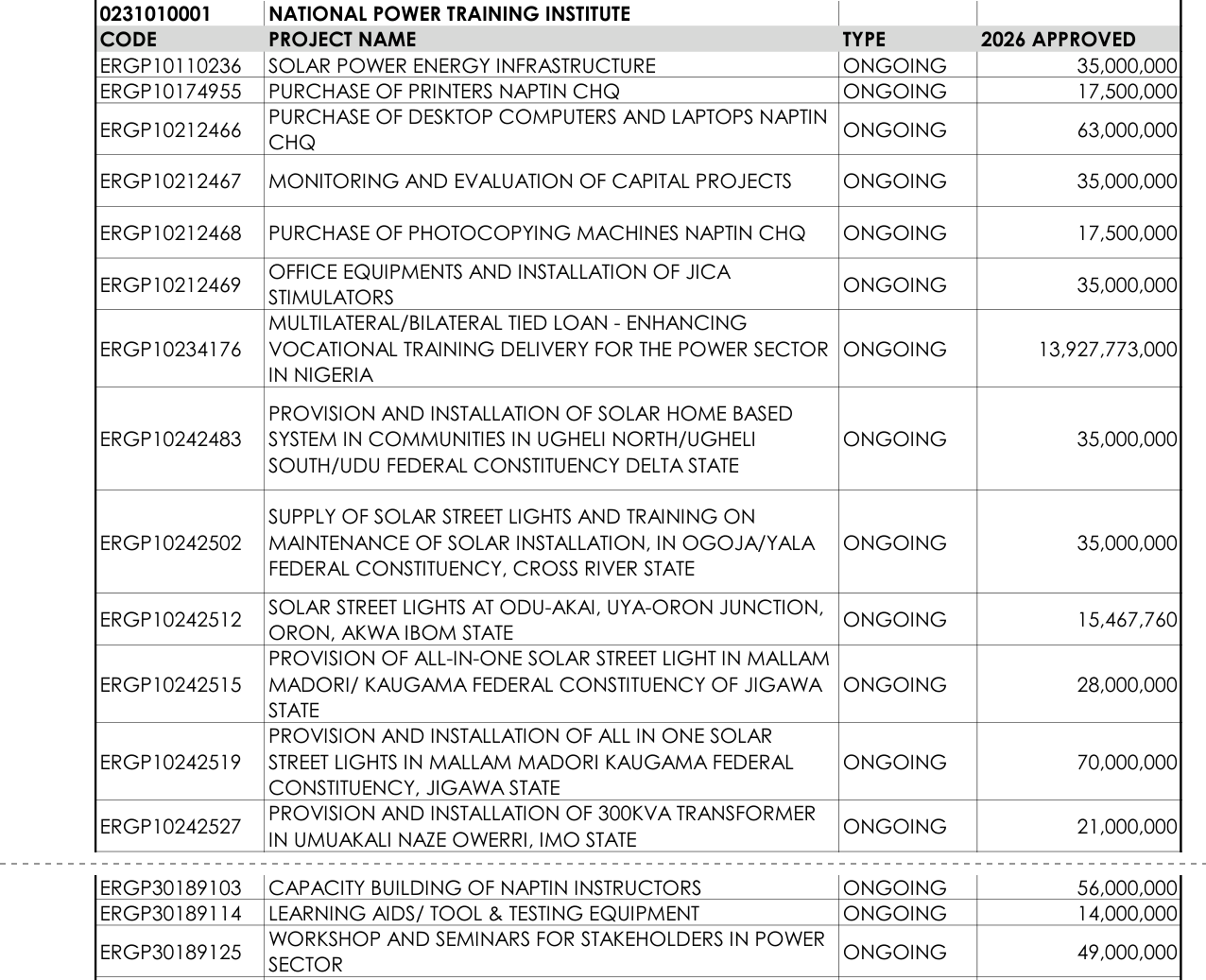
Forty-four of those 54 lines are for electrical works: 16 lines that include transformers, worth N1,621,000,000; 21 lines for solar streetlights, worth N2,021,800,760; and seven for mini-grids, solar systems and power poles, worth N654,500,000. Eight are for training or "empowerment" of young people or graduates in named places, six of them in solar or renewable energy installation (N584,444,000 in all), and two are for toilets and solar boreholes at a secondary school in Delta State and for IT centres in Jigawa State (N140,000,000). The largest group, nine lines worth N1,295,000,000, is in Abia South senatorial district, including six streetlight lines of N140,000,000 each, one for each of six local government areas. Six lines worth N1,040,000,000 are in Kwara State, and three worth N350,000,000 are in Ijebu Ode, Ogun State.
The record also supports the institute on several points. Most of its 2026 capital, the N13.93 billion loan, is for the vocational training that is its purpose, and 12 of the 54 place-named lines, worth N969,444,000, include training or "empowerment" of young people, mostly in installing or maintaining solar and electrical equipment. The Act is passed by the National Assembly; NAPTIN carries out the lines it is given, and the Act does not say who proposed any of them. The 2015 circular the auditors cite in Issue 10 gives the Federal Ministry of Special Duties and Inter-Governmental Affairs the duty "to verify and ascertain the level of work done as well as authorize payments" under constituency projects, so the missing certification is not a matter for NAPTIN alone. And the audit covers 2022 and 2023: it says nothing about how the 2026 lines will be awarded or supervised.
Set side by side, the two documents describe the same kind of work in both periods. The audit queried how NAPTIN paid for, recorded and had certified transformers, streetlights and other constituency works in 2022 and 2023, and its report shows no answer from the institute. The 2026 Act gives NAPTIN more of that work: N3,642,800,760 for transformer and streetlight lines alone. That is 65 times the line for training its own instructors, though about a quarter of the training loan.
NAPTIN was not asked for comment for this report. The audit report's only record of its views is the 11 entries that read "No response".
What this rests on
Office of the Auditor-General for the Federation, 2024 Annual Report on Non-compliance (Internal Control Weakness), Vol. II, section on the National Power Training Institute, Abuja, pages 502 to 513 (PDF pages 67 to 78), period 1 January 2022 to 31 December 2023, read from page images; Issues 1, 2, 3, 7, 9 (recommendations), 10 and the Issue 8 heading checked by eye on rendered pages, the remaining text from OCR of the same pages. 2026 Appropriation Act, NAPTIN under the Federal Ministry of Power, pages 1446 to 1451 (economic classification and project list). Page extracts of both are saved with this report. Arithmetic re-done: Issue 10 table 59,200,000.00 + 38,526,875.25 + 98,861,000.00 = 196,587,875.25 (the recommendation on p.512 prints N196,587,875.00); Act personnel 998,745,966 + overhead 423,904,359 = recurrent 1,422,650,325; + capital 19,503,351,554 = 20,926,001,879, the printed total; the 73 project lines add to 19,503,351,554; tied loan 13,927,773,000 / 19,503,351,554 = 71.4%; 19,503,351,554 - 13,927,773,000 = 5,575,578,554; place-named lines: 44 works lines 4,297,300,760 (16 transformer lines 1,621,000,000 + 21 streetlight lines 2,021,800,760 + 7 mini-grid, solar and pole lines 654,500,000) + 8 training lines 584,444,000 + 2 other lines 140,000,000 = 5,021,744,760; 5,021,744,760 / 5,575,578,554 = 90.1%; own lines 5,575,578,554 - 5,021,744,760 = 553,833,794 (18 lines, re-added); 1,621,000,000 + 2,021,800,760 = 3,642,800,760, and 3,642,800,760 / 56,000,000 = 65.05; 3,642,800,760 / 13,927,773,000 = 26.2%; Abia South 6 x 140,000,000 + 175,000,000 + 140,000,000 + 140,000,000 = 1,295,000,000; Kwara 210,000,000 + 175,000,000 + 210,000,000 + 140,000,000 + 200,000,000 + 105,000,000 = 1,040,000,000; Ijebu Ode 70,000,000 + 175,000,000 + 105,000,000 = 350,000,000; training-related place-named lines 12, worth 969,444,000; tender fees 2,771,731,464.25 / 423,904,359 = 6.54. The grouping of lines is Vero Record's reading of each line's name; the full list with groups is saved as naptin_2026_project_lines.json. Issue 8's own recommendation on page 510 gives N542,214,158.13, N5,000,000 less than the N547,214,158.13 in its heading and finding on page 509; we use the finding's figure.
What this does not establish
How the auditors arrived at N2,771,731,464.25 of tender fees, how many bid documents were sold and at what price, or for which contracts; whether any of the money was remitted later. Whether the transformers, streetlights and store items queried were delivered, installed and working; the audit found no store or certification records, which is not the same as finding the items missing. Whether NAPTIN answered the queries after the report was compiled, or whether the Public Accounts Committees have taken them up. Who proposed the 54 place-named lines in the 2026 Act, whether any repeat projects from 2022 and 2023, and how much of the 2026 capital will be released or spent; an appropriation is not a release. The Act does not label any NAPTIN line as a constituency project; that word appears only in the audit. The audit's own figures differ slightly in places: Issue 10 prints N196,587,875.25 in its heading and table and N196,587,875.00 in its recommendation. Nothing in the documents suggests wrongdoing by any named person, and none is alleged. NAPTIN was not asked for comment.
What we did ourselves
Read the 12 NAPTIN pages of the Auditor-General's Volume II from page images and recorded each of the 11 queries, the amounts and the management response printed against each. Re-added the Issue 10 payment table. Extracted all 73 NAPTIN capital lines from the 2026 Appropriation Act, checked that they add to the capital total and that recurrent and capital add to the total allocation, and grouped every line by what its name says: the training loan, the institute's own items, and lines naming an outside community, local government area, constituency or senatorial district, split into transformers, streetlights, other electrical works, training and other works. Compared the kind of work queried in 2022 and 2023 with the kind of work funded in 2026.
Sources for this report
(A) Office of the Auditor-General for the Federation, 2024 Annual Report on Non-compliance (Internal Control Weakness), Vol. II, National Power Training Institute, Abuja, pp.502 to 513; 2026 Appropriation Act, National Power Training Institute (Federal Ministry of Power), pp.1446 to 1451.
- 2024 Annual Report on Non-compliance (Internal Control Weakness), Vol. II · Office of the Auditor-General for the Federation · 2026
- 2026 Appropriation Act (copy published by PLAC) · National Assembly of the Federal Republic of Nigeria · April 2026
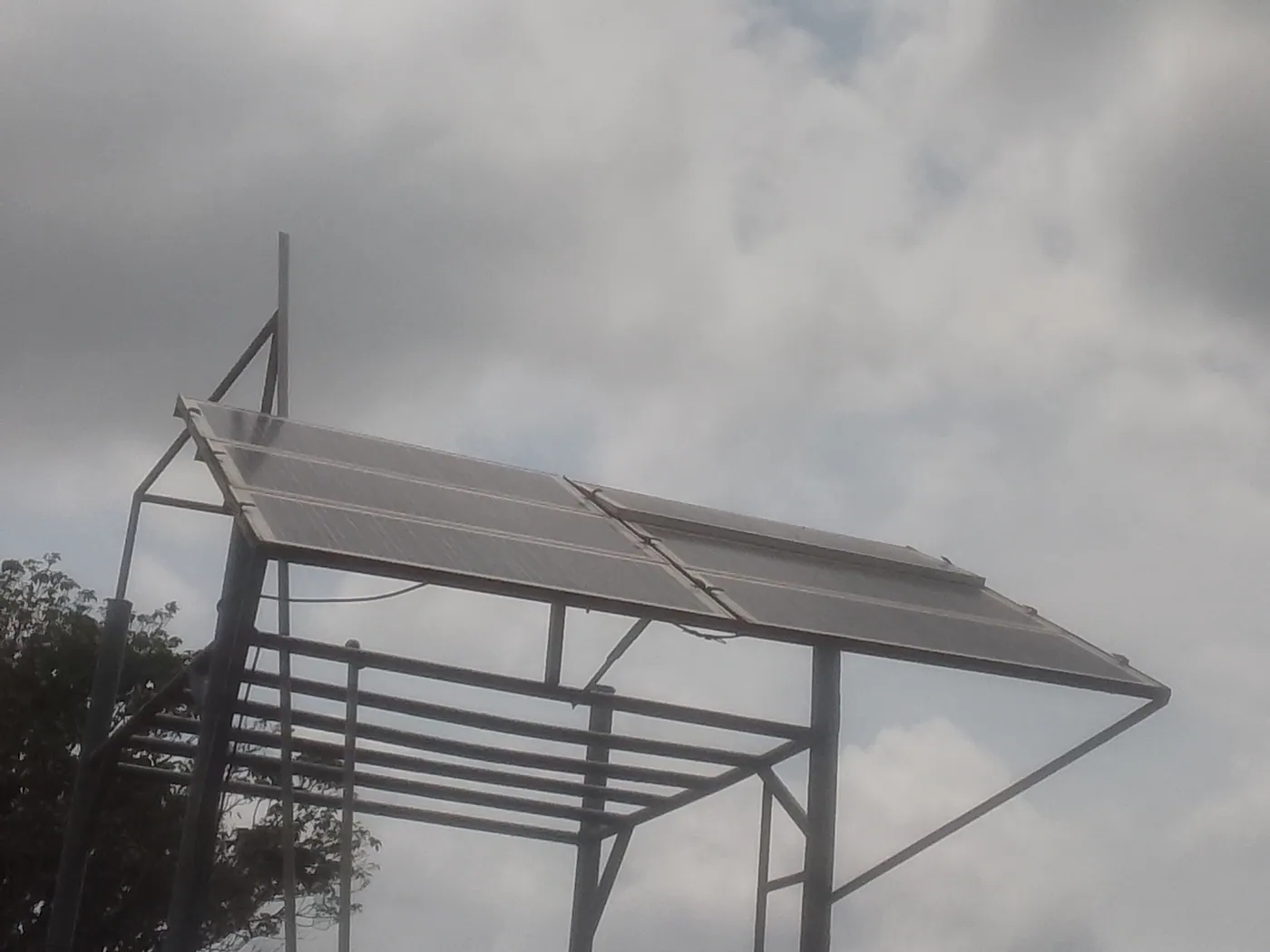
- File:Solar photovoltaic panels in Irawo, Atisbo, Oyo State, Nigeria.jpg · Wikimedia Commons (NigerianScribe, CC0) · 28 June 2026
Confidence: high. This is our own assessment of whether the event occurred as described, separate from the grade, which describes what kind of thing the claim rests on.
Not obtained: where the underlying document is named above but not linked, we did not hold a copy at the time of publication. We purchase nothing and request nothing in our own name.
Corrections
None on this report. If you find an error, it will be published here, at the same length, with the date it was found, and the original wording will remain visible above it.
Dr VeroInvestigations editor, Vero Record
Reads the Nigerian public record that others leave unread: budgets, audit reports, court files and registers. Every claim on this page carries the grade of the document behind it, and the report says what that document does not establish.
All 169 reportsHow we grade evidenceAdd Vero Record as a preferred source on Google