
DR VERO - TODAY’S NIGERIAN HISTORY LESSON
This one is a little different today. No politics. No investigations.
No debates.
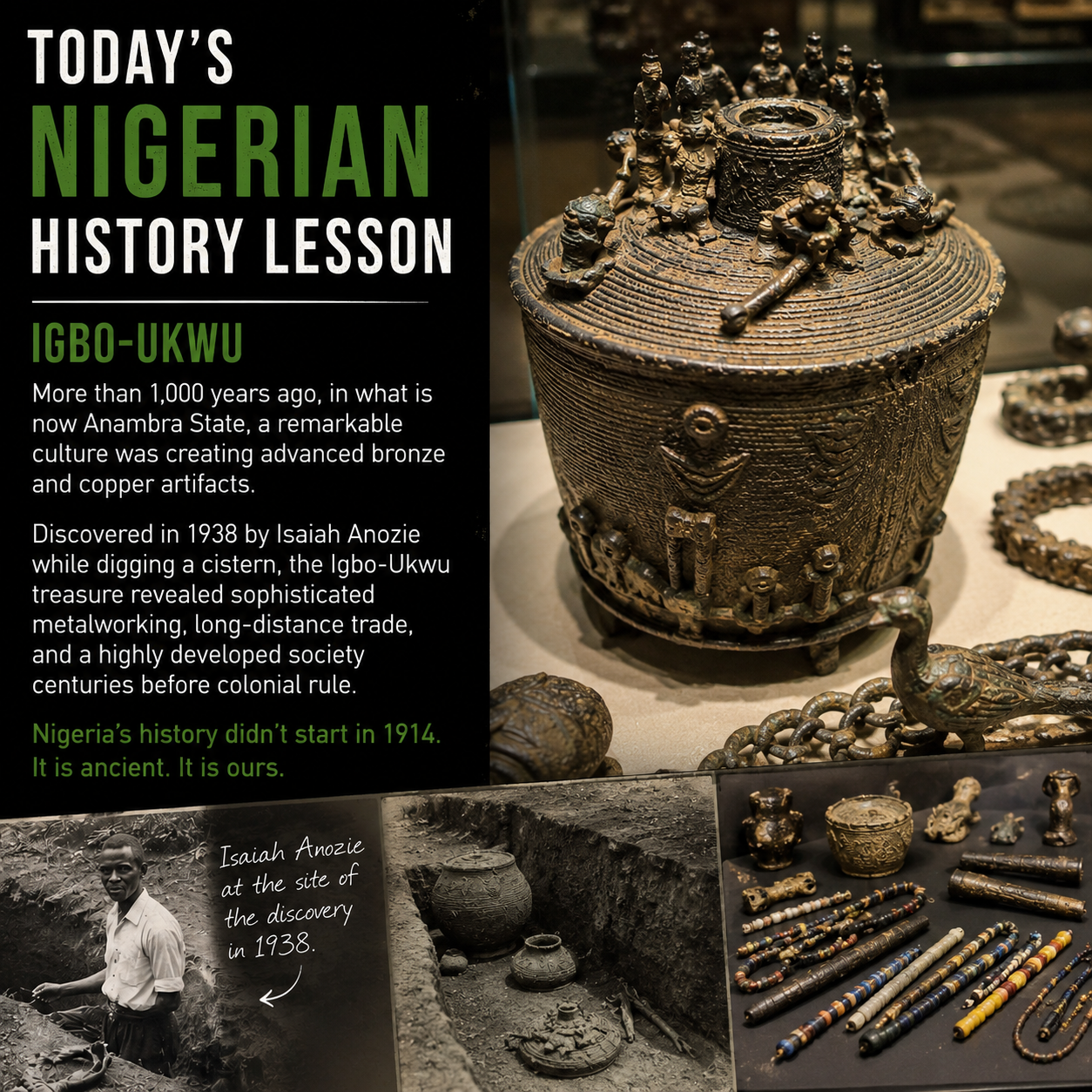
Simply Nigerian history. Over a millennium ago long before the modern country of Nigeria existed , a fascinating civilization was crafting sophisticated metal objects in the modern-day Anambra State. This was Igbo-Ukwu. In 1938, in a man named Isaiah Anozie, when digging a cistern for in compound , he stumbled upon objects that had for been buried deep in the earth.
What he had unearthed would later emerge to be one of the most incredible archaeological discoveries in Nigerian history.
Subsequent excavations revealed that sophisticated bronze and copper objects, beads, vessels, ornaments , and ritual artefacts, that dated all the way back to approximately the 9th Century AD. Consider this date: the 800s. These were pieces, exhibiting an incredible mastery of metal working , many of which were fashioned with sophisticated lost-wax casting technology.
The details contained on surfaces were intricate, depicting insects , animals , ropes, and patterns in the most incredible detail. It was not only metalworking that Igbo-Ukwu shed light on: they indicated that this culture was not in isolated corner of Africa. Thousands of beads were unearthed , and analysis of their components, assisted to paint a richer image of long-distance commerce linking parts of West Africa to regions far beyond its borders.
The ancestors of modern Nigeria were engaging in the complex worlds, economic and cultural, long before the European imposed colonial order.
But this is far from all that the history of the Nigerian lands tell: Nok , a tradition of terracotta sculpture that dates back well over two millennia; Ife , famous its exquisite naturalism with its famous heads; the great Benin bronzes; the empire that once stood in Oyo ; Kanem Bornu , a centuries long existence in the Lake Chad basin; thriving commercial and academic centers of scholarship that served the extensive Sahara trade that would grow in importance in cities such as Kano and Katsina . Nigeria did not just 'acquire' history when an administrative line was drawn on its boundaries , it brought together various distinct historical societies under a single name , and beneath that name lies histories centuries, sometimes millennia , deep. That's one of the amazing things about studying Nigeria, the more you dig, the more ancient the story becomes. In the case of Igbo-Ukwu, that's also literal: a man digs in his compound for cistern, and by chance, opens a window into another Nigeria that had existed 1000 years before he was alive.
Modern Nigeria; Ancient Nigerian history.
A bit of history class today .
– Dr Vero
About this dispatch
This is a public post by Dr Vero, archived here as published, with its full text and every graphic that accompanied it. Dispatches are written for a general audience and are not graded: they are a record of what was said publicly and when, not a sourced report.
Graded, document-sourced reporting is kept separate, in the newsroom and the dossiers.