
The Maiduguri T-shirt charge sheet names printing, not drugs
The First Information Report filed against five men in Maiduguri accuses them of printing "Tinubu Must Go" T-shirts to breach the peace. The drugs the Borno police later described do not appear on it.

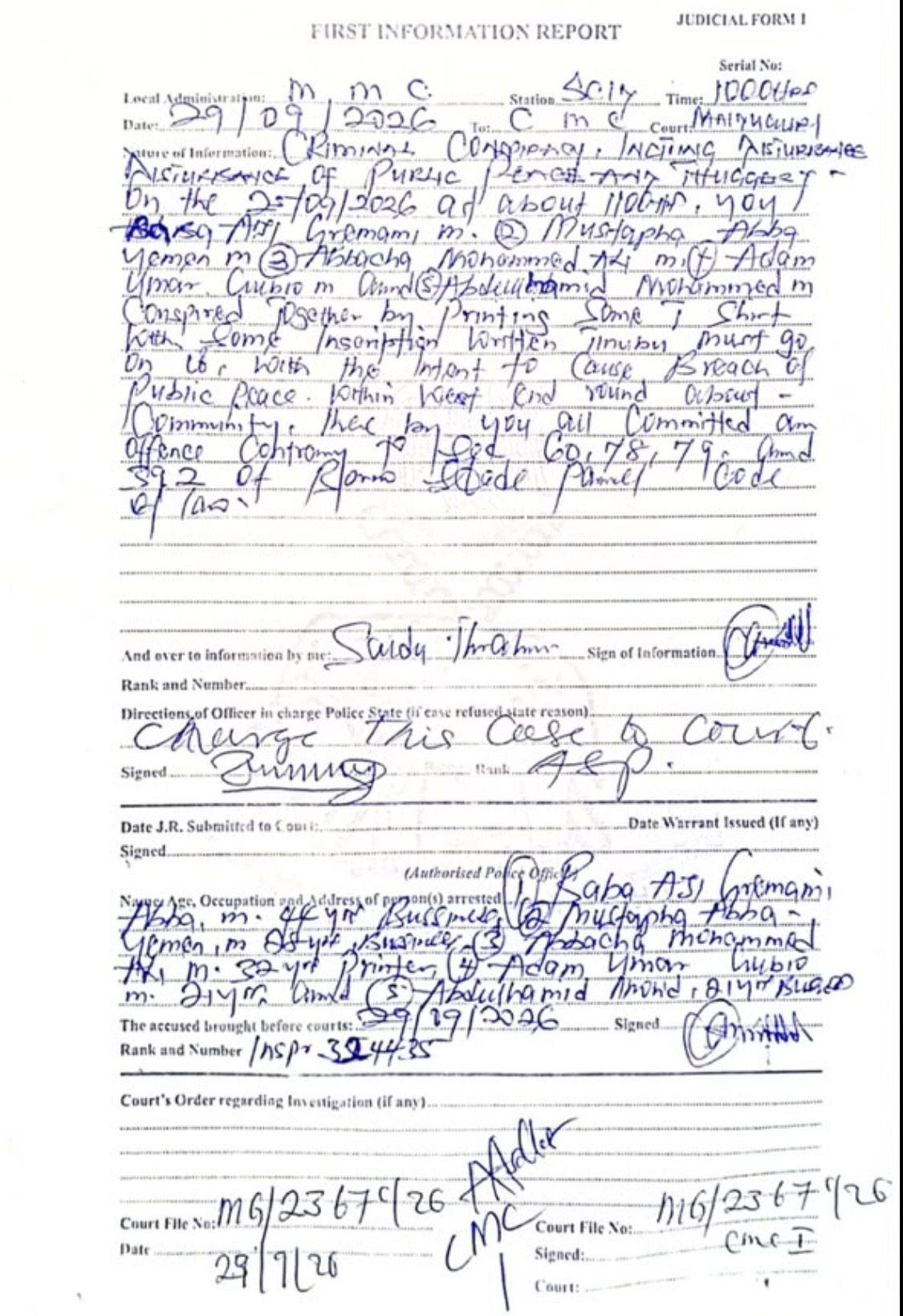
Five men in Maiduguri are in a correctional facility this week after the Borno State Police Command took them before Chief Magistrate Court I in the city on 29 September 2026. The court document that started the case is a single handwritten page, a First Information Report on the form headed Judicial Form 1. We downloaded a photograph of that page, published by Sahara Reporters on 29 September, and read it line by line. What it says, and what it leaves out, matters more than the public statements that followed.
The report is dated 29/09/2026 and addressed to the Chief Magistrate Court, Maiduguri. Under 'Nature of Information' it lists criminal conspiracy, inciting disturbance, disturbance of public peace and thuggery. It then states that on 25/09/2026 at about 1100 hours the five men 'conspired together by printing some T shirt with some inscription written Tinubu must go on it, with the intent to cause breach of public peace within West End round about community', and that they thereby committed an offence 'contrary to Sec 60, 78, 79 and 392 of Borno State Penal Code Law'. The spelling here is our reading of handwriting; the section numbers are clear on the page.
The men are named on the form as Baba Aji Gremami, Mustapha Abba Yemen, Abbacha Mohammed Ali, Adam Umar Gubio and Abdulhamid Mohammed. The ages written against them match those in press reports, 44, 28, 32, 21 and 21. The occupations column, as far as it can be read, describes most of them as business people and Abbacha Mohammed Ali as a printer. An officer whose rank is written as ASP gave the direction 'Charge this case to court'. Two court file numbers are handwritten at the foot, one ending in CMC and one in CMC I, which we read as MG/2367c/26 and MG/2367/26; we are not certain of the suffixes.
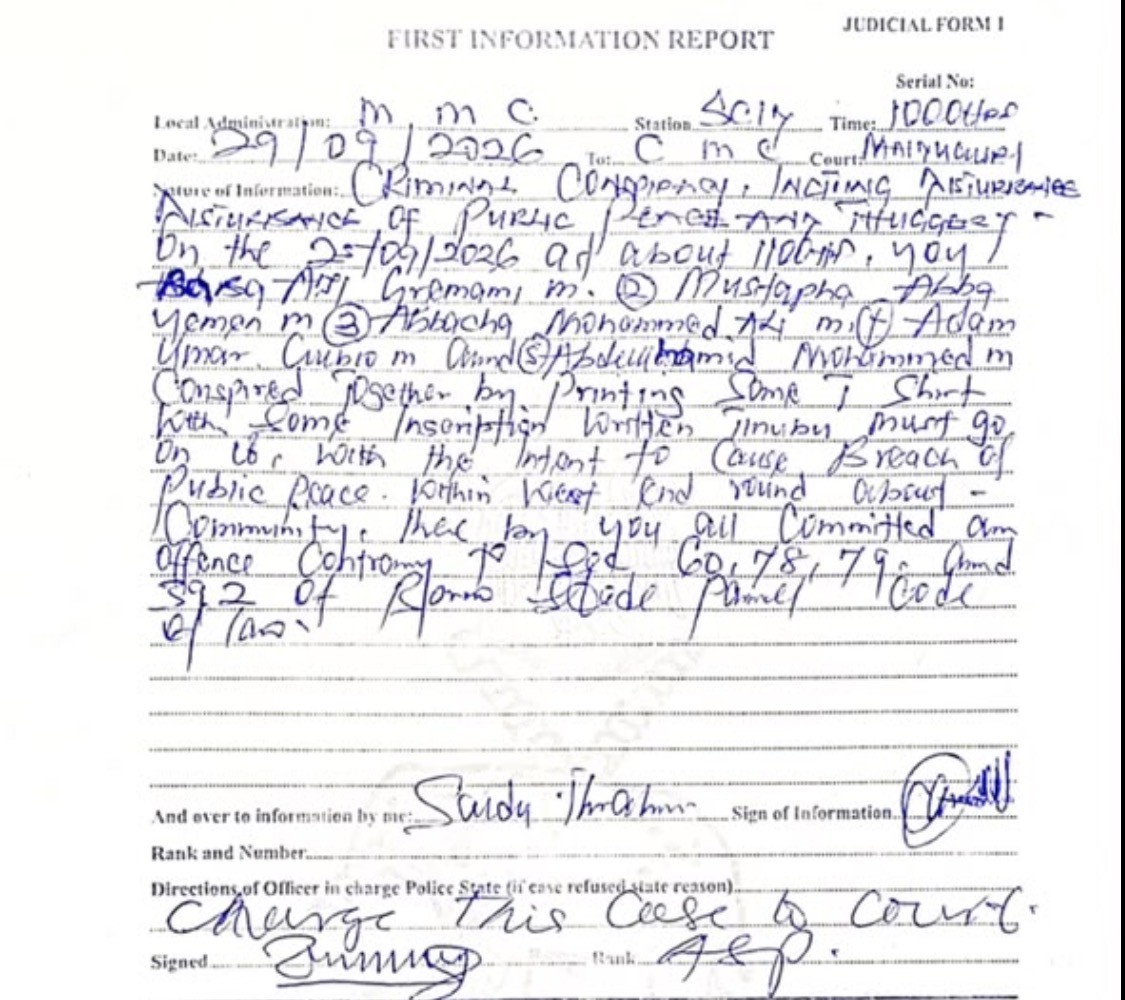
The factual allegation on the form is narrow. It concerns printing T-shirts with a slogan, with an intent to breach the peace that the police assert. The form does not say the men wore the shirts, though several reports have described it that way, and it does not describe any act of violence, damage, crowd or confrontation at the roundabout. Whether printing a political slogan can meet the elements of the four offences is a question for the magistrate, and nothing in this case has been proved. All five pleaded not guilty, according to Daily Trust and Pulse, and the court fixed 6 October 2026 for a ruling on bail and 26 October for hearing.
After public criticism, the police gave a different account. Legit.ng reported a statement from the command's spokesperson, ASP Nahum Kenneth Daso, saying the men were arrested during a 'routine township patrol' near the West End roundabout on 25 September, and that officers recovered '15 wraps of dried leaves suspected to be Indian hemp, 100 tablets suspected to be D5, one shisha pot' and other items. The statement said the Nigeria Police Force 'is a professional, non-partisan institution and does not discriminate against persons on the basis of political affiliation or viewpoint.' We have not seen the statement itself, only the press account of it, so we grade it B.
The First Information Report, filed four days after the arrest and on the day of arraignment, contains no reference to Indian hemp, tablets, a shisha pot or any drug offence. It cites only the four Penal Code sections. If the police recovered drugs on 25 September, the charge they took to court on 29 September does not rely on them. We cannot say from the record why. A drug offence would ordinarily fall under federal law, and the police may have separate plans for it, but no such charge has been reported, and the police statement as reported does not say one has been filed.
Amnesty International Nigeria called the drug account 'a new narrative introduced after public backlash', according to Legit.ng and Daily Trust, and asked for the men to be released and the charges dropped. In a statement reported by allAfrica on 30 September it said that 'expressing peaceful political dissent through clothing is a fundamental human right, not a criminal offense.' Those are Amnesty's words, not findings of any court.
Sahara Reporters, citing an unnamed source, reported that the arrests followed a directive from Governor Babagana Umara Zulum to the Commissioner of Police, Naziru Abdulmajid. Pulse noted that the claim has not been confirmed by any official source, and we have found nothing in the record that supports or rules it out. We are reporting it only as an unverified allegation carried by one outlet.
We tried to read the four sections the police cited. The Borno State Penal Code Law is not published on any government website we could reach, and we did not find a copy in the public legal databases we searched. The descriptions of the sections used here, conspiracy, inciting disturbance, disturbance of public peace and thuggery, are the police's own labels from the form. We cannot tell readers what penalties the sections carry or what elements the prosecution must prove, and we will not guess.
The brief for this story included the Cybercrimes Act, which has been used against critics of officials in other cases. It does not appear on this form. The only law cited against the five men is the state Penal Code.
The constitutional background is not in doubt. Section 39(1) of the 1999 Constitution, which we read in the revised text published by the Constitute Project, says 'Every person shall be entitled to freedom of expression, including freedom to hold opinions and to receive and impart ideas and information without interference.' Section 39(3) saves laws that are 'reasonably justifiable in a democratic society' for listed purposes, and Section 45 allows restrictions in the interest of public order. Section 36(12), on the same text, says no one may be convicted of an offence that is not defined, with its penalty, in a written law. The question the magistrate will face is whether a public-order charge built on a printed slogan fits inside those limits.
There is a recent federal precedent for political protest charges collapsing. After the August 2024 #EndBadGovernance protests, the federal government charged protesters, including minors, with treason and related offences at the Federal High Court in Abuja. According to P.M. News and Daily Trust, on 5 November 2024 Justice Obiora Egwuatu struck out the charge against the minors after counsel for the Attorney-General of the Federation, Lateef Fagbemi, applied to discontinue it; reports put the number released across the two groups at 119. We have not read those court records ourselves and grade that account B.
The two cases differ in scale and in the court involved. The 2024 case was a federal treason prosecution of protesters. The Maiduguri case is a magistrate court charge under state law against five men over a printed slogan, with no protest described on the charge sheet at all.
What the record shows today is limited and specific. A police form filed in a Maiduguri magistrate court accuses five men of printing a political slogan with intent to breach the peace, cites four sections of a state law that is not publicly available online, and does not mention the drugs the police spokesperson later described. The men have not been convicted of anything. We will follow the bail ruling on 6 October and ask the Borno State Police Command why the recovered items it described are not part of the charge.
What this rests on
The handwritten FIR (read ourselves, A, with the caveat that its authenticity rests on Sahara Reporters' publication and we could not obtain it from the court); the constitution text (A); police statement, Amnesty statement, plea and hearing dates and 2024 precedent from press reports (B); the observation that the FIR omits drugs is our own reading (C inference about significance).
What this does not establish
Text of Borno State Penal Code sections 60, 78, 79 and 392 and their penalties; whether a separate drug charge exists; whether the governor directed the arrests; whether the men wore the shirts; independent confirmation of the FIR from the court registry.
What we did ourselves
Read and transcribed the FIR ourselves, identified that it alleges printing only and cites no drug offence and no Cybercrimes Act section, compared it against the police's later public account, searched for the Borno Penal Code text, and read the constitutional provisions.
Sources for this report
(A) First Information Report (Judicial Form 1), dated 29/09/2026, filed at Chief Magistrate Court I, Maiduguri, court file MG/2367/26 (handwritten; suffix uncertain), photograph published by Sahara Reporters and downloaded and read by us.
- First Information Report (Judicial Form 1), five defendants, CMC I Maiduguri · Borno State Police Command (published by Sahara Reporters) · 2026-09-29
- Borno Police Arrest Five Men For Wearing 'Tinubu Must Go' T-Shirts, Remand Them In Prison · Sahara Reporters · 2026-09-29
- Police prosecute 5 men over 'Tinubu Must Go' T-shirts · Daily Trust
- 5 men arrested and remanded in Borno over 'Tinubu Must Go' T-shirts · Pulse Nigeria · 2026-09-30
- Police Give Actual Reason for Arresting Men Who Wore 'Tinubu Must Go' Shirts · Legit.ng
- Amnesty International Condemns Arrest of 5 Men Wearing 'Tinubu Must Go' T-Shirts in Borno · allAfrica · 2026-09-30
- Constitution of Nigeria 1999 (rev. 2011) · Constitute Project
- Court strikes out treason charge against minors after FG's withdrawal · P.M. News · 2024-11-05
- Court strikes out suit against #EndBadGovernance minors · Daily Trust

Confidence: medium. This is our own assessment of whether the event occurred as described, separate from the grade, which describes what kind of thing the claim rests on.
Not obtained: where the underlying document is named above but not linked, we did not hold a copy at the time of publication. We purchase nothing and request nothing in our own name.
Corrections
None on this report. If you find an error, it will be published here, at the same length, with the date it was found, and the original wording will remain visible above it.