Lagos says it has carried out 69% of its 2026 budget. Its own table says 34.6%
The Lagos State Government's second-quarter 2026 budget implementation report gives two readings of the same half-year. Its summary table puts spending at 34.6% of the approved annual budget. Its conclusions say 69%.
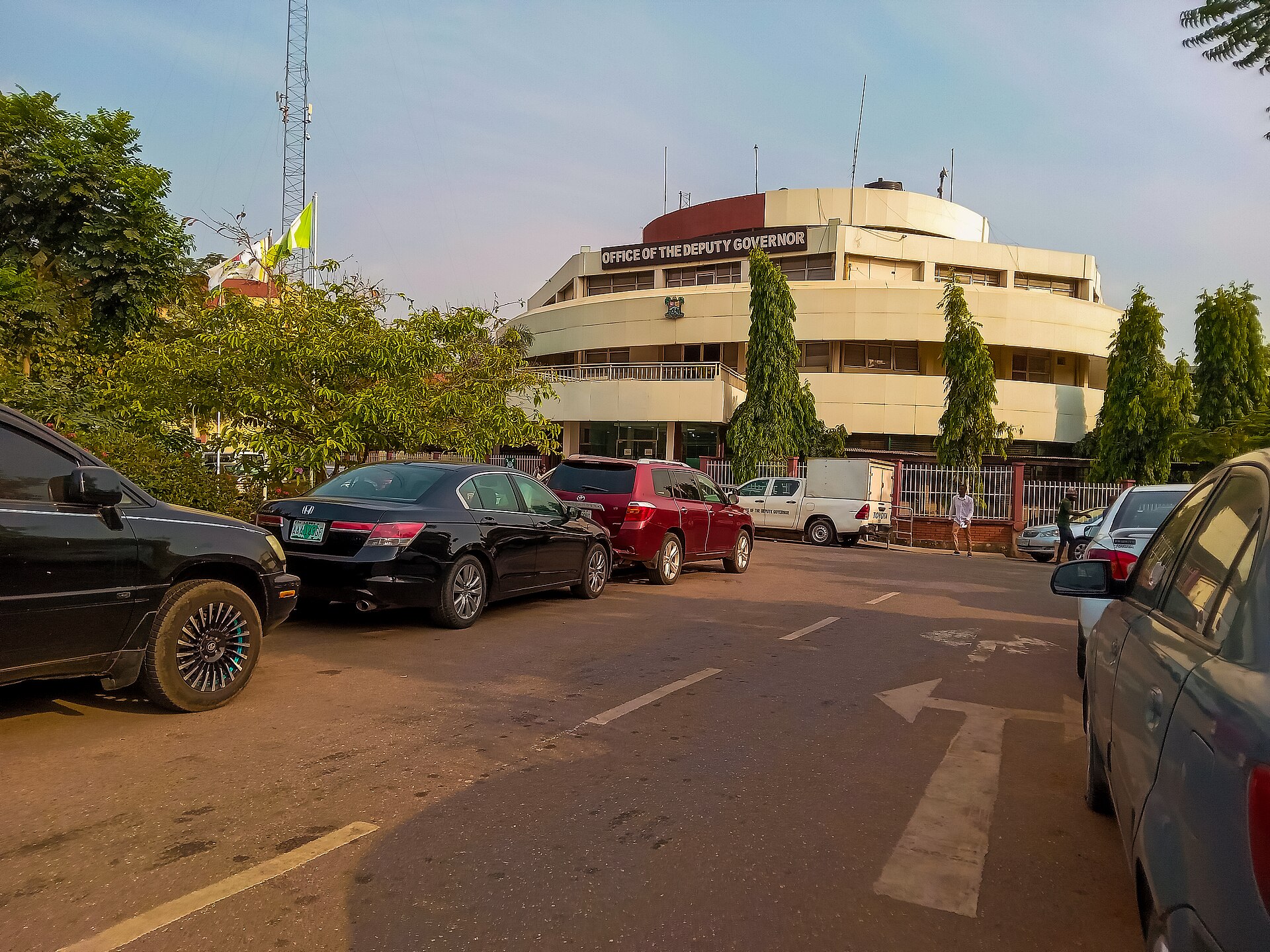
The Lagos State Ministry of Economic Planning and Budget has published its Budget Implementation Report for the second quarter of 2026. The cover is dated July 27, 2026, and the report covers the six months to 30 June. Vero Record downloaded the 79-page PDF from the ministry's website, lagosmepb.org, and read it. It is the state's own account of how much of the N4,444,509,776,438.00 "Budget of Shared Prosperity" it collected and spent in the first half of the year.
Table 1 on page 8, the Budget Implementation Summary, puts total expenditure for January to June 2026 at N1,539,793,109,366.25 against an approved total of N4,444,509,776,438.00. The table's own column, "% Performance Year to Date against 2026 Original Budget", records this as 34.6%. On the same row it leaves a balance of N2,904,716,667,071.75 to spend.
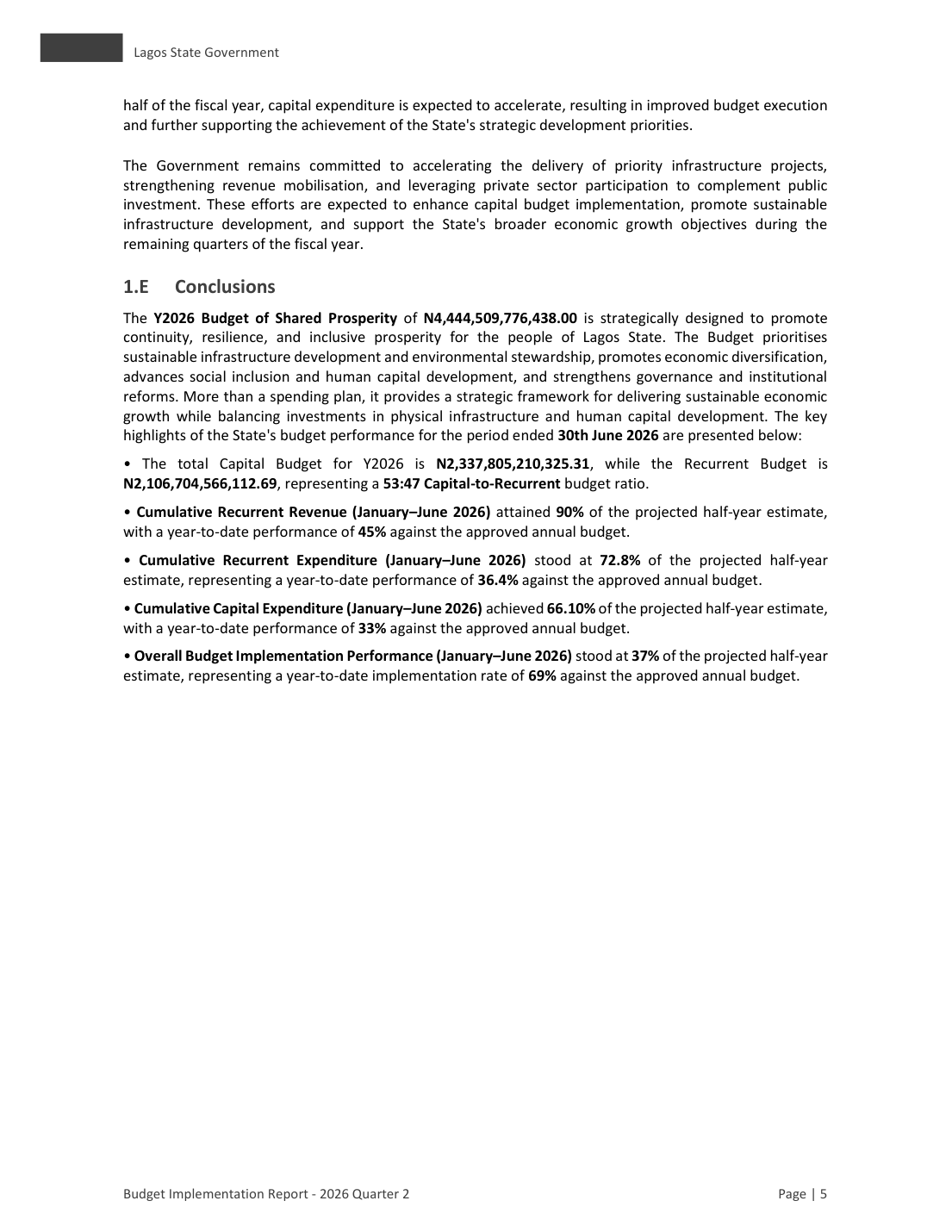
Three pages earlier, the conclusions section describes the same period differently. Its last bullet reads: "Overall Budget Implementation Performance (January-June 2026) stood at 37% of the projected half-year estimate, representing a year-to-date implementation rate of 69% against the approved annual budget."
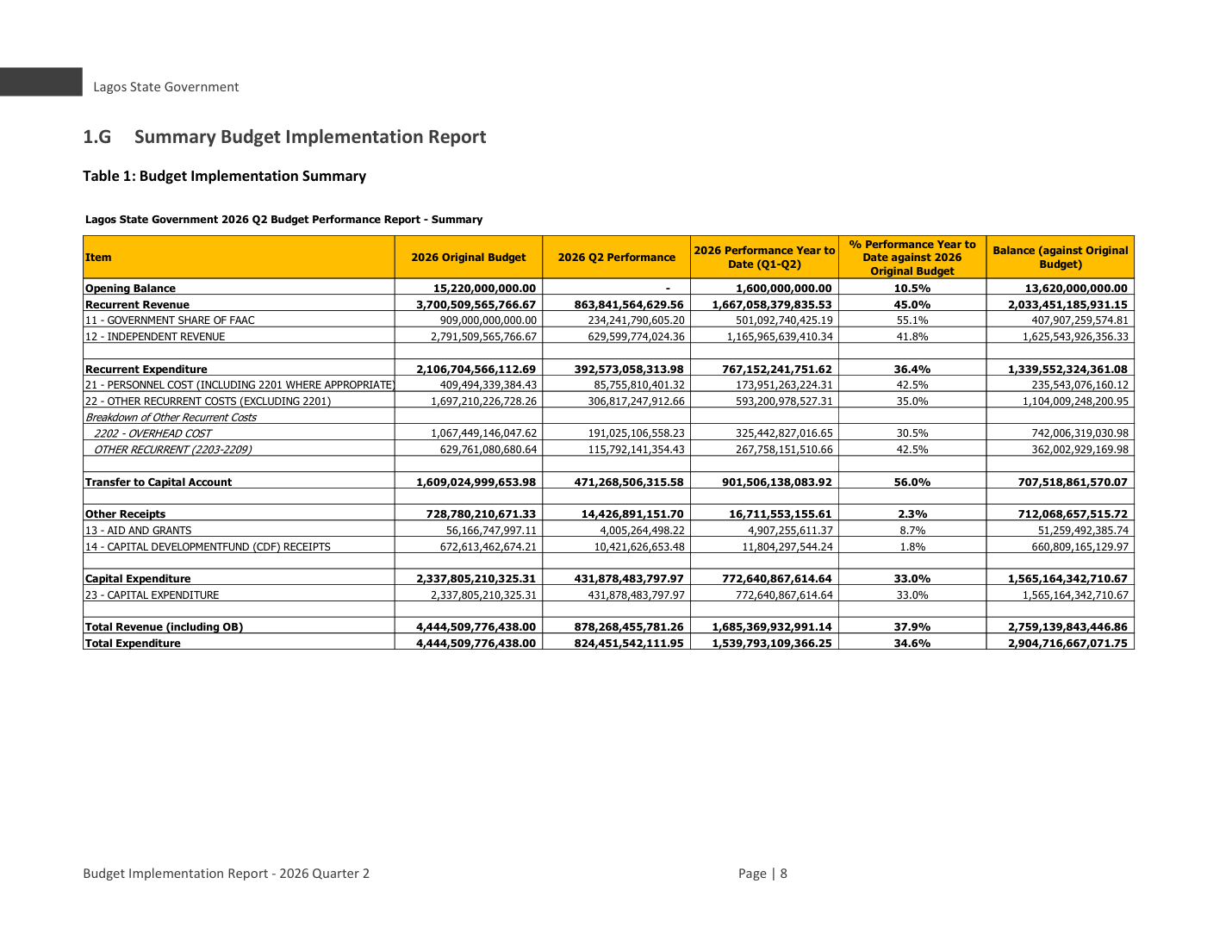
Neither figure in that sentence matches the report's own numbers where the sentence places it. Vero Record divided the spending total from Table 1 by the full-year budget and by half of it; this is our arithmetic, not the report's. N1,539,793,109,366.25 is 34.6% of the annual budget, which agrees with Table 1, and 69.3% of a half-year estimate of N2,222,254,888,219. On the report's own figures, the 69% belongs to the half-year and the roughly 35% belongs to the year. The conclusions attach them the other way round and turn the 34.6% into 37%. The report does not say how it arrived at 37%.
The report's section-by-section bullets follow the same pattern as Table 1, so the reversal is confined to the overall line. Recurrent revenue of N1,667,058,379,835.53 is given as 45% of the annual estimate of N3,700,509,565,766.67 and 90% of the half-year estimate of N1,850,254,782,883.33. Recurrent expenditure of N767,152,241,751.62 is given as 36.4% of the annual estimate and 72.83% of the half-year estimate. Capital expenditure of N772,640,867,614.64 is given as 33% of the annual estimate and 66.10% of the half-year estimate. Added together, the recurrent and capital amounts come to N1,539,793,109,366.26, one kobo from the table's total, a difference that is consistent with rounding.
A second wording error appears in section 1.D. It describes capital spending of N772,640,867,614.64 as 33% "of the Recurrent Expenditure estimate of N2,337,805,210,325.31". The N2,337,805,210,325.31 figure is the capital budget, as the report states elsewhere and as the state's Citizens' Budget confirms. The recurrent estimate is N2,106,704,566,112.69.
The 90% figure is the one that reached the public. Nairametrics reported on 31 July 2026 that Lagos had collected N1.67 trillion in six months and "hits 90% revenue target", citing this report. That percentage covers recurrent revenue only: federation account receipts and the state's independent revenue. Table 1 puts total revenue including the opening balance at N1,685,369,932,991.14, which is 37.9% of the N4,444,509,776,438.00 annual figure.
The largest shortfall in the table is on the capital receipts side. The line "Other Receipts" was budgeted at N728,780,210,671.33. By 30 June the state had received N16,711,553,155.61, or 2.3%. This line includes aid and grants (N4,907,255,611.37 of N56,166,747,997.11, or 8.7%) and "Capital Development Fund (CDF) Receipts" (N11,804,297,544.24 of N672,613,462,674.21, or 1.8%). The opening balance line shows N1,600,000,000.00 received against N15,220,000,000.00 budgeted.
The Citizens' Budget, which the ministry published on 26 February 2026, shows what the state expected those capital receipts to contain. It lists N481,635,921,481 in aids and grants, including a final drawdown of N177,169,173,484 for railway projects from the French development agency AFD and N148,800,000,000 in donor funding for Omi Eko waterways. It also lists N216,497,528,308 in loans, including a N150,000,000,000 green bond and a N50,000,000,000 CBN loan for the Blue Line rail. The Q2 report explains the low figures as a matter of timing. It says aid inflows depend on donor "disbursement schedules" and that loan drawdowns reflect a "prudent debt and cash management strategy" under which borrowing is drawn only when projects need it.
Where the capital money came from is shown in the same table. The line "Transfer to Capital Account", the recurrent surplus moved into capital spending, stood at N901,506,138,083.92 by 30 June, 56.0% of its N1,609,024,999,653.98 annual figure. Set against N772,640,867,614.64 of capital spending, the report's own figures show that first-half capital work was paid from recurrent revenue, not from the donor funds and borrowing the budget had counted on. This is our reading of the table. The report does not put it that way.
The Citizens' Budget has smaller discrepancies of its own, and Vero Record re-added its tables. Its text says the deficit is N216,517,528,307.98 and will be financed by domestic borrowing of N209.038bn and foreign loans of N7.458bn. Those two loan figures, N209,038,814,465 and N7,458,713,843, add to N216,497,528,308, which is N20,000,000 less than the stated deficit. The Figure 2 overview in the same document gives "Total Budget Size" as N4,429,289,776,438, which is N15,220,000,000 below the N4,444,509,776,437.86 stated on the page before. The difference equals the opening balance, and the Q2 report uses the lower figure as its revenue total in Table 2.
None of this shows that money was lost or misapplied. The report is an implementation summary prepared by the ministry with the State Treasury Office. It is not an audited statement, and the discrepancies described here are in how the report presents its own figures, not in the underlying accounts, which Vero Record has not seen. The practical point is narrower. A reader who relies on the report's conclusions, rather than its table, would think Lagos had spent twice as large a share of its 2026 budget by mid-year as the state's own figures record.
We checked whether an earlier or later version of the PDF had been archived. On 29 September 2026 the Internet Archive's Wayback Machine held no copy of the file, so we could not compare versions. The copy Vero Record read has an embedded creation date of 27 July 2026 and the internal title "Lagos Q2'2026 BRP Publication CR". Vero Record has not yet put these discrepancies to the Ministry of Economic Planning and Budget for comment.
What this rests on
Grade A: the Q2 2026 Budget Implementation Report and the Y2026 Citizens' Budget, both downloaded from lagosmepb.org and read at the relevant pages. Grade B: the Nairametrics report of 31 July 2026 on the 90% revenue figure. Grade C (our arithmetic, labelled as such in the text): the 34.6% and 69.3% ratios, the re-added sums, and the reading that first-half capital spending was paid from the recurrent transfer.
What this does not establish
Why the conclusions reverse the two ratios, or where 37% comes from. Whether the PDF has been changed since 27 July (the Wayback Machine holds no copy to compare). The underlying treasury accounts. Any audited 2026 figures. Which specific capital projects were paid from the recurrent transfer. The ministry has not been asked for comment.
What we did ourselves
We downloaded and read the state's own Q2 2026 implementation report and 2026 Citizens' Budget, compared the report's narrative conclusions with its Summary Table 1, re-added the component figures in both documents, and set the capital receipts actually received against the donor and loan lines the Citizens' Budget lists.
Sources for this report
(A) Lagos State Government, Budget Implementation Report Quarter Q2 2026 (dated July 27, 2026), Ministry of Economic Planning and Budget, lagosmepb.org/wp-content/uploads/Y2026-LASG-Q2-BIR.pdf, pages 3-8 (sections 1.B-1.E and Table 1).
- Lagos State Government Budget Implementation Report Quarter Q2 2026 · Lagos State Ministry of Economic Planning and Budget · 2026-07-27
- Lagos State Government Y2026 Citizens' Budget · Lagos State Ministry of Economic Planning and Budget · 2026-02-26
- Lagos collects N1.67 trillion in six months, hits 90% revenue target · Nairametrics · 2026-07-31
- File:Round House Lagos.jpg · Wikimedia Commons
- Wayback availability query for the Q2 report · Internet Archive · 2026-09-29

Confidence: high. This is our own assessment of whether the event occurred as described, separate from the grade, which describes what kind of thing the claim rests on.
Not obtained: where the underlying document is named above but not linked, we did not hold a copy at the time of publication. We purchase nothing and request nothing in our own name.
Corrections
None on this report. If you find an error, it will be published here, at the same length, with the date it was found, and the original wording will remain visible above it.