
Four state assemblies have backed state police in press reports, and none has published its own record of the vote that Vero Record could find
Section 9 of the Constitution asks the states for one thing: a resolution of the House of Assembly, from at least two-thirds of the 36 states. In the two weeks since the National Assembly sent the state police alteration bill out, Osun, Edo, Rivers and Oyo have been reported as approving it. So far the only public account of how each House voted comes from speakers' announcements, aides' statements and newspaper reports. None of the four has published votes and proceedings, and the reports describe the approvals in different procedural terms.
On Wednesday, 16 September 2026, the Clerk to the National Assembly, Kamoru Ogunlana, sent the Constitution of the Federal Republic of Nigeria, 1999 (Sixth Alteration) Bill, 2026 to the 36 State Houses of Assembly. As reported by New Telegraph and ThisDay, its long title reads "A Bill for an Act to Alter the Constitution of the Federal Republic of Nigeria, 1999 to Provide for the Establishment of State Police Services; and for Related Matters". In a later press release, reported by New Telegraph on 22 September, Mr Ogunlana said this was the only alteration bill sent to the states so far and that the others would follow once both chambers had passed them "in identical form". According to Tribune's report of the Oyo sitting, the National Assembly's covering message said the Senate passed the bill on 24 June 2026 and the House of Representatives on 23 July 2026.
Once a bill is transmitted, what the states have to do is set out in the Constitution itself. Vero Record downloaded the text of the 1999 Constitution (as revised to 2011) from the Constitute Project, a compilation published by the Comparative Constitutions Project, and read section 9. Section 9(2) says an Act altering the Constitution "shall not be passed in either House of the National Assembly unless the proposal is supported by the votes of not less than two-thirds majority of all the members of that House and approved by resolution of the Houses of Assembly of not less than two-thirds of all the States." This copy is a compilation, not the government-printed edition, and it predates the alterations made after 2011; Vero Record compared only the wording of section 9 and did not check it against a gazetted text.
The wording sets the bar for the states as a count of states, not members. Two-thirds of 36 is 24, the figure the Rivers Speaker and several newspapers have cited. Section 9 requires each state's approval to take the form of a "resolution" of its House of Assembly. It sets no majority inside each state House. Section 9(4) says the membership of each House of the National Assembly is deemed to be its full number "notwithstanding any vacancy". The section contains no equivalent rule for state Houses. That is Vero Record's reading of the text, not a ruling by any court.
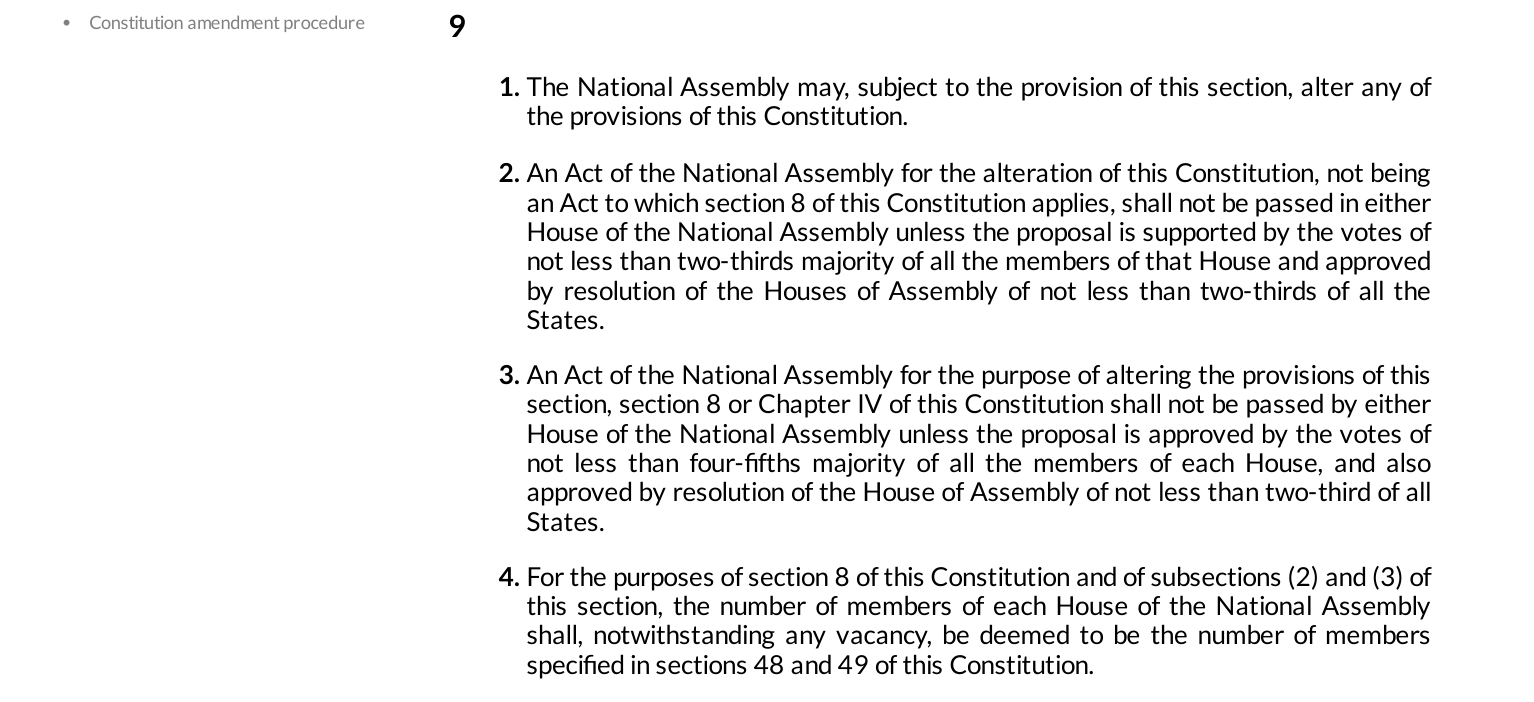
Section 9(3) sets a higher bar of four-fifths of National Assembly members, together with resolutions from two-thirds of the states, for any alteration of section 9 itself, section 8 or Chapter IV, the fundamental rights chapter. Vero Record has not obtained the text of the transmitted bill and cannot say whether any of its clauses touches those provisions. The press reports read for this story do not say so either.
According to ThisDay's report of 21 September, Mr Ogunlana asked the state assemblies to return their decisions within 30 days. He also said that period was an administrative window and not a constitutional deadline. That matches the text Vero Record read: section 9 sets no time limit for the states.
Osun was the first state reported to act. Legit.ng reported that the Osun State House of Assembly voted unanimously for the amendment at plenary after the Speaker, Adewale Egbedun, read the National Assembly's letter. The report gives the day as Tuesday but the date as 23 September, which was a Wednesday, so the exact day is not settled. It gives no vote count and no number of members present.
Edo followed. Time News, citing Daily Post, reported that the Edo State House of Assembly voted unanimously on Wednesday, 23 September 2026. The Majority Leader moved the motion and the Minority Leader, Natasha Osawaru, seconded it. According to the same report, the Speaker, Yekini Idaiye, then directed the Clerk of the House, Yahaya Omogbai, to "prepare and forward clean copies of the concurrence resolution to the National Assembly". Of the four accounts Vero Record read, this is the only one that names a resolution being sent to Abuja. No figure for members present or voting is given.
Rivers is the only state for which a vote count has been reported. ThisDay reported that at plenary on Monday, 28 September, the Speaker, Martin Amaewhule, read out the proposed amendment and members voted by raising their hands. According to the report, he announced: "Twenty-five members voted in favour, none against and none abstained." The report does not say how many seats the House has, how many members were absent, or whether the 25 was a count of those present. Daily Trust attributed the unanimous outcome to a statement by the Speaker's Special Assistant on Media, Martins Wachukwu, and described Rivers as "the third state to approve the bill after Osun and Edo".
The accounts of Oyo describe a different procedure. Tribune, in a report dated 29 September, said the Oyo State House of Assembly "passed" the Sixth Alteration Bill at plenary that Tuesday "after clause-by-clause consideration", with the Speaker, Adebo Ogundoyin, presiding. A later report found in search results said the House resolved into a Committee of the Whole and passed the bill at third reading, which is the usual procedure for a state's own bills. Section 9 does not ask a state House to pass the federal bill. It asks for a resolution approving it. Vero Record has not seen the Oyo House's own record and cannot say what form of resolution, if any, was adopted or sent to the National Assembly. None of the Oyo reports Vero Record read gives a vote tally.
The reports also show a state that has not yet decided. Daily Trust reported that on Monday, 28 September, the Kano State House of Assembly read the bill on the floor and referred it to its Committee on Rules and Business. It quoted the Majority Leader, Lawan Hussaini Chediyar Yangurasa: "The Assembly will take all necessary steps on the bill once the committee submits its report." A 21 September ThisDay report said the Ogun House had received the bill. Vero Record found no report of a vote there.
The count stands at four if the press reports are taken at face value: Osun, Edo, Rivers and Oyo. That leaves 20 more needed to reach 24. This is Vero Record's own tally from the reports listed below. It is not an official count, and the National Assembly has not published one that Vero Record could find. The Clerk's office has not said how many resolutions it has received.
Vero Record looked for the assemblies' own records. It tried two addresses that appear to be the websites of the Oyo State House of Assembly (oyohouseofassembly.gov.ng and oyshoa.gov.ng) and two for Rivers (rvsha.gov.ng and riversstatehouseofassembly.gov.ng). None returned a page from our location on 30 September 2026. Vero Record did not confirm that any of those four addresses is an official site, and a failed connection does not show that a record does not exist. The National Assembly's news page loaded, but a search of its links for "alteration", "state police" and "transmission" found no statement on resolutions received. Vero Record found no published votes and proceedings, order paper or signed resolution from Osun, Edo, Rivers or Oyo.
That gap matters because of what section 9 asks for. The constitutional step is a resolution of each House of Assembly, and that resolution is what the National Assembly will count. For now, the public cannot check the dates, the wording of any resolution, or, except in Rivers, how many members voted, against any document published by the Houses themselves. The dates Vero Record reports come from newspaper accounts and could shift once the resolutions themselves are released.
Vero Record will add the resolutions to this record once any Assembly or the Clerk to the National Assembly publishes them. Until then, each approval described here is graded as a press report and not as a documented vote.
What this rests on
Grade A: the text of section 9 of the 1999 Constitution, read by Vero Record in the Constitute Project compilation (rev. 2011, not a gazetted edition). Grade B: newspaper accounts of the transmission and of the Osun, Edo, Rivers, Oyo and Kano sittings. Grade C: Vero Record's reading that section 9 sets no internal majority for state Houses, and the four-of-24 tally.
What this does not establish
The text of the transmitted bill; whether it touches Chapter IV (section 9(3)); the wording, form and transmission date of any state resolution; the exact day of the Osun vote; vote tallies and attendance for Osun, Edo and Oyo; Rivers House total membership and absences; any official count held by the Clerk to the National Assembly.
What we did ourselves
Vero Record read section 9 and compared it with how each state's approval was described in four sets of reports; it tried the possible websites of the Oyo and Rivers assemblies and searched the National Assembly news page for published resolutions; it produced its own tally.
Sources for this report
(B) Constitution of the Federal Republic of Nigeria 1999 (rev. 2011), section 9, via constituteproject.org PDF, page 10
- Constitution of Nigeria 1999 (rev. 2011), section 9 · Constitute Project
- Only State Police Bill Transmitted To State Assemblies, NASS Clarifies · New Telegraph · 2026-09-22
- Beyond Transmitting State Policing Bill to 36 State Houses of Assembly · ThisDay · 2026-09-21
- Osun Assembly Becomes First State to Approve State Police Constitutional Bill · Legit.ng · 2026-09-23
- Edo Assembly Approves State Police Bill and Confirms EDSOGPADEC Board Member · Time News (citing Daily Post) · 2026-09-24
- Rivers Assembly Backs State Police, Gives Tinubu's Security Reform Boost · ThisDay · 2026-09-29
- Rivers Assembly passes state police bill, Kano begins deliberation · Daily Trust · 2026-09-29
- Oyo Assembly passes State Police bill · Tribune · 2026-09-29
- Rivers Assembly endorses constitutional amendment on state police · Vanguard · 2026-09-29
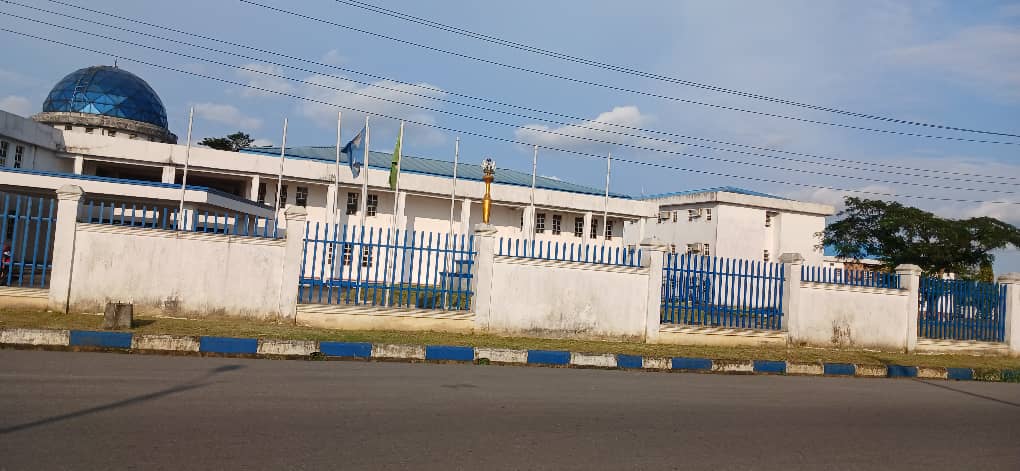
- Rivers State House of Assembly Complex, Port Harcourt (photo) · Wikimedia Commons

Confidence: medium. This is our own assessment of whether the event occurred as described, separate from the grade, which describes what kind of thing the claim rests on.
Not obtained: where the underlying document is named above but not linked, we did not hold a copy at the time of publication. We purchase nothing and request nothing in our own name.
Corrections
None on this report. If you find an error, it will be published here, at the same length, with the date it was found, and the original wording will remain visible above it.